Vietnam Cooking Appliances Market Summary
The vietnam cooking appliances market was estimated at USD 1327 Million in 2025 and is projected to reach USD 1884 Million by 2032, growing at a CAGR of 8.1% from 2026 to 2032.
Vietnam Cooking Appliances Market Year-wise Growth Rate and Key Drivers
This graph highlights how the Vietnam Cooking Appliances Market has steadily grown over the past five years, supported by major growth factors.
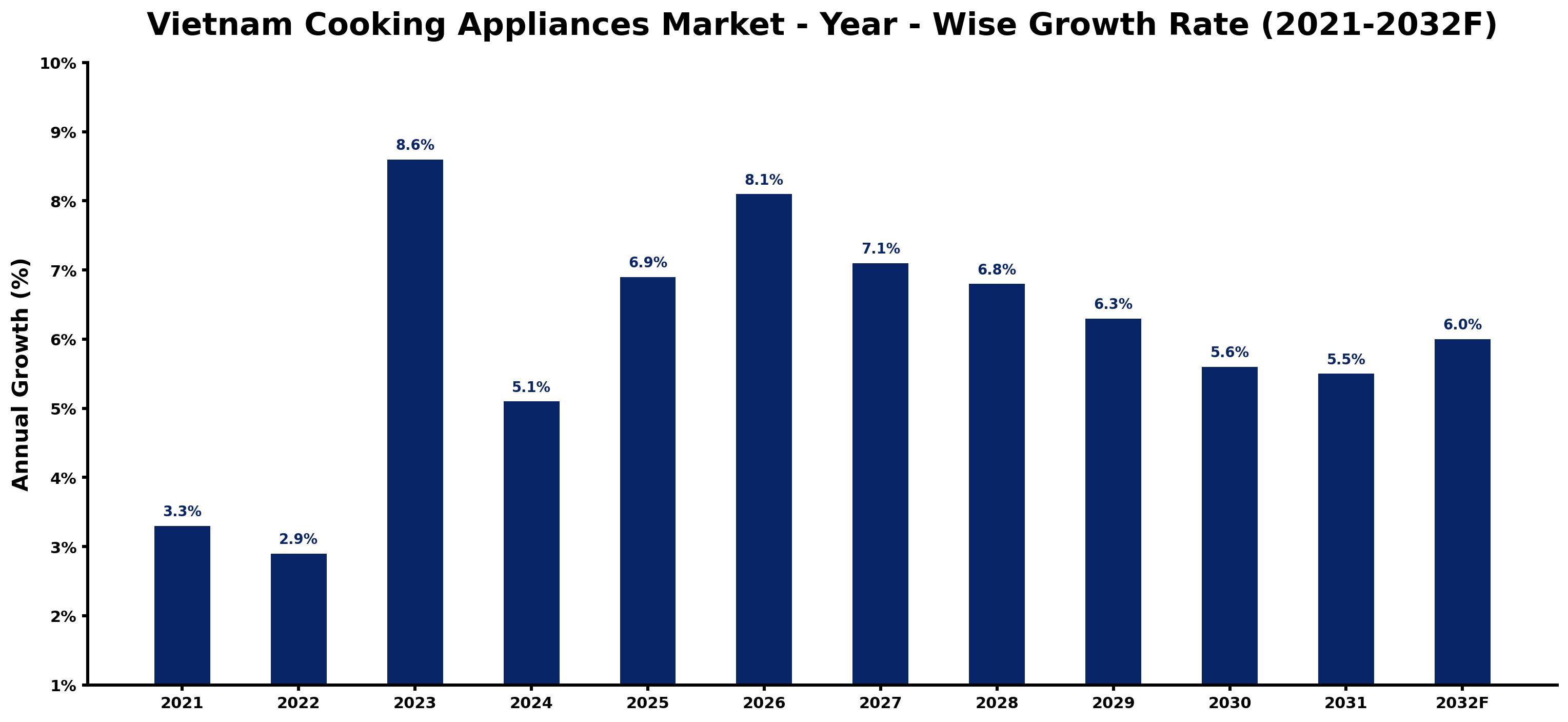
The table below presents the year wise growth rates along with the key drivers influencing the market
| Year | Growth Rate | Major Drivers |
| 2021 | 3.3% | Post-lockdown retail projects sparked a renewed interest in home cooking appliances. |
| 2022 | 2.9% | Consumer preferences shifted towards energy-efficient cooking technologies, enhancing appliance appeal. |
| 2023 | 8.6% | Local manufacturers ramped up production to meet rising urban household demands. |
| 2024 | 5.1% | Innovative designs and smart features attracted tech-savvy younger consumers significantly. |
| 2025 | 6.9% | E-commerce platforms expanded, providing easier access to diverse cooking appliance brands. |
| 2026 | 8.1% | Increased disposable income led to a surge in premium appliance purchases across urban areas. |
| 2027 | 7.1% | Health-conscious lifestyles promoted the adoption of appliances for healthier cooking methods. |
| 2028 | 6.8% | Rural electrification efforts improved accessibility to modern cooking technologies in remote regions. |
| 2029 | 6.3% | Culinary tourism initiatives sparked interest in high-quality kitchen gadgets and tools. |
| 2030 | 5.6% | Sustainability trends drove brands to develop eco-friendly and recyclable cooking appliances. |
| 2031 | 5.5% | Partnerships with local chefs popularized specialized cooking appliances among home cooks. |
| 2032 | 6.0% | Urbanization trends created demand for compact and multifunctional cooking appliances. |
Note - Market size estimations and growth projections presented in this report are based on 6Wresearch's advanced forecasting approach, validated with industry datasets as of June 2026.
Vietnam Cooking Appliances Market Synopsis
The Vietnam Cooking Appliances Market is projected to reach 8.1% and witness significant growth during the forecast period (2026-2032). This market has demonstrated resilience and steady performance over recent years, driven by increasing disposable incomes and evolving consumer preferences towards convenience and modern kitchen technologies. More households are investing in electric and gas cooking appliances, including hobs, ovens, and other utilities designed to elevate home cooking experiences.
Vietnam Cooking Appliances Market Growth Drivers
The growth of the Vietnam Cooking Appliances Market can be attributed to several key factors:
- Rising Disposable Incomes: As economic conditions improve, more consumers have access to higher disposable incomes, enabling them to upgrade their kitchen appliances.
- Urbanization Trends: The increase in urban population has led to smaller homes and a focus on efficient cooking solutions, thereby driving demand for innovative cooking appliances.
- Technological Advancements: The adoption of modern cooking technologies, such as induction cooking, is gaining popularity among consumers, who are looking for energy-efficient and time-saving solutions.
- Health Consciousness: A growing awareness of health and nutrition is prompting consumers to seek cooking appliances, like multi-functional steam ovens, that facilitate healthier meal preparation without sacrificing flavor.
- Supportive Government Policies: Government initiatives aimed at enhancing the infrastructure and accessibility of modern cooking technologies contribute significantly to market expansion.
Vietnam Cooking Appliances Market Trends and Opportunities
Identifying and capitalizing on trends is crucial for stakeholders in the Vietnam Cooking Appliances Market. Notable trends include:
- Shift Towards Electric Appliances: With advancements in electric cooking technologies, including induction cookers, the popularity of electric appliances continues to rise, offering potential growth opportunities.
- Demand for Multi-Functional Devices: Consumers are increasingly seeking versatile appliances that combine multiple cooking functions to maximize convenience and efficiency in the kitchen.
- Focus on Sustainability: Eco-friendly and energy-efficient cooking appliances are becoming more desirable, aligning with global sustainability trends.
- Increased Online Sales Channels: The growing preference for online shopping enhances market accessibility, allowing consumers to explore and purchase a variety of cooking appliances easily.
- Rising Influence of Culinary Trends: The increasing interest in cooking shows and culinary culture encourages investments in high-quality cooking appliances to create restaurant-style meals at home.
Vietnam Cooking Appliances Market Challenges and Restraints
Despite the promising outlook, the Vietnam Cooking Appliances Market faces several challenges:
- Price Sensitivity: Many consumers remain price-conscious, which can limit their willingness to invest in higher-priced electric cooking appliances.
- Infrastructure Development: Inadequate infrastructure in rural areas may hinder the adoption of modern cooking technologies.
- Market Competition: The presence of numerous local and international brands increases competition, making it challenging for new entrants to establish a foothold.
- Consumer Education: There is a need for enhancing consumer awareness regarding the benefits of modern cooking appliances, which can be a barrier to adoption.
- Supply Chain Disruptions: Global supply chain issues can lead to increased costs and reduced availability of certain cooking appliances in the market.
Vietnam Cooking Appliances Market Government Investment and Initiatives
The Vietnamese government plays a pivotal role in supporting the development of the cooking appliances sector through various initiatives aimed at modernizing kitchen technologies:
- Investment in Infrastructure: The government is investing in infrastructure projects to enhance the accessibility of modern appliances, particularly in urban areas.
- Incentives for Energy Efficiency: Policies promoting energy-efficient appliances encourage manufacturers to innovate and consumers to adopt sustainable products.
- Public Awareness Campaigns: The government is engaged in campaigns to raise awareness among consumers about the benefits of modern cooking technologies, which can drive market growth.
- Support for Research and Development: Government funding for R&D initiatives fosters innovation in cooking appliances and supports the introduction of advanced technologies.
- Regulatory Framework: Establishing a supportive regulatory environment is essential to attract foreign investment and ensure quality standards in the cooking appliances market.
Vietnam Cooking Appliances Market Latest Developments (May 2025 - June 2026)
Recent developments in the Vietnam Cooking Appliances Market indicate a dynamic shift towards innovation and consumer engagement:
- Launch of New Product Lines: Manufacturers are introducing advanced cooking appliances that incorporate smart technology, appealing to tech-savvy consumers.
- Increased Marketing Efforts: Brands are enhancing marketing strategies to highlight the benefits of modern cooking appliances, particularly in urban areas.
- Collaborations for Enhanced Distribution: Partnerships between manufacturers and retail outlets are being formed to improve product availability across various consumer segments.
- Emphasis on After-Sales Service: Companies are focusing on providing better after-sales support and services to enhance customer satisfaction and brand loyalty.
- Integration of Health-Conscious Features: The introduction of cooking appliances that promote healthy cooking practices reflects changing consumer preferences in meal preparation.
Vietnam Cooking Appliances Market - Key Attractiveness of the Report
- 10 Years of Market Numbers
- Historical Data Starting from 2022 to 2025
- Base Year: 2025
- Forecast Data until 2032
- Key Performance Indicators Impacting the Market
- Major Upcoming Developments and Projects
Key Highlights of the Report:
- Vietnam Cooking Appliances Market Outlook
- Market Size of Vietnam Cooking Appliances Market, 2025
- Forecast of Vietnam Cooking Appliances Market, 2032
- Historical Data and Forecast of Vietnam Cooking Appliances Revenues & Volume for the Period 2022-2032
- Vietnam Cooking Appliances Market Trend Evolution
- Vietnam Cooking Appliances Market Drivers and Challenges
- Vietnam Cooking Appliances Price Trends
- Vietnam Cooking Appliances Porter's Five Forces
- Vietnam Cooking Appliances Industry Life Cycle
- Historical Data and Forecast of Vietnam Cooking Appliances Market Revenues & Volume By Types for the Period 2022-2032
- Historical Data and Forecast of Vietnam Cooking Appliances Market Revenues & Volume By Microwaves for the Period 2022-2032
- Historical Data and Forecast of Vietnam Cooking Appliances Market Revenues & Volume By Ovens for the Period 2022-2032
- Historical Data and Forecast of Vietnam Cooking Appliances Market Revenues & Volume By Cooktops for the Period 2022-2032
- Historical Data and Forecast of Vietnam Cooking Appliances Market Revenues & Volume By Range Hoods for the Period 2022-2032
- Historical Data and Forecast of Vietnam Cooking Appliances Market Revenues & Volume By Small Appliances for the Period 2022-2032
- Historical Data and Forecast of Vietnam Cooking Appliances Market Revenues & Volume By Parts & Accessories for the Period 2022-2032
- Historical Data and Forecast of Vietnam Cooking Appliances Market Revenues & Volume By Applications for the Period 2022-2032
- Historical Data and Forecast of Vietnam Cooking Appliances Market Revenues & Volume By Household for the Period 2022-2032
- Historical Data and Forecast of Vietnam Cooking Appliances Market Revenues & Volume By Commercial for the Period 2022-2032
- Historical Data and Forecast of Vietnam Cooking Appliances Market Revenues & Volume By Fuel Type for the Period 2022-2032
- Historical Data and Forecast of Vietnam Cooking Appliances Market Revenues & Volume By Cooking gas for the Period 2022-2032
- Historical Data and Forecast of Vietnam Cooking Appliances Market Revenues & Volume By Electricity for the Period 2022-2032
- Historical Data and Forecast of Vietnam Cooking Appliances Market Revenues & Volume By Distribution Channel for the Period 2022-2032
- Historical Data and Forecast of Vietnam Cooking Appliances Market Revenues & Volume By Online for the Period 2022-2032
- Historical Data and Forecast of Vietnam Cooking Appliances Market Revenues & Volume By Offline for the Period 2022-2032
- Vietnam Cooking Appliances Import Export Trade Statistics
- Market Opportunity Assessment By Types
- Market Opportunity Assessment By Applications
- Market Opportunity Assessment By Fuel Type
- Market Opportunity Assessment By Distribution Channel
- Vietnam Cooking Appliances Top Companies Market Share
- Vietnam Cooking Appliances Competitive Benchmarking By Technical and Operational Parameters
- Vietnam Cooking Appliances Company Profiles
- Vietnam Cooking Appliances Key Strategic Recommendations






































