Vietnam Copper Forged Market Summary
The vietnam copper forged market was estimated at USD 1486 Million in 2025 and is projected to reach USD 2108 Million by 2032, growing at a CAGR of 7.8% from 2026 to 2032.
Vietnam Copper Forged Market Year-wise Growth Rate and Key Drivers
This graph highlights how the Vietnam Copper Forged Market has steadily grown over the past five years, supported by major growth factors.
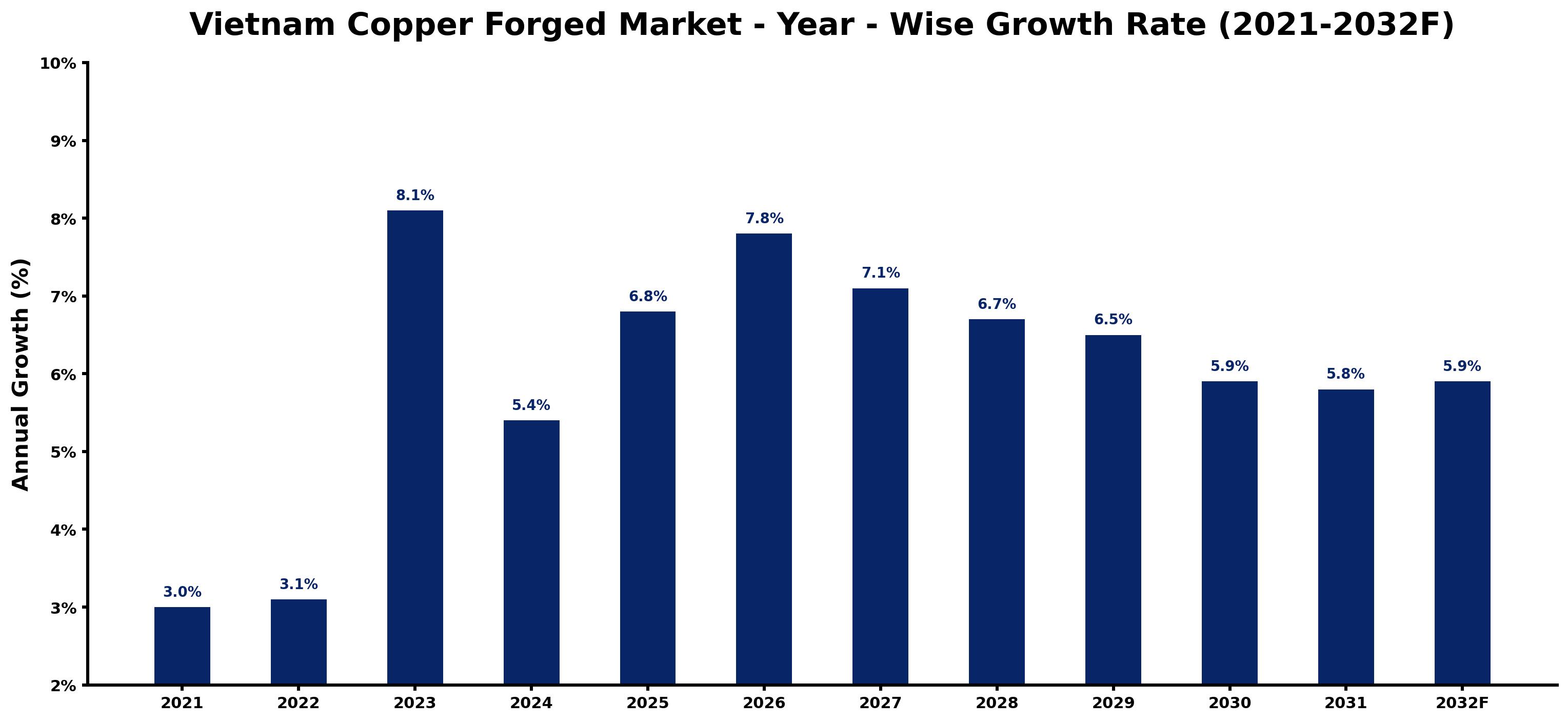
The table below presents the year wise growth rates along with the key drivers influencing the market
| Year | Growth Rate | Major Drivers |
| 2021 | 3.0% | Post-lockdown retail projects surged, increasing demand for copper in electrical wiring. |
| 2022 | 3.1% | Manufacturing shift towards Vietnam attracted foreign investment in copper forging sector. |
| 2023 | 8.1% | Construction projects in urban areas expanded, raising copper usage in infrastructure significantly. |
| 2024 | 5.4% | Emerging technology sectors began requiring specialized copper components for electronic devices. |
| 2025 | 6.8% | Local supply chains strengthened, enhancing reliability in copper material sourcing for industries. |
| 2026 | 7.8% | Rural electrification projects initiated nationwide, fueling copper demand for power grids. |
| 2027 | 7.1% | Increased global trade partnerships provided market access for Vietnamese copper manufacturers. |
| 2028 | 6.7% | Sustainability measures pushed manufacturers towards recycled copper production techniques. |
| 2029 | 6.5% | Innovations in forging technology improved efficiency, reducing costs for copper manufacturers. |
| 2030 | 5.9% | Growing automotive manufacturing in Vietnam increased demand for high-quality copper parts. |
| 2031 | 5.8% | Smart city developments relied heavily on copper for smart infrastructure implementations. |
| 2032 | 5.9% | Market consolidation led to fewer, more robust players shaping the copper forging landscape. |
Note - Market size estimations and growth projections presented in this report are based on 6Wresearch's advanced forecasting approach, validated with industry datasets as of June 2026.
Vietnam Copper Forged Market Synopsis
The Vietnam Copper Forged Market is projected to reach 7.8% and witness significant growth during the forecast period (2026-2032). This market encompasses the production, consumption, and trade of copper forged products, which are meticulously created through the forging process utilizing copper and its alloys. The significance of copper forged products is underscored by their extensive applications across diverse industries such as automotive, electrical, aerospace, and construction, highlighting their integral role in various economic sectors.
Vietnam Copper Forged Market Growth Drivers
The Vietnam Copper Forged Market is bolstered by several key drivers that propel demand and create opportunities for growth. One prominent factor is the rising utilization of copper forged products within the automotive industry. These products are essential for numerous components, including connectors, bushings, and bearings, which are vital for vehicle efficiency and durability. Furthermore, the electrical sector continues to adopt copper forged products for connectors, switches, and various other electronic components, capitalizing on their superior conductivity.
- The need for energy-efficient solutions in the automotive sector drives the demand for lightweight yet durable copper forged components.
- Construction and infrastructure projects emphasize the advantages of copper's electrical conductivity and resistance to corrosion, further expanding market opportunities.
- With a growing emphasis on sustainability, copper's recyclability enhances its appeal in industries focusing on eco-friendly practices.
- Vietnam's strategic geographical location presents export opportunities, allowing the country to serve as a supplier to neighboring regions.
- The drive towards technological innovation in forging processes is resulting in advanced manufacturing methods and enhanced product performance.
Vietnam Copper Forged Market Challenges and Restraints
Despite the promising growth trajectory of the Vietnam Copper Forged Market, certain challenges may hinder its progress. Fluctuations in copper prices, influenced by global market dynamics and geopolitical tensions, can significantly impact manufacturers' profitability. These price variations create an unpredictable environment for both suppliers and consumers, complicating budgeting and financial forecasting.
- Manufacturers must navigate the complexities posed by supply-demand imbalances, affecting production capacity and market stability.
- The industry faces constant pressure to keep pace with technological advancements, which can be resource-intensive and require substantial investment in R&D.
- Compliance with environmental regulations associated with copper mining and processing remains a critical concern that necessitates diligent attention and investment.
- The lingering effects of the COVID-19 pandemic have exposed vulnerabilities in the supply chain, necessitating more resilient logistic strategies to mitigate future disruptions.
- The transition to advanced manufacturing practices may require significant retraining of the workforce to ensure optimal operation of new technologies.
Vietnam Copper Forged Market Government Investment and Initiatives
The Vietnamese government has demonstrated a commitment to fostering the growth of the copper forged sector through various investment initiatives and development plans. Public spending aimed at enhancing infrastructure and industrial capabilities provides a supportive environment for manufacturers and exporters within this market. Policymakers are increasingly focused on promoting sustainable practices and innovation in the manufacturing process, encouraging investments in technology and process improvements.
- Government incentives for foreign investments in the copper forged market aim to attract advanced technologies and expertise.
- The establishment of industrial parks equipped with modern facilities is part of a broader strategy to streamline production processes and enhance competitiveness.
- Regulatory frameworks are being developed to facilitate smoother operations while ensuring compliance with environmental standards.
- Investment in workforce development initiatives is vital to equip workers with the necessary skills to embrace new technologies in the forging process.
- Partnerships between public and private sectors are being promoted to leverage resources and knowledge-sharing, enhancing overall market growth.
Vietnam Copper Forged Market Latest Developments (May 2025 - June 2026)
Recent industry developments from May 2025 to June 2026 have indicated a shift in operational practices within the Vietnam Copper Forged Market. The post-COVID recovery phase has prompted many companies to reassess their supply chains, implementing more robust and resilient strategies to mitigate potential disruptions. Innovations in manufacturing processes, focusing on automation and digitalization, have been increasingly adopted to enhance production efficiency and reduce reliance on labor-intensive methods.
- Market participants are exploring new materials and forging techniques, aiming to improve product performance and meet evolving consumer preferences.
- Collaborative efforts between industry stakeholders are fostering a culture of innovation, leading to the development of advanced copper forged applications in emerging sectors.
- Increased investments in research and development are expected to yield breakthroughs in environmentally friendly processing methods, aligning with global sustainability trends.
- International trade agreements are providing Vietnamese manufacturers with expanded access to markets outside of Southeast Asia, facilitating export growth.
- Public initiatives aimed at reducing customs barriers and enhancing logistics efficiency are also under consideration to support the copper forged industry's growth trajectory.
Vietnam Copper Forged Market - Key Attractiveness of the Report
- 10 Years of Market Numbers
- Historical Data Starting from 2022 to 2025
- Base Year: 2025
- Forecast Data until 2032
- Key Performance Indicators Impacting the Market
- Major Upcoming Developments and Projects
Key Highlights of the Report:
- Vietnam Copper Forged Market Outlook
- Market Size of Vietnam Copper Forged Market, 2025
- Forecast of Vietnam Copper Forged Market, 2032
- Historical Data and Forecast of Vietnam Copper Forged Revenues & Volume for the Period 2022-2032F
- Vietnam Copper Forged Market Trend Evolution
- Vietnam Copper Forged Market Drivers and Challenges
- Vietnam Copper Forged Price Trends
- Vietnam Copper Forged Porter's Five Forces
- Vietnam Copper Forged Industry Life Cycle
- Historical Data and Forecast of Vietnam Copper Forged Market Revenues & Volume By Product Types for the Period 2022-2032F
- Historical Data and Forecast of Vietnam Copper Forged Market Revenues & Volume By Closed Die Forging for the Period 2022-2032F
- Historical Data and Forecast of Vietnam Copper Forged Market Revenues & Volume By Open Die Forging for the Period 2022-2032F
- Historical Data and Forecast of Vietnam Copper Forged Market Revenues & Volume By Rolled Ring Forging for the Period 2022-2032F
- Historical Data and Forecast of Vietnam Copper Forged Market Revenues & Volume By Applications for the Period 2022-2032F
- Historical Data and Forecast of Vietnam Copper Forged Market Revenues & Volume By Automotive for the Period 2022-2032F
- Historical Data and Forecast of Vietnam Copper Forged Market Revenues & Volume By Aerospace for the Period 2022-2032F
- Historical Data and Forecast of Vietnam Copper Forged Market Revenues & Volume By Oil & Gas for the Period 2022-2032F
- Historical Data and Forecast of Vietnam Copper Forged Market Revenues & Volume By Construction for the Period 2022-2032F
- Historical Data and Forecast of Vietnam Copper Forged Market Revenues & Volume By Agriculture for the Period 2022-2032F
- Historical Data and Forecast of Vietnam Copper Forged Market Revenues & Volume By Others for the Period 2022-2032F
- Vietnam Copper Forged Import Export Trade Statistics
- Market Opportunity Assessment By Product Types
- Market Opportunity Assessment By Applications
- Vietnam Copper Forged Top Companies Market Share
- Vietnam Copper Forged Competitive Benchmarking By Technical and Operational Parameters
- Vietnam Copper Forged Company Profiles
- Vietnam Copper Forged Key Strategic Recommendations






































