Vietnam Cork Stopper Market Size, Share & Growth Rate
The Vietnam Cork Stopper Market was estimated at USD 205 Million in 2025 and is projected to reach USD 288 Million by 2032, growing at a CAGR of 5.0% from 2026 to 2032. This positive trajectory is primarily driven by the burgeoning wine and spirits industry in Vietnam, which has seen a marked increase in consumption. The growing preference for natural and sustainable packaging solutions among both manufacturers and consumers is further fueling demand for cork stoppers, aligning with global trends toward eco-friendly products.
Vietnam Cork Stopper Market Year-wise Growth Rate and Key Drivers
This graph highlights how the Vietnam Cork Stopper Market has steadily grown over the years, supported by major growth factors.
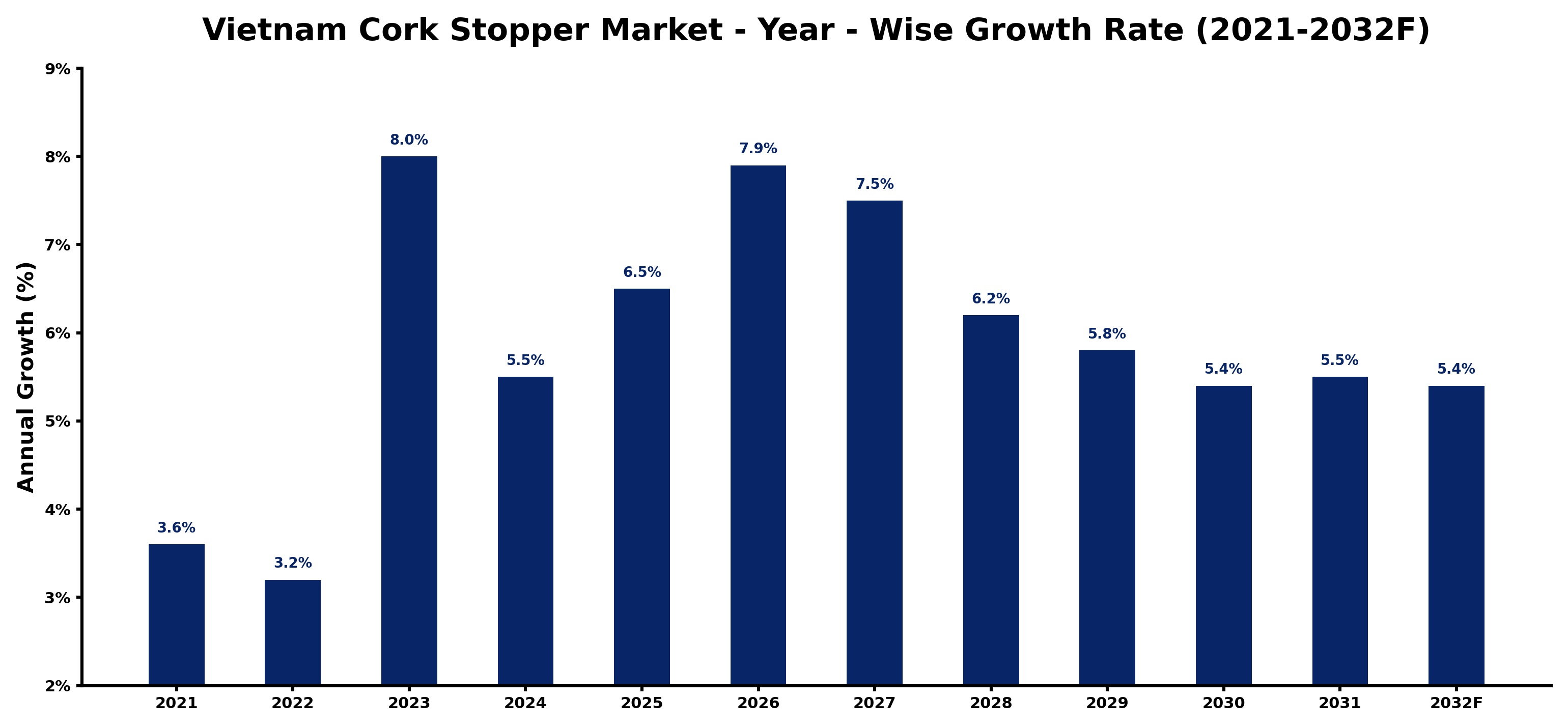
The table below presents the year‑wise growth rates along with the key drivers influencing the market
| Year | Growth Rate | Major Drivers |
| 2021 | 3.6% | Government infrastructure modernization initiatives |
| 2022 | 3.2% | Expansion of transportation and logistics networks |
| 2023 | 8.0% | Increasing adoption of advanced technologies |
| 2024 | 5.5% | Expansion of transportation and logistics networks |
| 2025 | 6.5% | Increasing smart city development projects |
| 2026 | 7.9% | Rapid growth in telecom and data center sectors |
| 2027 | 7.5% | Increasing adoption of advanced technologies |
| 2028 | 6.2% | Increasing smart city development projects |
| 2029 | 5.8% | Increasing industrial automation investments |
| 2030 | 5.4% | Growing urbanization and commercial development |
| 2031 | 5.5% | Increasing adoption of advanced technologies |
| 2032 | 5.4% | Expansion of manufacturing activities |
Note - Market size estimations and growth projections presented in this report are based on 6Wresearch's advanced forecasting approach, validated with industry datasets as of June 2026.
Vietnam Cork Stopper Market Synopsis
In Vietnam, the cork stopper market is uniquely positioned as the wine culture continues to expand, driven by younger consumers' willingness to explore premium and organic offerings. This trend has propelled the need for high-quality cork stoppers that preserve the integrity and flavor of beverages, ultimately enhancing consumer experiences.
Additionally, cork stoppers are gaining traction in the fragrance and cosmetic industries due to their sustainable attributes. As these sectors emphasize luxury and environmentally friendly options, they contribute to the upward momentum of the cork stopper market in Vietnam, creating a diverse demand landscape.
Vietnam Cork Stopper Market Key Takeaways
- The market is expected to reach USD 288 Million by 2032, indicating robust growth in the upcoming years.
- Increasing consumer preference for premium, organic, and sustainable products drives cork stopper demand.
- Growth in the wine and spirits sector is crucial to the market's expansion.
- Emerging opportunities are present in the fragrance and cosmetics industries.
- Government initiatives supporting sustainability enhance market prospects.
Evaluation of Restraints in Vietnam Cork Stopper Market
The Vietnam Cork Stopper market faces notable restraints that could impede its growth. Competition from alternative closure options, such as synthetic corks and screw caps, presents a significant challenge. Many producers are transitioning to these alternatives due to cost-effectiveness and ease of use. Additionally, issues related to cork taint—where certain compounds in cork can spoil wine—continue to pose a risk for manufacturers, potentially undermining consumer trust in cork products. Addressing these concerns is crucial for the cork stopper market to maintain its relevance and secure its position in a rapidly evolving beverage landscape.
Vietnam Cork Stopper Market Trends
The market is currently influenced by trends emphasizing sustainability and premium quality. A notable trend is the rise in demand for organic wines, which increasingly favors natural cork closures that appeal to eco-conscious consumers. Moreover, innovations in cork production technology are enhancing the quality and consistency of cork stoppers, further driving their appeal in high-end beverage packaging.
Additionally, the COVID-19 pandemic has shifted consumer purchasing behaviors, increasing online sales of beverages and by extension, cork-stopped products. As e-commerce continues to grow, it is becoming an important channel for cork stopper sales, prompting manufacturers to adapt their strategies to this emerging marketplace.
Vietnam Cork Stopper Market Opportunities
Significant growth and investment opportunities lie in the intersection of sustainability and luxury branding. As more companies pivot towards eco-friendly practices, those specializing in sustainable cork production stand to benefit immensely. Furthermore, tapping into the growing organic product segment within the wine and spirits market offers a promising avenue for cork stopper manufacturers. Collaborations with beverage producers focused on quality and sustainability will also be pivotal for capturing market share.
Government Initiatives in the Vietnam Cork Stopper Market
The Vietnamese government is increasingly prioritizing sustainability in its economic policies, which includes support for industries that adopt eco-friendly practices. Initiatives aimed at promoting sustainable forestry and responsible sourcing of raw materials bolster the cork industry. Public spending focused on environmental conservation also paves the way for cork stoppers to gain recognition as a viable, eco-friendly option in packaging. This alignment of government policy with sustainability goals is expected to create a conducive environment for the cork stopper market.
Future Insights of the Vietnam Cork Stopper Market
Looking ahead, the Vietnam Cork Stopper Market is poised for continued growth through 2032. The anticipated increase in domestic wine consumption will sustain demand for cork stoppers, particularly as consumers increasingly seek quality and authenticity in their beverages. As sustainability remains a prominent consumer concern, cork stoppers will likely capitalize on this trend, reinforcing their position as a preferred choice in the beverage packaging sector.
Vietnam Cork Stopper Market Latest Developments (May 2025 - June 2026)
Recent developments in the Vietnam Cork Stopper market have highlighted an industry shift towards integrating advanced technology in cork production processes. Companies are investing in research and development to enhance the quality and reliability of cork stoppers. Additionally, partnerships between cork manufacturers and local beverage producers are emerging, aimed at promoting the benefits of using cork stoppers in packaging. This collaborative approach is enhancing the market's resilience and adaptability in a rapidly changing economic landscape.
Vietnam Cork Stopper Market - Key Attractiveness of the Report
- 10 Years of Market Numbers
- Historical Data Starting from 2022 to 2025
- Base Year: 2025
- Forecast Data until 2032
- Key Performance Indicators Impacting the Market
- Major Upcoming Developments and Projects
Key Highlights of the Report:
- Vietnam Cork Stopper Market Outlook
- Market Size of Vietnam Cork Stopper Market, 2025
- Forecast of Vietnam Cork Stopper Market, 2032
- Historical Data and Forecast of Vietnam Cork Stopper Revenues & Volume for the Period 2022-2032F
- Vietnam Cork Stopper Market Trend Evolution
- Vietnam Cork Stopper Market Drivers and Challenges
- Vietnam Cork Stopper Price Trends
- Vietnam Cork Stopper Porter's Five Forces
- Vietnam Cork Stopper Industry Life Cycle
- Historical Data and Forecast of Vietnam Cork Stopper Market Revenues & Volume By Product Type for the Period 2022-2032F
- Historical Data and Forecast of Vietnam Cork Stopper Market Revenues & Volume By Natural cork stopper for the Period 2022-2032F
- Historical Data and Forecast of Vietnam Cork Stopper Market Revenues & Volume By Colmated cork stoppers for the Period 2022-2032F
- Historical Data and Forecast of Vietnam Cork Stopper Market Revenues & Volume By Champagne/Sparkling wine cork stoppers for the Period 2022-2032F
- Historical Data and Forecast of Vietnam Cork Stopper Market Revenues & Volume By Agglomerated cork stoppers for the Period 2022-2032F
- Historical Data and Forecast of Vietnam Cork Stopper Market Revenues & Volume By Technical cork stoppers for the Period 2022-2032F
- Historical Data and Forecast of Vietnam Cork Stopper Market Revenues & Volume By Bar top cork stoppers for the Period 2022-2032F
- Historical Data and Forecast of Vietnam Cork Stopper Market Revenues & Volume By Multi-Piece cork stoppers for the Period 2022-2032F
- Historical Data and Forecast of Vietnam Cork Stopper Market Revenues & Volume By Container for the Period 2022-2032F
- Historical Data and Forecast of Vietnam Cork Stopper Market Revenues & Volume By Wooden for the Period 2022-2032F
- Historical Data and Forecast of Vietnam Cork Stopper Market Revenues & Volume By Metal for the Period 2022-2032F
- Historical Data and Forecast of Vietnam Cork Stopper Market Revenues & Volume By Glass for the Period 2022-2032F
- Historical Data and Forecast of Vietnam Cork Stopper Market Revenues & Volume By Polyvinyl chloride (PVC) for the Period 2022-2032F
- Historical Data and Forecast of Vietnam Cork Stopper Market Revenues & Volume By Porcelain for the Period 2022-2032F
- Historical Data and Forecast of Vietnam Cork Stopper Market Revenues & Volume By Other material container for the Period 2022-2032F
- Historical Data and Forecast of Vietnam Cork Stopper Market Revenues & Volume By Application for the Period 2022-2032F
- Historical Data and Forecast of Vietnam Cork Stopper Market Revenues & Volume By Wines for the Period 2022-2032F
- Historical Data and Forecast of Vietnam Cork Stopper Market Revenues & Volume By Premium spirits for the Period 2022-2032F
- Historical Data and Forecast of Vietnam Cork Stopper Market Revenues & Volume By Fragrances for the Period 2022-2032F
- Historical Data and Forecast of Vietnam Cork Stopper Market Revenues & Volume By Oils for the Period 2022-2032F
- Historical Data and Forecast of Vietnam Cork Stopper Market Revenues & Volume By Others for the Period 2022-2032F
- Vietnam Cork Stopper Import Export Trade Statistics
- Market Opportunity Assessment By Product Type
- Market Opportunity Assessment By Container
- Market Opportunity Assessment By Application
- Vietnam Cork Stopper Top Companies Market Share
- Vietnam Cork Stopper Competitive Benchmarking By Technical and Operational Parameters
- Vietnam Cork Stopper Company Profiles
- Vietnam Cork Stopper Key Strategic Recommendations






































