Vietnam Critical Infrastructure Protection Market Size & Growth Rate (2026-2032)
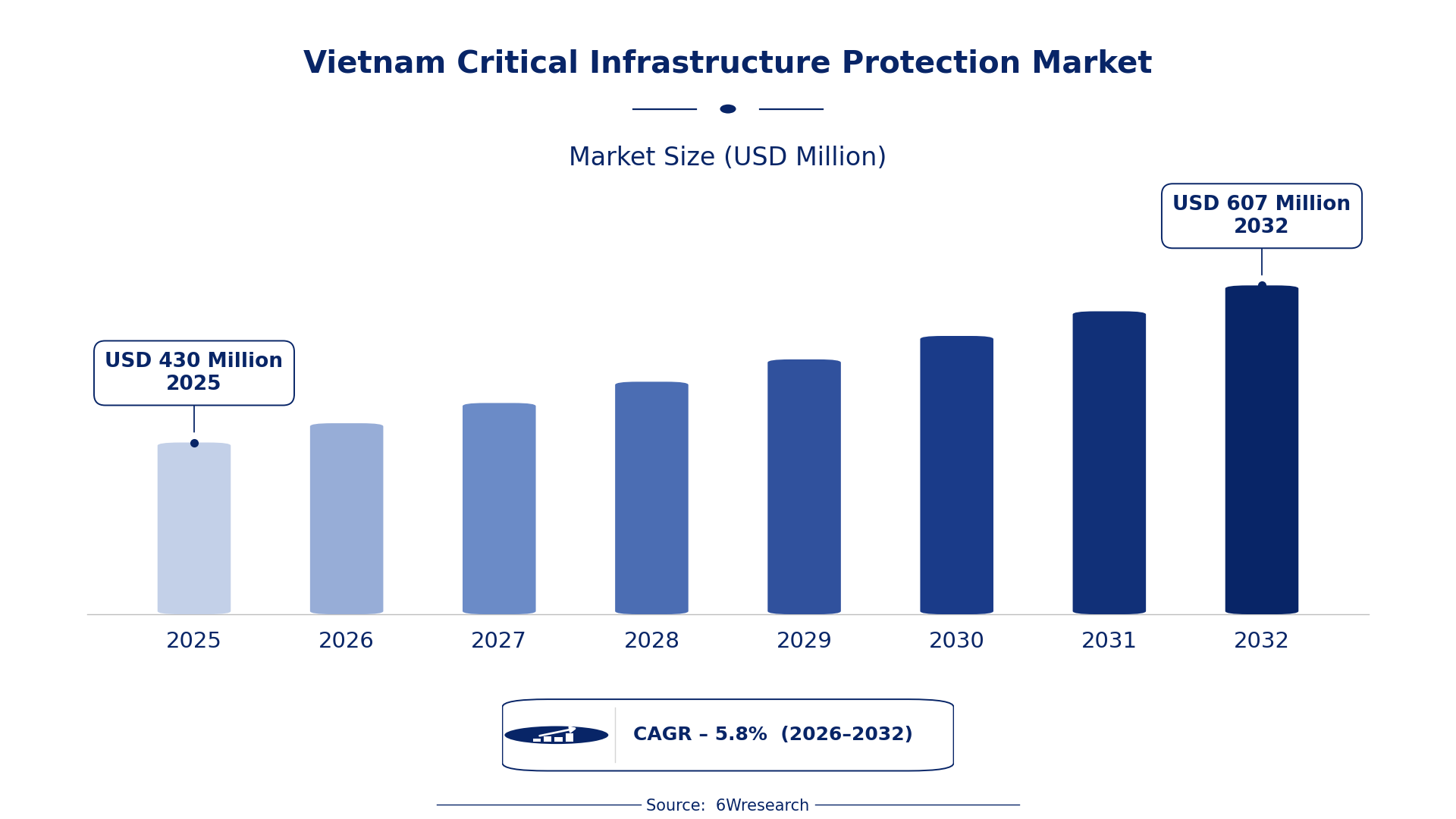
The Vietnam Critical Infrastructure Protection Market was estimated at USD 430 Million in 2025 and is projected to reach USD 607 Million by 2032, growing at a CAGR of 5.8% from 2026 to 2032.
Vietnam Critical Infrastructure Protection Market Synopsis
In recent years, the Critical Infrastructure Protection market in Vietnam has witnessed significant momentum, driven by heightened awareness of security vulnerabilities. This surge is primarily fueled by the increasing interdependence of critical services such as energy, transportation, and telecommunications with digital technologies, which have made them more susceptible to cyber threats.
Looking ahead, the market is set to evolve in response to both technological advancements and escalating cyber risks. With the government’s focus on fortifying critical infrastructure, we anticipate substantial investments in protective measures, enhancing the resilience of vital sectors against potential disruptions.
Vietnam Critical Infrastructure Protection Market Year-wise Growth Rate and Key Drivers
This graph illustrates the annual growth rates of the Vietnam Critical Infrastructure Protection Market from 2021 to 2032, highlighting a steady upward trajectory and projected expansion over the forecast period.
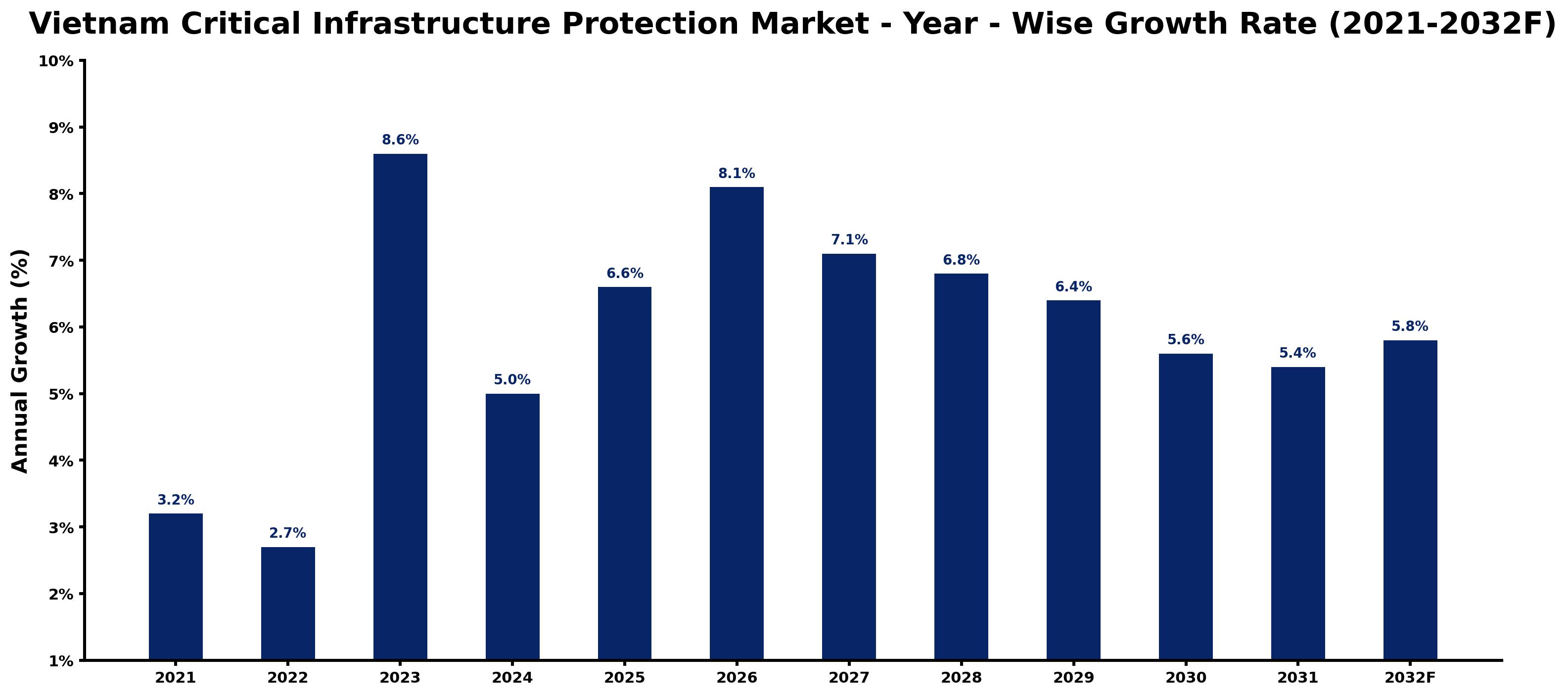
The table below presents the year‑wise growth rates along with the key drivers influencing the market
| Year | Growth Rate | Major Drivers |
| 2021 | 3.2% | Vietnamese government investment in cybersecurity infrastructure growth. |
| 2022 | 2.7% | Implementation of updated national security regulations by government. |
| 2023 | 8.6% | Increased foreign investment in critical infrastructure security initiatives. |
| 2024 | 5.0% | Emerging cybersecurity startups driving innovative protection solutions. |
| 2025 | 6.6% | Public-private partnerships enhancing vulnerability assessments and strategies. |
| 2026 | 8.1% | Rising awareness of cyber threats among local enterprises. |
| 2027 | 7.1% | Formation of national critical infrastructure protection task force. |
| 2028 | 6.8% | Growing online commerce boosting demand for security systems. |
| 2029 | 6.4% | Urbanization trends elevating critical infrastructure protection needs. |
| 2030 | 5.6% | Enhancements in defense protocols driven by ASEAN security cooperation. |
| 2031 | 5.4% | Continued investment in technology to safeguard national assets. |
| 2032 | 5.8% | Adoption of smart grid technologies requiring upgraded protection measures. |
Note: Market size estimations and growth projections presented in this report are based on 6Wresearch's proprietary forecasting methodology, utilizing the latest available industry data, government publications, and primary research inputs.
Vietnam Critical Infrastructure Protection Market Key Takeaways
Below are some of the specific key takeaways from the market, including:
- Growing investment by the government in critical infrastructure security solutions.
- Increasing demand for cybersecurity technologies to safeguard interconnected systems.
- Emerging public-private partnerships focusing on infrastructure resilience.
- Heightened awareness of potential cyber threats stemming from the pandemic.
- Focus on developing local talent to address the shortage of cybersecurity professionals.
Evaluation of Restraints in Vietnam Critical Infrastructure Protection Market
Several factors are constraining the growth of the Vietnam Critical Infrastructure Protection market. A primary restraint is the lack of comprehensive threat intelligence and vulnerability assessments, which leaves critical assets exposed. Budgetary limitations further hinder organizations from investing adequately in security measures. Coupled with a persistent shortage of skilled cybersecurity professionals, these constraints underscore the urgent need for government and private sectors to prioritize infrastructure protection and enhance workforce development in cybersecurity.
Vietnam Critical Infrastructure Protection Market Trends
Several current trends are shaping the Vietnam Critical Infrastructure Protection market. The increasing digitization of critical infrastructure is compelling organizations to adopt advanced cybersecurity measures. Additionally, the rise of Internet of Things (IoT) applications in critical sectors is driving demand for integrated security solutions. Investment in threat intelligence sharing platforms is also gaining traction as organizations recognize the necessity of collaborative approaches to combat evolving threats.
Vietnam Critical Infrastructure Protection Market Opportunities
Opportunities within this market are substantial, particularly as Vietnam enhances its commitment to infrastructure resilience. Investment in innovative cybersecurity technologies offers promising growth potential. Public-private partnerships can lead to the development of advanced security frameworks, encouraging industry stakeholders to collaborate. on top of that, the growing awareness of cybersecurity risks presents opportunities for training programs and educational initiatives aimed at building a skilled workforce.
Government Initiatives in the Vietnam Critical Infrastructure Protection Market
The Vietnamese government is playing a crucial role in shaping the Critical Infrastructure Protection market through various initiatives. A strong regulatory posture highlights the importance of security in safeguarding critical assets. Policymakers are increasingly focused on establishing a framework that promotes resilience and encourages investment in security technologies.
- A national digital infrastructure upgrade programme now in its rollout phase, enhancing the security of essential services.
- A current initiative focused on strengthening cybersecurity protocols for government facilities, ensuring they are fortified against cyber threats.
- A planned public-private partnership aimed at improving threat intelligence sharing by 2027, which will bolster industry collaboration on cybersecurity.
- A recent campaign launched to raise awareness about cybersecurity risks in critical sectors, fostering a culture of security across organizations.
Future Insights of the Vietnam Critical Infrastructure Protection Market
Looking towards 2026-2032, the Vietnam Critical Infrastructure Protection market is expected to experience robust growth. Enhanced government support and strategic investments in security technologies will likely drive this expansion. As organizations increasingly recognize the critical nature of infrastructure security, we anticipate a shift towards more innovative solutions. The landscape will evolve, promoting resilience and the ability to mitigate emerging threats effectively.
Vietnam Critical Infrastructure Protection Market Latest Developments
Over the last year, Vietnam's Critical Infrastructure Protection market has seen notable developments that signal a proactive stance towards enhancing security measures. Increasing collaboration between public and private sectors reflects a shared commitment to safeguarding critical infrastructure. on top of that, ongoing technological advancements are playing a significant role in shaping future strategies.
- A major technology vendor initiated a rollout of advanced cybersecurity solutions for transportation systems, started in early 2025 and projected to complete by late 2025.
- A leading regional operator is currently implementing a program to upgrade cybersecurity measures at energy facilities, which began in Q2 2025 and remains underway.
- Plans for a nationwide cybersecurity training initiative have been announced, aimed at equipping local professionals with essential skills by mid-2026.
- An ongoing collaboration between the government and private sector has focused on developing a comprehensive cybersecurity framework, expected to be finalized by late 2025.
Vietnam Critical Infrastructure Protection Market - Key Attractiveness of the Report
- 10 Years of Market Numbers
- Historical Data Starting from 2022 to 2025
- Base Year: 2025
- Forecast Data until 2032
- Key Performance Indicators Impacting the Market
- Major Upcoming Developments and Projects
Key Highlights of the Report:
- Vietnam Critical Infrastructure Protection Market Outlook
- Market Size of Vietnam Critical Infrastructure Protection Market, 2025
- Forecast of Vietnam Critical Infrastructure Protection Market, 2032
- Historical Data and Forecast of Vietnam Critical Infrastructure Protection Revenues & Volume for the Period 2022-2032F
- Vietnam Critical Infrastructure Protection Market Trend Evolution
- Vietnam Critical Infrastructure Protection Market Drivers and Challenges
- Vietnam Critical Infrastructure Protection Price Trends
- Vietnam Critical Infrastructure Protection Porter's Five Forces
- Vietnam Critical Infrastructure Protection Industry Life Cycle
- Historical Data and Forecast of Vietnam Critical Infrastructure Protection Market Revenues & Volume By Solution for the Period 2022-2032F
- Historical Data and Forecast of Vietnam Critical Infrastructure Protection Market Revenues & Volume By Physical Safety for the Period 2022-2032F
- Historical Data and Forecast of Vietnam Critical Infrastructure Protection Market Revenues & Volume By Security Video Surveillance Systems for the Period 2022-2032F
- Historical Data and Forecast of Vietnam Critical Infrastructure Protection Market Revenues & Volume By Screening for the Period 2022-2032F
- Historical Data and Forecast of Vietnam Critical Infrastructure Protection Market Revenues & Volume By Scanning for the Period 2022-2032F
- Historical Data and Forecast of Vietnam Critical Infrastructure Protection Market Revenues & Volume By Cybersecurity for the Period 2022-2032F
- Historical Data and Forecast of Vietnam Critical Infrastructure Protection Market Revenues & Volume By Encryption for the Period 2022-2032F
- Historical Data and Forecast of Vietnam Critical Infrastructure Protection Market Revenues & Volume By Threat Intelligence for the Period 2022-2032F
- Historical Data and Forecast of Vietnam Critical Infrastructure Protection Market Revenues & Volume By Component for the Period 2022-2032F
- Historical Data and Forecast of Vietnam Critical Infrastructure Protection Market Revenues & Volume By Solution for the Period 2022-2032F
- Historical Data and Forecast of Vietnam Critical Infrastructure Protection Market Revenues & Volume By Services for the Period 2022-2032F
- Historical Data and Forecast of Vietnam Critical Infrastructure Protection Market Revenues & Volume By Vertical for the Period 2022-2032F
- Historical Data and Forecast of Vietnam Critical Infrastructure Protection Market Revenues & Volume By Financial Institutions for the Period 2022-2032F
- Historical Data and Forecast of Vietnam Critical Infrastructure Protection Market Revenues & Volume By Government for the Period 2022-2032F
- Historical Data and Forecast of Vietnam Critical Infrastructure Protection Market Revenues & Volume By Defense for the Period 2022-2032F
- Historical Data and Forecast of Vietnam Critical Infrastructure Protection Market Revenues & Volume By Transport and Logistics for the Period 2022-2032F
- Historical Data and Forecast of Vietnam Critical Infrastructure Protection Market Revenues & Volume By Energy and Power for the Period 2022-2032F
- Historical Data and Forecast of Vietnam Critical Infrastructure Protection Market Revenues & Volume By Commercial Sector for the Period 2022-2032F
- Historical Data and Forecast of Vietnam Critical Infrastructure Protection Market Revenues & Volume By Telecom for the Period 2022-2032F
- Historical Data and Forecast of Vietnam Critical Infrastructure Protection Market Revenues & Volume By Chemicals and Manufacturing for the Period 2022-2032F
- Vietnam Critical Infrastructure Protection Import Export Trade Statistics
- Market Opportunity Assessment By Solution
- Market Opportunity Assessment By Cybersecurity
- Market Opportunity Assessment By Component
- Market Opportunity Assessment By Vertical
- Vietnam Critical Infrastructure Protection Top Companies Market Share
- Vietnam Critical Infrastructure Protection Competitive Benchmarking By Technical and Operational Parameters
- Vietnam Critical Infrastructure Protection Company Profiles
- Vietnam Critical Infrastructure Protection Key Strategic Recommendations






































