Vietnam Cultured Meat Market Size, Share & Growth Rate
The Vietnam Cultured Meat Market was estimated at USD 204 Million in 2025 and is projected to reach USD 288 Million by 2032, growing at a CAGR of 5.0% from 2026 to 2032. This growth trajectory is largely driven by increasing consumer awareness regarding sustainability and a shift towards healthier dietary options. As urbanization accelerates and population dynamics change, the demand for sustainable protein sources is expected to rise significantly in Vietnam.
Vietnam Cultured Meat Market Year-wise Growth Rate and Key Drivers
This graph highlights how the Vietnam Cultured Meat Market has steadily grown over the years, supported by major growth factors.
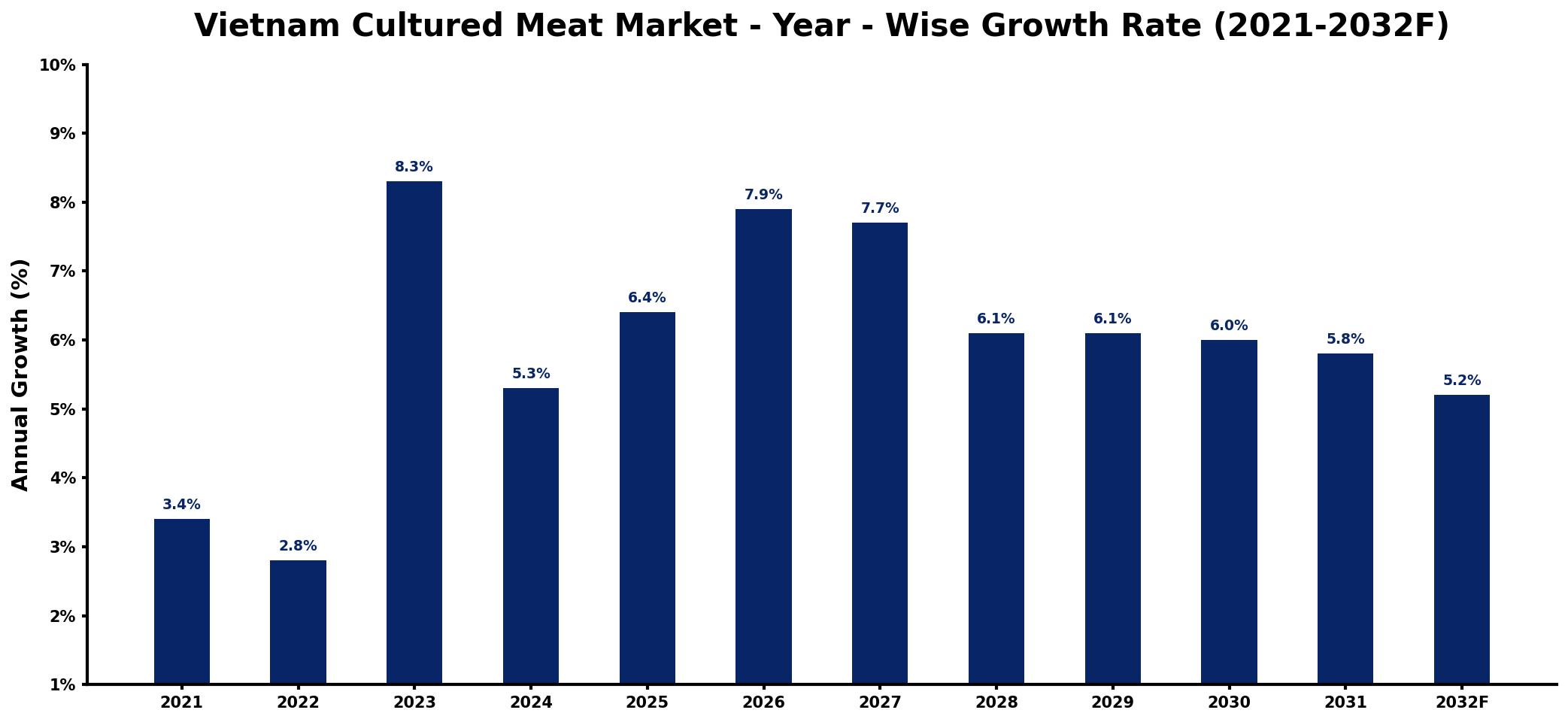
The table below presents the year‑wise growth rates along with the key drivers influencing the market
| Year | Growth Rate | Major Drivers |
| 2021 | 3.4% | Emerging consumer interest in alternatives |
| 2022 | 2.8% | Rising investments in innovative technologies |
| 2023 | 8.3% | Growing awareness of sustainability benefits |
| 2024 | 5.3% | Increased retail partnerships and distribution |
| 2025 | 6.4% | Enhanced research and development funding |
| 2026 | 7.9% | Expanding consumer acceptance and adoption |
| 2027 | 7.7% | Strengthening regulatory support initiatives |
| 2028 | 6.1% | Diversifying product offerings and flavors |
| 2029 | 6.1% | Innovative marketing strategies gaining traction |
| 2030 | 6.0% | Strengthening supply chain efficiencies |
| 2031 | 5.8% | Heightened focus on health trends |
| 2032 | 5.2% | Emerging market opportunities for investments |
Note: Market size estimations and growth projections presented in this report are based on 6Wresearch's proprietary forecasting methodology, utilizing the latest available industry data, government publications, and primary research inputs.
Vietnam Cultured Meat Market Synopsis
The most significant force shaping the Vietnam cultured meat market today is the growing consumer demand for sustainable food alternatives. With rising environmental concerns, especially regarding the ecological impact of conventional meat production, more individuals are exploring the benefits of cultured meat as a viable option.
Moreover, the shift in dietary preferences towards ethically produced food is gaining momentum. As urban populations expand and lifestyle changes occur, cultured meat is positioned to provide a scalable solution that addresses both health and sustainability issues, thereby attracting a wider consumer base in the country.
Vietnam Cultured Meat Market Key Takeaways
- The market is anticipated to grow steadily due to increased environmental awareness among consumers.
- Cultured meat presents a sustainable alternative that mitigates many drawbacks of traditional livestock farming.
- Ongoing research and development will be crucial for scalability and cost reduction.
- Consumer acceptance remains a vital factor that could determine market growth.
- Government policies are evolving to support the development and regulation of cultured meat technologies.
Evaluation of Restraints in Vietnam Cultured Meat Market
Despite the promising outlook, several restraints hinder the rapid growth of the Vietnam cultured meat market. Consumer acceptance is a primary concern, as many individuals remain unfamiliar with lab-grown products. This gap in awareness necessitates extensive education and marketing efforts. Furthermore, the industry faces challenges related to scaling production to meet rising demand while simultaneously managing costs effectively. Regulatory frameworks are also in flux, requiring clearer guidelines to ensure safety and efficacy, which can slow down market entry for new products.
Vietnam Cultured Meat Market Trends
Several trends are currently shaping the Vietnam cultured meat market. The increasing penetration of technology in food production is one notable trend, as innovations in biotechnology and lab-grown methodologies continue to evolve. Additionally, there is a noticeable rise in collaboration among startups and research institutions to accelerate product development. The emphasis on health and wellness is also influencing consumer choices, with a marked shift towards clean-label, nutritious options. Finally, sustainability has become a key selling point, appealing not only to environmentally conscious consumers but also to investors seeking responsible investment opportunities.
Vietnam Cultured Meat Market Opportunities
The Vietnam cultured meat market offers substantial growth and investment opportunities, especially as awareness of sustainable food sources rises. Companies focusing on R&D to improve production techniques and enhance product offerings are likely to thrive. Additionally, partnerships with local food distributors and retailers could facilitate market penetration and consumer acceptance. There's also potential in targeting specific demographics, such as health-conscious consumers and urban dwellers, who are more inclined to invest in alternative protein sources.
Government Initiatives in the Vietnam Cultured Meat Market
The Vietnamese government is gradually recognizing the importance of alternative protein sources as part of its food security strategy. Policies promoting research and development in biotechnology are emerging, alongside funding opportunities aimed at innovative agricultural practices. Furthermore, initiatives aimed at enhancing food safety standards are being reviewed to accommodate new food technologies, which will foster a supportive environment for cultured meat production.
Future Insights of the Vietnam Cultured Meat Market
Looking forward to 2026-2032, the Vietnam cultured meat market is set to expand significantly. The increasing prioritization of sustainability in food production and consumption patterns will drive further acceptance of lab-grown meat. Additionally, advancements in production technology will likely lead to lower costs and improved product quality, making cultured meat more accessible to the average consumer. As the market matures, it could redefine traditional meat consumption patterns and establish a lasting impact on Vietnam's food industry.
Vietnam Cultured Meat Market Latest Developments (2025 - 2026)
Recent developments in the Vietnam cultured meat market reflect a growing interest from both consumers and investors. Startups have been actively seeking partnerships with international firms to share knowledge and technology, thereby accelerating their growth. Public interest in sustainable food sources has risen, contributing to a supportive market environment. While challenges persist in terms of regulatory approvals and production scalability, the overall trend suggests a robust expansion in the cultured meat segment as more consumers are educated about its benefits.
Vietnam Cultured Meat Market - Key Attractiveness of the Report
- 10 Years of Market Numbers
- Historical Data Starting from 2022 to 2025
- Base Year: 2025
- Forecast Data until 2032
- Key Performance Indicators Impacting the Market
- Major Upcoming Developments and Projects
Key Highlights of the Report:
- Vietnam Cultured Meat Market Outlook
- Market Size of Vietnam Cultured Meat Market, 2025
- Forecast of Vietnam Cultured Meat Market, 2032
- Historical Data and Forecast of Vietnam Cultured Meat Revenues & Volume for the Period 2022-2032F
- Vietnam Cultured Meat Market Trend Evolution
- Vietnam Cultured Meat Market Drivers and Challenges
- Vietnam Cultured Meat Price Trends
- Vietnam Cultured Meat Porter's Five Forces
- Vietnam Cultured Meat Industry Life Cycle
- Historical Data and Forecast of Vietnam Cultured Meat Market Revenues & Volume By Product Type for the Period 2022-2032F
- Historical Data and Forecast of Vietnam Cultured Meat Market Revenues & Volume By Poultry for the Period 2022-2032F
- Historical Data and Forecast of Vietnam Cultured Meat Market Revenues & Volume By Beef for the Period 2022-2032F
- Historical Data and Forecast of Vietnam Cultured Meat Market Revenues & Volume By Seafood for the Period 2022-2032F
- Historical Data and Forecast of Vietnam Cultured Meat Market Revenues & Volume By Pork for the Period 2022-2032F
- Historical Data and Forecast of Vietnam Cultured Meat Market Revenues & Volume By Duck for the Period 2022-2032F
- Historical Data and Forecast of Vietnam Cultured Meat Market Revenues & Volume By End-Use for the Period 2022-2032F
- Historical Data and Forecast of Vietnam Cultured Meat Market Revenues & Volume By Nuggets for the Period 2022-2032F
- Historical Data and Forecast of Vietnam Cultured Meat Market Revenues & Volume By Burgers for the Period 2022-2032F
- Historical Data and Forecast of Vietnam Cultured Meat Market Revenues & Volume By Meatballs for the Period 2022-2032F
- Historical Data and Forecast of Vietnam Cultured Meat Market Revenues & Volume By Sausage for the Period 2022-2032F
- Historical Data and Forecast of Vietnam Cultured Meat Market Revenues & Volume By Hot dogs for the Period 2022-2032F
- Historical Data and Forecast of Vietnam Cultured Meat Market Revenues & Volume By Others for the Period 2022-2032F
- Vietnam Cultured Meat Import Export Trade Statistics
- Market Opportunity Assessment By Product Type
- Market Opportunity Assessment By End-Use
- Vietnam Cultured Meat Top Companies Market Share
- Vietnam Cultured Meat Competitive Benchmarking By Technical and Operational Parameters
- Vietnam Cultured Meat Company Profiles
- Vietnam Cultured Meat Key Strategic Recommendations






































