Vietnam Decorative tile Market Summary
The vietnam decorative tile market was estimated at USD 1110 Million in 2025 and is projected to reach USD 1576 Million by 2032, growing at a CAGR of 7.7% from 2026 to 2032.
Vietnam Decorative tile Market Year-wise Growth Rate and Key Drivers
This graph highlights how the Vietnam Decorative tile Market has steadily grown over the past five years, supported by major growth factors.
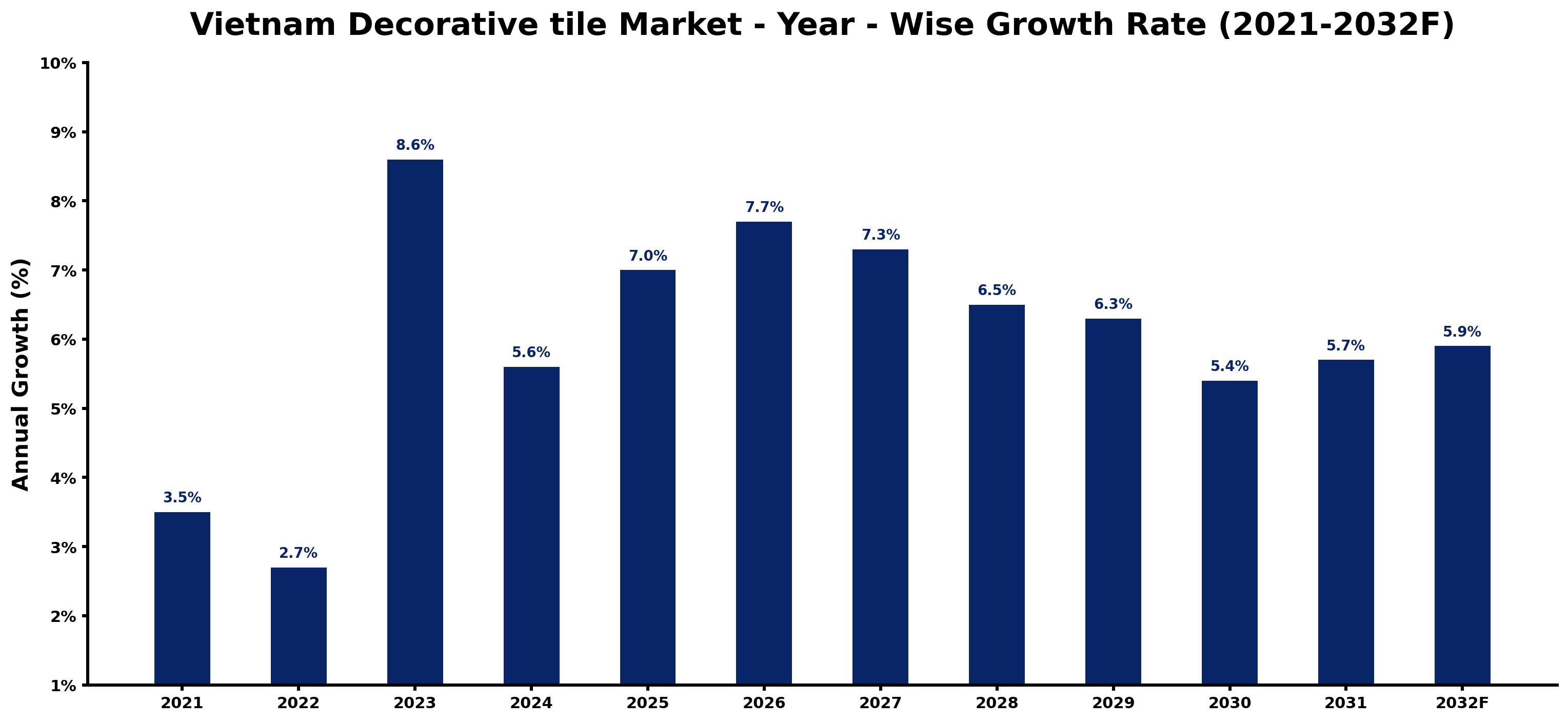
The table below presents the year wise growth rates along with the key drivers influencing the market
| Year | Growth Rate | Major Drivers |
| 2021 | 3.5% | Post-lockdown retail projects ignited a surge in home renovation interests across Vietnam. |
| 2022 | 2.7% | Manufacturing relocation from China positioned Vietnam as a competitive tile production hub. |
| 2023 | 8.6% | Urbanization trends led to a significant increase in residential construction across cities. |
| 2024 | 5.6% | Rising disposable incomes prompted a shift towards premium decorative tile options. |
| 2025 | 7.0% | The demand for sustainable building materials began influencing tile manufacturing processes. |
| 2026 | 7.7% | Home improvement TV shows contributed to growing public interest in tile designs. |
| 2027 | 7.3% | Architectural firms increasingly incorporated decorative tiles into diverse building projects. |
| 2028 | 6.5% | Advancements in digital printing technologies allowed for more personalized tile designs. |
| 2029 | 6.3% | E-commerce platforms expanded, allowing consumers to easily access decorative tile options. |
| 2030 | 5.4% | Emerging trends in minimalism influenced the popularity of simpler tile patterns. |
| 2031 | 5.7% | International brands entered the market, providing consumers with diverse product choices. |
| 2032 | 5.9% | Focus on aesthetic appeal drove innovative designs, enhancing the decorative tile market. |
Note - Market size estimations and growth projections presented in this report are based on 6Wresearch's advanced forecasting approach, validated with industry datasets as of June 2026.
Vietnam Decorative tile Market Synopsis
The Vietnam Decorative tile Market is projected to reach 7.7% and witness significant growth during the forecast period (2026-2032). This expansion is largely attributed to the accelerating construction and real estate sectors, along with a continual rise in urbanization and disposable incomes. Decorative tiles have become essential for enhancing the aesthetic quality of residential and commercial properties, making them a preferred choice among homeowners, architects, and interior designers.
Vietnam Decorative tile Market Growth Drivers
The growth trajectory of the Vietnam decorative tile market is underpinned by several key drivers:
- The surge in urbanization has resulted in the rapid construction of new residential buildings, shopping malls, and hotels, thereby increasing the demand for decorative tiles.
- With the real estate sector flourishing, particularly in major urban areas, there is a heightened focus on modern interior design, spurring the adoption of decorative tiles for diverse applications.
- An increase in disposable income among the populace has led to greater consumer spending on home improvement projects, fueling the demand for aesthetically pleasing tiles.
- Innovative tile designs and advancements in manufacturing techniques have enhanced the appeal of decorative tiles, contributing to their growing popularity.
- The rising trend of personalization in interior decor has encouraged consumers to opt for unique and customized tile solutions that cater to their specific design preferences.
Vietnam Decorative tile Market Challenges and Restraints
While the Vietnam decorative tile market experiences robust growth, it is not without its challenges:
- The inflow of imported decorative tiles poses a significant challenge, as these products often feature unique designs and high-quality finishes that can attract local consumers, potentially detracting from the market share of domestic products.
- Fluctuations in raw material costs can significantly impact production expenses, leading manufacturers to navigate tight profit margins while striving to maintain competitive pricing.
- Ensuring quality and durability in decorative tiles is paramount, yet the need for continuous innovation and investment in superior materials can strain resources for manufacturers.
- The COVID-19 pandemic temporarily disrupted construction activities, which in turn affected the demand for decorative tiles, highlighting the market's vulnerability to external shocks.
- Environmental regulations and sustainability concerns are increasingly dictating the materials and processes used in tile manufacturing, thus compelling producers to adapt in order to comply with new standards.
Vietnam Decorative tile Market COVID-19 Impact
The COVID-19 pandemic left a notable impact on the Vietnam decorative tile market. Lockdowns and restrictions on movement led to significant disruptions in construction activities and a slowdown in real estate projects, causing a temporary dip in tile demand. Moreover, supply chain issues hampered the availability and delivery of decorative tiles during the hardest-hit periods. However, as home improvement and renovation projects gained momentum due to increased time spent at home, some segments of the market witnessed a resurgence in demand as consumers turned towards enhancing their living spaces.
Vietnam Decorative tile Market Government Investment and Initiatives
The Vietnamese government is actively promoting various initiatives aimed at bolstering the decorative tile market. Significant investments in infrastructure development are designed to stimulate construction activities across urban and rural areas. Public spending programs focused on housing, commercial complexes, and public facilities also serve to create opportunities for decorative tile applications. Additionally, government policies encouraging foreign investment in the construction sector may facilitate technology transfer and innovation, enhancing the overall quality and competitiveness of the domestic tile market.
Vietnam Decorative tile Market Latest Developments (May 2025 - June 2026)
During the period from May 2025 to June 2026, the Vietnam decorative tile market has seen several notable developments. A rising trend towards eco-friendly and sustainable materials has emerged, with manufacturers increasingly focusing on environmentally responsible production practices. Technological advancements in the manufacturing process are yielding innovative tile designs that cater to modern aesthetic preferences. Furthermore, the continued expansion of the real estate and construction sectors has provided a steady demand base for decorative tiles, indicating positive momentum heading into the forecast period.
Vietnam Decorative tile Market - Key Attractiveness of the Report
- 10 Years of Market Numbers
- Historical Data Starting from 2022 to 2025
- Base Year: 2025
- Forecast Data until 2032
- Key Performance Indicators Impacting the Market
- Major Upcoming Developments and Projects
Key Highlights of the Report:
- Vietnam Decorative tile Market Outlook
- Market Size of Vietnam Decorative tile Market, 2025
- Forecast of Vietnam Decorative tile Market, 2032
- Historical Data and Forecast of Vietnam Decorative tile Revenues & Volume for the Period 2022-2032F
- Vietnam Decorative tile Market Trend Evolution
- Vietnam Decorative tile Market Drivers and Challenges
- Vietnam Decorative tile Price Trends
- Vietnam Decorative tile Porter's Five Forces
- Vietnam Decorative tile Industry Life Cycle
- Historical Data and Forecast of Vietnam Decorative tile Market Revenues & Volume By Type for the Period 2022-2032F
- Historical Data and Forecast of Vietnam Decorative tile Market Revenues & Volume By Ceramic Wall Tiles for the Period 2022-2032F
- Historical Data and Forecast of Vietnam Decorative tile Market Revenues & Volume By Vinyl Wall Tiles for the Period 2022-2032F
- Historical Data and Forecast of Vietnam Decorative tile Market Revenues & Volume By Stone Wall Tiles for the Period 2022-2032F
- Historical Data and Forecast of Vietnam Decorative tile Market Revenues & Volume By Other Types for the Period 2022-2032F
- Historical Data and Forecast of Vietnam Decorative tile Market Revenues & Volume By End-users for the Period 2022-2032F
- Historical Data and Forecast of Vietnam Decorative tile Market Revenues & Volume By Residential for the Period 2022-2032F
- Historical Data and Forecast of Vietnam Decorative tile Market Revenues & Volume By Commercial for the Period 2022-2032F
- Historical Data and Forecast of Vietnam Decorative tile Market Revenues & Volume By Application for the Period 2022-2032F
- Historical Data and Forecast of Vietnam Decorative tile Market Revenues & Volume By Flooring for the Period 2022-2032F
- Historical Data and Forecast of Vietnam Decorative tile Market Revenues & Volume By Wall Coverings for the Period 2022-2032F
- Historical Data and Forecast of Vietnam Decorative tile Market Revenues & Volume By Other Applications for the Period 2022-2032F
- Vietnam Decorative tile Import Export Trade Statistics
- Market Opportunity Assessment By Type
- Market Opportunity Assessment By End-users
- Market Opportunity Assessment By Application
- Vietnam Decorative tile Top Companies Market Share
- Vietnam Decorative tile Competitive Benchmarking By Technical and Operational Parameters
- Vietnam Decorative tile Company Profiles
- Vietnam Decorative tile Key Strategic Recommendations






































