Vietnam Deodorants and Anti-Perspirant Products Market Summary
The vietnam deodorants and anti-perspirant products market was estimated at USD 540 Million in 2025 and is projected to reach USD 766 Million by 2032, growing at a CAGR of 8.4% from 2026 to 2032.
Vietnam Deodorants and Anti-Perspirant Products Market Year-wise Growth Rate and Key Drivers
This graph highlights how the Vietnam Deodorants and Anti-Perspirant Products Market has steadily grown over the past five years, supported by major growth factors.
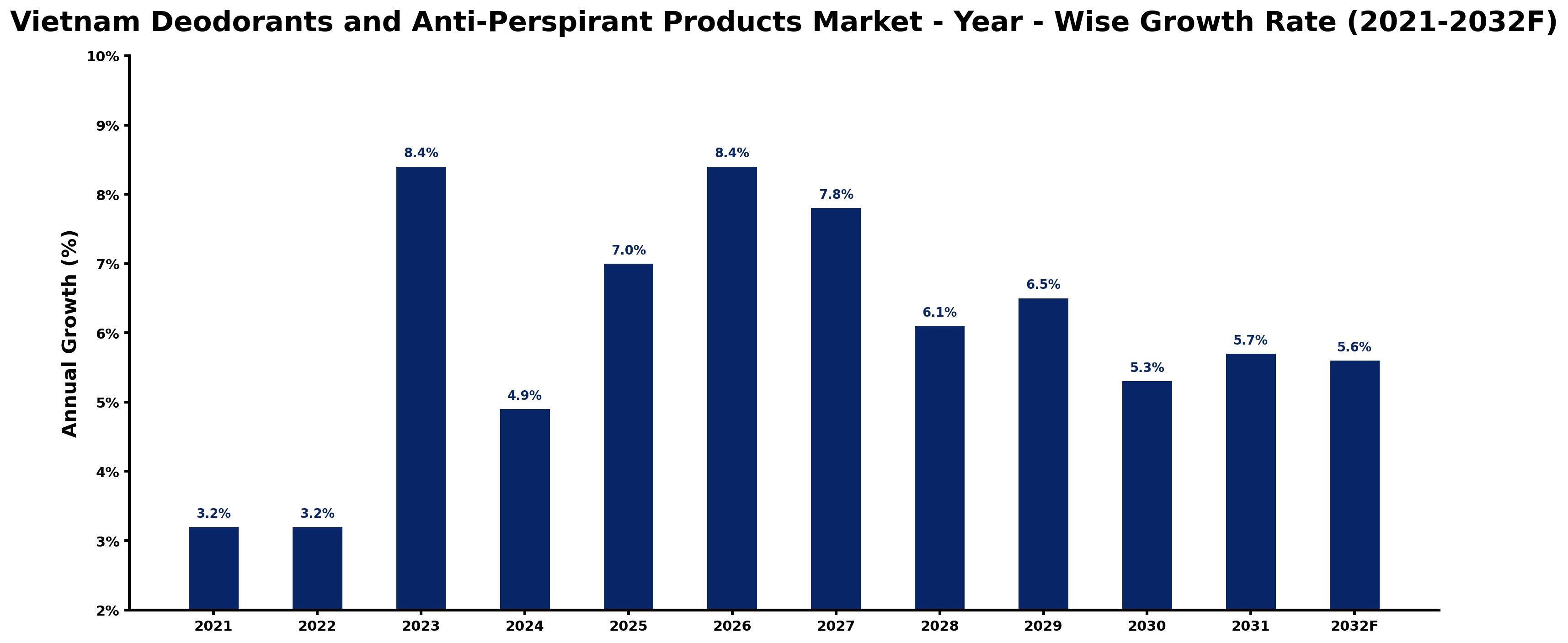
The table below presents the year wise growth rates along with the key drivers influencing the market
| Year | Growth Rate | Major Drivers |
| 2021 | 3.2% | Shifting consumer preferences towards personal care products create market opportunities. |
| 2022 | 3.2% | Increased local manufacturing capabilities enhance product availability across urban centers. |
| 2023 | 8.4% | E-commerce platforms expand, allowing consumers easy access to a variety of products. |
| 2024 | 4.9% | Emergence of natural and organic deodorant options caters to health-conscious individuals. |
| 2025 | 7.0% | Cultural shifts towards self-care encourage investments in personal grooming products. |
| 2026 | 8.4% | Growing awareness of body odor management drives product innovation and diversification. |
| 2027 | 7.8% | Youth demographics increasingly seek trendy and effective deodorant solutions. |
| 2028 | 6.1% | Partnerships with local celebrities boost brand visibility and consumer trust. |
| 2029 | 6.5% | Urbanization trends facilitate demand for deodorants in densely populated areas. |
| 2030 | 5.3% | Sustainability initiatives prompt brands to develop eco-friendly packaging and formulations. |
| 2031 | 5.7% | Competitive pricing strategies become essential as more brands enter the market. |
| 2032 | 5.6% | Consumer education campaigns emphasize the importance of effective odor control. |
Note - Market size estimations and growth projections presented in this report are based on 6Wresearch's advanced forecasting approach, validated with industry datasets as of June 2026.
Vietnam Deodorants and Anti-Perspirant Products Market Synopsis
The Vietnam Deodorants and Anti-Perspirant Products Market is projected to reach 8.4% and witness significant growth during the forecast period (2026-2032). This growth trajectory can be largely attributed to the evolving lifestyle patterns of consumers, an increase in disposable income, and heightened awareness regarding personal grooming and hygiene. The rapid urbanization and modernization of Vietnam have also contributed to a shift in consumer preferences, particularly toward deodorants and anti-perspirants. Furthermore, aggressive marketing strategies, product innovations, and an expanding variety of available products have significantly driven this market's expansion.
Vietnam Deodorants and Anti-Perspirant Products Market Growth Drivers
Several pivotal factors are propelling the growth of the Vietnam deodorants and anti-perspirant products market. Firstly, a younger, urban demographic is increasingly aware of personal hygiene and grooming practices, leading to a robust demand for deodorants and anti-perspirants. As consumers become more sensitive to body odors and seek effective sweat control, the product adoption has seen a marked increase.
- The rise of disposable incomes among the burgeoning middle class in Vietnam has provided consumers the financial capacity to invest in personal care products, spurring market growth.
- Aggressive marketing campaigns and promotional activities by various brands have successfully shifted consumer preferences, enhancing the acceptance of deodorants and anti-perspirants.
- The increasing availability of a diverse range of products catering to different demographics has also played a significant role in expanding consumer reach.
- Innovations in product formulations, including natural and organic options, are attracting health-conscious consumers and contributing to market growth.
- The influence of social media and online platforms has further bolstered awareness and consumption of deodorant products among younger consumers.
Vietnam Deodorants and Anti-Perspirant Products Market Challenges and Restraints
Despite the promising growth outlook, the Vietnam deodorants and anti-perspirant products market faces several challenges. One of the main obstacles is the persistent popularity of traditional alternatives such as talcum powder and natural remedies, particularly in rural regions, which may limit the penetration of modern deodorants.
- The local climate, characterized by high humidity and temperatures, necessitates stronger product formulations, thus posing challenges for existing product effectiveness.
- Competition from both local and international brands can lead to price wars, complicating brand positioning and profitability.
- Changes in consumer preferences toward more sustainable and eco-friendly products may require brands to adapt rapidly to maintain relevance.
- The fragmented market with numerous options can overwhelm consumers, resulting in indecision and affecting purchasing behavior.
- Supply chain disruptions can adversely impact the availability and pricing of key ingredients used in deodorants and anti-perspirants.
Vietnam Deodorants and Anti-Perspirant Products Market COVID-19 Impact
The COVID-19 pandemic has had a complex impact on the Vietnam deodorants and anti-perspirant products market. Initial lockdowns and restrictions resulted in a temporary decline in demand, as consumers prioritized essential goods over luxury and personal care items.
However, with the gradual lifting of restrictions and an increased focus on personal hygiene, the market began to rebound. Consumers' heightened awareness of health and hygiene practices during the pandemic underscored the importance of deodorants and anti-perspirants. Additionally, the rise in e-commerce and online shopping during this period facilitated product accessibility, significantly contributing to increased sales.
Vietnam Deodorants and Anti-Perspirant Products Market Government Investment and Initiatives
The Vietnamese government has recognized the potential for growth in the personal care sector, including deodorants and anti-perspirants, leading to various supportive initiatives. Policies aimed at enhancing public health and personal hygiene are being implemented, which indirectly boost the market for these products.
Public spending on hygiene campaigns and education around personal care practices is also on the rise. Moreover, the government is working to streamline regulatory processes for cosmetic and personal care products, making it easier for new brands and products to enter the market. Incentives aimed at local manufacturers are also anticipated to foster innovation within the sector.
Vietnam Deodorants and Anti-Perspirant Products Market Latest Developments (May 2025 - June 2026)
In the timeframe from May 2025 to June 2026, the Vietnam deodorants and anti-perspirant products market has observed several notable developments. The trend of product innovation has accelerated, with an increase in the introduction of organic and natural formulations appealing to health-conscious consumers. Furthermore, brands are increasingly leveraging advanced marketing technologies, including influencer partnerships on social media platforms, to effectively engage targeted demographics.
The growth of e-commerce has continued to play a pivotal role in shaping purchasing behaviors, with many consumers opting for online shopping due to convenience. Additionally, businesses are increasingly focusing on sustainability, reflected in eco-friendly packaging solutions and ethically sourced ingredients, which resonate with an environmentally aware customer base. These developments indicate a dynamic shift in the market, driven by changing consumer preferences and societal trends.
Vietnam Deodorants and Anti-Perspirant Products Market - Key Attractiveness of the Report
- 10 Years of Market Numbers
- Historical Data Starting from 2022 to 2025
- Base Year: 2025
- Forecast Data until 2032
- Key Performance Indicators Impacting the Market
- Major Upcoming Developments and Projects
Key Highlights of the Report:
- Vietnam Deodorants and Anti-Perspirant Products Market Outlook
- Market Size of Vietnam Deodorants and Anti-Perspirant Products Market, 2025
- Forecast of Vietnam Deodorants and Anti-Perspirant Products Market, 2032
- Historical Data and Forecast of Vietnam Deodorants and Anti-Perspirant Products Revenues & Volume for the Period 2022-2032F
- Vietnam Deodorants and Anti-Perspirant Products Market Trend Evolution
- Vietnam Deodorants and Anti-Perspirant Products Market Drivers and Challenges
- Vietnam Deodorants and Anti-Perspirant Products Price Trends
- Vietnam Deodorants and Anti-Perspirant Products Porter's Five Forces
- Vietnam Deodorants and Anti-Perspirant Products Industry Life Cycle
- Historical Data and Forecast of Vietnam Deodorants and Anti-Perspirant Products Market Revenues & Volume By Function for the Period 2022-2032F
- Historical Data and Forecast of Vietnam Deodorants and Anti-Perspirant Products Market Revenues & Volume By Aerosol Spray for the Period 2022-2032F
- Historical Data and Forecast of Vietnam Deodorants and Anti-Perspirant Products Market Revenues & Volume By Cream for the Period 2022-2032F
- Historical Data and Forecast of Vietnam Deodorants and Anti-Perspirant Products Market Revenues & Volume By Roll-On for the Period 2022-2032F
- Historical Data and Forecast of Vietnam Deodorants and Anti-Perspirant Products Market Revenues & Volume By Gel for the Period 2022-2032F
- Historical Data and Forecast of Vietnam Deodorants and Anti-Perspirant Products Market Revenues & Volume By Ingredient for the Period 2022-2032F
- Historical Data and Forecast of Vietnam Deodorants and Anti-Perspirant Products Market Revenues & Volume By Alcohol for the Period 2022-2032F
- Historical Data and Forecast of Vietnam Deodorants and Anti-Perspirant Products Market Revenues & Volume By Antimicrobials for the Period 2022-2032F
- Historical Data and Forecast of Vietnam Deodorants and Anti-Perspirant Products Market Revenues & Volume By Conditioner and Moisturizer for the Period 2022-2032F
- Historical Data and Forecast of Vietnam Deodorants and Anti-Perspirant Products Market Revenues & Volume By Fragrances for the Period 2022-2032F
- Historical Data and Forecast of Vietnam Deodorants and Anti-Perspirant Products Market Revenues & Volume By Paraben and Propellants for the Period 2022-2032F
- Historical Data and Forecast of Vietnam Deodorants and Anti-Perspirant Products Market Revenues & Volume By Others for the Period 2022-2032F
- Vietnam Deodorants and Anti-Perspirant Products Import Export Trade Statistics
- Market Opportunity Assessment By Function
- Market Opportunity Assessment By Ingredient
- Vietnam Deodorants and Anti-Perspirant Products Top Companies Market Share
- Vietnam Deodorants and Anti-Perspirant Products Competitive Benchmarking By Technical and Operational Parameters
- Vietnam Deodorants and Anti-Perspirant Products Company Profiles
- Vietnam Deodorants and Anti-Perspirant Products Key Strategic Recommendations






































