Vietnam Digital Badges Market Size, Share & Growth Rate
The Vietnam Digital Badges Market was estimated at USD 1292 Million in 2025 and is projected to reach USD 1844 Million by 2032, growing at a CAGR of 5.2% from 2026 to 2032. This growth trajectory is primarily fueled by an increasing demand for digital credentials as more educational institutions and organizations embrace online learning and remote working paradigms. The portability and verifiability of digital badges make them an attractive option for showcasing skills and achievements across various sectors.
Vietnam Digital Badges Market Year-wise Growth Rate and Key Drivers
This graph highlights how the Vietnam Digital Badges Market has steadily grown over the years, supported by major growth factors.
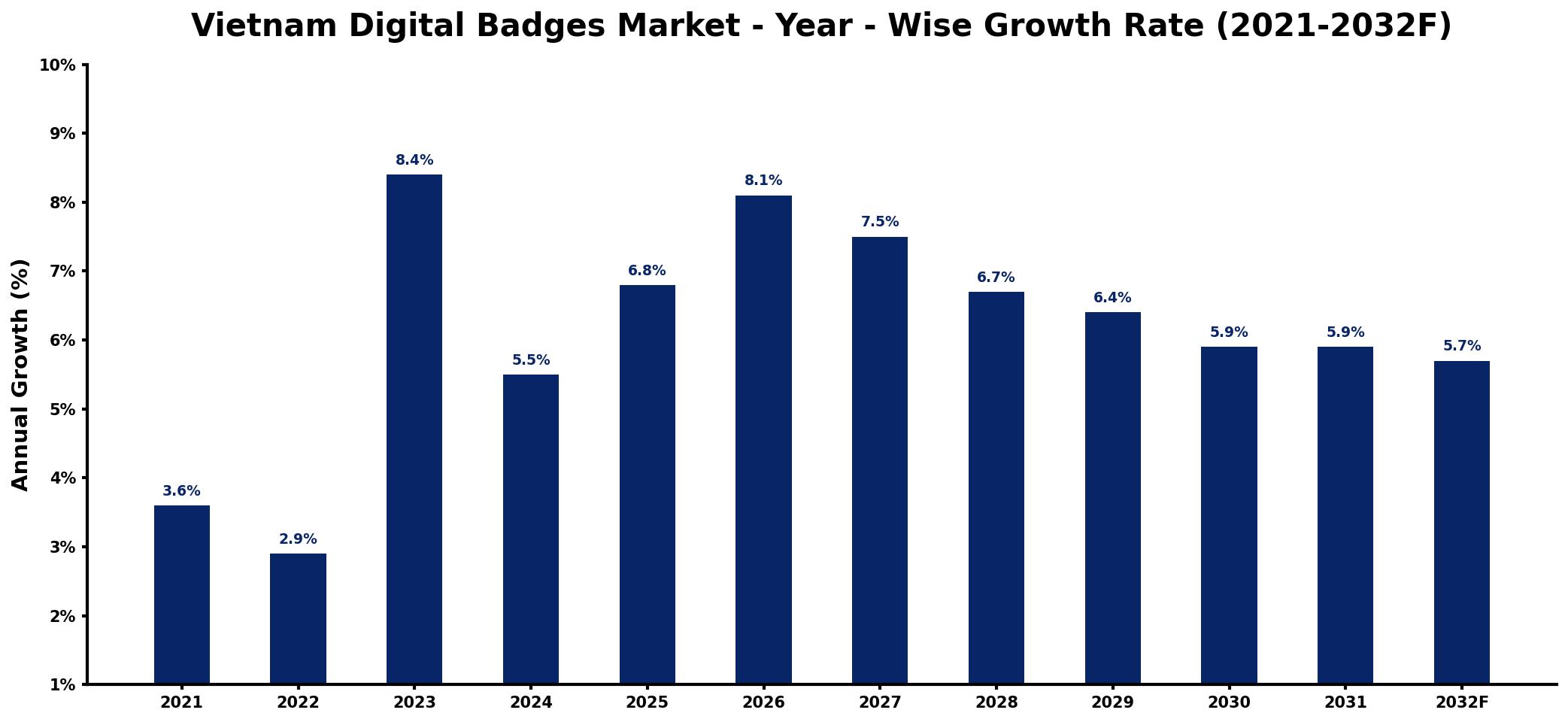
The table below presents the year‑wise growth rates along with the key drivers influencing the market
| Year | Growth Rate | Major Drivers |
| 2021 | 3.6% | Increased adoption in education sector |
| 2022 | 2.9% | Growing interest in online credentials |
| 2023 | 8.4% | Rise in remote learning initiatives |
| 2024 | 5.5% | Expansion of corporate training programs |
| 2025 | 6.8% | Higher demand for skill recognition |
| 2026 | 8.1% | Investment in innovative learning solutions |
| 2027 | 7.5% | Enhanced focus on workforce development |
| 2028 | 6.7% | Emergence of gamification strategies |
| 2029 | 6.4% | Strengthening partnerships with institutions |
| 2030 | 5.9% | Diversification of credentialing platforms |
| 2031 | 5.9% | Advancement in technology integration |
| 2032 | 5.7% | Broader acceptance of micro-credentials |
Note: Market size estimations and growth projections presented in this report are based on 6Wresearch's proprietary forecasting methodology, utilizing the latest available industry data, government publications, and primary research inputs.
Vietnam Digital Badges Market Synopsis
The shift towards digital credentialing is the strongest force shaping the Vietnam digital badges market right now. With educational institutions adopting online platforms, there is a significant push for verifiable achievements that digital badges provide, catering to both students and professionals alike.
This transition is bolstered by the growing recognition of digital badges in the professional realm, where employers seek demonstrable skills. As the appetite for skill validation increases, the market finds itself well-positioned to capitalize on the evolving landscape of education and professional development.
Vietnam Digital Badges Market Key Takeaways
- The market is on a growth trajectory driven by increased adoption of digital credentialing in education and professional settings.
- Digital badges provide a portable and verifiable means for showcasing skills and accomplishments.
- Collaborative efforts for establishing standardization in digital badge formats are crucial for widespread acceptance.
- Privacy and data security concerns must be addressed to foster trust in digital credentialing solutions.
- Government initiatives and support play a pivotal role in encouraging the growth of the digital badges sector.
Evaluation of Restraints in Vietnam Digital Badges Market
Despite the promising growth of the digital badges market in Vietnam, there are notable restraints hindering its full potential. A significant barrier is the lack of standardized formats that would allow for seamless sharing and verification across multiple platforms. Without such interoperability, digital badges may struggle to gain broad acceptance in various sectors. Additionally, privacy and data security concerns regarding the information stored in digital badges can deter users, necessitating robust security measures to safeguard personal data. Overcoming these challenges will require collaboration among industry stakeholders to establish standards and improve user confidence.
Vietnam Digital Badges Market Trends
Several current trends are shaping the Vietnam digital badges market. One prominent trend is the integration of gamification elements within digital badge systems, which enhances user engagement and motivation in both educational and professional contexts. Furthermore, the rise of remote work is prompting organizations to recognize and validate skills acquired through virtual platforms, leading to a surge in the issuance of digital badges. Additionally, there is a growing emphasis on lifelong learning, with professionals seeking to upskill and showcase their competencies through verified achievements.
Vietnam Digital Badges Market Opportunities
The Vietnam digital badges market is poised for genuine growth opportunities driven by expanding applications across various industries. As sectors such as technology, healthcare, and finance increasingly value digital credentials, providers can tap into new customer bases by offering tailored solutions. Additionally, partnerships with educational institutions to embed digital badges into curricula can significantly enhance their adoption. There's also potential for leveraging advancements in blockchain technology to bolster security and verification processes, making digital badges more appealing to users concerned about privacy.
Government Initiatives in the Vietnam Digital Badges Market
The Vietnamese government has begun to recognize the importance of digital credentials, promoting initiatives aimed at modernizing educational frameworks. Public spending on digital infrastructure, alongside programs designed to support online learning, is facilitating the adoption of digital badges. Furthermore, government agencies are exploring collaborations with educational institutions and industry stakeholders to implement national standards for digital credentials, which could enhance the credibility and usage of digital badges across various sectors.
Future Insights of the Vietnam Digital Badges Market
Looking ahead to 2026-2032, the Vietnam digital badges market is set for transformative advancements. As more organizations recognize the value of lifelong learning and skill validation, demand for digital badges is expected to grow. The establishment of standardized formats will likely drive further adoption, allowing for interoperability between various platforms. Moreover, with increasing focus on user privacy and security, innovations in technology will enhance trust and reliability in digital credentialing, ultimately solidifying the position of digital badges in the educational and professional landscape.
Vietnam Digital Badges Market Latest Developments (2025 - 2026)
Recent developments in the Vietnam digital badges market indicate a heightened focus on collaborative efforts among industry stakeholders to establish standardization in digital badge formats. Educational institutions are increasingly integrating digital badges into their certification processes, while businesses are adopting them as a part of employee skill validation. Additionally, the emphasis on data security measures is gaining traction, with providers investing in advanced technologies to protect user information, addressing key concerns among potential adopters.
Vietnam Digital Badges Market - Key Attractiveness of the Report
- 10 Years of Market Numbers
- Historical Data Starting from 2022 to 2025
- Base Year: 2025
- Forecast Data until 2032
- Key Performance Indicators Impacting the Market
- Major Upcoming Developments and Projects
Key Highlights of the Report:
- Vietnam Digital Badges Market Outlook
- Market Size of Vietnam Digital Badges Market, 2025
- Forecast of Vietnam Digital Badges Market, 2032
- Historical Data and Forecast of Vietnam Digital Badges Revenues & Volume for the Period 2022-2032F
- Vietnam Digital Badges Market Trend Evolution
- Vietnam Digital Badges Market Drivers and Challenges
- Vietnam Digital Badges Price Trends
- Vietnam Digital Badges Porter's Five Forces
- Vietnam Digital Badges Industry Life Cycle
- Historical Data and Forecast of Vietnam Digital Badges Market Revenues & Volume By Offering for the Period 2022-2032F
- Historical Data and Forecast of Vietnam Digital Badges Market Revenues & Volume By Platform for the Period 2022-2032F
- Historical Data and Forecast of Vietnam Digital Badges Market Revenues & Volume By Services for the Period 2022-2032F
- Historical Data and Forecast of Vietnam Digital Badges Market Revenues & Volume By End-User for the Period 2022-2032F
- Historical Data and Forecast of Vietnam Digital Badges Market Revenues & Volume By Academic for the Period 2022-2032F
- Historical Data and Forecast of Vietnam Digital Badges Market Revenues & Volume By Corporate for the Period 2022-2032F
- Vietnam Digital Badges Import Export Trade Statistics
- Market Opportunity Assessment By Offering
- Market Opportunity Assessment By End-User
- Vietnam Digital Badges Top Companies Market Share
- Vietnam Digital Badges Competitive Benchmarking By Technical and Operational Parameters
- Vietnam Digital Badges Company Profiles
- Vietnam Digital Badges Key Strategic Recommendations






































