Vietnam Dill Seed Oil Market Size, Share & Growth Rate
The Vietnam Dill Seed Oil Market was estimated at USD 151 Million in 2025 and is projected to reach USD 212 Million by 2032, growing at a CAGR of 5.0% from 2026 to 2032. This growth trajectory is primarily fueled by the increasing consumer awareness regarding the health benefits associated with natural oils, particularly in culinary and therapeutic uses. Additionally, the expanding wellness trend and the shift towards herbal remedies are significantly enhancing the demand for dill seed oil across various sectors.
Vietnam Dill Seed Oil Market Year-wise Growth Rate and Key Drivers
This graph highlights how the Vietnam Dill Seed Oil Market has steadily grown over the years, supported by major growth factors.
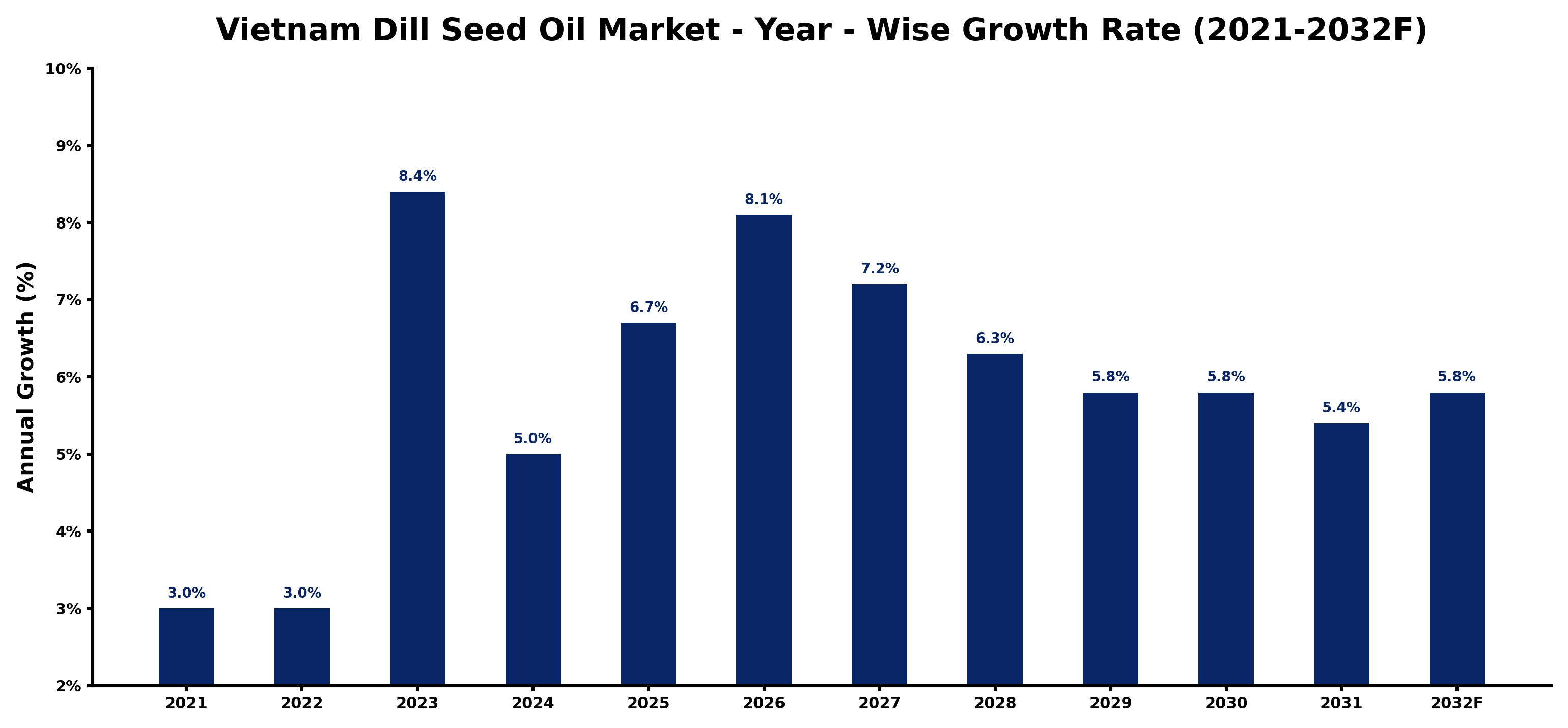
The table below presents the year‑wise growth rates along with the key drivers influencing the market
| Year | Growth Rate | Major Drivers |
| 2021 | 3.0% | Increasing industrial infrastructure investments |
| 2022 | 3.0% | Expansion of commercial construction activities |
| 2023 | 8.4% | Growing urbanization and commercial development |
| 2024 | 5.0% | Increasing smart city development projects |
| 2025 | 6.7% | Rising electricity demand across industries |
| 2026 | 8.1% | Rapid growth in telecom and data center sectors |
| 2027 | 7.2% | Expansion of transportation and logistics networks |
| 2028 | 6.3% | Expansion of commercial construction activities |
| 2029 | 5.8% | Expansion of manufacturing activities |
| 2030 | 5.8% | Growing renewable energy integration projects |
| 2031 | 5.4% | Government infrastructure modernization initiatives |
| 2032 | 5.8% | Increasing smart city development projects |
Note - Market size estimations and growth projections presented in this report are based on 6Wresearch's advanced forecasting approach, validated with industry datasets as of June 2026.
Vietnam Dill Seed Oil Market Synopsis
A significant force shaping the Vietnam Dill Seed Oil Market is the rising trend towards natural and organic products. As consumers become more health-conscious, the demand for dill seed oil—known for its digestive and medicinal properties—continues to escalate. Furthermore, the oil's versatility in culinary applications solidifies its role in both households and restaurants, further driving market growth.
Another important factor is Vietnam's commitment to sustainable agricultural practices, which enhances the quality of dill seed oil produced. Local producers are adept at employing traditional farming methods, which not only ensure a high-quality product but also resonate with the growing consumer preference for sustainably sourced oils. This alignment with sustainability is increasingly appealing to both domestic and international markets.
Vietnam Dill Seed Oil Market Key Takeaways
- The market is expected to grow at a CAGR of 5.0% from 2026 to 2032.
- Rising health consciousness among consumers is driving demand for natural oils like dill seed oil.
- Sustainable farming practices in Vietnam contribute to the quality of dill seed oil.
- Increased applications in the food industry bolster market expansion.
- Growing interest in alternative therapies and herbal products supports market growth.
Evaluation of Restraints in Vietnam Dill Seed Oil Market
The Vietnam Dill Seed Oil Market is facing challenges that stem from the inherent unpredictability of agricultural yields. Climate variability poses a significant risk, impacting the availability of dill plants necessary for oil extraction. This fluctuation can lead to supply inconsistencies and varying market prices, presenting challenges for producers. Additionally, the market's competition with other essential oils necessitates innovative differentiation strategies to capture consumer attention and maintain market share.
Vietnam Dill Seed Oil Market Trends
One of the defining trends in the Vietnam Dill Seed Oil Market is the increasing consumer shift towards natural and organic products, particularly in the food and wellness sectors. The rise of the health and wellness movement is driving demand for herbal products, including dill seed oil, due to its purported health benefits. Additionally, advancements in extraction technologies are enhancing the quality of dill seed oil, making it a more appealing choice for manufacturers and consumers alike.
Vietnam Dill Seed Oil Market Opportunities
The Vietnam Dill Seed Oil Market presents numerous growth and investment opportunities, particularly in export markets. As global demand for high-quality essential oils continues to rise, Vietnamese producers can leverage their reputation for quality and sustainability. Additionally, expanding applications in personal care and cosmetics provide new avenues for growth, as consumers increasingly seek natural ingredients in their products.
Government Initiatives in the Vietnam Dill Seed Oil Market
The Vietnamese government is actively promoting initiatives aimed at enhancing agricultural productivity and supporting the essential oils industry. Through subsidies and programs focused on sustainable farming practices, the government encourages farmers to adopt methods that improve yield quality. Additionally, investment in research and development for essential oil extraction and processing techniques is being prioritized to bolster the sector's competitiveness in the global market.
Future Insights of the Vietnam Dill Seed Oil Market
Looking ahead to 2026-2032, the Vietnam Dill Seed Oil Market is poised for notable growth, driven by increasing consumer trends towards health and sustainability. The expansion of distribution channels, including e-commerce platforms, is likely to enhance accessibility for consumers. Furthermore, as international markets continue to seek high-quality essential oils, Vietnam's dill seed oil is well-positioned to capitalize on these opportunities, with a robust growth forecast supported by both local and global demand.
Vietnam Dill Seed Oil Market Latest Developments (May 2025 - June 2026)
In recent months, the Vietnam Dill Seed Oil Market has experienced a notable uptick in interest from international buyers, particularly as they seek sustainable sourcing options. Producers are increasingly investing in marketing initiatives that highlight the health benefits and culinary versatility of dill seed oil. Additionally, partnerships between local farmers and international brands are being established to enhance the distribution of high-quality dill seed oil to a broader audience.
Vietnam Dill Seed Oil Market - Key Attractiveness of the Report
- 10 Years of Market Numbers
- Historical Data Starting from 2022 to 2025
- Base Year: 2025
- Forecast Data until 2032
- Key Performance Indicators Impacting the Market
- Major Upcoming Developments and Projects
Key Highlights of the Report:
- Vietnam Dill Seed Oil Market Outlook
- Market Size of Vietnam Dill Seed Oil Market, 2025
- Forecast of Vietnam Dill Seed Oil Market, 2032
- Historical Data and Forecast of Vietnam Dill Seed Oil Revenues & Volume for the Period 2022-2032F
- Vietnam Dill Seed Oil Market Trend Evolution
- Vietnam Dill Seed Oil Market Drivers and Challenges
- Vietnam Dill Seed Oil Price Trends
- Vietnam Dill Seed Oil Porter's Five Forces
- Vietnam Dill Seed Oil Industry Life Cycle
- Historical Data and Forecast of Vietnam Dill Seed Oil Market Revenues & Volume By Type for the Period 2022-2032F
- Historical Data and Forecast of Vietnam Dill Seed Oil Market Revenues & Volume By Anethum Graveolens Seed Oil for the Period 2022-2032F
- Historical Data and Forecast of Vietnam Dill Seed Oil Market Revenues & Volume By Anethum Sowa Seed Oil for the Period 2022-2032F
- Historical Data and Forecast of Vietnam Dill Seed Oil Market Revenues & Volume By Application for the Period 2022-2032F
- Historical Data and Forecast of Vietnam Dill Seed Oil Market Revenues & Volume By Flavor for the Period 2022-2032F
- Historical Data and Forecast of Vietnam Dill Seed Oil Market Revenues & Volume By Fragrance for the Period 2022-2032F
- Historical Data and Forecast of Vietnam Dill Seed Oil Market Revenues & Volume By Pharmaceutical for the Period 2022-2032F
- Historical Data and Forecast of Vietnam Dill Seed Oil Market Revenues & Volume By Skincare for the Period 2022-2032F
- Historical Data and Forecast of Vietnam Dill Seed Oil Market Revenues & Volume By Aromatherapy for the Period 2022-2032F
- Vietnam Dill Seed Oil Import Export Trade Statistics
- Market Opportunity Assessment By Type
- Market Opportunity Assessment By Application
- Vietnam Dill Seed Oil Top Companies Market Share
- Vietnam Dill Seed Oil Competitive Benchmarking By Technical and Operational Parameters
- Vietnam Dill Seed Oil Company Profiles
- Vietnam Dill Seed Oil Key Strategic Recommendations






































