Vietnam Disposable Razor Blades Market Size, Share & Growth Rate
The Vietnam Disposable Razor Blades Market was estimated at USD 452 Million in 2025 and is projected to reach USD 636 Million by 2032, growing at a CAGR of 5.0% from 2026 to 2032. This robust growth trajectory is fueled by increasing consumer demand for grooming products that offer both convenience and affordability. As Vietnam's middle class expands, personal grooming has become integral to daily routines, prompting innovative product launches to cater to a diverse and discerning customer base.
Vietnam Disposable Razor Blades Market Year-wise Growth Rate and Key Drivers
This graph highlights how the Vietnam Disposable Razor Blades Market has steadily grown over the years, supported by major growth factors.
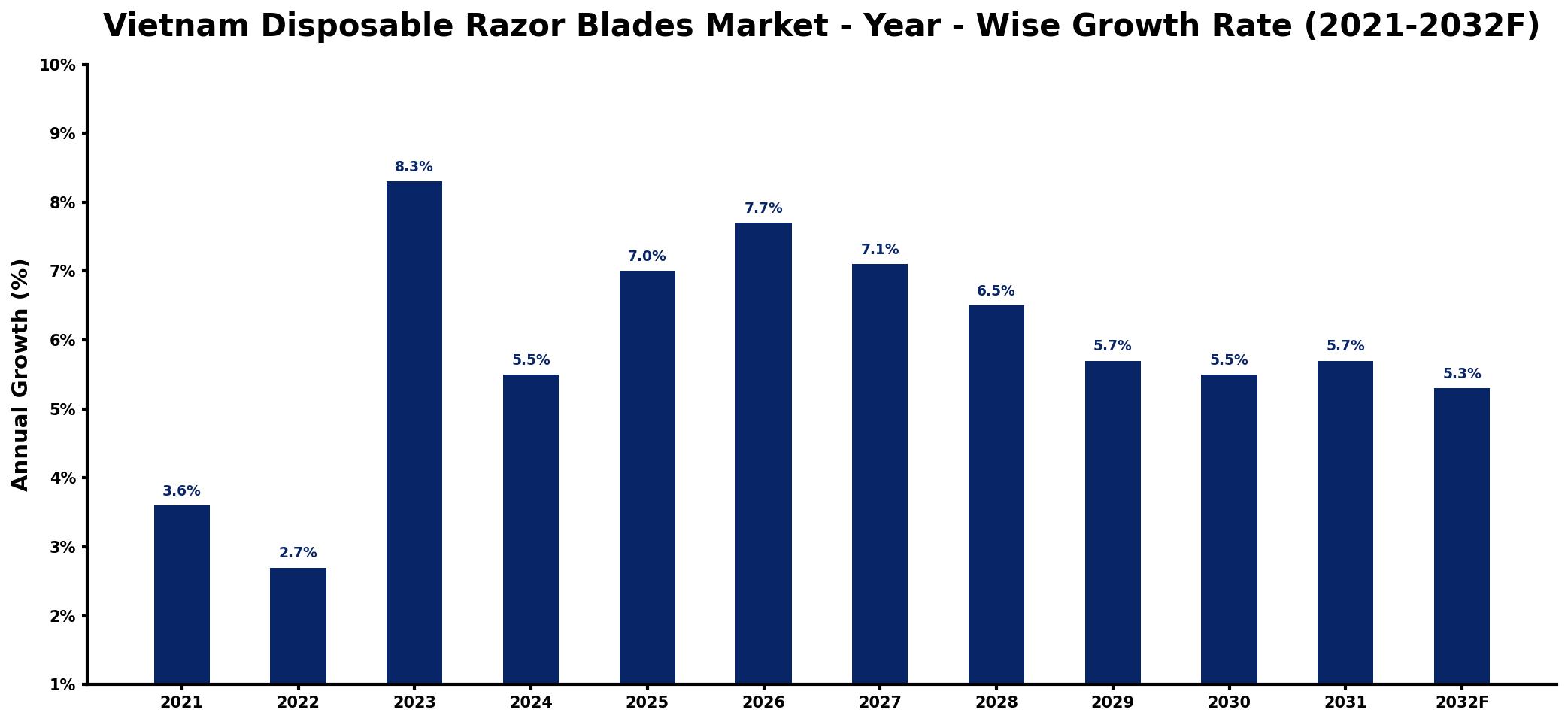
The table below presents the year‑wise growth rates along with the key drivers influencing the market
| Year | Growth Rate | Major Drivers |
| 2021 | 3.6% | Rising consumer grooming awareness |
| 2022 | 2.7% | Increased online retail penetration |
| 2023 | 8.3% | Growth in male grooming market |
| 2024 | 5.5% | Expansion of beauty retail outlets |
| 2025 | 7.0% | Surge in personal care spending |
| 2026 | 7.7% | Emergence of eco-friendly alternatives |
| 2027 | 7.1% | Innovation in grooming technologies |
| 2028 | 6.5% | growing regional consumption patterns |
| 2029 | 5.7% | Rising influence of social media |
| 2030 | 5.5% | Increased focus on convenience products |
| 2031 | 5.7% | stronger distribution network expansion |
| 2032 | 5.3% | Growing demand for travel-friendly items |
Note: Market size estimations and growth projections presented in this report are based on 6Wresearch's proprietary forecasting methodology, utilizing the latest available industry data, government publications, and primary research inputs.
Vietnam Disposable Razor Blades Market Synopsis
The disposable razor blades market in Vietnam is witnessing a notable shift as consumers increasingly prioritize hygiene and ease of use in their grooming routines. This shift is driving demand for high-quality disposable options, as manufacturers innovate with new designs and materials that enhance performance.
In response to this growing demand, suppliers are keenly focused on expanding their product lines to include razor blades with enhanced features. Marketing campaigns are also emphasizing the convenience of disposable razors, tapping into the lifestyles of a population that values efficiency without compromising on grooming quality.
Vietnam Disposable Razor Blades Market Key Takeaways
- The market is driven by the rising importance of personal grooming in daily life.
- Convenience and affordability are key factors in consumer purchasing decisions.
- Innovation in product offerings is critical to meet the diverse needs of consumers.
- Price sensitivity remains a notable challenge impacting market competition.
- The pandemic has influenced consumer behavior, highlighting the importance of self-care.
Evaluation of Restraints in Vietnam Disposable Razor Blades Market
One of the major constraints affecting the Vietnam disposable razor blades market is the price sensitivity among a significant segment of the population. Many consumers are budget-conscious, which compels manufacturers to engage in fierce price competition. This competitive pressure can lead to compromises in product quality, making it crucial for brands to balance affordability with high standards. Additionally, economic fluctuations can impact consumer purchasing power, further complicating market dynamics.
Vietnam Disposable Razor Blades Market Trends
Current trends in the Vietnam disposable razor blades market include a growing preference for multi-blade systems that promise a closer shave and enhanced comfort. Eco-conscious consumers are also pushing brands to explore sustainable packaging and recyclable materials, driving innovation towards greener solutions. Furthermore, the rise of e-commerce is reshaping distribution channels, enabling consumers to access a wider variety of products with greater convenience.
Vietnam Disposable Razor Blades Market Opportunities
The market presents significant growth opportunities, particularly in the segment of premium disposable razor blades. As consumers become more discerning, there is a demand for higher-quality products that offer better performance and experience. Additionally, expanding online sales channels provides an avenue for brands to reach a broader audience. Furthermore, partnerships with personal care retailers could enhance visibility and accessibility, tapping into the rising trend of grooming as self-care.
Government Initiatives in the Vietnam Disposable Razor Blades Market
The Vietnamese government is promoting the growth of the personal care industry through various initiatives aimed at boosting domestic manufacturing and consumer awareness of hygiene products. Public spending on health and personal care education is contributing to a better-informed consumer base, which in turn supports the market for disposable razor blades. Moreover, policies encouraging sustainable practices in manufacturing may stimulate innovations that resonate with eco-conscious consumers.
Future Insights of the Vietnam Disposable Razor Blades Market
Looking ahead to 2026-2032, the Vietnam disposable razor blades market is likely to continue its upward trajectory, driven by the ongoing evolution of consumer grooming habits. Increased urbanization and the rise of social media influencers are expected to further elevate the importance of personal grooming. As technology advances, manufacturers are likely to invest in smarter, more efficient production methods, allowing for the introduction of differentiated products tailored to specific consumer needs. This evolution will not only sustain market growth but may also reshape the competitive landscape.
Vietnam Disposable Razor Blades Market Latest Developments (2025 - 2026)
In recent months, the Vietnam disposable razor blades market has seen a surge in product launches that cater to the growing demand for specialized grooming solutions. Companies have been adapting their marketing strategies to emphasize the dual benefits of hygiene and convenience in their messaging. Additionally, e-commerce platforms are gaining traction, with brands enhancing their online presence to reach a wider audience. This shift highlights the ongoing adaptation of companies to meet the evolving needs of Vietnamese consumers.
Vietnam Disposable Razor Blades Market - Key Attractiveness of the Report
- 10 Years of Market Numbers
- Historical Data Starting from 2022 to 2025
- Base Year: 2025
- Forecast Data until 2032
- Key Performance Indicators Impacting the Market
- Major Upcoming Developments and Projects
Key Highlights of the Report:
- Vietnam Disposable Razor Blades Market Outlook
- Market Size of Vietnam Disposable Razor Blades Market, 2025
- Forecast of Vietnam Disposable Razor Blades Market, 2032
- Historical Data and Forecast of Vietnam Disposable Razor Blades Revenues & Volume for the Period 2022-2032F
- Vietnam Disposable Razor Blades Market Trend Evolution
- Vietnam Disposable Razor Blades Market Drivers and Challenges
- Vietnam Disposable Razor Blades Price Trends
- Vietnam Disposable Razor Blades Porter's Five Forces
- Vietnam Disposable Razor Blades Industry Life Cycle
- Historical Data and Forecast of Vietnam Disposable Razor Blades Market Revenues & Volume By Blade Count for the Period 2022-2032F
- Historical Data and Forecast of Vietnam Disposable Razor Blades Market Revenues & Volume By 1 & 2 Blades for the Period 2022-2032F
- Historical Data and Forecast of Vietnam Disposable Razor Blades Market Revenues & Volume By 3 & 4 Blades for the Period 2022-2032F
- Historical Data and Forecast of Vietnam Disposable Razor Blades Market Revenues & Volume By 5 & More Blades for the Period 2022-2032F
- Historical Data and Forecast of Vietnam Disposable Razor Blades Market Revenues & Volume By End-user for the Period 2022-2032F
- Historical Data and Forecast of Vietnam Disposable Razor Blades Market Revenues & Volume By Men for the Period 2022-2032F
- Historical Data and Forecast of Vietnam Disposable Razor Blades Market Revenues & Volume By Women for the Period 2022-2032F
- Historical Data and Forecast of Vietnam Disposable Razor Blades Market Revenues & Volume By Distribution Channel for the Period 2022-2032F
- Historical Data and Forecast of Vietnam Disposable Razor Blades Market Revenues & Volume By Hypermarkets/Supermarkets for the Period 2022-2032F
- Historical Data and Forecast of Vietnam Disposable Razor Blades Market Revenues & Volume By Pharmacies for the Period 2022-2032F
- Historical Data and Forecast of Vietnam Disposable Razor Blades Market Revenues & Volume By Online for the Period 2022-2032F
- Historical Data and Forecast of Vietnam Disposable Razor Blades Market Revenues & Volume By Others for the Period 2022-2032F
- Vietnam Disposable Razor Blades Import Export Trade Statistics
- Market Opportunity Assessment By Blade Count
- Market Opportunity Assessment By End-user
- Market Opportunity Assessment By Distribution Channel
- Vietnam Disposable Razor Blades Top Companies Market Share
- Vietnam Disposable Razor Blades Competitive Benchmarking By Technical and Operational Parameters
- Vietnam Disposable Razor Blades Company Profiles
- Vietnam Disposable Razor Blades Key Strategic Recommendations






































