Vietnam Edge Ai Hardware Market Size, Share & Growth Rate
The Vietnam Edge Ai Hardware Market was estimated at USD 970 Million in 2025 and is projected to reach USD 1583 Million by 2032, growing at a CAGR of 7.2% from 2026 to 2032. This impressive growth trajectory underscores the increasing integration of AI capabilities within edge devices across various sectors. As industries in Vietnam focus on enhancing operational efficiency, real-time processing, and data analytics, the demand for edge AI hardware is poised for substantial expansion.
Vietnam Edge Ai Hardware Market Year-wise Growth Rate and Key Drivers
This graph highlights how the Vietnam Edge Ai Hardware Market has steadily grown over the years, supported by major growth factors.
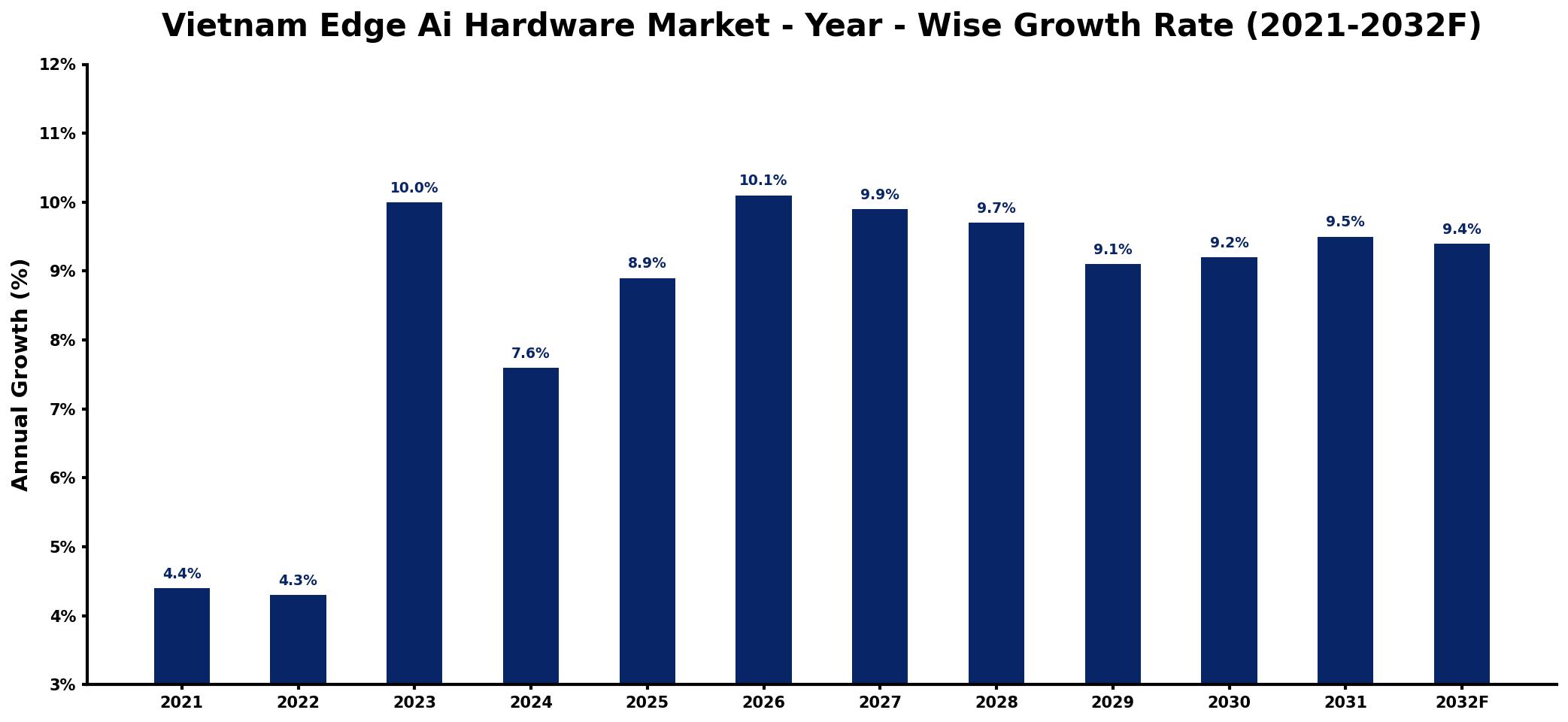
The table below presents the year‑wise growth rates along with the key drivers influencing the market
| Year | Growth Rate | Major Drivers |
| 2021 | 4.4% | Rising demand for automation solutions |
| 2022 | 4.3% | Increased investments in AI technologies |
| 2023 | 10.0% | Growth in smart city initiatives |
| 2024 | 7.6% | Expansion of cloud computing services |
| 2025 | 8.9% | Surge in data analytics applications |
| 2026 | 10.1% | Emergence of IoT integration trends |
| 2027 | 9.9% | Demand for real time processing |
| 2028 | 9.7% | Adoption of machine learning tools |
| 2029 | 9.1% | strengthening underlying market demand |
| 2030 | 9.2% | Increase in renewable energy projects |
| 2031 | 9.5% | increased domestic production output |
| 2032 | 9.4% | Rise in cybersecurity investment initiatives |
Note: Market size estimations and growth projections presented in this report are based on 6Wresearch's proprietary forecasting methodology, utilizing the latest available industry data, government publications, and primary research inputs.
Vietnam Edge Ai Hardware Market Synopsis
In recent years, the Vietnam edge AI hardware market has gained significant momentum due to the rapid technological advancements in AI and edge computing. As organizations seek to optimize their operations, edge AI has emerged as a vital solution, offering real-time insights that are essential for informed decision-making. This upward trend is expected to accelerate further, fueled by Vietnams vibrant tech ecosystem and supportive government initiatives.
Looking ahead, the market is transitioning from initial adoption phases to a more mature phase characterized by widespread deployment across critical industries, such as manufacturing, healthcare, and transportation. The convergence of AI capabilities with edge computing is creating a robust foundation for innovative applications, ultimately reshaping how businesses operate and compete.
Vietnam Edge Ai Hardware Market Key Takeaways
- The market is anticipated to witness a strong growth trajectory, reaching USD 1583 Million by 2032.
- Real-time data processing needs are driving demand across various sectors, including manufacturing and healthcare.
- Continuous innovation is vital for companies to stay competitive amid rapid technological changes.
- The pandemic accelerated the adoption of edge AI solutions, highlighting their importance in automation and efficiency.
- Government initiatives and support are pivotal in fostering the growth of the edge AI hardware market.
Evaluation of Restraints in Vietnam Edge Ai Hardware Market
Despite its promising growth, the Vietnam edge AI hardware market faces certain restraints that may hinder its potential. One significant challenge is the rapid pace of technological change, which necessitates continuous innovation to keep products relevant and competitive. Companies must invest significantly in research and development to avoid the risk of obsolescence. Additionally, the relatively nascent ecosystem for edge AI solutions means that businesses may encounter skill gaps or inadequate infrastructure, impacting their ability to implement these technologies effectively. Furthermore, market participants face pressure to ensure cybersecurity and data privacy, which are paramount in the deployment of AI-driven hardware.
Vietnam Edge Ai Hardware Market Trends
Several current and emerging trends are shaping the Vietnam edge AI hardware market. One notable trend is the increasing emphasis on energy-efficient solutions, as organizations aim to reduce operational costs while minimizing their environmental impact. Additionally, the integration of 5G technology is enabling faster data transmission, further enhancing the capabilities of edge AI devices. Companies are increasingly exploring collaboration opportunities within the tech ecosystem to drive innovation and accelerate the development of edge AI applications, thus fostering a collaborative landscape that enhances competitiveness.
Vietnam Edge Ai Hardware Market Opportunities
Genuine growth and investment opportunities in the Vietnam edge AI hardware market lie in the burgeoning demand for AI-powered solutions across various industries. Manufacturing companies are actively seeking to enhance automation and streamline operations, presenting a lucrative avenue for edge AI hardware adoption. Similarly, the healthcare sector is increasingly recognizing the value of real-time patient data processing, which can significantly improve patient outcomes. Moreover, as logistics and supply chain operations evolve, the demand for smart edge devices to optimize these processes is expected to rise, creating further opportunities for market participants.
Government Initiatives in the Vietnam Edge Ai Hardware Market
The Vietnamese government has been proactive in promoting the adoption of AI technologies, recognizing their potential to boost economic growth and innovation. Various initiatives and policies have been implemented to encourage investment in AI research and development, along with public spending on technology upgrades in critical sectors. By fostering a supportive regulatory environment and establishing partnerships between public and private entities, the government is laying the groundwork for sustainable growth within the edge AI hardware market.
Future Insights of the Vietnam Edge Ai Hardware Market
Looking ahead to 2026-2032, the Vietnam edge AI hardware market is expected to evolve significantly as organizations increasingly recognize the value of AI-driven insights and automated processes. The market will likely see the emergence of more sophisticated applications that harness advanced analytics and machine learning capabilities. Furthermore, as digital transformation initiatives gain momentum, the integration of edge computing with AI will become a key driver of operational efficiency across industries, paving the way for innovative use cases that were previously unattainable.
Vietnam Edge Ai Hardware Market Latest Developments (2025 - 2026)
Recent developments in the Vietnam edge AI hardware market reflect a growing emphasis on collaboration and investment in technological advancements. Companies have been exploring partnerships to enhance their capabilities and expand their product offerings. Additionally, the market has witnessed a surge in investment aimed at bolstering R&D efforts, allowing businesses to stay ahead of the curve in a rapidly evolving landscape. The trend toward automation and AI integration is becoming increasingly prevalent across manufacturing and logistics, highlighting the critical role of edge AI hardware in these sectors.
Vietnam Edge Ai Hardware Market - Key Attractiveness of the Report
- 10 Years of Market Numbers
- Historical Data Starting from 2022 to 2025
- Base Year: 2025
- Forecast Data until 2032
- Key Performance Indicators Impacting the Market
- Major Upcoming Developments and Projects
Key Highlights of the Report:
- Vietnam Edge Ai Hardware Market Outlook
- Market Size of Vietnam Edge Ai Hardware Market, 2025
- Forecast of Vietnam Edge Ai Hardware Market, 2032
- Historical Data and Forecast of Vietnam Edge Ai Hardware Revenues & Volume for the Period 2022-2032F
- Vietnam Edge Ai Hardware Market Trend Evolution
- Vietnam Edge Ai Hardware Market Drivers and Challenges
- Vietnam Edge Ai Hardware Price Trends
- Vietnam Edge Ai Hardware Porter's Five Forces
- Vietnam Edge Ai Hardware Industry Life Cycle
- Historical Data and Forecast of Vietnam Edge Ai Hardware Market Revenues & Volume By Device for the Period 2022-2032F
- Historical Data and Forecast of Vietnam Edge Ai Hardware Market Revenues & Volume By Smartphones for the Period 2022-2032F
- Historical Data and Forecast of Vietnam Edge Ai Hardware Market Revenues & Volume By Robots for the Period 2022-2032F
- Historical Data and Forecast of Vietnam Edge Ai Hardware Market Revenues & Volume By Surveillance cameras for the Period 2022-2032F
- Historical Data and Forecast of Vietnam Edge Ai Hardware Market Revenues & Volume By Wearables for the Period 2022-2032F
- Historical Data and Forecast of Vietnam Edge Ai Hardware Market Revenues & Volume By Smart speakers for the Period 2022-2032F
- Historical Data and Forecast of Vietnam Edge Ai Hardware Market Revenues & Volume By Automotive for the Period 2022-2032F
- Historical Data and Forecast of Vietnam Edge Ai Hardware Market Revenues & Volume By Edge servers for the Period 2022-2032F
- Historical Data and Forecast of Vietnam Smartphones Edge Ai Hardware Market Revenues & Volume By Smart mirrors for the Period 2022-2032F
- Historical Data and Forecast of Vietnam Edge Ai Hardware Market Revenues & Volume By End User for the Period 2022-2032F
- Historical Data and Forecast of Vietnam Edge Ai Hardware Market Revenues & Volume By Smart home for the Period 2022-2032F
- Historical Data and Forecast of Vietnam Edge Ai Hardware Market Revenues & Volume By Consumer electronics for the Period 2022-2032F
- Historical Data and Forecast of Vietnam Edge Ai Hardware Market Revenues & Volume By Automotive & transportation for the Period 2022-2032F
- Historical Data and Forecast of Vietnam Edge Ai Hardware Market Revenues & Volume By Aerospace & defense for the Period 2022-2032F
- Historical Data and Forecast of Vietnam Edge Ai Hardware Market Revenues & Volume By Industrial for the Period 2022-2032F
- Historical Data and Forecast of Vietnam Edge Ai Hardware Market Revenues & Volume By Government for the Period 2022-2032F
- Historical Data and Forecast of Vietnam Edge Ai Hardware Market Revenues & Volume By Healthcare for the Period 2022-2032F
- Historical Data and Forecast of Vietnam Edge Ai Hardware Market Revenues & Volume By Construction for the Period 2022-2032F
- Historical Data and Forecast of Vietnam Edge Ai Hardware Market Revenues & Volume By Function for the Period 2022-2032F
- Historical Data and Forecast of Vietnam Edge Ai Hardware Market Revenues & Volume By Training for the Period 2022-2032F
- Historical Data and Forecast of Vietnam Edge Ai Hardware Market Revenues & Volume By Inference for the Period 2022-2032F
- Historical Data and Forecast of Vietnam Edge Ai Hardware Market Revenues & Volume By Processor for the Period 2022-2032F
- Historical Data and Forecast of Vietnam Edge Ai Hardware Market Revenues & Volume By CPU for the Period 2022-2032F
- Historical Data and Forecast of Vietnam Edge Ai Hardware Market Revenues & Volume By GPU for the Period 2022-2032F
- Historical Data and Forecast of Vietnam Edge Ai Hardware Market Revenues & Volume By ASICs for the Period 2022-2032F
- Historical Data and Forecast of Vietnam Edge Ai Hardware Market Revenues & Volume By Power Consumption for the Period 2022-2032F
- Historical Data and Forecast of Vietnam Edge Ai Hardware Market Revenues & Volume By Less than 1W for the Period 2022-2032F
- Historical Data and Forecast of Vietnam Edge Ai Hardware Market Revenues & Volume By 1-3W for the Period 2022-2032F
- Historical Data and Forecast of Vietnam Edge Ai Hardware Market Revenues & Volume By 3-5W for the Period 2022-2032F
- Historical Data and Forecast of Vietnam Edge Ai Hardware Market Revenues & Volume By 5-10W for the Period 2022-2032F
- Historical Data and Forecast of Vietnam Edge Ai Hardware Market Revenues & Volume By More than 10W for the Period 2022-2032F
- Vietnam Edge Ai Hardware Import Export Trade Statistics
- Market Opportunity Assessment By Device
- Market Opportunity Assessment By End User
- Market Opportunity Assessment By Function
- Market Opportunity Assessment By Processor
- Market Opportunity Assessment By Power Consumption
- Vietnam Edge Ai Hardware Top Companies Market Share
- Vietnam Edge Ai Hardware Competitive Benchmarking By Technical and Operational Parameters
- Vietnam Edge Ai Hardware Company Profiles
- Vietnam Edge Ai Hardware Key Strategic Recommendations






































