Vietnam Educational Toys Market Size, Share & Growth Rate
The Vietnam Educational Toys Market was estimated at USD 1114 Million in 2025 and is projected to reach USD 1580 Million by 2032, growing at a CAGR of 5.1% from 2026 to 2032. This positive growth trajectory is propelled by an increasing parental emphasis on early childhood education, alongside a broader recognition of the vital role that interactive and skill-enhancing toys play in child development. As more families prioritize educational playtime, manufacturers are responding with innovative products that cater to the evolving demands of todays parents and educators.
Vietnam Educational Toys Market Year-wise Growth Rate and Key Drivers
This graph highlights how the Vietnam Educational Toys Market has steadily grown over the years, supported by major growth factors.
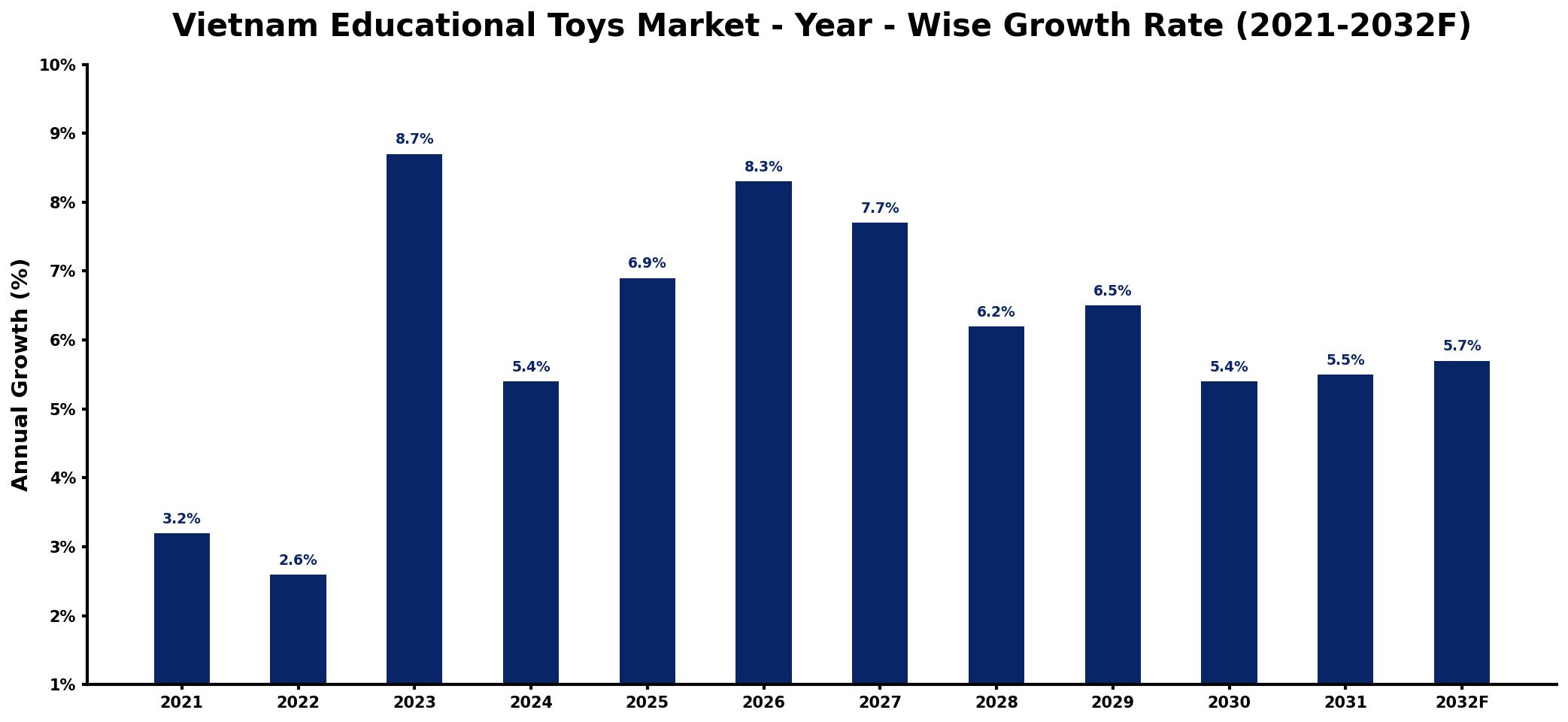
The table below presents the year‑wise growth rates along with the key drivers influencing the market
| Year | Growth Rate | Major Drivers |
| 2021 | 3.2% | Increased parental investment in learning |
| 2022 | 2.6% | Growing awareness of developmental benefits |
| 2023 | 8.7% | Rise in online learning platforms |
| 2024 | 5.4% | Expansion of retail distribution channels |
| 2025 | 6.9% | expanding healthcare application demand |
| 2026 | 8.3% | Increased government support for education |
| 2027 | 7.7% | Technological advancements in learning tools |
| 2028 | 6.2% | Higher disposable income among families |
| 2029 | 6.5% | Growing trend of homeschooling practices |
| 2030 | 5.4% | increased production capacity utilization |
| 2031 | 5.5% | rising infrastructure development spending |
| 2032 | 5.7% | Growth in multicultural learning resources |
Note: Market size estimations and growth projections presented in this report are based on 6Wresearch's proprietary forecasting methodology, utilizing the latest available industry data, government publications, and primary research inputs.
Vietnam Educational Toys Market Synopsis
The Vietnam educational toys market has recently gained substantial momentum, driven by heightened awareness of early childhood education's significance. Parents are increasingly investing in toys that not only entertain but also promote essential developmental skills, reflecting a broader cultural shift toward prioritizing educational resources for children.
Looking ahead, the market is poised for further expansion as educational institutions and families seek to incorporate innovative learning methods into children's play. The ongoing fusion of technology with traditional educational toys will likely redefine how children engage with learning materials, paving the way for an enriched educational landscape.
Vietnam Educational Toys Market Key Takeaways
- The market is witnessing a growing trend toward the integration of technology in educational toys, enhancing interactive learning.
- Increased parental investment in educational resources reflects a cultural shift towards valuing early childhood development.
- Manufacturers are focusing on aligning their products with educational standards to gain acceptance among educators and parents.
- The rise of e-commerce has transformed retail strategies, making educational toys more accessible to families across Vietnam.
- Innovative product offerings are critical for companies to maintain competitiveness in this evolving market landscape.
Evaluation of Restraints in Vietnam Educational Toys Market
Despite its positive trajectory, the Vietnam educational toys market faces several constraints that may inhibit growth. Alignment with educational standards and parental expectations remains a challenge for many manufacturers. Additionally, market competition can lead to pricing pressures, which may affect the perceived value of educational toys. The need for companies to consistently demonstrate product efficacy and educational value is critical, as this influences purchasing behavior among discerning parents.
Vietnam Educational Toys Market Trends
Currently, the market is witnessing trends that are reshaping the educational landscape for children in Vietnam. One prominent trend is the increasing use of technology in educational toys, such as augmented reality (AR) and interactive learning apps that enhance engagement. Furthermore, toys promoting STEM (Science, Technology, Engineering, and Mathematics) education are gaining traction, reflecting the global push for skill development in these crucial areas. Theres also a noticeable emphasis on sustainability, with eco-friendly materials being prioritized by both parents and manufacturers, aligning with broader environmental consciousness.
Vietnam Educational Toys Market Opportunities
Significant growth opportunities exist within the Vietnam educational toys market, particularly in the realm of innovative product development. Companies that can effectively integrate technology with traditional play methods are likely to capture the interest of tech-savvy parents. Additionally, theres potential for expansion into rural areas, where access to quality educational toys is still limited. This, coupled with rising disposable incomes, presents a ripe environment for targeted marketing strategies and localized product offerings.
Government Initiatives in the Vietnam Educational Toys Market
The Vietnamese government has recognized the importance of early childhood education and is actively promoting initiatives aimed at improving educational resources. Public spending on education has seen incremental increases, allowing for the development of educational programs that highlight the value of play in learning. Furthermore, various governmental policies are encouraging local manufacturing of educational toys to support the domestic market while ensuring quality standards are met.
Future Insights of the Vietnam Educational Toys Market
Looking forward to 2026-2032, the Vietnam educational toys market is anticipated to undergo significant transformations driven by continuous innovation and evolving consumer preferences. As the digital landscape expands, the convergence of physical and digital play experiences is expected to dominate market offerings. The integration of personalized learning through data analytics will likely enhance product effectiveness. Overall, as awareness around child development continues to grow, the market will adapt, ensuring a diverse range of educational tools are available for fostering young minds.
Vietnam Educational Toys Market Latest Developments (2025 - 2026)
Recent developments in the Vietnam educational toys market reflect a shift towards digital engagement and online learning solutions. Companies are increasingly launching hybrid products that combine physical toys with digital applications, catering to the preferences of modern families. Retailers are also enhancing their e-commerce platforms to facilitate easier access to educational resources, particularly as parents look for quality educational materials for home learning. This trend is expected to further evolve as educational institutions begin to integrate these tools into their curricula.
Vietnam Educational Toys Market - Key Attractiveness of the Report
- 10 Years of Market Numbers
- Historical Data Starting from 2022 to 2025
- Base Year: 2025
- Forecast Data until 2032
- Key Performance Indicators Impacting the Market
- Major Upcoming Developments and Projects
Key Highlights of the Report:
- Vietnam Educational Toys Market Outlook
- Market Size of Vietnam Educational Toys Market, 2025
- Forecast of Vietnam Educational Toys Market, 2032
- Historical Data and Forecast of Vietnam Educational Toys Revenues & Volume for the Period 2022-2032F
- Vietnam Educational Toys Market Trend Evolution
- Vietnam Educational Toys Market Drivers and Challenges
- Vietnam Educational Toys Price Trends
- Vietnam Educational Toys Porter's Five Forces
- Vietnam Educational Toys Industry Life Cycle
- Historical Data and Forecast of Vietnam Educational Toys Market Revenues & Volume By Product Type for the Period 2022-2032F
- Historical Data and Forecast of Vietnam Educational Toys Market Revenues & Volume By Academic toys for the Period 2022-2032F
- Historical Data and Forecast of Vietnam Educational Toys Market Revenues & Volume By Cognitive toys for the Period 2022-2032F
- Historical Data and Forecast of Vietnam Educational Toys Market Revenues & Volume By Motor skills toys for the Period 2022-2032F
- Historical Data and Forecast of Vietnam Educational Toys Market Revenues & Volume By Others for the Period 2022-2032F
- Historical Data and Forecast of Vietnam Educational Toys Market Revenues & Volume By Age Group for the Period 2022-2032F
- Historical Data and Forecast of Vietnam Educational Toys Market Revenues & Volume By 1 ?? 4 years for the Period 2022-2032F
- Historical Data and Forecast of Vietnam Educational Toys Market Revenues & Volume By 4 ?? 8 years for the Period 2022-2032F
- Historical Data and Forecast of Vietnam Educational Toys Market Revenues & Volume By Above 8 years for the Period 2022-2032F
- Historical Data and Forecast of Vietnam Educational Toys Market Revenues & Volume By Others for the Period 2022-2032F
- Historical Data and Forecast of Vietnam Educational Toys Market Revenues & Volume By End-Users for the Period 2022-2032F
- Historical Data and Forecast of Vietnam Educational Toys Market Revenues & Volume By Residential for the Period 2022-2032F
- Historical Data and Forecast of Vietnam Educational Toys Market Revenues & Volume By Commercial for the Period 2022-2032F
- Vietnam Educational Toys Import Export Trade Statistics
- Market Opportunity Assessment By Product Type
- Market Opportunity Assessment By Age Group
- Market Opportunity Assessment By End-Users
- Vietnam Educational Toys Top Companies Market Share
- Vietnam Educational Toys Competitive Benchmarking By Technical and Operational Parameters
- Vietnam Educational Toys Company Profiles
- Vietnam Educational Toys Key Strategic Recommendations






































