Vietnam Enterprise AI Market Size & Growth Rate (2026-2032)
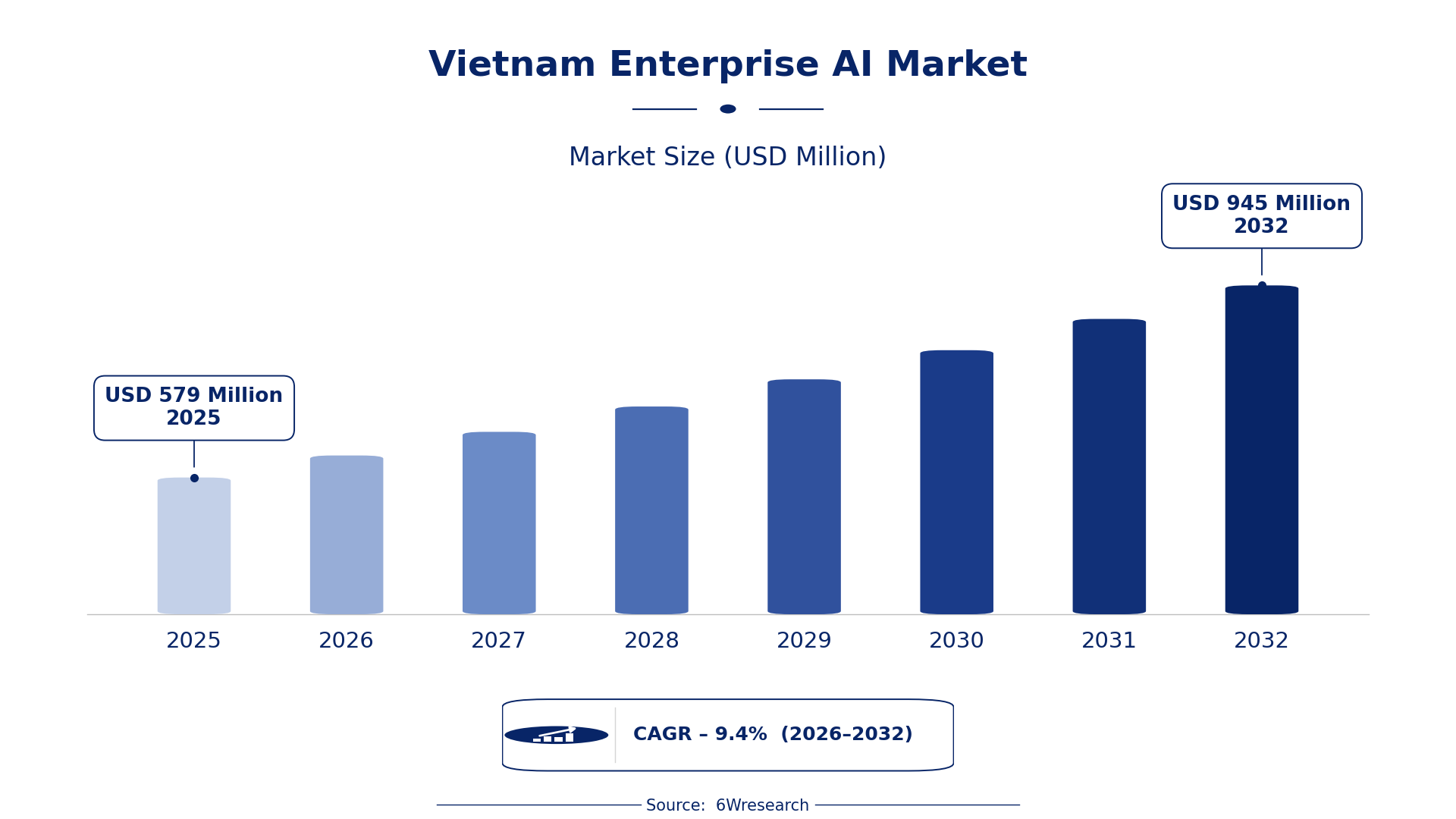
The Vietnam Enterprise AI Market was estimated at USD 579 Million in 2025 and is projected to reach USD 945 Million by 2032, growing at a CAGR of 9.4% from 2026 to 2032.
Vietnam Enterprise AI Market Synopsis
The Vietnam Enterprise AI market is currently experiencing a notable surge as businesses recognize the critical role of artificial intelligence in driving efficiency and innovation. This momentum, however, masks the underlying challenges that need to be addressed for sustained growth, including talent shortages and regulatory uncertainty.
Looking ahead, the market is set to expand significantly as organizations across sectors increasingly deploy AI solutions for diverse applications. From enhancing customer service to predictive analytics, the realization of AI's transformative potential is expected to deepen, fostering a more competitive business environment.
Vietnam Enterprise AI Market Year-wise Growth Rate and Key Drivers
This graph illustrates the annual growth rates of the Vietnam Enterprise AI Market from 2021 to 2032, highlighting a steady upward trajectory and projected expansion over the forecast period.
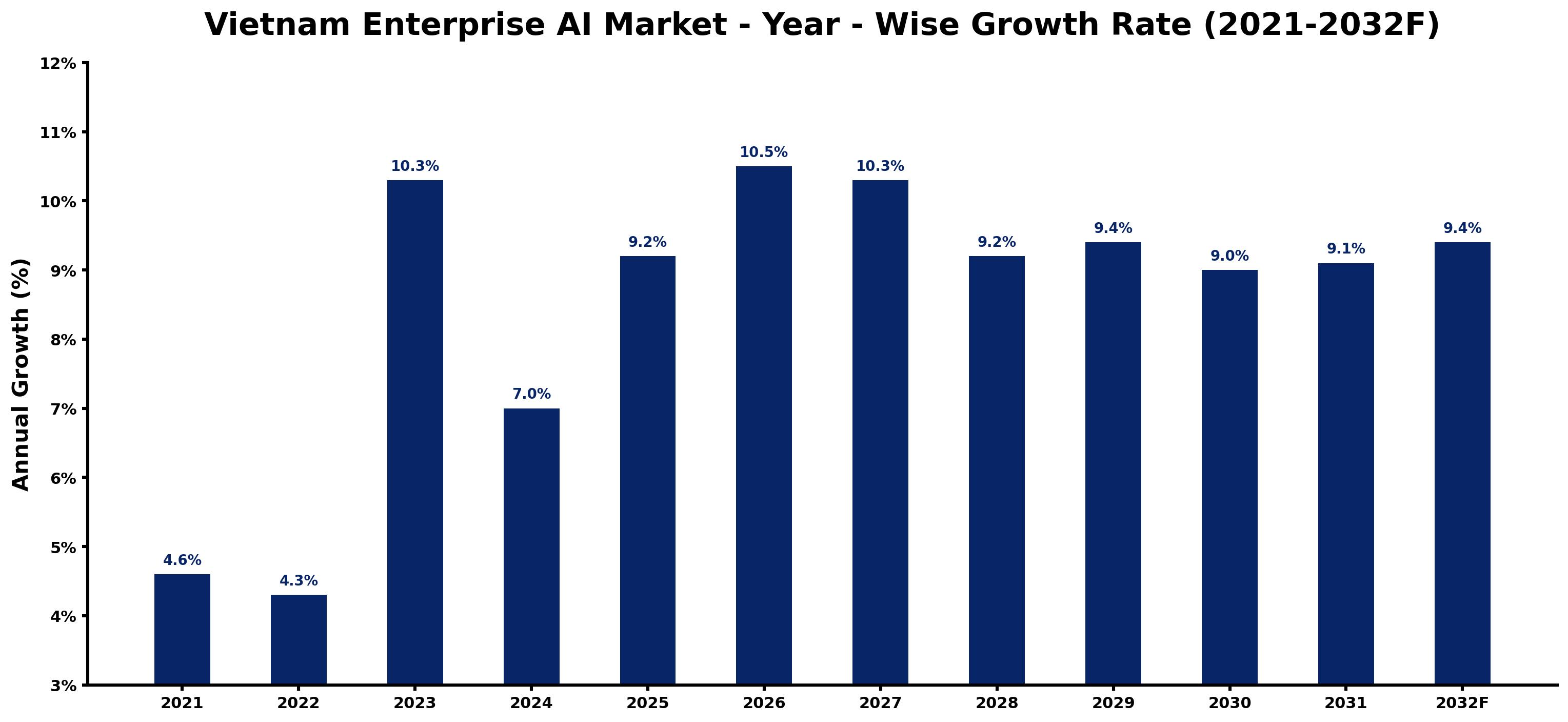
The table below presents the year‑wise growth rates along with the key drivers influencing the market
| Year | Growth Rate | Major Drivers |
| 2021 | 4.6% | Government's Vietnam Digital Transformation Strategy boosts AI adoption. |
| 2022 | 4.3% | Growing e-commerce sector increases demand for AI solutions. |
| 2023 | 10.3% | New regulations promoting data utilization in enterprises emerge. |
| 2024 | 7.0% | Increased foreign investment in tech startups accelerates growth. |
| 2025 | 9.2% | Rising interest in AI for optimizing supply chains. |
| 2026 | 10.5% | Local companies implementing AI for enhanced customer experience. |
| 2027 | 10.3% | Investment in AI research and development by universities rises. |
| 2028 | 9.2% | Growth of fintech sector drives AI implementation initiatives. |
| 2029 | 9.4% | Rising mobile internet penetration fosters AI app development. |
| 2030 | 9.0% | Demand for predictive analytics in agriculture expands significantly. |
| 2031 | 9.1% | Local governments supporting AI initiatives for smart cities. |
| 2032 | 9.4% | Healthcare sector's digital transformation accelerates AI software use. |
Note: Market size estimations and growth projections presented in this report are based on 6Wresearch's proprietary forecasting methodology, utilizing the latest available industry data, government publications, and primary research inputs.
Vietnam Enterprise AI Market Key Takeaways
Below are some of the specific key takeaways from the market, including:
- Growing adoption of AI technologies across various sectors, including finance, healthcare, and manufacturing.
- Government initiatives are increasingly supporting digital transformation and AI implementation.
- The emergence of local startups is contributing to innovative AI solutions tailored for the Vietnamese market.
- Data proliferation is driving demand for AI-driven analytics and decision-making tools.
- Talent shortages in AI expertise pose a challenge to market growth and implementation.
Evaluation of Restraints in Vietnam Enterprise AI Market
Despite the positive trends, the Vietnam Enterprise AI market grapples with several constraints that hinder its potential. A primary concern is the acute shortage of skilled professionals capable of developing and implementing AI technologies. This gap in expertise can slow down the pace of AI adoption across industries. Additionally, the lack of clear regulations surrounding AI usage creates an environment of uncertainty, impacting corporate decisions on investments in AI solutions. Companies must also address data quality and accessibility issues, requiring substantial investments in infrastructure to fully realize AI's capabilities.
Vietnam Enterprise AI Market Trends
Several trends are shaping the demand for AI technologies in Vietnam. Organizations are increasingly adopting AI for process automation, aiming to enhance operational efficiency and reduce costs. Predictive analytics is gaining traction as businesses seek data-driven insights to inform strategic decisions. on top of that, the rise of remote work has accelerated the need for AI solutions that support remote operations and customer engagement, pushing enterprises to rethink traditional business models.
Vietnam Enterprise AI Market Opportunities
The opportunities within the Vietnam Enterprise AI market are compelling. As companies strive for digital transformation, there is substantial room for investment in AI technologies that streamline operations and improve customer experiences. Sectors such as healthcare and finance are particularly ripe for AI-driven innovations, offering pathways for startups and established players to introduce tailored solutions. on top of that, collaboration between private enterprises and government agencies can enhance infrastructure and regulatory frameworks, promoting a more conducive environment for AI growth.
Government Initiatives in the Vietnam Enterprise AI Market
The Vietnamese government is taking significant steps to foster a favorable environment for the Enterprise AI market. Through a series of initiatives focused on digital transformation, the government is prioritizing the integration of AI technologies into various sectors. These efforts are crucial, as they not only provide a regulatory framework but also encourage businesses to adopt AI solutions.
- A national digital transformation strategy was launched in early 2023, aiming to enhance AI adoption across sectors.
- Current initiatives include partnerships with educational institutions to develop AI talent, which began in late 2022 and continue to expand.
- Upcoming plans involve establishing an AI regulatory body by 2026 to provide guidelines and ethical standards for AI implementation.
- Ongoing funding programs support startups focusing on AI innovation, facilitating their entry into the market since mid-2023.
- A comprehensive digital infrastructure upgrade program is currently underway to improve data accessibility and quality by 2025.
Future Insights of the Vietnam Enterprise AI Market
As we look toward 2026-2032, the Vietnam Enterprise AI market is expected to evolve significantly. With the continued push for digital transformation across industries, AI adoption will likely expand beyond initial use cases. Companies will increasingly seek advanced AI capabilities, such as machine learning and natural language processing, to drive deeper insights and automation. The market will become more competitive, encouraging innovation and collaboration among key stakeholders, including businesses, government, and academia.
Vietnam Enterprise AI Market Latest Developments
Recent activity in the Vietnam Enterprise AI market reflects a strong commitment to innovation and implementation. Over the last year, many enterprises have accelerated their AI initiatives, resulting in notable partnerships and product launches.
- A major technology vendor announced a new AI-driven customer service platform in Q1 2023, significantly improving response times for clients.
- In early 2023, a local startup successfully secured funding for an AI analytics tool aimed at enhancing operational efficiency in the manufacturing sector.
- An ongoing initiative launched in late 2022 focuses on developing AI capabilities within state-owned enterprises, with pilot projects currently in execution.
- Plans for a collaborative research program between universities and tech companies are expected to kick off in mid-2024, aimed at fostering AI talent development.
- A rollout of AI-enhanced data management systems is anticipated to begin in late 2025, targeting healthcare institutions seeking to improve patient care.
Vietnam Enterprise AI Market - Key Attractiveness of the Report
- 10 Years of Market Numbers
- Historical Data Starting from 2022 to 2025
- Base Year: 2025
- Forecast Data until 2032
- Key Performance Indicators Impacting the Market
- Major Upcoming Developments and Projects
Key Highlights of the Report:
- Vietnam Enterprise AI Market Outlook
- Market Size of Vietnam Enterprise AI Market, 2025
- Forecast of Vietnam Enterprise AI Market, 2032
- Historical Data and Forecast of Vietnam Enterprise AI Revenues & Volume for the Period 2022-2032F
- Vietnam Enterprise AI Market Trend Evolution
- Vietnam Enterprise AI Market Drivers and Challenges
- Vietnam Enterprise AI Price Trends
- Vietnam Enterprise AI Porter's Five Forces
- Vietnam Enterprise AI Industry Life Cycle
- Historical Data and Forecast of Vietnam Enterprise AI Market Revenues & Volume By Component for the Period 2022-2032F
- Historical Data and Forecast of Vietnam Enterprise AI Market Revenues & Volume By Solution for the Period 2022-2032F
- Historical Data and Forecast of Vietnam Enterprise AI Market Revenues & Volume By Services for the Period 2022-2032F
- Historical Data and Forecast of Vietnam Enterprise AI Market Revenues & Volume By Technology for the Period 2022-2032F
- Historical Data and Forecast of Vietnam Enterprise AI Market Revenues & Volume By Machine learning and deep learning for the Period 2022-2032F
- Historical Data and Forecast of Vietnam Enterprise AI Market Revenues & Volume By Natural Language Processing (NLP) for the Period 2022-2032F
- Historical Data and Forecast of Vietnam Enterprise AI Market Revenues & Volume By Application Area for the Period 2022-2032F
- Historical Data and Forecast of Vietnam Enterprise AI Market Revenues & Volume By Security and risk management for the Period 2022-2032F
- Historical Data and Forecast of Vietnam Enterprise AI Market Revenues & Volume By Marketing management for the Period 2022-2032F
- Historical Data and Forecast of Vietnam Enterprise AI Market Revenues & Volume By Customer support and experience for the Period 2022-2032F
- Historical Data and Forecast of Vietnam Enterprise AI Market Revenues & Volume By Human resource and recruitment management for the Period 2022-2032F
- Historical Data and Forecast of Vietnam Enterprise AI Market Revenues & Volume By Analytics application for the Period 2022-2032F
- Historical Data and Forecast of Vietnam Enterprise AI Market Revenues & Volume By Process automation for the Period 2022-2032F
- Historical Data and Forecast of Vietnam Enterprise AI Market Revenues & Volume By Deployment Type for the Period 2022-2032F
- Historical Data and Forecast of Vietnam Enterprise AI Market Revenues & Volume By Cloud for the Period 2022-2032F
- Historical Data and Forecast of Vietnam Enterprise AI Market Revenues & Volume By On-premises for the Period 2022-2032F
- Historical Data and Forecast of Vietnam Enterprise AI Market Revenues & Volume By Organization Size for the Period 2022-2032F
- Historical Data and Forecast of Vietnam Enterprise AI Market Revenues & Volume By Small and Medium-sized Businesses (SMBs) for the Period 2022-2032F
- Historical Data and Forecast of Vietnam Enterprise AI Market Revenues & Volume By Large enterprises for the Period 2022-2032F
- Vietnam Enterprise AI Import Export Trade Statistics
- Market Opportunity Assessment By Component
- Market Opportunity Assessment By Technology
- Market Opportunity Assessment By Application Area
- Market Opportunity Assessment By Deployment Type
- Market Opportunity Assessment By Organization Size
- Vietnam Enterprise AI Top Companies Market Share
- Vietnam Enterprise AI Competitive Benchmarking By Technical and Operational Parameters
- Vietnam Enterprise AI Company Profiles
- Vietnam Enterprise AI Key Strategic Recommendations






































