Vietnam Enterprise Application Integration Market Size & Growth Rate (2026-2032)
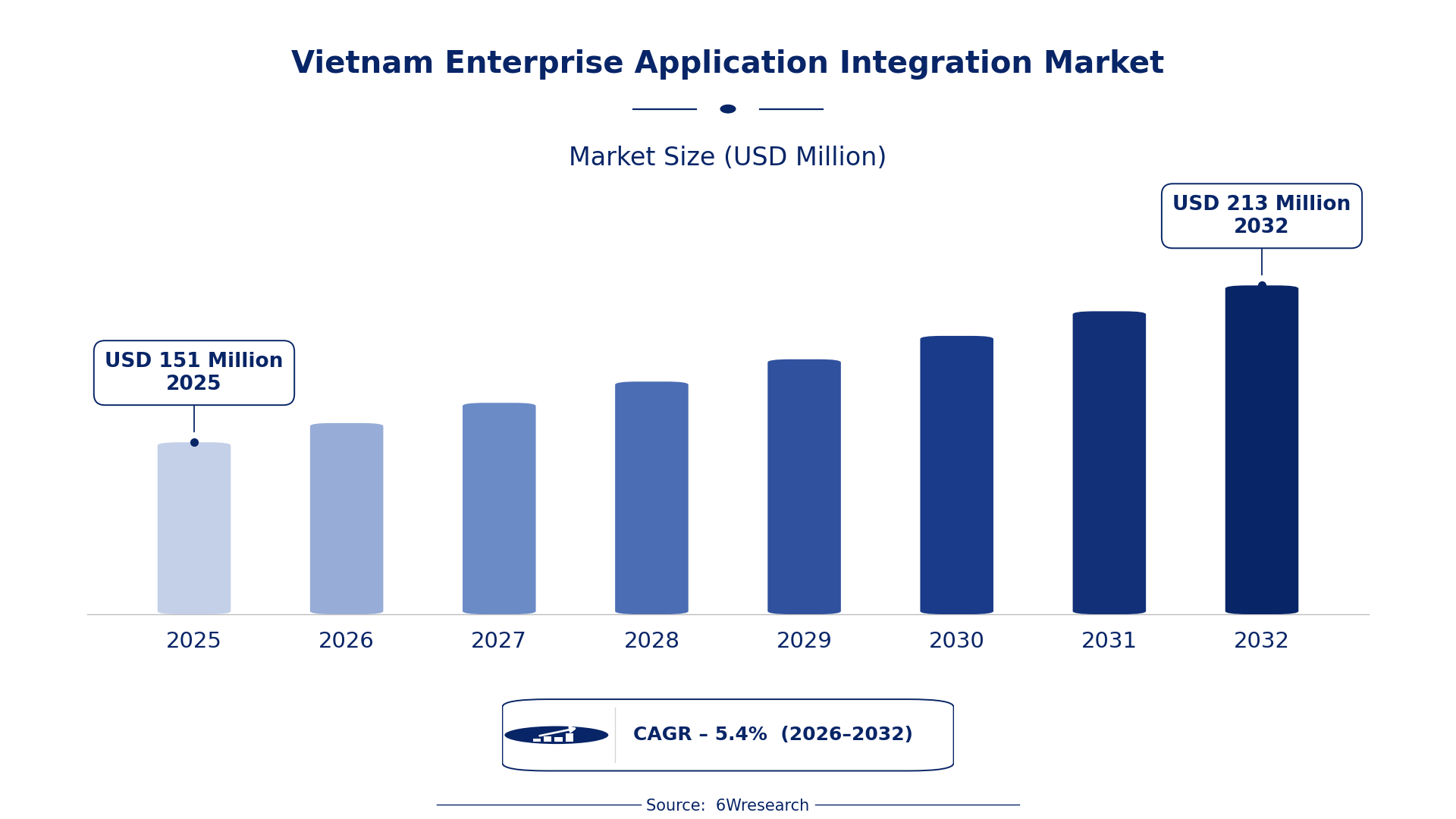
The Vietnam Enterprise Application Integration Market was estimated at USD 151 Million in 2025 and is projected to reach USD 213 Million by 2032, growing at a CAGR of 5.4% from 2026 to 2032.
Vietnam Enterprise Application Integration Market Synopsis
The rising complexity of business processes in Vietnam is pushing organizations to adopt Enterprise Application Integration (EAI) solutions. As companies strive for efficiency, the demand for streamlined connectivity between disparate applications is increasing, marking a significant trend in the integration landscape.
With an eye on digital transformation, Vietnamese businesses are prioritizing EAI to break down silos and enhance operational agility. This shift not only facilitates improved data sharing but also aligns with the broader technological advancements being embraced across the region.
Vietnam Enterprise Application Integration Market Year-wise Growth Rate and Key Drivers
This graph illustrates the annual growth rates of the Vietnam Enterprise Application Integration Market from 2021 to 2032, highlighting a steady upward trajectory and projected expansion over the forecast period.
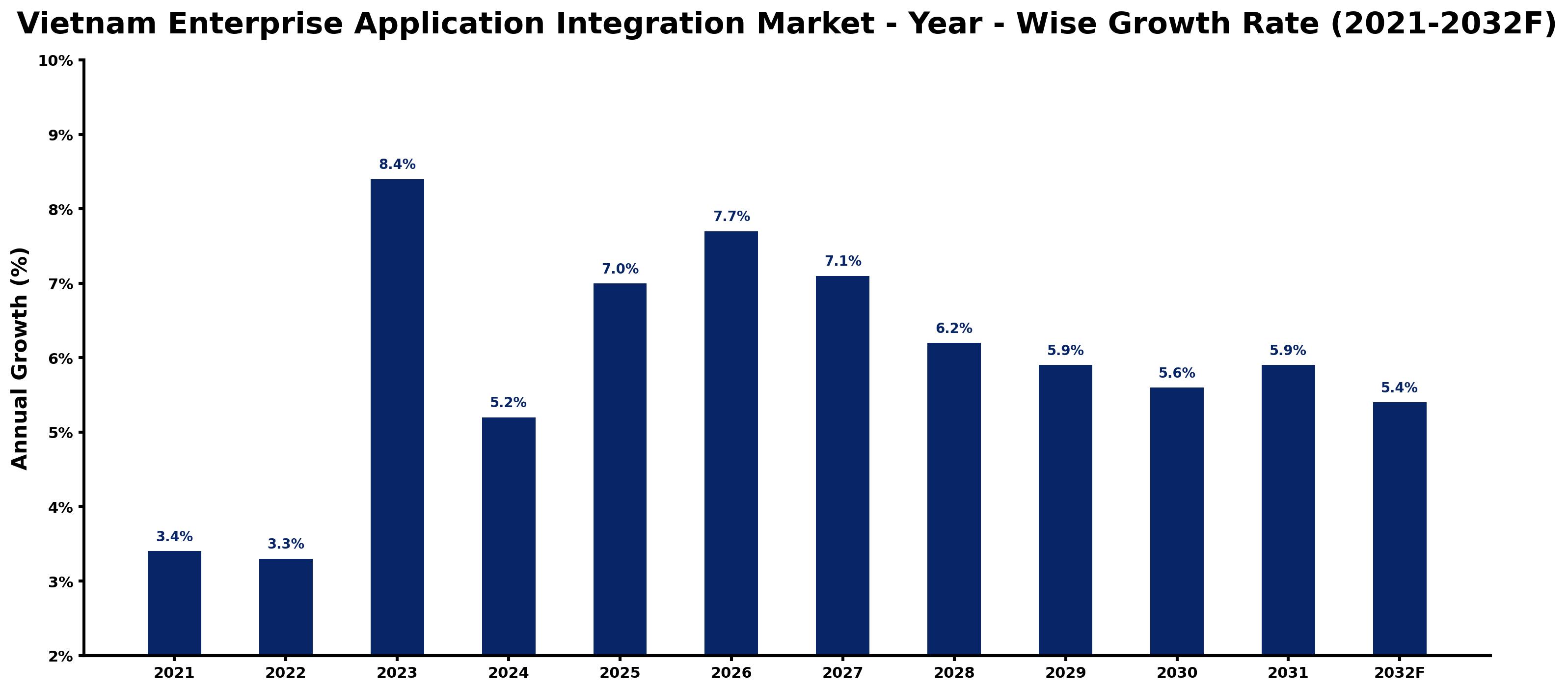
The table below presents the year‑wise growth rates along with the key drivers influencing the market
| Year | Growth Rate | Major Drivers |
| 2021 | 3.4% | Government's Digital Transformation Program boosting IT investment. |
| 2022 | 3.3% | Increased demand for cloud-based solutions post-pandemic. |
| 2023 | 8.4% | Growing focus on seamless data integration in enterprises. |
| 2024 | 5.2% | Rise of Vietnamese SMEs adopting integrated software solutions. |
| 2025 | 7.0% | Supportive e-commerce growth driving enterprise process automation. |
| 2026 | 7.7% | Advancements in local IT talent enhancing integration services. |
| 2027 | 7.1% | Emergence of fintech solutions requiring robust data integration. |
| 2028 | 6.2% | Government incentives for digital solutions in manufacturing industries. |
| 2029 | 5.9% | Increased cross-border trade requiring improved data management. |
| 2030 | 5.6% | Growing cybersecurity regulations demanding integrated security solutions. |
| 2031 | 5.9% | Continued urbanization fostering demand for enterprise efficiency. |
| 2032 | 5.4% | Rising competitive pressures compelling data-driven decision-making. |
Note: Market size estimations and growth projections presented in this report are based on 6Wresearch's proprietary forecasting methodology, utilizing the latest available industry data, government publications, and primary research inputs.
Vietnam Enterprise Application Integration Market Key Takeaways
Below are some of the specific key takeaways from the market, including:
- The market is experiencing a strong growth trajectory driven by increased demand for data integration.
- Cloud-based EAI solutions are becoming a standard choice for businesses looking to modernize their infrastructure.
- Integration challenges posed by legacy systems remain a significant barrier for many organizations.
- Real-time data sharing is emerging as a critical factor influencing EAI investments.
- Government initiatives are beginning to support the advancement of digital integration frameworks.
Evaluation of Restraints in Vietnam Enterprise Application Integration Market
The integration landscape in Vietnam is not without its challenges. Legacy systems remain deeply entrenched in many organizations, complicating the integration of new technologies. This issue is exacerbated by the lack of interoperability among diverse applications, making it difficult for businesses to achieve a cohesive IT environment. As organizations struggle to keep pace with rapid technological advancements, the pressure to enhance scalability and security adds another layer of complexity to the integration efforts.
Vietnam Enterprise Application Integration Market Trends
The trend towards cloud-based EAI solutions is reshaping how organizations approach integration. Companies are increasingly seeking flexible solutions that adapt to their evolving needs. Additionally, the push for real-time data analytics is driving investments in EAI technologies, enabling businesses to make quicker decisions. The emphasis on agility and responsiveness has never been greater, as firms recognize that integrated systems are vital for competitive advantage.
Vietnam Enterprise Application Integration Market Opportunities
Investment opportunities abound in the Vietnam EAI market, particularly for vendors offering cloud solutions. As businesses pivot towards digital transformation, those who can provide scalable integration solutions will find a receptive market. on top of that, the need for enhanced security measures presents an avenue for solutions that address compliance and data protection. The ongoing emphasis on modernization across sectors indicates a fertile ground for innovative EAI technologies.
Government Initiatives in the Vietnam Enterprise Application Integration Market
Government policy is increasingly focused on promoting digital integration and enhancing the overall infrastructure for enterprise applications in Vietnam. The strategic priority placed on digital transformation is crucial, particularly as the country aims to elevate its technological capabilities. Such initiatives can significantly influence the direction of the EAI market, making it essential for businesses to stay informed about regulatory developments.
- A national digital infrastructure upgrade programme launched in early 2023 aims to bolster connectivity across sectors.
- Currently underway is a public initiative to enhance data governance and interoperability standards for enterprise applications.
- Plans for a regulatory framework expected to be introduced by 2026 will mandate improved transparency in application integration processes.
- A public-private partnership focusing on integrating cloud services is anticipated to commence in late 2025, enhancing service delivery.
Future Insights of the Vietnam Enterprise Application Integration Market
Looking ahead, the Vietnam Enterprise Application Integration market is set for continued expansion. By 2032, organizations will increasingly prioritize agility and data-driven decision-making, solidifying the role of EAI in their operations. The integration of artificial intelligence and machine learning into EAI solutions will further streamline processes and enhance analytical capabilities, leading to smarter business practices. As companies adapt to the demands of a digital-first economy, the importance of integration will only grow.
Vietnam Enterprise Application Integration Market Latest Developments
In recent months, the Vietnam Enterprise Application Integration market has seen several notable developments that reflect the growing focus on digital transformation. Companies are increasingly investing in EAI solutions to enhance their operational capabilities and respond to evolving market demands.
- A leading technology provider announced a new cloud-based EAI solution in Q1 2023, aimed at improving integration across multiple sectors.
- An ongoing collaboration between major local firms is focused on developing a comprehensive EAI framework, expected to be completed by mid-2025.
- A pilot program initiated in late 2022 for integrating legacy systems with modern applications is currently underway, aiming to tackle interoperability challenges.
- Upcoming in early 2024, a series of workshops are planned to educate businesses on best practices for implementing EAI solutions effectively.
Vietnam Enterprise Application Integration Market - Key Attractiveness of the Report
- 10 Years of Market Numbers
- Historical Data Starting from 2022 to 2025
- Base Year: 2025
- Forecast Data until 2032
- Key Performance Indicators Impacting the Market
- Major Upcoming Developments and Projects
Key Highlights of the Report:
- Vietnam Enterprise Application Integration Market Outlook
- Market Size of Vietnam Enterprise Application Integration Market, 2025
- Forecast of Vietnam Enterprise Application Integration Market, 2032
- Historical Data and Forecast of Vietnam Enterprise Application Integration Revenues & Volume for the Period 2022-2032F
- Vietnam Enterprise Application Integration Market Trend Evolution
- Vietnam Enterprise Application Integration Market Drivers and Challenges
- Vietnam Enterprise Application Integration Price Trends
- Vietnam Enterprise Application Integration Porter's Five Forces
- Vietnam Enterprise Application Integration Industry Life Cycle
- Historical Data and Forecast of Vietnam Enterprise Application Integration Market Revenues & Volume By Deployment type for the Period 2022-2032F
- Historical Data and Forecast of Vietnam Enterprise Application Integration Market Revenues & Volume By Hosted for the Period 2022-2032F
- Historical Data and Forecast of Vietnam Enterprise Application Integration Market Revenues & Volume By On-Premise for the Period 2022-2032F
- Historical Data and Forecast of Vietnam Enterprise Application Integration Market Revenues & Volume By Hybrid for the Period 2022-2032F
- Historical Data and Forecast of Vietnam Enterprise Application Integration Market Revenues & Volume By Organization size for the Period 2022-2032F
- Historical Data and Forecast of Vietnam Enterprise Application Integration Market Revenues & Volume By Small for the Period 2022-2032F
- Historical Data and Forecast of Vietnam Enterprise Application Integration Market Revenues & Volume By Medium for the Period 2022-2032F
- Historical Data and Forecast of Vietnam Enterprise Application Integration Market Revenues & Volume By Enterprises for the Period 2022-2032F
- Historical Data and Forecast of Vietnam Enterprise Application Integration Market Revenues & Volume By Large Enterprises for the Period 2022-2032F
- Historical Data and Forecast of Vietnam Enterprise Application Integration Market Revenues & Volume By Industry Vertical for the Period 2022-2032F
- Historical Data and Forecast of Vietnam Enterprise Application Integration Market Revenues & Volume By Banking, financial services and insurance(BFSI) for the Period 2022-2032F
- Historical Data and Forecast of Vietnam Enterprise Application Integration Market Revenues & Volume By Business services for the Period 2022-2032F
- Historical Data and Forecast of Vietnam Enterprise Application Integration Market Revenues & Volume By IT and telecom for the Period 2022-2032F
- Historical Data and Forecast of Vietnam Enterprise Application Integration Market Revenues & Volume By Manufacturing for the Period 2022-2032F
- Historical Data and Forecast of Vietnam Enterprise Application Integration Market Revenues & Volume By Retail and wholesale for the Period 2022-2032F
- Historical Data and Forecast of Vietnam Enterprise Application Integration Market Revenues & Volume By Healthcare for the Period 2022-2032F
- Historical Data and Forecast of Vietnam Enterprise Application Integration Market Revenues & Volume By Government for the Period 2022-2032F
- Historical Data and Forecast of Vietnam Enterprise Application Integration Market Revenues & Volume By Other verticals( education, entertainment and media, power and utilities) for the Period 2022-2032F
- Vietnam Enterprise Application Integration Import Export Trade Statistics
- Market Opportunity Assessment By Deployment type
- Market Opportunity Assessment By Organization size
- Market Opportunity Assessment By Industry Vertical
- Vietnam Enterprise Application Integration Top Companies Market Share
- Vietnam Enterprise Application Integration Competitive Benchmarking By Technical and Operational Parameters
- Vietnam Enterprise Application Integration Company Profiles
- Vietnam Enterprise Application Integration Key Strategic Recommendations






































