Vietnam Ergonomic Chair Market Size, Share & Growth Rate
The Vietnam Ergonomic Chair Market was estimated at USD 610 Million in 2025 and is projected to reach USD 1000 Million by 2032, growing at a CAGR of 7.3% from 2026 to 2032. This significant growth trajectory is primarily driven by an escalating awareness of the importance of ergonomic solutions for employee health and productivity, particularly as remote and flexible working arrangements become more prevalent in Vietnam. Businesses are increasingly investing in ergonomic chairs to enhance worker comfort and reduce the risk of musculoskeletal disorders.
Vietnam Ergonomic Chair Market Year-wise Growth Rate and Key Drivers
This graph highlights how the Vietnam Ergonomic Chair Market has steadily grown over the years, supported by major growth factors.
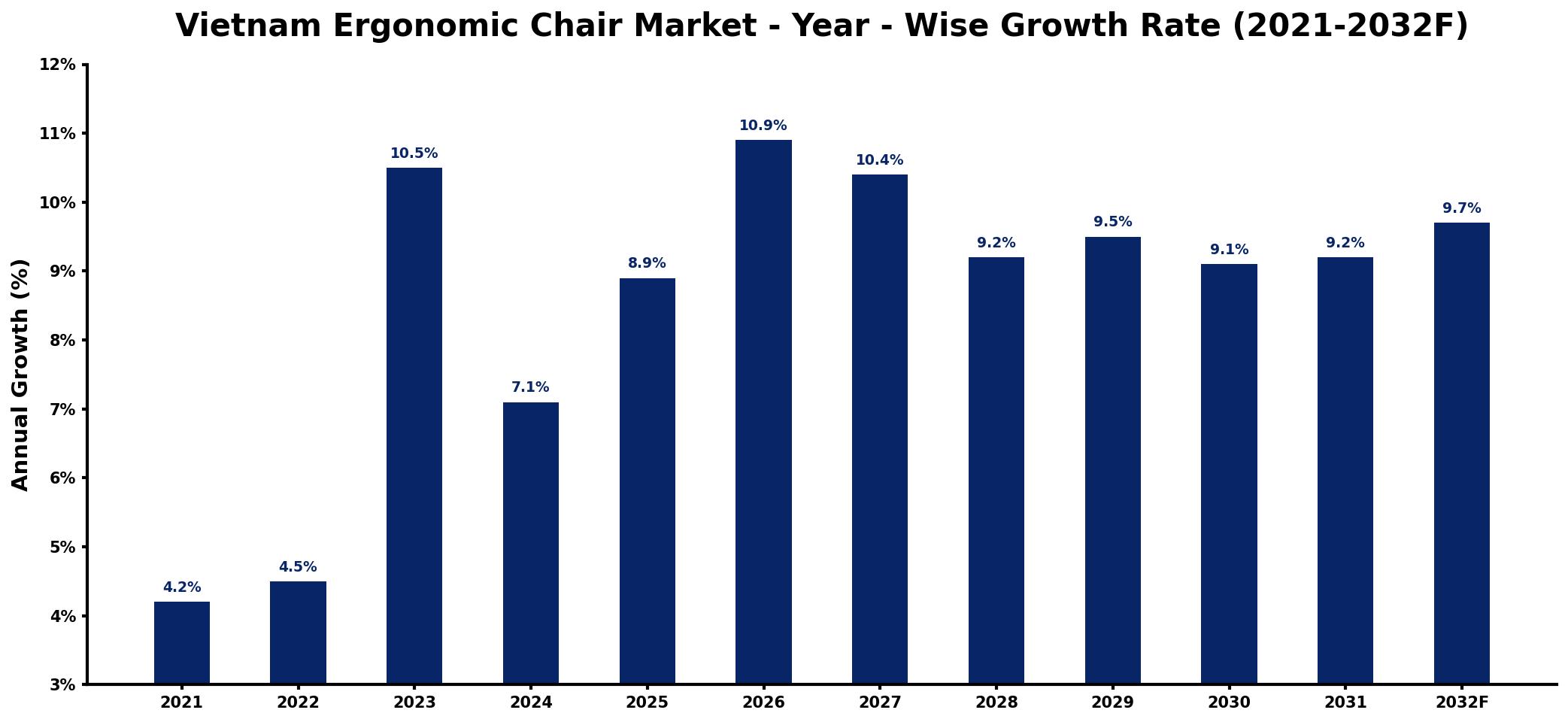
The table below presents the year‑wise growth rates along with the key drivers influencing the market
| Year | Growth Rate | Major Drivers |
| 2021 | 4.2% | Remote work demand increases significantly |
| 2022 | 4.5% | Health awareness among workers rises |
| 2023 | 10.5% | Corporate wellness programs expand rapidly |
| 2024 | 7.1% | E-commerce penetration accelerates growth |
| 2025 | 8.9% | Home office investments continue rising |
| 2026 | 10.9% | Sustainability trends drive consumer choices |
| 2027 | 10.4% | Technological advancements enhance comfort |
| 2028 | 9.2% | Workplace design prioritizes employee well-being |
| 2029 | 9.5% | rising infrastructure development spending |
| 2030 | 9.1% | Online education drives furniture purchases |
| 2031 | 9.2% | Freelancing culture fosters new demands |
| 2032 | 9.7% | Market diversification opens new opportunities |
Note: Market size estimations and growth projections presented in this report are based on 6Wresearch's proprietary forecasting methodology, utilizing the latest available industry data, government publications, and primary research inputs.
Vietnam Ergonomic Chair Market Synopsis
In recent years, the Vietnam ergonomic chair market has experienced a notable shift, with an increasing number of businesses recognizing the value of ergonomics in the workplace. This trend is largely attributed to the growing acknowledgment that a comfortable and supportive seating environment can significantly boost productivity and employee satisfaction.
As more companies adopt hybrid work models post-COVID-19, the demand for ergonomic office chairs is on the rise. Consumers are now seeking solutions that not only promise functionality but also incorporate modern design aesthetics, highlighting the evolution of consumer preferences in the Vietnam ergonomic chair market.
Vietnam Ergonomic Chair Market Key Takeaways
- Rapid growth in the ergonomic chair segment, fueled by heightened awareness of workplace wellness.
- Shifts towards remote work and hybrid office setups increasing the demand for ergonomic seating solutions.
- Challenges in consumer education regarding the benefits of ergonomic seating persist.
- Price sensitivity remains a barrier for budget-conscious consumers, affecting market accessibility.
- Manufacturers are focusing on diverse options to cater to different body types and ergonomic needs.
Evaluation of Restraints in Vietnam Ergonomic Chair Market
While the Vietnam ergonomic chair market is on a growth trajectory, it faces notable restraints that hinder its full potential. A significant challenge is the low level of consumer awareness regarding the health benefits associated with ergonomic seating solutions. Many potential buyers may not understand the long-term advantages of investing in ergonomic products versus conventional seating options. Additionally, price sensitivity plays a crucial role; higher price points often discourage budget-conscious consumers from making a purchase. Manufacturers must also navigate the complexities of maintaining product quality and durability while keeping costs competitive, which is vital in a market that is becoming increasingly crowded.
Vietnam Ergonomic Chair Market Trends
Current trends in the Vietnam ergonomic chair market highlight a growing preference for customizable seating solutions. Features such as adjustable lumbar support, seat height, and armrests are becoming standard offerings as consumers prioritize personal comfort. Furthermore, the trend towards sustainable materials is gaining traction, with manufacturers increasingly exploring eco-friendly alternatives in their designs. Enhanced online sales platforms and direct-to-consumer models are also emerging, facilitating easier access to ergonomic solutions for consumers across various demographics.
Vietnam Ergonomic Chair Market Opportunities
Opportunities for growth in the Vietnam ergonomic chair market are expanding as businesses continue to prioritize employee well-being. As the remote work trend solidifies, there is potential for the development of innovative home office solutions tailored for individual needs. Furthermore, collaboration with ergonomic specialists and health professionals can enhance product credibility, driving demand. Additionally, tapping into the education sector presents a promising avenue; integrating ergonomic chair solutions into schools and universities could foster healthier learning environments.
Government Initiatives in the Vietnam Ergonomic Chair Market
The Vietnamese government is increasingly recognizing the importance of occupational health and safety, which extends to the ergonomic furniture sector. Various initiatives aimed at promoting workplace wellness have emerged, encouraging businesses to invest in ergonomic solutions. Public health campaigns emphasizing the benefits of ergonomic workspaces not only aim to educate companies but also support local manufacturers in creating standards that align with global ergonomic practices.
Future Insights of the Vietnam Ergonomic Chair Market
Looking ahead to 2026-2032, the Vietnam ergonomic chair market is set to witness substantial growth driven by evolving workplace dynamics and increased consumer education. Companies are anticipated to enhance their product lines with advanced ergonomic features and sustainable materials, aligning with consumer preferences. The sustained focus on health, productivity, and well-being in the workplace will further solidify the position of ergonomic chairs as essential office investments. This market's adaptability and innovation will be crucial in meeting the diverse demands of a changing workforce.
Vietnam Ergonomic Chair Market Latest Developments (2025 - 2026)
Recent developments in the Vietnam ergonomic chair market indicate a shift towards more ergonomic-centric designs and materials. Many manufacturers are launching updated product lines that focus on flexibility and personalized comfort. There's also a growing emphasis on e-commerce platforms, which are expanding access to ergonomic solutions for consumers. Industry players are increasingly engaging in partnerships to enhance their distribution networks and reach a broader audience, further catalyzing market growth.
Vietnam Ergonomic Chair Market - Key Attractiveness of the Report
- 10 Years of Market Numbers
- Historical Data Starting from 2022 to 2025
- Base Year: 2025
- Forecast Data until 2032
- Key Performance Indicators Impacting the Market
- Major Upcoming Developments and Projects
Key Highlights of the Report:
- Vietnam Ergonomic Chair Market Outlook
- Market Size of Vietnam Ergonomic Chair Market, 2025
- Forecast of Vietnam Ergonomic Chair Market, 2032
- Historical Data and Forecast of Vietnam Ergonomic Chair Revenues & Volume for the Period 2022-2032F
- Vietnam Ergonomic Chair Market Trend Evolution
- Vietnam Ergonomic Chair Market Drivers and Challenges
- Vietnam Ergonomic Chair Price Trends
- Vietnam Ergonomic Chair Porter's Five Forces
- Vietnam Ergonomic Chair Industry Life Cycle
- Historical Data and Forecast of Vietnam Ergonomic Chair Market Revenues & Volume By Application for the Period 2022-2032F
- Historical Data and Forecast of Vietnam Ergonomic Chair Market Revenues & Volume By Enterprise Procurement for the Period 2022-2032F
- Historical Data and Forecast of Vietnam Ergonomic Chair Market Revenues & Volume By Government Procurement for the Period 2022-2032F
- Historical Data and Forecast of Vietnam Ergonomic Chair Market Revenues & Volume By School Procurement for the Period 2022-2032F
- Historical Data and Forecast of Vietnam Ergonomic Chair Market Revenues & Volume By Individual Procurement for the Period 2022-2032F
- Historical Data and Forecast of Vietnam Ergonomic Chair Market Revenues & Volume By Other for the Period 2022-2032F
- Vietnam Ergonomic Chair Import Export Trade Statistics
- Market Opportunity Assessment By Application
- Vietnam Ergonomic Chair Top Companies Market Share
- Vietnam Ergonomic Chair Competitive Benchmarking By Technical and Operational Parameters
- Vietnam Ergonomic Chair Company Profiles
- Vietnam Ergonomic Chair Key Strategic Recommendations






































