Vietnam Fashion Belt Market Size, Share & Growth Rate
The Vietnam Fashion Belt Market was estimated at USD 249 Million in 2025 and is projected to reach USD 351 Million by 2032, growing at a CAGR of 5.0% from 2026 to 2032. This upward trajectory is fueled by an expanding middle class with increasing disposable incomes, as well as a growing preference for fashionable accessories that express personal style. Additionally, the surge in e-commerce platforms facilitates easier access to diverse fashion options, enhancing market growth.
Vietnam Fashion Belt Market Year-wise Growth Rate and Key Drivers
This graph highlights how the Vietnam Fashion Belt Market has steadily grown over the years, supported by major growth factors.
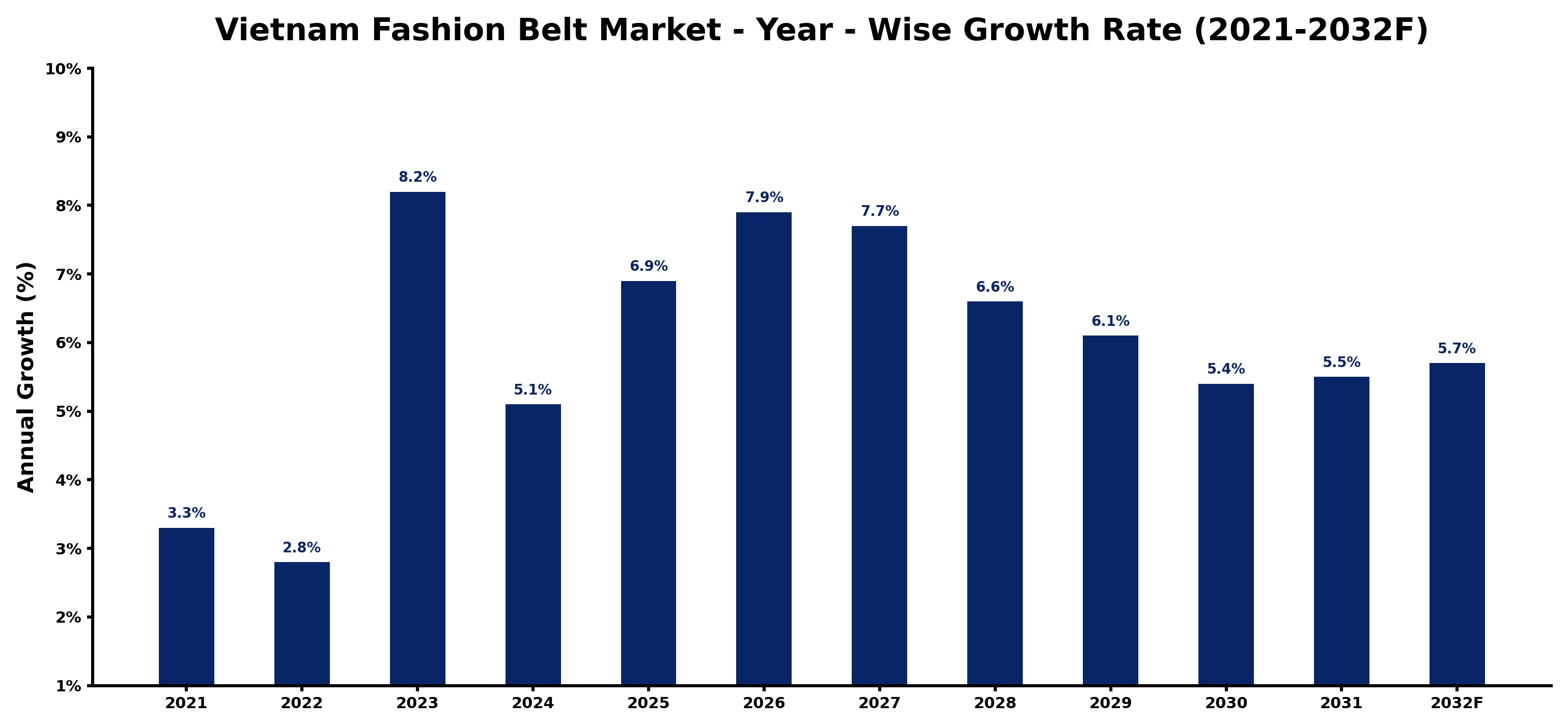
The table below presents the year‑wise growth rates along with the key drivers influencing the market
| Year | Growth Rate | Major Drivers |
| 2021 | 3.3% | Foreign investments boost textile production capacity for export markets |
| 2022 | 2.8% | Export demand for fashion belts boosted local manufacturing capacity |
| 2023 | 8.2% | Local manufacturers adopt automated cutting technology for efficiency improvements |
| 2024 | 5.1% | Automotive assembly growth boosts demand for fashion belt materials |
| 2025 | 6.9% | Foreign investments boost production capacity for fashion belt exports |
| 2026 | 7.9% | Vietnam's automotive assembly expansion boosted fashion belt manufacturing capacity |
| 2027 | 7.7% | Domestic textile manufacturers ramped up production for export contracts |
| 2028 | 6.6% | Foreign investments boost local belt production capabilities and efficiency |
| 2029 | 6.1% | Foreign investments boost local textile manufacturing capacity for exports |
| 2030 | 5.4% | Advanced textile machinery adoption boosts belt production efficiency |
| 2031 | 5.5% | Improved manufacturing technologies boosted textile efficiency in export production |
| 2032 | 5.7% | Optimized logistics systems enhance textile production capacity and efficiency |
Note - Market size estimations and growth projections presented in this report are based on 6Wresearch’s advanced forecasting approach, validated with industry datasets as of June 2026.
Vietnam Fashion Belt Market Synopsis
A driving force currently shaping the Vietnam Fashion Belt market is the consumer's desire for self-expression through fashion. This trend is evident in the increasing popularity of unique and innovative designs, catering to a fashion-savvy population eager to showcase their individuality.
Moreover, social media plays a pivotal role in influencing fashion trends and consumer preferences. As platforms like Instagram and TikTok showcase emerging styles, they inspire Vietnamese consumers to seek out stylish belts that align with current trends, creating a vibrant and competitive landscape.
Vietnam Fashion Belt Market Key Takeaways
- The market is poised for significant growth, driven by rising disposable incomes and evolving fashion sensibilities.
- E-commerce expansion is enhancing the accessibility of fashionable belts, thereby reaching a wider audience.
- Design innovation and quality are critical to standing out in a saturated market.
- The influence of social media continues to shape consumer preferences and purchasing behavior.
- Key market players are adapting to rapid trends, demonstrating agility in their strategies.
Evaluation of Restraints in Vietnam Fashion Belt Market
Despite the vibrant growth trajectory, the Vietnam Fashion Belt market faces notable constraints, primarily stemming from fierce competition. With numerous players vying for market share, distinguishing products through innovative design, quality, and competitive pricing is essential yet increasingly challenging. Additionally, the rapidly changing nature of fashion trends necessitates swift production and distribution processes, which can strain supply chains and logistics, complicating efforts to meet consumer demand promptly.
Vietnam Fashion Belt Market Trends
Currently, sustainability is emerging as a key trend within the Vietnam Fashion Belt market. Consumers are increasingly inclined toward eco-friendly materials and ethically produced accessories. This shift is prompting manufacturers to innovate with sustainable practices, such as using recycled materials and reducing waste in production processes. Furthermore, customization options are gaining traction, allowing consumers to personalize their belts, thus enhancing their appeal.
Vietnam Fashion Belt Market Opportunities
Significant growth opportunities are arising in the Vietnam Fashion Belt market, particularly in the realms of online retailing and niche markets. As more consumers turn to e-commerce for shopping, brands that invest in robust online platforms can capture a larger market share. Furthermore, targeting specific demographics, such as younger consumers or those seeking luxury options, can yield substantial rewards. Collaborations with local designers and artisans may also provide a unique competitive edge.
Government Initiatives in the Vietnam Fashion Belt Market
The Vietnamese government is fostering a conducive environment for the fashion industry through various initiatives aimed at boosting local production and innovation. Policies promoting investment in the textile and apparel sector, alongside support for e-commerce, are enhancing the capabilities of manufacturers and retailers. Additionally, programs focused on vocational training in fashion design and craftsmanship are expected to strengthen the skill set within the industry, contributing to higher quality products and a more competitive market.
Future Insights of the Vietnam Fashion Belt Market
Looking ahead to 2026-2032, the Vietnam Fashion Belt market is anticipated to evolve significantly. A growing focus on sustainability and ethical fashion will likely reshape product offerings, as consumers demand transparency and eco-friendly practices. The rise of digital platforms will further streamline marketing and sales channels, making it essential for brands to develop effective digital strategies to engage their target audiences. As fashion trends continue to accelerate, agility and innovation will be key to seizing opportunities in this competitive landscape.
Vietnam Fashion Belt Market Latest Developments (May 2025 - June 2026)
Recent developments in the Vietnam Fashion Belt market indicate a strong shift towards online sales channels, driven by changing consumer shopping behaviors. Additionally, a growing emphasis on collaborative collections featuring local designers is becoming more prevalent, promoting unique and culturally-inspired fashion. Brands are increasingly investing in social media marketing strategies to enhance their visibility and engage with consumers directly, capitalizing on trends in real-time.
Vietnam Fashion Belt Market - Key Attractiveness of the Report
- 10 Years of Market Numbers
- Historical Data Starting from 2022 to 2025
- Base Year: 2025
- Forecast Data until 2032
- Key Performance Indicators Impacting the Market
- Major Upcoming Developments and Projects
Key Highlights of the Report:
- Vietnam Fashion Belt Market Outlook
- Market Size of Vietnam Fashion Belt Market, 2025
- Forecast of Vietnam Fashion Belt Market, 2032
- Historical Data and Forecast of Vietnam Fashion Belt Revenues & Volume for the Period 2022-2032F
- Vietnam Fashion Belt Market Trend Evolution
- Vietnam Fashion Belt Market Drivers and Challenges
- Vietnam Fashion Belt Price Trends
- Vietnam Fashion Belt Porter's Five Forces
- Vietnam Fashion Belt Industry Life Cycle
- Historical Data and Forecast of Vietnam Fashion Belt Market Revenues & Volume By Types for the Period 2022-2032F
- Historical Data and Forecast of Vietnam Fashion Belt Market Revenues & Volume By Grommet Belt for the Period 2022-2032F
- Historical Data and Forecast of Vietnam Fashion Belt Market Revenues & Volume By Chain Belt for the Period 2022-2032F
- Historical Data and Forecast of Vietnam Fashion Belt Market Revenues & Volume By Leather Belt for the Period 2022-2032F
- Historical Data and Forecast of Vietnam Fashion Belt Market Revenues & Volume By Others for the Period 2022-2032F
- Historical Data and Forecast of Vietnam Fashion Belt Market Revenues & Volume By Industry for the Period 2022-2032F
- Historical Data and Forecast of Vietnam Fashion Belt Market Revenues & Volume By Online Sales for the Period 2022-2032F
- Historical Data and Forecast of Vietnam Fashion Belt Market Revenues & Volume By Offline Sales for the Period 2022-2032F
- Vietnam Fashion Belt Import Export Trade Statistics
- Market Opportunity Assessment By Types
- Market Opportunity Assessment By Industry
- Vietnam Fashion Belt Top Companies Market Share
- Vietnam Fashion Belt Competitive Benchmarking By Technical and Operational Parameters
- Vietnam Fashion Belt Company Profiles
- Vietnam Fashion Belt Key Strategic Recommendations






































