Vietnam Film Dubbing Market Size, Share & Growth Rate
The Vietnam Film Dubbing Market was estimated at USD 214 Million in 2025 and is projected to reach USD 302 Million by 2032, growing at a CAGR of 5.0% from 2026 to 2032. This growth trajectory is driven by the increasing demand for localized content as international films and series gain popularity among Vietnamese audiences. Additionally, the rise of digital streaming platforms is fueling the requirement for high-quality dubbing, making the market increasingly appealing for both local and international content creators.
Vietnam Film Dubbing Market Year-wise Growth Rate and Key Drivers
This graph highlights how the Vietnam Film Dubbing Market has steadily grown over the years, supported by major growth factors.
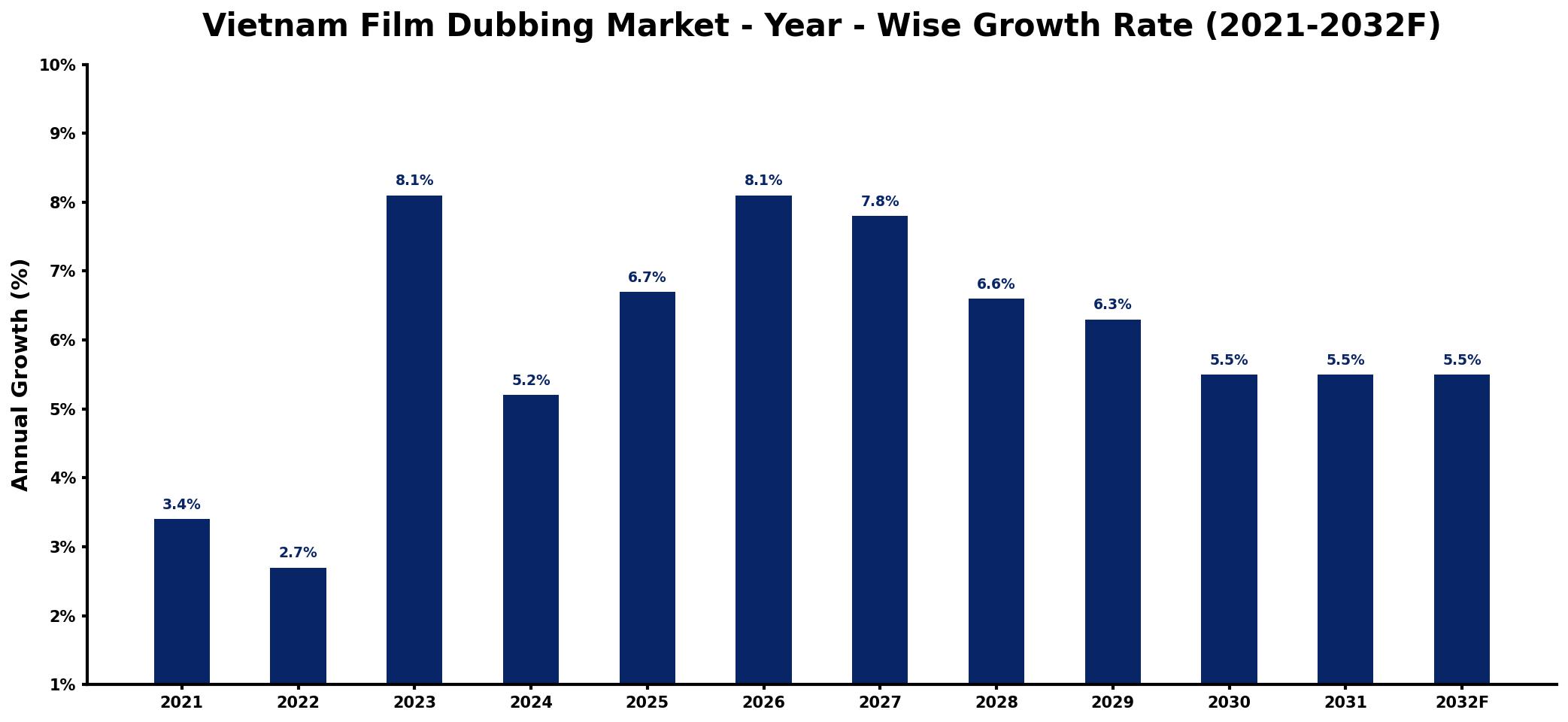
The table below presents the year‑wise growth rates along with the key drivers influencing the market
| Year | Growth Rate | Major Drivers |
| 2021 | 3.4% | Rising demand for local content |
| 2022 | 2.7% | Increased investment in media production |
| 2023 | 8.1% | Expansion of digital streaming platforms |
| 2024 | 5.2% | Growing audience for international shows |
| 2025 | 6.7% | Higher consumer spending on entertainment |
| 2026 | 8.1% | Advancements in audio technology adoption |
| 2027 | 7.8% | Emergence of new talent pool |
| 2028 | 6.6% | Strengthening partnerships with global studios |
| 2029 | 6.3% | Diversification of content offerings |
| 2030 | 5.5% | Growing popularity of animated series |
| 2031 | 5.5% | Increased focus on regional storytelling |
| 2032 | 5.5% | Enhanced collaboration with content creators |
Note: Market size estimations and growth projections presented in this report are based on 6Wresearch's proprietary forecasting methodology, utilizing the latest available industry data, government publications, and primary research inputs.
Vietnam Film Dubbing Market Synopsis
In Vietnam, dubbing has become a vital service as audiences increasingly prefer films and shows that resonate with their language and culture. The local film and television industrys growth directly impacts the need for skilled dubbing artists and state-of-the-art studios that can meet the demand for quality dubbing services.
Moreover, the film dubbing market reflects Vietnam's rich cultural diversity, catering to the preferences of different regional audiences. This cultural adaptation is key, as it allows foreign content to be successfully integrated and appreciated within various Vietnamese demographics.
Vietnam Film Dubbing Market Key Takeaways
- The market is bolstered by rising international content consumption among Vietnamese viewers.
- Digital streaming platforms are a significant driver of demand for dubbed content.
- Local production studios play a crucial role in delivering high-quality dubbing services.
- Cultural adaptation and linguistic accuracy are essential for successful market penetration.
- Investment in dubbing talent and technology continues to grow, enhancing production quality.
Evaluation of Restraints in Vietnam Film Dubbing Market
Despite its growth, the Vietnam Film Dubbing Market faces several restraints. Intellectual property rights pose ongoing challenges, as studios must navigate the complex landscape of copyright laws while ensuring that dubbed versions remain true to the original content. Additionally, the competition from subtitles and original audio versions can limit the potential audience for dubbed films. As audiences become more discerning, ensuring that dubbing captures the nuances of local dialects and cultural references becomes increasingly critical, presenting a challenge for many dubbing studios.
Vietnam Film Dubbing Market Trends
Current trends in the Vietnam Film Dubbing Market indicate a shift towards advanced technology solutions, including AI-assisted dubbing tools that improve efficiency. Moreover, there is a growing inclination towards creating original Vietnamese content that is locally dubbed to reach wider audiences. The trend of engaging popular local celebrities as voice actors is also rising, enhancing viewer relatability and appeal. Furthermore, as the market matures, there is a noticeable emphasis on professional training for dubbing artists to meet the industry's evolving demands.
Vietnam Film Dubbing Market Opportunities
The evolving landscape of the Vietnam Film Dubbing Market presents several lucrative opportunities. As digital streaming continues to flourish, there is increasing potential for partnerships with international platforms seeking to localize their content. Furthermore, developing regional dubbing services tailored to local dialects and cultural preferences can attract niche audiences. Investment in dubbing technologies, coupled with a push for quality and speed, can lead to new revenue streams and competitive advantages in a crowded marketplace.
Government Initiatives in the Vietnam Film Dubbing Market
The Vietnamese government has been supportive of the film and entertainment sector through various initiatives aimed at promoting local culture and talent. Policies encouraging foreign investment in media and entertainment have created an environment conducive to the growth of the film dubbing market. Additionally, public spending on cultural programs has fostered opportunities for local dubbing studios to thrive, aligning with national objectives to enhance the global competitiveness of Vietnam's film industry.
Future Insights of the Vietnam Film Dubbing Market
Looking ahead to the period of 2026-2032, the Vietnam Film Dubbing Market is poised for substantial expansion. The sustained growth of digital platforms, along with increasing consumer demand for localized content, will drive market development. A focus on quality and cultural resonance will ensure that dubbing remains a preferred option over subtitles among Vietnamese audiences. As the industry evolves, continued investments in technology and talent are essential to meet the high standards expected by consumers.
Vietnam Film Dubbing Market Latest Developments (2025 - 2026)
Recent developments in the Vietnam Film Dubbing Market reflect a shift towards innovation, with studios exploring the integration of cutting-edge technology in dubbing processes. Additionally, local companies are increasingly entering partnerships with international content providers to enhance their offerings. There has been a notable emphasis on creating original Vietnamese audio content tailored specifically for the domestic audience, as well as expanding dubbing services for regional languages to capture a broader market segment.
Vietnam Film Dubbing Market - Key Attractiveness of the Report
- 10 Years of Market Numbers
- Historical Data Starting from 2022 to 2025
- Base Year: 2025
- Forecast Data until 2032
- Key Performance Indicators Impacting the Market
- Major Upcoming Developments and Projects
Key Highlights of the Report:
- Vietnam Film Dubbing Market Outlook
- Market Size of Vietnam Film Dubbing Market, 2025
- Forecast of Vietnam Film Dubbing Market, 2032
- Historical Data and Forecast of Vietnam Film Dubbing Revenues & Volume for the Period 2022-2032F
- Vietnam Film Dubbing Market Trend Evolution
- Vietnam Film Dubbing Market Drivers and Challenges
- Vietnam Film Dubbing Price Trends
- Vietnam Film Dubbing Porter's Five Forces
- Vietnam Film Dubbing Industry Life Cycle
- Historical Data and Forecast of Vietnam Film Dubbing Market Revenues & Volume By Type for the Period 2022-2032F
- Historical Data and Forecast of Vietnam Film Dubbing Market Revenues & Volume By Native Language Dubbing for the Period 2022-2032F
- Historical Data and Forecast of Vietnam Film Dubbing Market Revenues & Volume By Foreign Language Dubbing for the Period 2022-2032F
- Historical Data and Forecast of Vietnam Film Dubbing Market Revenues & Volume By Minority Language Dubbing for the Period 2022-2032F
- Historical Data and Forecast of Vietnam Film Dubbing Market Revenues & Volume By Special Language Dubbing for the Period 2022-2032F
- Historical Data and Forecast of Vietnam Film Dubbing Market Revenues & Volume By Application for the Period 2022-2032F
- Historical Data and Forecast of Vietnam Film Dubbing Market Revenues & Volume By Drama for the Period 2022-2032F
- Historical Data and Forecast of Vietnam Film Dubbing Market Revenues & Volume By Comedy for the Period 2022-2032F
- Historical Data and Forecast of Vietnam Film Dubbing Market Revenues & Volume By Horror Movie for the Period 2022-2032F
- Historical Data and Forecast of Vietnam Film Dubbing Market Revenues & Volume By Romance for the Period 2022-2032F
- Historical Data and Forecast of Vietnam Film Dubbing Market Revenues & Volume By Action Movie for the Period 2022-2032F
- Historical Data and Forecast of Vietnam Film Dubbing Market Revenues & Volume By Other for the Period 2022-2032F
- Vietnam Film Dubbing Import Export Trade Statistics
- Market Opportunity Assessment By Type
- Market Opportunity Assessment By Application
- Vietnam Film Dubbing Top Companies Market Share
- Vietnam Film Dubbing Competitive Benchmarking By Technical and Operational Parameters
- Vietnam Film Dubbing Company Profiles
- Vietnam Film Dubbing Key Strategic Recommendations






































