Vietnam Fish Farming Market Size, Share & Growth Rate
The Vietnam Fish Farming Market was estimated at USD 374 Million in 2025 and is projected to reach USD 531 Million by 2032, growing at a CAGR of 5.1% from 2026 to 2032. This growth trajectory is primarily driven by the increasing domestic and international demand for seafood products, particularly tilapia, catfish, and pangasius. Additionally, advancements in sustainable aquaculture practices and technological innovations have further propelled the industry's capacity to enhance productivity while minimizing environmental impacts.
Vietnam Fish Farming Market Year-wise Growth Rate and Key Drivers
This graph highlights how the Vietnam Fish Farming Market has steadily grown over the years, supported by major growth factors.
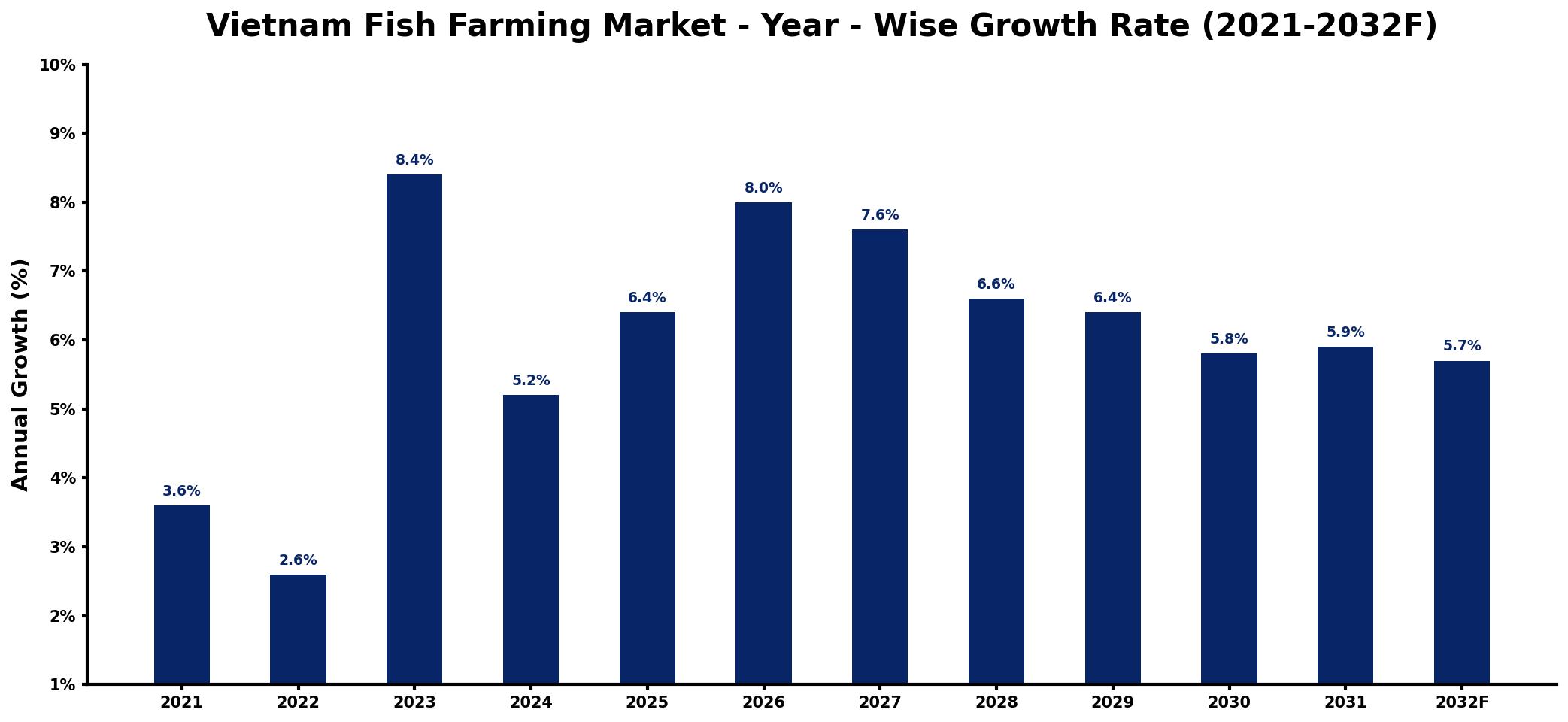
The table below presents the year‑wise growth rates along with the key drivers influencing the market
| Year | Growth Rate | Major Drivers |
| 2021 | 3.6% | Rising consumer health awareness |
| 2022 | 2.6% | Increased export market opportunities |
| 2023 | 8.4% | Technological advancements in aquaculture |
| 2024 | 5.2% | Growing domestic consumption rates |
| 2025 | 6.4% | Investment in sustainable practices |
| 2026 | 8.0% | Expansion of cold chain logistics |
| 2027 | 7.6% | Government support for aquaculture initiatives |
| 2028 | 6.6% | Emerging market for organic products |
| 2029 | 6.4% | Strengthened supply chain partnerships |
| 2030 | 5.8% | Increased demand for protein sources |
| 2031 | 5.9% | Innovations in feed formulations |
| 2032 | 5.7% | Enhanced regulatory frameworks supporting growth |
Note: Market size estimations and growth projections presented in this report are based on 6Wresearch's proprietary forecasting methodology, utilizing the latest available industry data, government publications, and primary research inputs.
Vietnam Fish Farming Market Synopsis
Vietnam's fish farming sector plays a pivotal role in both local consumption and seafood exports, catering to a burgeoning global appetite for aquaculture products. With abundant waterways, Vietnam's geographic advantage positions it favorably for the establishment and growth of diverse fish farming operations.
The industry's commitment to sustainability has led to the adoption of modern techniques, which not only boost production efficiency but also align with international standards. The focus on responsible aquaculture practices is becoming increasingly critical as environmental concerns rise, ensuring that fish farming can coexist harmoniously with Vietnam's rich aquatic ecosystems.
Vietnam Fish Farming Market Key Takeaways
- Vietnam's favorable geographical conditions and abundant water resources significantly support fish farming operations.
- Technological advancements are enhancing production efficiencies, leading to increased output and sustainability.
- Key species such as tilapia, catfish, and pangasius dominate the aquaculture landscape in Vietnam.
- Government initiatives are fostering a supportive environment for investment in the fish farming sector.
- The industry is increasingly focusing on biosecurity and disease management practices to safeguard fish health and production capacity.
Evaluation of Restraints in Vietnam Fish Farming Market
Despite the promising outlook for Vietnam's fish farming market, several restraints impede its growth. Environmental sustainability remains a major concern, as maintaining water quality is essential for fish health and output. The risk of disease outbreaks also poses a significant threat to profitability, necessitating constant vigilance and management. Furthermore, the escape of farmed species into natural ecosystems can disrupt local biodiversity, emphasizing the need for stringent environmental regulations. Access to affordable and sustainable fish feed remains another challenge that impacts the cost-efficiency of operations.
Vietnam Fish Farming Market Trends
Current trends in Vietnam's fish farming market reflect a strong inclination towards sustainability and technological integration. Many operators are implementing modern aquaculture systems that prioritize environmental stewardship while maximizing yield. Furthermore, there is a growing trend towards organic farming practices, appealing to health-conscious consumers both locally and abroad. The industry is also witnessing increased investment in research and development, aimed at enhancing disease resistance in farmed species and improving feed formulations.
Vietnam Fish Farming Market Opportunities
The opportunities for growth within the Vietnam Fish Farming Market are substantial. As global seafood demand continues to rise, local farmers are well-positioned to capitalize on international markets. Additionally, the increasing emphasis on sustainable practices presents investment avenues in eco-friendly farming technologies and processes. The exploration of value-added products, such as processed fish and seafood items, could also help diversify revenue streams and enhance profitability in this sector.
Government Initiatives in the Vietnam Fish Farming Market
The Vietnamese government has introduced various initiatives to support the fish farming industry, recognizing its economic importance. These initiatives include financial assistance programs, investment incentives, and research funding aimed at promoting sustainable aquaculture practices. Furthermore, the government is actively working to enhance export capabilities, ensuring that Vietnamese seafood products meet international standards, thus facilitating greater market access and competitiveness on the global stage.
Future Insights of the Vietnam Fish Farming Market
Looking ahead to the period from 2026 to 2032, the Vietnam Fish Farming Market is expected to evolve significantly. With growing global seafood demand, local farmers will likely increase production capacity to meet this need. The adoption of innovative farming techniques and sustainable practices will continue to be a focal point, enhancing both the environmental footprint and the economic viability of operations. As the sector matures, it will play an even more critical role in the countrys economic development and food security.
Vietnam Fish Farming Market Latest Developments (2025 - 2026)
Recent developments in Vietnam's fish farming sector indicate a robust adaptation to changing market dynamics. Many fish farmers are enhancing their biosecurity measures in response to past disease challenges, ensuring healthier stocks and more reliable production. Additionally, exploration into new domestic markets has gained momentum, reflecting a strategic pivot due to supply chain disruptions during the pandemic. The industry is also witnessing an increased emphasis on sustainability, with various stakeholders collaborating to promote responsible aquaculture practices.
Vietnam Fish Farming Market - Key Attractiveness of the Report
- 10 Years of Market Numbers
- Historical Data Starting from 2022 to 2025
- Base Year: 2025
- Forecast Data until 2032
- Key Performance Indicators Impacting the Market
- Major Upcoming Developments and Projects
Key Highlights of the Report:
- Vietnam Fish Farming Market Outlook
- Market Size of Vietnam Fish Farming Market, 2025
- Forecast of Vietnam Fish Farming Market, 2032
- Historical Data and Forecast of Vietnam Fish Farming Revenues & Volume for the Period 2022-2032F
- Vietnam Fish Farming Market Trend Evolution
- Vietnam Fish Farming Market Drivers and Challenges
- Vietnam Fish Farming Price Trends
- Vietnam Fish Farming Porter's Five Forces
- Vietnam Fish Farming Industry Life Cycle
- Historical Data and Forecast of Vietnam Fish Farming Market Revenues & Volume By Environment for the Period 2022-2032F
- Historical Data and Forecast of Vietnam Fish Farming Market Revenues & Volume By Marine Water for the Period 2022-2032F
- Historical Data and Forecast of Vietnam Fish Farming Market Revenues & Volume By Fresh Water for the Period 2022-2032F
- Historical Data and Forecast of Vietnam Fish Farming Market Revenues & Volume By Brackish Water for the Period 2022-2032F
- Historical Data and Forecast of Vietnam Fish Farming Market Revenues & Volume By Fish Type for the Period 2022-2032F
- Historical Data and Forecast of Vietnam Fish Farming Market Revenues & Volume By Pompano for the Period 2022-2032F
- Historical Data and Forecast of Vietnam Fish Farming Market Revenues & Volume By Snappers for the Period 2022-2032F
- Historical Data and Forecast of Vietnam Fish Farming Market Revenues & Volume By Groupers for the Period 2022-2032F
- Historical Data and Forecast of Vietnam Fish Farming Market Revenues & Volume By Salmon for the Period 2022-2032F
- Historical Data and Forecast of Vietnam Fish Farming Market Revenues & Volume By Milkfish for the Period 2022-2032F
- Historical Data and Forecast of Vietnam Fish Farming Market Revenues & Volume By Tuna for the Period 2022-2032F
- Historical Data and Forecast of Vietnam Fish Farming Market Revenues & Volume By Tilapia for the Period 2022-2032F
- Historical Data and Forecast of Vietnam Fish Farming Market Revenues & Volume By Others for the Period 2022-2032F
- Vietnam Fish Farming Import Export Trade Statistics
- Market Opportunity Assessment By Environment
- Market Opportunity Assessment By Fish Type
- Vietnam Fish Farming Top Companies Market Share
- Vietnam Fish Farming Competitive Benchmarking By Technical and Operational Parameters
- Vietnam Fish Farming Company Profiles
- Vietnam Fish Farming Key Strategic Recommendations






































