Vietnam Fishing Line Market Size, Share & Growth Rate
The Vietnam Fishing Line Market was estimated at USD 494 Million in 2025 and is projected to reach USD 703 Million by 2032, growing at a CAGR of 5.2% from 2026 to 2032. This growth trajectory is significantly fueled by the country's vast aquatic resources, which support both a robust commercial fishing sector and a flourishing recreational fishing community. As innovations in fishing line technologies evolve, local manufacturers are increasingly catering to diverse consumer preferences for sustainability and performance, further amplifying market expansion.
Vietnam Fishing Line Market Year-wise Growth Rate and Key Drivers
This graph highlights how the Vietnam Fishing Line Market has steadily grown over the years, supported by major growth factors.
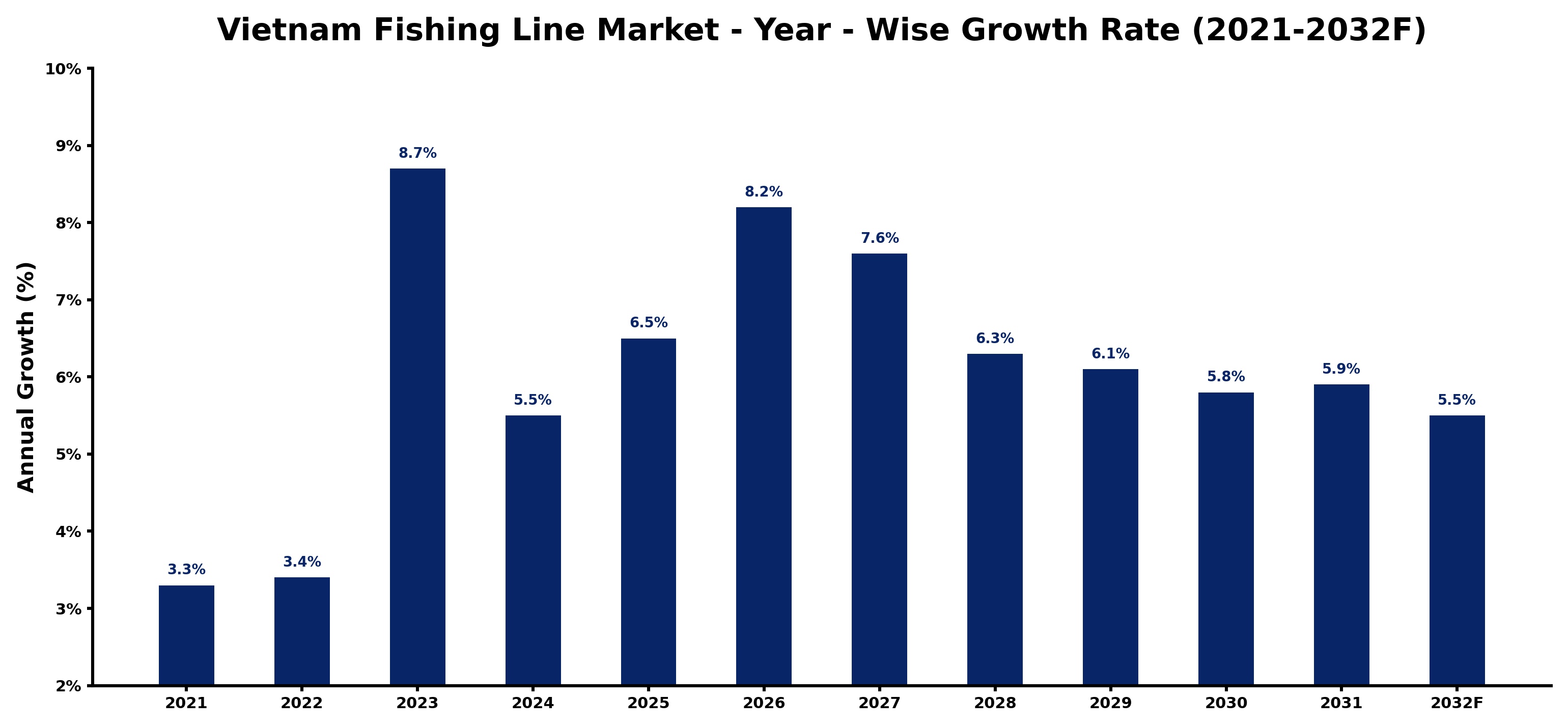
The table below presents the year‑wise growth rates along with the key drivers influencing the market
| Year | Growth Rate | Major Drivers |
| 2021 | 3.3% | Vietnam's fishing line exports benefit from improved manufacturing techniques |
| 2022 | 3.4% | Local fishing line production capacity increased to meet export demand |
| 2023 | 8.7% | Foreign investments boosted production capacity for fishing line manufacturers |
| 2024 | 5.5% | New fishing line manufacturing plants boost export capacity significantly |
| 2025 | 6.5% | Increased fishing line exports boost local manufacturing capacity and employment |
| 2026 | 8.2% | Technology integration in fishing line production boosts export competitiveness |
| 2027 | 7.6% | Upgraded fishing line production lines boost export readiness significantly |
| 2028 | 6.3% | Advanced weaving technology boosts fishing line production efficiency |
| 2029 | 6.1% | New manufacturing facilities enhance fishing line export capabilities |
| 2030 | 5.8% | Vietnam’s fishing line production boosts exports amid rising global demand |
| 2031 | 5.9% | New factory openings boost production capacity for fishing line exports |
| 2032 | 5.5% | Domestic fishing line manufacturers boosted production for export contracts |
Note - Market size estimations and growth projections presented in this report are based on 6Wresearch’s advanced forecasting approach, validated with industry datasets as of June 2026.
Vietnam Fishing Line Market Synopsis
Sustainability is currently the strongest force shaping the Vietnam Fishing Line Market. As consumers become more environmentally conscious, there is a notable shift towards eco-friendly materials, prompting manufacturers to innovate and adapt their product offerings. This trend is not just a reflection of consumer demand but also a response to increasing regulatory pressures aimed at minimizing plastic waste in aquatic environments.
Furthermore, the growing popularity of recreational fishing activities during the pandemic has created a renewed interest in high-quality fishing gear. Many individuals have discovered fishing as a leisure activity, which is driving demand for premium fishing lines that enhance the overall fishing experience, especially among novice anglers.
Vietnam Fishing Line Market Key Takeaways
- The market is poised for significant growth, driven by the increasing popularity of recreational fishing.
- Innovations in fishing line technology are leading to the development of more sustainable and durable products.
- Consumer preference for eco-friendly materials is reshaping manufacturing practices in the fishing line industry.
- The competitive landscape includes both local and foreign manufacturers vying for market share.
- Government initiatives aimed at reducing marine pollution are influencing product development strategies.
Evaluation of Restraints in Vietnam Fishing Line Market
Despite the optimistic growth projections, several restraints limit the Vietnam Fishing Line Market's potential. The challenge of adopting environmentally friendly materials remains a significant barrier, as biodegradable alternatives often lack the durability and performance characteristics of traditional fishing lines. Additionally, increasing competition from foreign manufacturers may pressure local companies to either innovate rapidly or risk losing market share. As awareness about responsible fishing practices continues to rise, industry participants must navigate the dual demands of sustainability and performance to remain competitive.
Vietnam Fishing Line Market Trends
Current trends show a marked shift towards the development of high-performance fishing lines that incorporate advanced materials. Innovations like fluorocarbon and braided lines are gaining traction due to their superior strength and sensitivity. Moreover, the adoption of smart technologies, such as integrated sensors for tracking fish movements, is beginning to emerge, catering to tech-savvy consumers looking for enhanced fishing experiences. The emphasis on sustainable fishing practices is also driving the demand for biodegradable fishing lines, further reflecting the industry's commitment to environmental stewardship.
Vietnam Fishing Line Market Opportunities
Opportunities for growth are abundant in the Vietnam Fishing Line Market, particularly in the development of eco-friendly products. Companies focusing on research and development of biodegradable lines are likely to capture an expanding segment of environmentally conscious consumers. Furthermore, the increase in domestic and international fishing tourism is poised to boost demand for high-quality fishing gear, including premium lines tailored to specific fishing conditions. Partnering with local fishing communities to promote sustainable practices can also enhance brand reputation and customer loyalty.
Government Initiatives in the Vietnam Fishing Line Market
The Vietnamese government is actively promoting sustainable fishing practices through various initiatives aimed at reducing oceanic plastic waste. Investment in public awareness campaigns and regulations encouraging the use of eco-friendly materials in fishing gear is gaining traction. Programs designed to enhance the seafood export industry also indirectly support the fishing line market, as improved fishing practices necessitate high-quality equipment. By fostering a sustainable fishing culture, government policies are helping shape the future of the fishing line market.
Future Insights of the Vietnam Fishing Line Market
Looking ahead to the period between 2026 and 2032, the Vietnam Fishing Line Market is expected to evolve significantly. The combination of rising consumer awareness around sustainability and continuous innovations in product technology will drive the market landscape. As recreational fishing gains popularity among younger demographics, the demand for specialized and high-performance fishing lines will likely increase. Additionally, strengthening distribution channels and enhancing supply chain resilience will be crucial for meeting the anticipated demand surge.
Vietnam Fishing Line Market Latest Developments (May 2025 - June 2026)
Recent industry developments indicate a growing emphasis on sustainability, with several manufacturers announcing initiatives aimed at reducing plastic waste in their products. Collaborations between fishing gear companies and environmental organizations are becoming more common, aiming to promote responsible fishing practices. Additionally, advancements in manufacturing technology are enabling the production of fishing lines that boast greater strength and reduced visibility underwater, appealing to a broader range of fishing enthusiasts.
Vietnam Fishing Line Market - Key Attractiveness of the Report
- 10 Years of Market Numbers
- Historical Data Starting from 2022 to 2025
- Base Year: 2025
- Forecast Data until 2032
- Key Performance Indicators Impacting the Market
- Major Upcoming Developments and Projects
Key Highlights of the Report:
- Vietnam Fishing Line Market Outlook
- Market Size of Vietnam Fishing Line Market, 2025
- Forecast of Vietnam Fishing Line Market, 2032
- Historical Data and Forecast of Vietnam Fishing Line Revenues & Volume for the Period 2022-2032F
- Vietnam Fishing Line Market Trend Evolution
- Vietnam Fishing Line Market Drivers and Challenges
- Vietnam Fishing Line Price Trends
- Vietnam Fishing Line Porter's Five Forces
- Vietnam Fishing Line Industry Life Cycle
- Historical Data and Forecast of Vietnam Fishing Line Market Revenues & Volume By Product Type for the Period 2022-2032F
- Historical Data and Forecast of Vietnam Fishing Line Market Revenues & Volume By Nylon Fishing Line for the Period 2022-2032F
- Historical Data and Forecast of Vietnam Fishing Line Market Revenues & Volume By Carbon Fishing Line for the Period 2022-2032F
- Historical Data and Forecast of Vietnam Fishing Line Market Revenues & Volume By PE Fishing Line for the Period 2022-2032F
- Historical Data and Forecast of Vietnam Fishing Line Market Revenues & Volume By Others for the Period 2022-2032F
- Historical Data and Forecast of Vietnam Fishing Line Market Revenues & Volume By Application for the Period 2022-2032F
- Historical Data and Forecast of Vietnam Fishing Line Market Revenues & Volume By River Fishing for the Period 2022-2032F
- Historical Data and Forecast of Vietnam Fishing Line Market Revenues & Volume By Ocean Fishing for the Period 2022-2032F
- Historical Data and Forecast of Vietnam Fishing Line Market Revenues & Volume By Others for the Period 2022-2032F
- Vietnam Fishing Line Import Export Trade Statistics
- Market Opportunity Assessment By Product Type
- Market Opportunity Assessment By Application
- Vietnam Fishing Line Top Companies Market Share
- Vietnam Fishing Line Competitive Benchmarking By Technical and Operational Parameters
- Vietnam Fishing Line Company Profiles
- Vietnam Fishing Line Key Strategic Recommendations






































