Vietnam Food & Beverages Processing Equipment Market Summary
The vietnam food & beverages processing equipment market was estimated at USD 846 Million in 2025 and is projected to reach USD 1351 Million by 2032, growing at a CAGR of 10.0% from 2026 to 2032.
Vietnam Food & Beverages Processing Equipment Market Year-wise Growth Rate and Key Drivers
This graph highlights how the Vietnam Food & Beverages Processing Equipment Market has steadily grown over the past five years, supported by major growth factors.
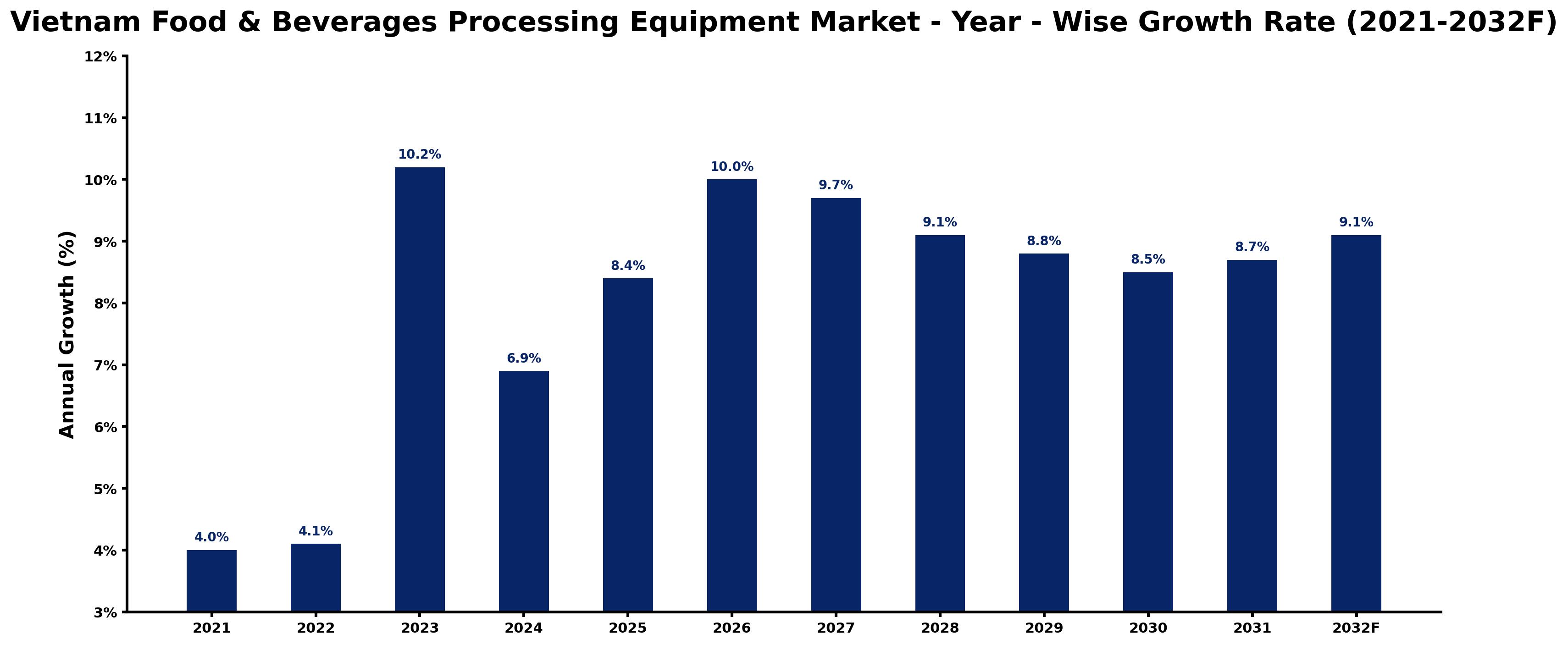
The table below presents the year wise growth rates along with the key drivers influencing the market
| Year | Growth Rate | Major Drivers |
| 2021 | 4.0% | Post-lockdown retail projects catalyzed an urgent need for processing equipment upgrades. |
| 2022 | 4.1% | Vietnam's bustling export market highlighted the importance of efficient food processing technologies. |
| 2023 | 10.2% | Local manufacturers increasingly sought automation solutions to enhance operational efficiency. |
| 2024 | 6.9% | Emerging consumer trends favored healthier options, compelling innovation in food production methods. |
| 2025 | 8.4% | A shift toward sustainable practices encouraged investments in eco-friendly processing technologies. |
| 2026 | 10.0% | Growing urban populations necessitated advanced food safety protocols in manufacturing environments. |
| 2027 | 9.7% | Increased competition among local businesses pushed for modernized equipment adoption. |
| 2028 | 9.1% | Rural electrification projects improved access to energy, enabling enhanced processing capabilities. |
| 2029 | 8.8% | Export regulations prompted companies to adapt equipment for compliance with international standards. |
| 2030 | 8.5% | Collaborations with global suppliers introduced new technologies, enriching the local equipment market. |
| 2031 | 8.7% | Consumer preferences shifted toward convenience foods, influencing production line requirements. |
| 2032 | 9.1% | Technological advancements in IoT created opportunities for smart processing equipment integration. |
Note - Market size estimations and growth projections presented in this report are based on 6Wresearch's advanced forecasting approach, validated with industry datasets as of June 2026.
Vietnam Food & Beverages Processing Equipment Market Synopsis
The Vietnam Food Beverages Processing Equipment Market is projected to reach 10.0% and witness significant growth during the forecast period (2026-2032). The market encompasses the production, distribution, and utilization of machinery critical for the processing and manufacturing of food and beverage products. This includes the equipment employed in food processing, packaging, bottling, and various related activities within the food and beverage sector.
Vietnam Food & Beverages Processing Equipment Market Growth Drivers
The burgeoning food and beverage industry in Vietnam significantly drives the Vietnam Food & Beverages Processing Equipment Market. Key factors contributing to this growth include:
- Expanding food production capabilities are imperative to meet the increasing consumer demand, prompting investments in advanced processing and packaging technologies.
- Shifting consumer preferences towards convenience and ready-to-eat options boost the demand for modern processing machinery that can handle complex manufacturing requirements.
- Technological advancements in food processing, such as automation and digital integration, enhance operational efficiency and reduce production waste, thereby driving the industry's evolution.
- Increasing export opportunities for Vietnamese food products necessitate compliance with international standards, further escalating the demand for sophisticated processing equipment.
- Investment incentives in the food and beverages sector, provided by both the government and financial institutions, support the acquisition of modern machinery and equipment.
Vietnam Food & Beverages Processing Equipment Market Challenges and Restraints
Despite the growth potential, the Vietnam Food & Beverages Processing Equipment Market faces several challenges that may hinder its progress:
- The initial capital investment required for modern food processing equipment can be a financial burden, particularly for small and medium-sized enterprises.
- The complexity of operating and maintaining advanced processing machinery necessitates a skilled workforce, which may be in limited supply.
- Compliance with strict quality and safety regulations can pose significant challenges for manufacturers, as failure to meet these standards may lead to product recalls or penalties.
- Supply chain disruptions, particularly exacerbated by global events such as the pandemic, can complicate procurement of machinery and raw materials essential for production.
- Rapidly shifting consumer tastes can lead to uncertainties in demand forecasting, complicating long-term investment planning in processing equipment.
Vietnam Food & Beverages Processing Equipment Market COVID-19 Impact
The COVID-19 pandemic has significantly influenced the Vietnam Food & Beverages Processing Equipment Market. Various challenges emerged during this period:
- Lockdowns and movement restrictions hampered supply chains, leading to delays in the production and distribution of processing equipment.
- Economic slowdowns prompted many businesses to defer or reduce investments in new processing machinery.
- Changes in consumer behavior, such as increased demand for online grocery delivery and packaged goods, reshaped the landscape of food production, affecting the types of equipment required.
- The pandemic highlighted the need for more resilient and flexible processing systems that can swiftly adapt to changing market conditions.
- Post-pandemic recovery has begun, with stakeholders reassessing their strategies, particularly in adopting technologies that enhance operational efficiency and product safety.
Vietnam Food & Beverages Processing Equipment Market Government Investment and Initiatives
The Vietnamese government plays a crucial role in fostering the growth of the food and beverages processing equipment market through various investments and initiatives. Key actions include:
- Policies aimed at enhancing agricultural productivity can lead to increased demand for sophisticated processing machinery, supporting the overall food industry.
- Public spending on infrastructure improvements facilitates better logistics and supply chain management, directly benefiting equipment manufacturers.
- Development plans focusing on food safety and quality assurance aim to elevate the standards of food products, underscoring the importance of modern processing technology.
- Incentives for research and development in food processing technologies stimulate innovation, encouraging companies to adopt advanced equipment solutions.
- Collaborative efforts between government bodies and industry stakeholders promote knowledge-sharing and capacity building in the food processing sector.
Vietnam Food & Beverages Processing Equipment Market Latest Developments (May 2025 - June 2026)
In the period from May 2025 to June 2026, the Vietnam Food & Beverages Processing Equipment Market witnessed several noteworthy developments. The industry trends indicated a shift towards sustainability, with increasing interest in eco-friendly processing technologies aimed at reducing carbon footprints. Investments in automation have surged, driven by the need for efficiency and resilience in production lines. Additionally, the government has announced several initiatives targeting modernization of the food processing sector, highlighting its commitment to ensuring compliance with international food safety standards. Stakeholders have begun to engage more deeply in partnerships aimed at enhancing capacity and knowledge-sharing within the industry. Furthermore, there has been a noticeable increase in demand for equipment supporting the production of health-oriented food and beverage products, reflecting evolving consumer preferences.
Vietnam Food & Beverages Processing Equipment Market - Key Attractiveness of the Report
- 10 Years of Market Numbers
- Historical Data Starting from 2022 to 2025
- Base Year: 2025
- Forecast Data until 2032
- Key Performance Indicators Impacting the Market
- Major Upcoming Developments and Projects
Key Highlights of the Report:
- Vietnam Food & Beverages Processing Equipment Market Outlook
- Market Size of Vietnam Food & Beverages Processing Equipment Market, 2025
- Forecast of Vietnam Food & Beverages Processing Equipment Market, 2032
- Historical Data and Forecast of Vietnam Food & Beverages Processing Equipment Revenues & Volume for the Period 2022-2032F
- Vietnam Food & Beverages Processing Equipment Market Trend Evolution
- Vietnam Food & Beverages Processing Equipment Market Drivers and Challenges
- Vietnam Food & Beverages Processing Equipment Price Trends
- Vietnam Food & Beverages Processing Equipment Porter's Five Forces
- Vietnam Food & Beverages Processing Equipment Industry Life Cycle
- Historical Data and Forecast of Vietnam Food & Beverages Processing Equipment Market Revenues & Volume By Types for the Period 2022-2032F
- Historical Data and Forecast of Vietnam Food & Beverages Processing Equipment Market Revenues & Volume By Pre-processing Equipment for the Period 2022-2032F
- Historical Data and Forecast of Vietnam Food & Beverages Processing Equipment Market Revenues & Volume By Sorting & Grading for the Period 2022-2032F
- Historical Data and Forecast of Vietnam Food & Beverages Processing Equipment Market Revenues & Volume By Processing Equipment for the Period 2022-2032F
- Historical Data and Forecast of Vietnam Food & Beverages Processing Equipment Market Revenues & Volume By Mode of Operations for the Period 2022-2032F
- Historical Data and Forecast of Vietnam Food & Beverages Processing Equipment Market Revenues & Volume By Automatic for the Period 2022-2032F
- Historical Data and Forecast of Vietnam Food & Beverages Processing Equipment Market Revenues & Volume By Semi-Automatic for the Period 2022-2032F
- Historical Data and Forecast of Vietnam Food & Beverages Processing Equipment Market Revenues & Volume By Forms for the Period 2022-2032F
- Historical Data and Forecast of Vietnam Food & Beverages Processing Equipment Market Revenues & Volume By Liquid for the Period 2022-2032F
- Historical Data and Forecast of Vietnam Food & Beverages Processing Equipment Market Revenues & Volume By Solid for the Period 2022-2032F
- Historical Data and Forecast of Vietnam Food & Beverages Processing Equipment Market Revenues & Volume By Semi-Solid for the Period 2022-2032F
- Historical Data and Forecast of Vietnam Food & Beverages Processing Equipment Market Revenues & Volume By Applications for the Period 2022-2032F
- Historical Data and Forecast of Vietnam Food & Beverages Processing Equipment Market Revenues & Volume By Bakery & Confectionery Products for the Period 2022-2032F
- Historical Data and Forecast of Vietnam Food & Beverages Processing Equipment Market Revenues & Volume By Meat & Poultry Products for the Period 2022-2032F
- Historical Data and Forecast of Vietnam Food & Beverages Processing Equipment Market Revenues & Volume By Fish & Sea food for the Period 2022-2032F
- Historical Data and Forecast of Vietnam Food & Beverages Processing Equipment Market Revenues & Volume By Dairy Products for the Period 2022-2032F
- Historical Data and Forecast of Vietnam Food & Beverages Processing Equipment Market Revenues & Volume By Alcoholic Beverages for the Period 2022-2032F
- Historical Data and Forecast of Vietnam Food & Beverages Processing Equipment Market Revenues & Volume By Non-Alcoholic Beverages for the Period 2022-2032F
- Historical Data and Forecast of Vietnam Food & Beverages Processing Equipment Market Revenues & Volume By Others for the Period 2022-2032F
- Vietnam Food & Beverages Processing Equipment Import Export Trade Statistics
- Market Opportunity Assessment By Types
- Market Opportunity Assessment By Mode of Operations
- Market Opportunity Assessment By Forms
- Market Opportunity Assessment By Applications
- Vietnam Food & Beverages Processing Equipment Top Companies Market Share
- Vietnam Food & Beverages Processing Equipment Competitive Benchmarking By Technical and Operational Parameters
- Vietnam Food & Beverages Processing Equipment Company Profiles
- Vietnam Food & Beverages Processing Equipment Key Strategic Recommendations






































