Vietnam Food Processing & Handling Equipment Market Summary
The vietnam food processing & handling equipment market was estimated at USD 1102 Million in 2025 and is projected to reach USD 1563 Million by 2032, growing at a CAGR of 8.1% from 2026 to 2032.
Vietnam Food Processing & Handling Equipment Market Year-wise Growth Rate and Key Drivers
This graph highlights how the Vietnam Food Processing & Handling Equipment Market has steadily grown over the past five years, supported by major growth factors.
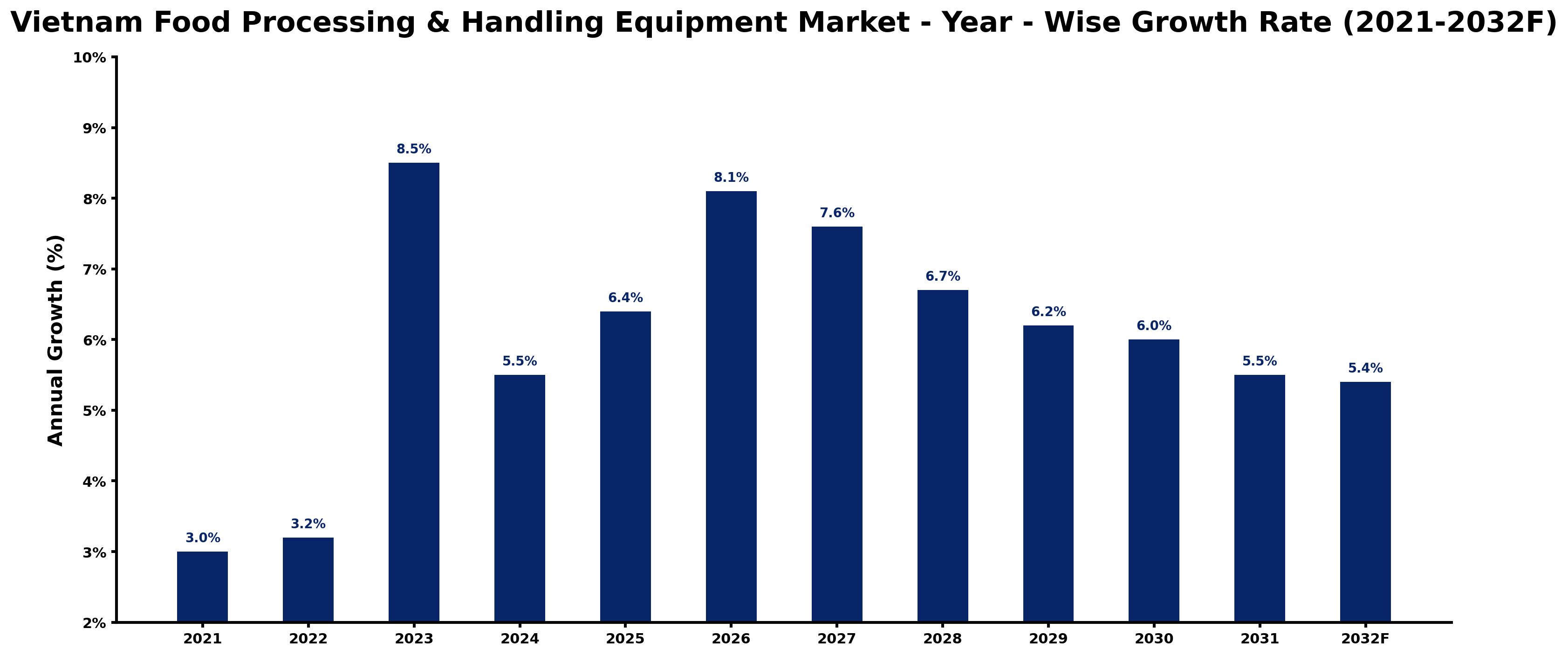
The table below presents the year wise growth rates along with the key drivers influencing the market
| Year | Growth Rate | Major Drivers |
| 2021 | 3.0% | Vietnam's food processing sector sees increased investment as foreign brands expand operations. |
| 2022 | 3.2% | Emerging trends in sustainability prompt companies to upgrade existing equipment significantly. |
| 2023 | 8.5% | Manufacturers face challenges from supply chain disruptions, necessitating efficient handling solutions. |
| 2024 | 5.5% | Technological integration in food safety enhances demand for advanced processing equipment. |
| 2025 | 6.4% | Rural electrification efforts boost small-scale food processing initiatives in various regions. |
| 2026 | 8.1% | Growing consumer preference for convenience foods drives innovation in packaging machinery. |
| 2027 | 7.6% | Increased urbanization leads to higher demand for ready-to-eat and processed products. |
| 2028 | 6.7% | E-commerce channels expand, requiring sophisticated logistics and food handling solutions. |
| 2029 | 6.2% | Local startups emerge, focusing on niche markets and tailored food processing technologies. |
| 2030 | 6.0% | International standards for food safety and quality shape equipment procurement decisions. |
| 2031 | 5.5% | Increased competition encourages manufacturers to invest in automation for efficiency gains. |
| 2032 | 5.4% | Vietnam's strategic trade agreements open new markets for food processing equipment exporters. |
Note - Market size estimations and growth projections presented in this report are based on 6Wresearch's advanced forecasting approach, validated with industry datasets as of June 2026.
Vietnam Food Processing & Handling Equipment Market Synopsis
The Vietnam Food Processing Handling Equipment Market is projected to reach 8.1% and witness significant growth during the forecast period (2026-2032). This essential market underpins the country's food industry by providing key machinery for the sorting, washing, cutting, packaging, and storage of food products. The burgeoning food processing sector in Vietnam fuels the demand for efficient and hygienic processing, propelled by a rising consumer appetite for processed and packaged food items.
Vietnam Food Processing & Handling Equipment Market Growth Drivers
Several critical factors catalyze the growth of the Vietnam Food Processing & Handling Equipment Market. The first major driver is the ongoing expansion of the food processing sector, where urbanization and shifting consumer preferences are profoundly influencing food consumption patterns. As more Vietnamese consumers opt for convenient and ready-to-eat products, there is an escalating demand for modern food processing solutions.
- The surge in processed food consumption necessitates advanced equipment to maintain quality and safety, which is a primary focus for food manufacturers.
- Government initiatives aimed at promoting the modernization of the agricultural sector are contributing to investments in advanced processing technologies.
- Technological advancements enable the introduction of automated solutions that enhance productivity and reduce operational costs, further driving adoption.
- As food safety standards tighten, the reliance on state-of-the-art equipment to ensure compliance is becoming pivotal for food processors.
- Changing lifestyles and dietary habits among the population are creating a robust market opportunity for innovative food processing and handling machinery.
Vietnam Food Processing & Handling Equipment Market Challenges and Restraints
Despite the promising growth prospects of the Vietnam Food Processing & Handling Equipment Market, several challenges pose risks to its overall development. One significant hurdle is the high capital expenditure associated with acquiring modern machinery. For small and medium-sized enterprises (SMEs), this initial investment can often be prohibitive, leading to reliance on outdated and less efficient processing methods.
- The scarcity of skilled labor capable of operating advanced processing equipment creates operational inefficiencies, which can stymie growth in the sector.
- Regulatory compliance regarding food safety adds an additional layer of complexity, requiring manufacturers to invest in certifications and maintain rigorous standards.
- Addressing increasing environmental concerns necessitates sustainable practices, which can be challenging for manufacturers balancing cost and efficacy.
- The recent pandemic has highlighted vulnerabilities in supply chains, affecting equipment availability and production schedules.
- Competition from imported equipment may force local manufacturers to enhance their technology and reduce costs to maintain market share.
Vietnam Food Processing & Handling Equipment Market Government Investment and Initiatives
The Vietnamese government plays a pivotal role in shaping the landscape of the Food Processing & Handling Equipment Market through various investment and developmental initiatives. A focus on agricultural modernization has prompted policies aimed at enhancing food processing capabilities. These policies include financial incentives aimed at boosting local investments in processing technology and infrastructure.
- Government programs seek to improve food safety standards, thereby encouraging the adoption of advanced processing technologies and practices.
- Investment in research and development through public-private partnerships is fostering innovation within the food processing equipment sector.
- Infrastructure improvements, including better transport networks and cold storage facilities, are enabling more efficient logistics for food products.
- The push for sustainable agricultural practices is promoting investments in eco-friendly processing technologies, aligning with global sustainability trends.
- Regulatory support is vital for the local production of advanced food processing equipment, ensuring that local manufacturers can compete effectively in the global marketplace.
Vietnam Food Processing & Handling Equipment Market Latest Developments (May 2025 - June 2026)
In the period from May 2025 to June 2026, the Vietnam Food Processing & Handling Equipment Market witnessed notable developments aligned with evolving industry needs. As food processors adapted to the post-pandemic landscape, there was a substantial shift towards the implementation of automation and hygiene-focused processing solutions. This trend reflected an industry-wide effort to enhance operational efficiencies while ensuring compliance with heightened food safety regulations.
- Manufacturers increasingly focused on integrating cutting-edge technologies, such as IoT and AI, into processing machinery to optimize performance and minimize waste.
- Partnerships between local firms and international technology providers facilitated knowledge transfer and technological advancements in equipment manufacturing.
- Research initiatives aimed at developing energy-efficient machinery gained traction, addressing both cost concerns and environmental sustainability goals.
- As consumer preferences evolved, product diversification in processed foods prompted the need for specialized equipment catering to varied production requirements.
- Market players began emphasizing the importance of hygiene in equipment design, reflecting consumer concerns regarding food safety and quality.
Vietnam Food Processing & Handling Equipment Market - Key Attractiveness of the Report
- 10 Years of Market Numbers
- Historical Data Starting from 2022 to 2025
- Base Year: 2025
- Forecast Data until 2032
- Key Performance Indicators Impacting the Market
- Major Upcoming Developments and Projects
Key Highlights of the Report:
- Vietnam Food Processing & Handling Equipment Market Outlook
- Market Size of Vietnam Food Processing & Handling Equipment Market, 2025
- Forecast of Vietnam Food Processing & Handling Equipment Market, 2032
- Historical Data and Forecast of Vietnam Food Processing & Handling Equipment Revenues & Volume for the Period 2022-2032F
- Vietnam Food Processing & Handling Equipment Market Trend Evolution
- Vietnam Food Processing & Handling Equipment Market Drivers and Challenges
- Vietnam Food Processing & Handling Equipment Price Trends
- Vietnam Food Processing & Handling Equipment Porter's Five Forces
- Vietnam Food Processing & Handling Equipment Industry Life Cycle
- Historical Data and Forecast of Vietnam Food Processing & Handling Equipment Market Revenues & Volume By Equipment Type for the Period 2022-2032F
- Historical Data and Forecast of Vietnam Food Processing & Handling Equipment Market Revenues & Volume By Food Processing equipment for the Period 2022-2032F
- Historical Data and Forecast of Vietnam Food Processing & Handling Equipment Market Revenues & Volume By Foodservice equipment for the Period 2022-2032F
- Historical Data and Forecast of Vietnam Food Processing & Handling Equipment Market Revenues & Volume By Food Packaging equipment for the Period 2022-2032F
- Historical Data and Forecast of Vietnam Food Processing & Handling Equipment Market Revenues & Volume By Application for the Period 2022-2032F
- Historical Data and Forecast of Vietnam Food Processing & Handling Equipment Market Revenues & Volume By Bakery & confectionery products for the Period 2022-2032F
- Historical Data and Forecast of Vietnam Food Processing & Handling Equipment Market Revenues & Volume By Meat & poultry products for the Period 2022-2032F
- Historical Data and Forecast of Vietnam Food Processing & Handling Equipment Market Revenues & Volume By Dairy products for the Period 2022-2032F
- Historical Data and Forecast of Vietnam Food Processing & Handling Equipment Market Revenues & Volume By Alcoholic beverages for the Period 2022-2032F
- Historical Data and Forecast of Vietnam Food Processing & Handling Equipment Market Revenues & Volume By Non-alcoholic beverages for the Period 2022-2032F
- Historical Data and Forecast of Vietnam Food Processing & Handling Equipment Market Revenues & Volume By Fish & seafood products for the Period 2022-2032F
- Historical Data and Forecast of Vietnam Food Processing & Handling Equipment Market Revenues & Volume By Others? for the Period 2022-2032F
- Historical Data and Forecast of Vietnam Food Processing & Handling Equipment Market Revenues & Volume By Form for the Period 2022-2032F
- Historical Data and Forecast of Vietnam Food Processing & Handling Equipment Market Revenues & Volume By Solid for the Period 2022-2032F
- Historical Data and Forecast of Vietnam Food Processing & Handling Equipment Market Revenues & Volume By Liquid for the Period 2022-2032F
- Historical Data and Forecast of Vietnam Food Processing & Handling Equipment Market Revenues & Volume By Semi-solid for the Period 2022-2032F
- Vietnam Food Processing & Handling Equipment Import Export Trade Statistics
- Market Opportunity Assessment By Equipment Type
- Market Opportunity Assessment By Application
- Market Opportunity Assessment By Form
- Vietnam Food Processing & Handling Equipment Top Companies Market Share
- Vietnam Food Processing & Handling Equipment Competitive Benchmarking By Technical and Operational Parameters
- Vietnam Food Processing & Handling Equipment Company Profiles
- Vietnam Food Processing & Handling Equipment Key Strategic Recommendations






































