Vietnam Food products machinery Market Summary
The vietnam food products machinery market was estimated at USD 459 Million in 2025 and is projected to reach USD 650 Million by 2032, growing at a CAGR of 8.3% from 2026 to 2032.
Vietnam Food products machinery Market Year-wise Growth Rate and Key Drivers
This graph highlights how the Vietnam Food products machinery Market has steadily grown over the past five years, supported by major growth factors.
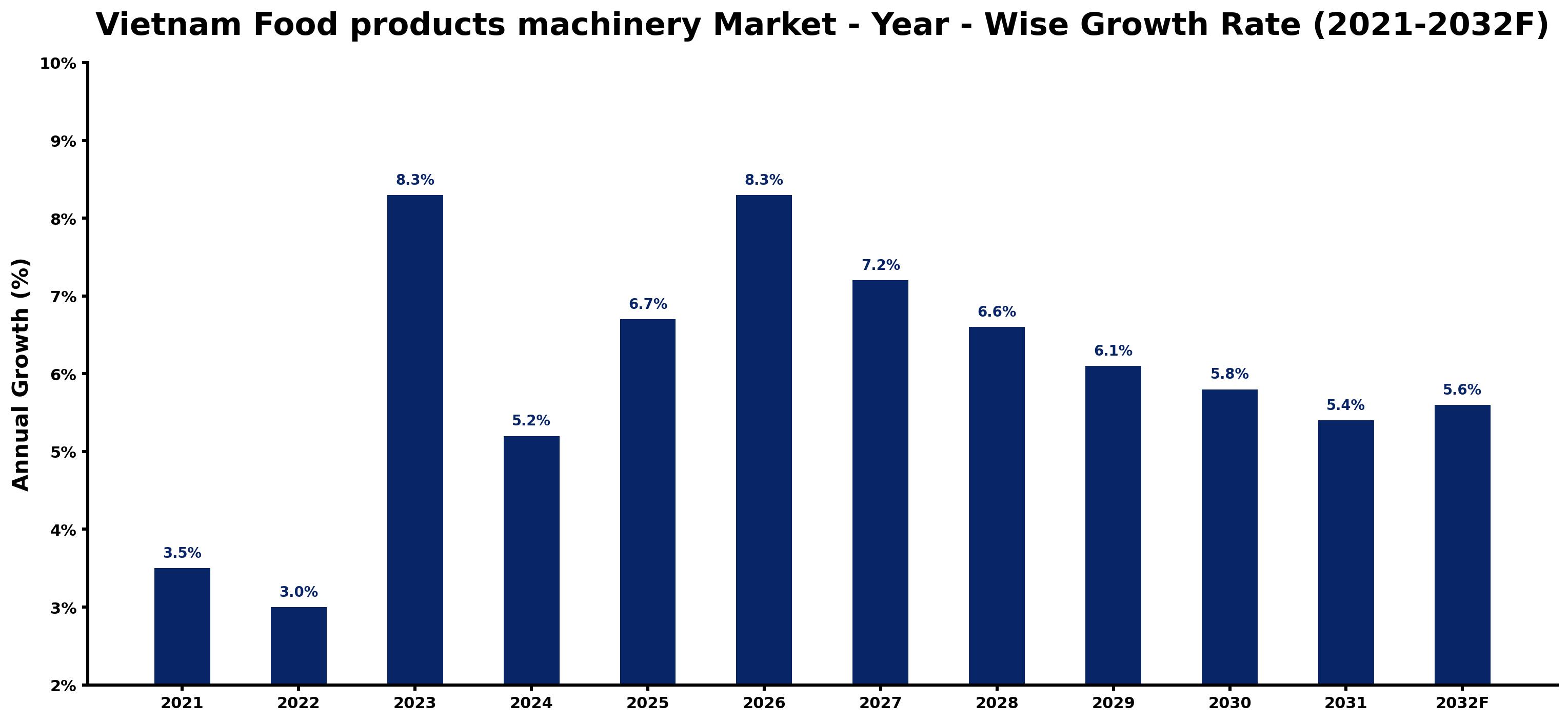
The table below presents the year wise growth rates along with the key drivers influencing the market
| Year | Growth Rate | Major Drivers |
| 2021 | 3.5% | Vietnam's food processing sector began recovering from pandemic disruptions, highlighting machinery needs. |
| 2022 | 3.0% | Manufacturers increasingly sought automation solutions to enhance operational efficiency and reduce costs. |
| 2023 | 8.3% | Consumer preferences shifted towards convenience, promoting investments in food packaging technologies. |
| 2024 | 5.2% | Rural electrification initiatives boosted energy availability, facilitating machine operations in remote areas. |
| 2025 | 6.7% | E-commerce expansion encouraged food producers to adopt advanced machinery for faster throughput. |
| 2026 | 8.3% | Manufacturing relocation from China drew attention to Vietnam's machinery market for food products. |
| 2027 | 7.2% | Healthier food trends prompted demand for specialized machines catering to organic product processing. |
| 2028 | 6.6% | International trade agreements improved market access, stimulating investment in food production technologies. |
| 2029 | 6.1% | Sustainability concerns prompted shifts towards eco-friendly machinery in food processing facilities. |
| 2030 | 5.8% | Technological collaborations with foreign firms enhanced Vietnam's machinery manufacturing capabilities significantly. |
| 2031 | 5.4% | Increased exports of processed foods encouraged local companies to upgrade their machinery inventory. |
| 2032 | 5.6% | Consumer awareness campaigns about food quality further spurred machinery investments across the sector. |
Note - Market size estimations and growth projections presented in this report are based on 6Wresearch's advanced forecasting approach, validated with industry datasets as of June 2026.
Vietnam Food products machinery Market Synopsis
The Vietnam Food products machinery Market is projected to reach 8.3% and witness significant growth during the forecast period (2026-2032). This evolving market encompasses an array of machinery and equipment integral to the food processing and packaging industries, thereby playing a pivotal role in bolstering the rapidly expanding food and beverage sector across Vietnam. As consumer behaviors shift towards convenience foods, the demand for advanced food processing and packaging solutions becomes increasingly pronounced, underpinning market growth.
Vietnam Food products machinery Market Growth Drivers
The Vietnam Food products machinery Market is experiencing a surge, primarily driven by several key factors:
- The robust growth of the food and beverage sector in Vietnam has led to an escalating demand for sophisticated food processing and packaging machinery.
- Urbanization is a significant driver, with an increasing number of consumers in metropolitan areas opting for processed and packaged food products due to their convenience.
- Technological advancements in food processing and packaging, including automation and improved operational efficiency, are enhancing production capabilities and driving market expansion.
- Export opportunities are expanding as Vietnamese food and beverage products gain traction in international markets, further fueling the machinery demand.
- The evolving consumer preferences for quality and safety in food products are pushing manufacturers to invest in modern machinery that meets stringent standards.
Vietnam Food products machinery Market Challenges and Restraints
While the Vietnam Food products machinery Market presents numerous growth opportunities, several challenges must be addressed:
- High initial capital investment required for advanced machinery can be a barrier for small and medium-sized enterprises (SMEs) entering the market.
- Strict compliance with quality and safety standards poses challenges for manufacturers, requiring them to continually upgrade their machinery and training programs.
- The market faces intense competition from both domestic and international manufacturers, which can lead to price pressures and reduced profit margins.
- Supply chain disruptions, particularly highlighted during the COVID-19 pandemic, can impact the availability of machinery components and raw materials.
- Rapid changes in consumer preferences necessitate continuous innovation, compelling manufacturers to invest in research and development to keep pace with market trends.
Vietnam Food products machinery Market Government Investment and Initiatives
The Vietnamese government has recognized the critical role of the food products machinery market in strengthening the national economy and enhancing food security. Key initiatives include:
- Investment in infrastructure development aimed at improving logistics and supply chain efficiencies, which directly benefits the food processing and packaging sectors.
- Supportive policies to encourage foreign investments in the food machinery sector, fostering technological transfer and innovation.
- Public funding programs aimed at assisting SMEs in acquiring state-of-the-art machinery to boost their production capabilities and competitiveness.
- Development of training programs focusing on modern food processing technologies to build a skilled workforce that meets industry demands.
- Implementation of regulations that incentivize the adoption of environmentally friendly and energy-efficient machinery solutions within the food processing industry.
Vietnam Food products machinery Market Latest Developments (May 2025 - June 2026)
Recent developments in the Vietnam Food products machinery Market indicate a strategic pivot towards innovation and sustainability. Manufacturers are increasingly focusing on integrating digital technologies, such as IoT and AI, into their machinery to streamline operations and enhance product tracking. Moreover, there is a notable trend towards developing eco-friendly machinery options that align with global sustainability efforts. Investment activities have also intensified, driven by government initiatives aimed at modernizing food processing capabilities. The recovery of the food and beverage sector from the pandemic has further rejuvenated demand for advanced processing and packaging solutions, indicating positive momentum for market players.
Vietnam Food products machinery Market - Key Attractiveness of the Report
- 10 Years of Market Numbers
- Historical Data Starting from 2022 to 2025
- Base Year: 2025
- Forecast Data until 2032
- Key Performance Indicators Impacting the Market
- Major Upcoming Developments and Projects
Key Highlights of the Report:
- Vietnam Food products machinery Market Outlook
- Market Size of Vietnam Food products machinery Market, 2025
- Forecast of Vietnam Food products machinery Market, 2032
- Historical Data and Forecast of Vietnam Food products machinery Revenues & Volume for the Period 2022-2032F
- Vietnam Food products machinery Market Trend Evolution
- Vietnam Food products machinery Market Drivers and Challenges
- Vietnam Food products machinery Price Trends
- Vietnam Food products machinery Porter's Five Forces
- Vietnam Food products machinery Industry Life Cycle
- Historical Data and Forecast of Vietnam Food products machinery Market Revenues & Volume By Type for the Period 2022-2032F
- Historical Data and Forecast of Vietnam Food products machinery Market Revenues & Volume By Dairy Product Plant Machinery and Equipment for the Period 2022-2032F
- Historical Data and Forecast of Vietnam Food products machinery Market Revenues & Volume By Bakery Machinery and Equipment for the Period 2022-2032F
- Historical Data and Forecast of Vietnam Food products machinery Market Revenues & Volume By Meat and Poultry Processing And Preparation Machinery for the Period 2022-2032F
- Historical Data and Forecast of Vietnam Food products machinery Market Revenues & Volume By Other Commercial Food Products Machinery for the Period 2022-2032F
- Historical Data and Forecast of Vietnam Food products machinery Market Revenues & Volume By Applications for the Period 2022-2032F
- Historical Data and Forecast of Vietnam Food products machinery Market Revenues & Volume By Bakery & Confectionery for the Period 2022-2032F
- Historical Data and Forecast of Vietnam Food products machinery Market Revenues & Volume By Meat, Poultry, and Seafood for the Period 2022-2032F
- Historical Data and Forecast of Vietnam Food products machinery Market Revenues & Volume By Dairy for the Period 2022-2032F
- Historical Data and Forecast of Vietnam Food products machinery Market Revenues & Volume By Beverages for the Period 2022-2032F
- Historical Data and Forecast of Vietnam Food products machinery Market Revenues & Volume By Others for the Period 2022-2032F
- Vietnam Food products machinery Import Export Trade Statistics
- Market Opportunity Assessment By Type
- Market Opportunity Assessment By Applications
- Vietnam Food products machinery Top Companies Market Share
- Vietnam Food products machinery Competitive Benchmarking By Technical and Operational Parameters
- Vietnam Food products machinery Company Profiles
- Vietnam Food products machinery Key Strategic Recommendations






































