Vietnam Foot Care Products Market Size, Share & Growth Rate
The Vietnam Foot Care Products Market was estimated at USD 213 Million in 2025 and is projected to reach USD 302 Million by 2032, growing at a CAGR of 5.1% from 2026 to 2032. This substantial growth trajectory is attributed to rising health consciousness among consumers, coupled with an aging demographic increasingly aware of the importance of foot care. Furthermore, the trend towards personal grooming and wellness continues to amplify demand for specialized foot care solutions throughout the country.
Vietnam Foot Care Products Market Year-wise Growth Rate and Key Drivers
This graph highlights how the Vietnam Foot Care Products Market has steadily grown over the years, supported by major growth factors.
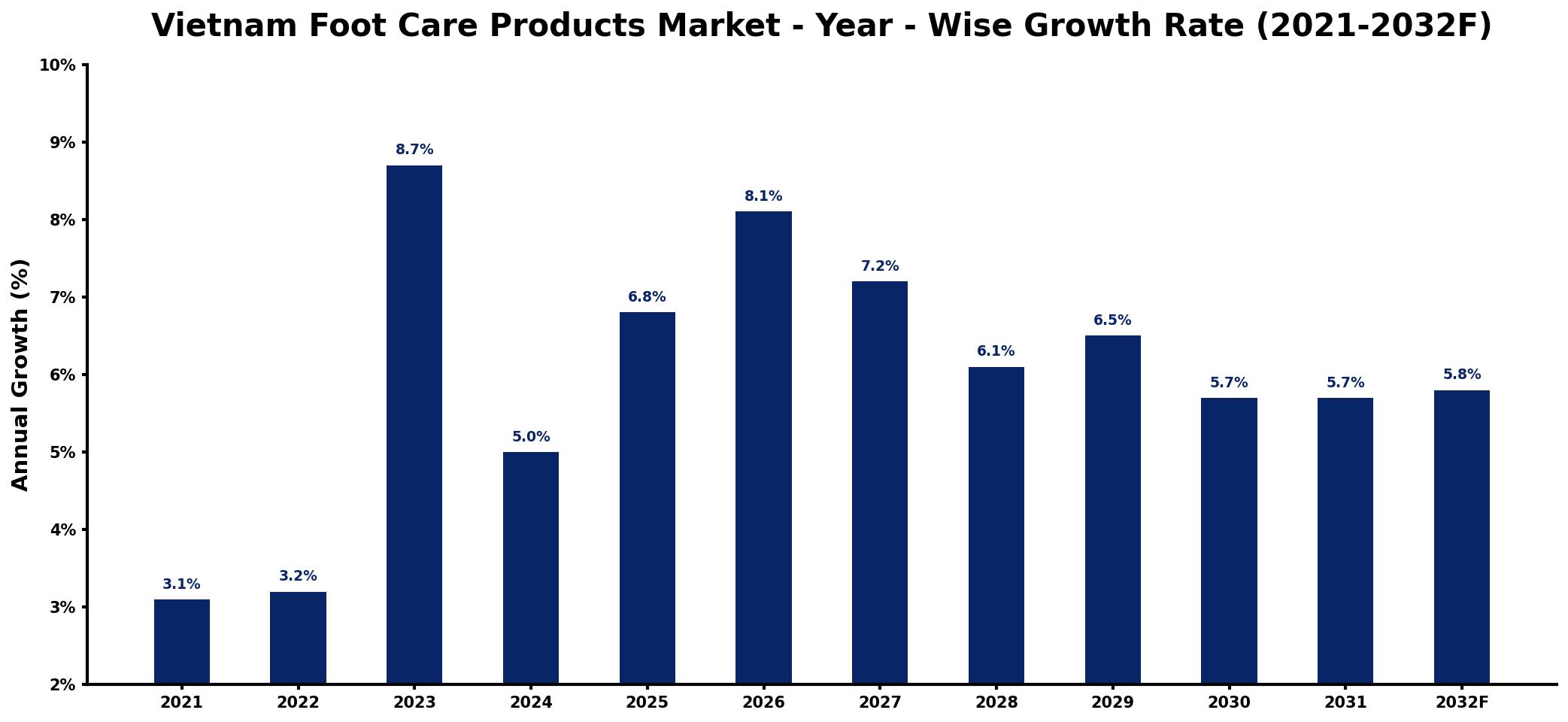
The table below presents the year‑wise growth rates along with the key drivers influencing the market
| Year | Growth Rate | Major Drivers |
| 2021 | 3.1% | Rising consumer health consciousness |
| 2022 | 3.2% | Increased disposable income levels |
| 2023 | 8.7% | Growing e-commerce penetration rates |
| 2024 | 5.0% | Expansion of retail distribution channels |
| 2025 | 6.8% | Higher demand for natural ingredients |
| 2026 | 8.1% | growing downstream application demand |
| 2027 | 7.2% | Growth in wellness tourism sector |
| 2028 | 6.1% | Surge in online shopping habits |
| 2029 | 6.5% | enhanced product quality standards |
| 2030 | 5.7% | Investment in innovative packaging solutions |
| 2031 | 5.7% | Emergence of niche market segments |
| 2032 | 5.8% | Focus on sustainable sourcing practices |
Note: Market size estimations and growth projections presented in this report are based on 6Wresearch's proprietary forecasting methodology, utilizing the latest available industry data, government publications, and primary research inputs.
Vietnam Foot Care Products Market Synopsis
The most significant force driving the Vietnam Foot Care Products Market is the growing awareness of foot health and hygiene. Consumers are increasingly recognizing the importance of caring for their feet, particularly as lifestyle changes result in more foot-related health issues.
As urbanization rises and sedentary habits become common, problems such as corns and fungal infections are prompting a heightened interest in foot care products. This shift in focus from merely aesthetic concerns to genuine health considerations is reshaping consumer behavior within the market.
Vietnam Foot Care Products Market Key Takeaways
- The market is experiencing significant growth driven by increased consumer awareness of foot health.
- Aging populations are creating a demand for specialized foot care products to address age-related issues.
- Urban lifestyle changes are contributing to a rise in foot health problems, thus fueling market demand.
- COVID-19 has shifted consumer focus towards foot health, resulting in increased product interest.
- Competition within the market encourages continuous innovation and product differentiation.
Evaluation of Restraints in Vietnam Foot Care Products Market
One notable restraint is the general lack of consumer education regarding foot health, which hampers the effective promotion of foot care products. Many individuals tend to overlook the necessity of regular foot care, often unaware of the potential complications that can arise from neglect. In addition, the competitive landscape requires that brands not only maintain product quality but also focus on educating consumers about the benefits of their offerings. Without a concerted effort in outreach and information dissemination, the market could experience a slower growth rate than anticipated.
Vietnam Foot Care Products Market Trends
Current trends indicate a growing inclination toward natural and organic ingredients in foot care products. This shift reflects a broader consumer preference for sustainable and health-conscious choices across various personal care sectors. Additionally, technological advancements are introducing innovative solutions, such as smart foot care tools that enhance user experience and efficacy. Furthermore, e-commerce is increasingly becoming a vital channel for distributing foot care products, allowing consumers greater access and convenience in their shopping experiences.
Vietnam Foot Care Products Market Opportunities
Genuine growth opportunities exist in expanding product lines that cater to specific demographic needs, such as products designed explicitly for the elderly or athletes. There is also significant potential in developing targeted marketing strategies that address the unique foot care concerns of urban dwellers. Furthermore, partnerships with healthcare professionals to endorse foot care products can enhance credibility and spur consumer interest, creating fertile ground for market expansion.
Government Initiatives in the Vietnam Foot Care Products Market
The Vietnamese government has been proactive in promoting health and wellness initiatives, which indirectly benefit the foot care products market. Programs focused on public health awareness, including campaigns to improve hygiene practices, are critical in shaping consumer habits. Additionally, public spending in healthcare has increased, leading to better accessibility of healthcare services and resources that can include foot care. This holistic approach creates a favorable environment for the growth of foot care products in the country.
Future Insights of the Vietnam Foot Care Products Market
Looking ahead to 2026-2032, the Vietnam Foot Care Products Market is poised for robust growth driven by sustained consumer awareness of foot health. As lifestyle diseases become more prevalent, the demand for effective foot care solutions will likely rise. With continued urbanization and an aging population, brands that embrace innovation and consumer education will have a competitive edge. The integration of technology into foot care routines will likely play a pivotal role in enhancing market offerings, ensuring that the industry remains dynamic and responsive to consumer needs.
Vietnam Foot Care Products Market Latest Developments (2025 - 2026)
Recent developments indicate an increased emphasis on product innovation and digital marketing strategies among companies in the Vietnam foot care market. Manufacturers are exploring new formulations that focus on natural ingredients, capitalizing on the growing consumer demand for eco-friendly products. Additionally, brands are enhancing their online presence to better engage with consumers, particularly in response to the trends accelerated by the COVID-19 pandemic, which has shifted more shopping to e-commerce platforms.
Vietnam Foot Care Products Market - Key Attractiveness of the Report
- 10 Years of Market Numbers
- Historical Data Starting from 2022 to 2025
- Base Year: 2025
- Forecast Data until 2032
- Key Performance Indicators Impacting the Market
- Major Upcoming Developments and Projects
Key Highlights of the Report:
- Vietnam Foot Care Products Market Outlook
- Market Size of Vietnam Foot Care Products Market, 2025
- Forecast of Vietnam Foot Care Products Market, 2032
- Historical Data and Forecast of Vietnam Foot Care Products Revenues & Volume for the Period 2022-2032F
- Vietnam Foot Care Products Market Trend Evolution
- Vietnam Foot Care Products Market Drivers and Challenges
- Vietnam Foot Care Products Price Trends
- Vietnam Foot Care Products Porter's Five Forces
- Vietnam Foot Care Products Industry Life Cycle
- Historical Data and Forecast of Vietnam Foot Care Products Market Revenues & Volume By Application for the Period 2022-2032F
- Historical Data and Forecast of Vietnam Foot Care Products Market Revenues & Volume By Sports & Athletics for the Period 2022-2032F
- Historical Data and Forecast of Vietnam Foot Care Products Market Revenues & Volume By Medical for the Period 2022-2032F
- Historical Data and Forecast of Vietnam Foot Care Products Market Revenues & Volume By Personal Comfort for the Period 2022-2032F
- Historical Data and Forecast of Vietnam Foot Care Products Market Revenues & Volume By Distribution Channel for the Period 2022-2032F
- Historical Data and Forecast of Vietnam Foot Care Products Market Revenues & Volume By Drug Stores & Pharmacies for the Period 2022-2032F
- Historical Data and Forecast of Vietnam Foot Care Products Market Revenues & Volume By Hospitals & Specialty Clinics for the Period 2022-2032F
- Historical Data and Forecast of Vietnam Foot Care Products Market Revenues & Volume By Online Stores for the Period 2022-2032F
- Historical Data and Forecast of Vietnam Foot Care Products Market Revenues & Volume By Others for the Period 2022-2032F
- Vietnam Foot Care Products Import Export Trade Statistics
- Market Opportunity Assessment By Application
- Market Opportunity Assessment By Distribution Channel
- Vietnam Foot Care Products Top Companies Market Share
- Vietnam Foot Care Products Competitive Benchmarking By Technical and Operational Parameters
- Vietnam Foot Care Products Company Profiles
- Vietnam Foot Care Products Key Strategic Recommendations






































