Vietnam Footwear Manufacturing Machinery Market Size, Share & Growth Rate
The Vietnam Footwear Manufacturing Machinery Market was estimated at USD 309 Million in 2025 and is projected to reach USD 435 Million by 2032, growing at a CAGR of 5.0% from 2026 to 2032. This remarkable growth trajectory is largely driven by Vietnams status as a leading footwear manufacturing hub, characterized by an expanding export market and increasing global demand. The need for advanced machinery that enhances efficiency, quality, and automation is also accelerating this upward trend.
Vietnam Footwear Manufacturing Machinery Market Year-wise Growth Rate and Key Drivers
This graph highlights how the Vietnam Footwear Manufacturing Machinery Market has steadily grown over the years, supported by major growth factors.
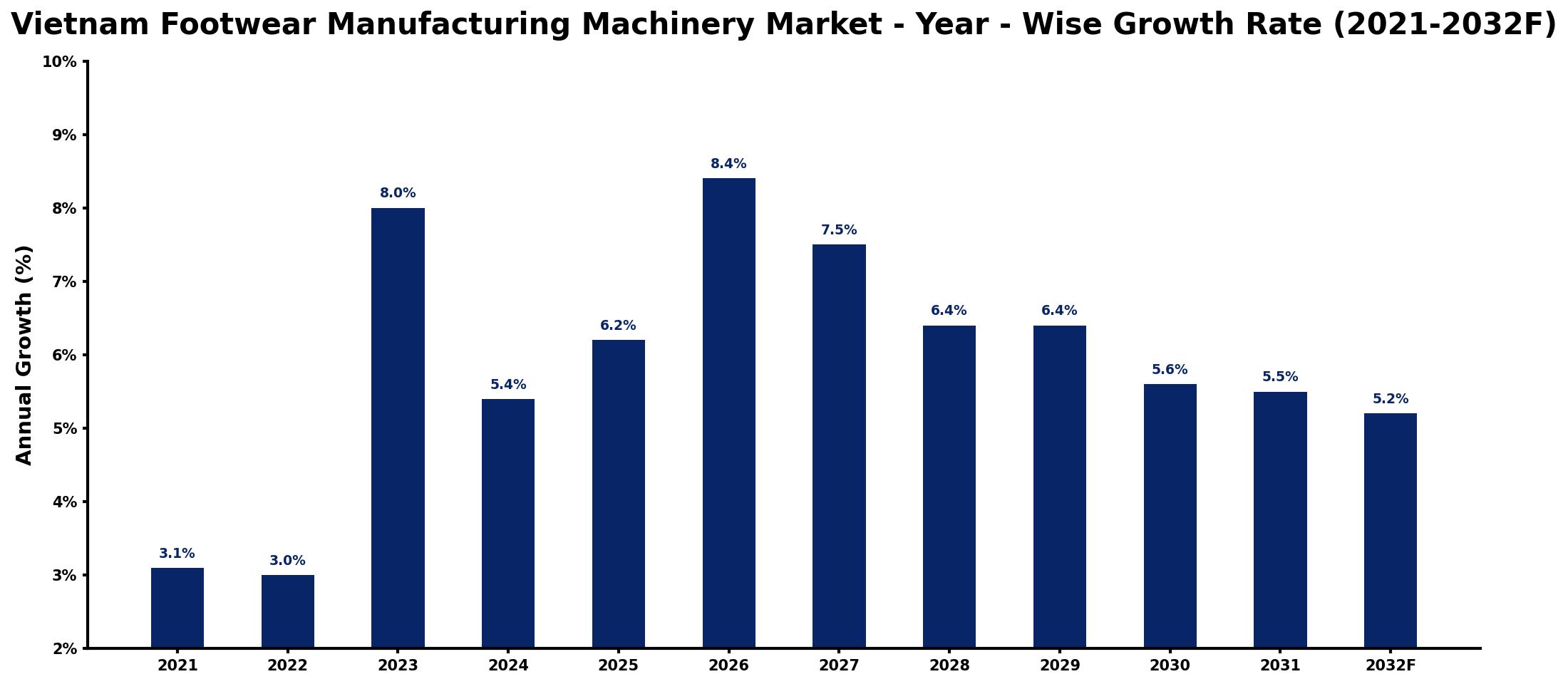
The table below presents the year‑wise growth rates along with the key drivers influencing the market
| Year | Growth Rate | Major Drivers |
| 2021 | 3.1% | Rising demand for automation solutions |
| 2022 | 3.0% | Increased production capacity investments |
| 2023 | 8.0% | Expansion of export markets opportunities |
| 2024 | 5.4% | Growth in domestic retail sector |
| 2025 | 6.2% | Technological advancements in production |
| 2026 | 8.4% | Enhanced focus on sustainability practices |
| 2027 | 7.5% | Rising labor costs driving innovation |
| 2028 | 6.4% | Growing consumer preferences for quality |
| 2029 | 6.4% | Investment in smart factory technologies |
| 2030 | 5.6% | Strengthened supply chain collaborations |
| 2031 | 5.5% | Emerging trends in customization services |
| 2032 | 5.2% | Focus on energy efficiency improvements |
Note: Market size estimations and growth projections presented in this report are based on 6Wresearch's proprietary forecasting methodology, utilizing the latest available industry data, government publications, and primary research inputs.
Vietnam Footwear Manufacturing Machinery Market Synopsis
The strongest force currently shaping the Vietnam Footwear Manufacturing Machinery Market is the relentless pursuit of modernization within the footwear manufacturing sector. As international competition intensifies, manufacturers are compelled to invest in cutting-edge technology that not only streamlines operations but also responds swiftly to changing consumer preferences.
Moreover, the market is buoyed by a robust supply chain infrastructure and favorable labor costs. These factors collectively empower companies to scale up production and improve their offerings, thus solidifying Vietnam's position in the global footwear landscape.
Vietnam Footwear Manufacturing Machinery Market Key Takeaways
- Vietnam is set to remain a key player in the global footwear industry, necessitating advanced manufacturing machinery.
- Adoption of automation technologies is critical to maintaining competitive edge and addressing labor cost concerns.
- Ongoing fluctuations in raw material prices pose a significant challenge to the production landscape.
- The market is adapting rapidly to changing fashion trends, prompting continuous innovation from machinery manufacturers.
- Sustainability practices are becoming increasingly important in machine manufacturing processes.
Evaluation of Restraints in Vietnam Footwear Manufacturing Machinery Market
While the market shows strong growth potential, it is hindered by several constraints that need addressing. Raw material price volatility can significantly affect production budgets, forcing manufacturers to adapt their strategies continually. Furthermore, the rapid evolution of fashion trends challenges machinery providers to innovate swiftly, potentially straining R&D resources. As companies strive to automate and improve efficiencies, they must also consider the balance of labor costs, which can vary widely across the region. Ultimately, the pressure to comply with stricter environmental regulations adds an additional layer of complexity that companies must navigate in their quest for sustainability.
Vietnam Footwear Manufacturing Machinery Market Trends
Current trends indicate a growing preference for automation and smart technologies within footwear manufacturing processes. Businesses are increasingly adopting IoT-enabled machines that enhance connectivity and efficiency. Moreover, there is a rising focus on sustainability, leading to an uptick in the demand for eco-friendly materials and energy-efficient machinery. As consumer expectations shift towards personalized products, manufacturers are also investing in flexible machinery capable of accommodating customized production runs.
Vietnam Footwear Manufacturing Machinery Market Opportunities
There exists a plethora of growth and investment opportunities in the Vietnam Footwear Manufacturing Machinery Market. With the increasing export potential, manufacturers can capitalize on the growing demand for high-quality machinery that meets international standards. Furthermore, initiatives to enhance automation could lead to significant cost reductions, allowing companies to improve their margins. The development of environmentally friendly machinery also presents a ripe opportunity for market players to differentiate themselves in an increasingly conscientious marketplace.
Government Initiatives in the Vietnam Footwear Manufacturing Machinery Market
The Vietnamese government is actively supporting the growth of the footwear manufacturing sector through various initiatives aimed at improving infrastructure and enhancing workforce skills. Public spending on technology upgrades and training programs helps facilitate modernization efforts. Additionally, incentives for adopting sustainable practices are also being introduced to ensure compliance with international environmental standards. Such support is essential to fostering a more competitive landscape and positioning Vietnam as a leader in the global footwear market.
Future Insights of the Vietnam Footwear Manufacturing Machinery Market
Looking ahead to 2026-2032, the Vietnam Footwear Manufacturing Machinery Market is poised for robust growth. The shift toward automation and the incorporation of artificial intelligence in production processes will likely enhance productivity and efficiency. Moreover, the continuous emphasis on sustainability will drive innovation in machinery designed to minimize waste and energy consumption. As Vietnam continues to establish itself as a premier footwear manufacturing hub, the demand for sophisticated manufacturing machinery will become increasingly paramount.
Vietnam Footwear Manufacturing Machinery Market Latest Developments (2025 - 2026)
Recent industry developments indicate a surge in investments toward automation technologies aimed at improving operational efficiency in the footwear manufacturing space. Companies are focusing on integrating advanced robotics into production lines to enhance precision and speed. Additionally, there has been a noticeable shift toward eco-friendly materials and processes, as manufacturers strive to meet both consumer expectations and regulatory requirements. These trends are shaping a new landscape in footwear manufacturing machinery, making adaptability crucial for success.
Vietnam Footwear Manufacturing Machinery Market - Key Attractiveness of the Report
- 10 Years of Market Numbers
- Historical Data Starting from 2022 to 2025
- Base Year: 2025
- Forecast Data until 2032
- Key Performance Indicators Impacting the Market
- Major Upcoming Developments and Projects
Key Highlights of the Report:
- Vietnam Footwear Manufacturing Machinery Market Outlook
- Market Size of Vietnam Footwear Manufacturing Machinery Market, 2025
- Forecast of Vietnam Footwear Manufacturing Machinery Market, 2032
- Historical Data and Forecast of Vietnam Footwear Manufacturing Machinery Revenues & Volume for the Period 2022-2032F
- Vietnam Footwear Manufacturing Machinery Market Trend Evolution
- Vietnam Footwear Manufacturing Machinery Market Drivers and Challenges
- Vietnam Footwear Manufacturing Machinery Price Trends
- Vietnam Footwear Manufacturing Machinery Porter's Five Forces
- Vietnam Footwear Manufacturing Machinery Industry Life Cycle
- Historical Data and Forecast of Vietnam Footwear Manufacturing Machinery Market Revenues & Volume By Type for the Period 2022-2032F
- Historical Data and Forecast of Vietnam Footwear Manufacturing Machinery Market Revenues & Volume By Pattern-making for the Period 2022-2032F
- Historical Data and Forecast of Vietnam Footwear Manufacturing Machinery Market Revenues & Volume By Cutting for the Period 2022-2032F
- Historical Data and Forecast of Vietnam Footwear Manufacturing Machinery Market Revenues & Volume By Finishing for the Period 2022-2032F
- Historical Data and Forecast of Vietnam Footwear Manufacturing Machinery Market Revenues & Volume By Molds for the Period 2022-2032F
- Historical Data and Forecast of Vietnam Footwear Manufacturing Machinery Market Revenues & Volume By Repair for the Period 2022-2032F
- Historical Data and Forecast of Vietnam Footwear Manufacturing Machinery Market Revenues & Volume By Component Preparation for the Period 2022-2032F
- Historical Data and Forecast of Vietnam Footwear Manufacturing Machinery Market Revenues & Volume By Stitching Machinery for the Period 2022-2032F
- Historical Data and Forecast of Vietnam Pattern-making Footwear Manufacturing Machinery Market Revenues & Volume By Others for the Period 2022-2032F
- Historical Data and Forecast of Vietnam Footwear Manufacturing Machinery Market Revenues & Volume By Technology for the Period 2022-2032F
- Historical Data and Forecast of Vietnam Footwear Manufacturing Machinery Market Revenues & Volume By Manual for the Period 2022-2032F
- Historical Data and Forecast of Vietnam Footwear Manufacturing Machinery Market Revenues & Volume By Semi-Automatic for the Period 2022-2032F
- Historical Data and Forecast of Vietnam Footwear Manufacturing Machinery Market Revenues & Volume By Fully-Automatic for the Period 2022-2032F
- Historical Data and Forecast of Vietnam Footwear Manufacturing Machinery Market Revenues & Volume By Application for the Period 2022-2032F
- Historical Data and Forecast of Vietnam Footwear Manufacturing Machinery Market Revenues & Volume By Athletic for the Period 2022-2032F
- Historical Data and Forecast of Vietnam Footwear Manufacturing Machinery Market Revenues & Volume By Casual for the Period 2022-2032F
- Historical Data and Forecast of Vietnam Footwear Manufacturing Machinery Market Revenues & Volume By Military for the Period 2022-2032F
- Historical Data and Forecast of Vietnam Footwear Manufacturing Machinery Market Revenues & Volume By Others for the Period 2022-2032F
- Vietnam Footwear Manufacturing Machinery Import Export Trade Statistics
- Market Opportunity Assessment By Type
- Market Opportunity Assessment By Technology
- Vietnam Footwear Manufacturing Machinery Top Companies Market Share
- Vietnam Footwear Manufacturing Machinery Competitive Benchmarking By Technical and Operational Parameters
- Vietnam Footwear Manufacturing Machinery Company Profiles
- Vietnam Footwear Manufacturing Machinery Key Strategic Recommendations






































