Vietnam Formwork Market Summary
The vietnam formwork market was estimated at USD 214 Million in 2025 and is projected to reach USD 301 Million by 2032, growing at a CAGR of 7.9% from 2026 to 2032.
Vietnam Formwork Market Year-wise Growth Rate and Key Drivers
This graph highlights how the Vietnam Formwork Market has steadily grown over the past five years, supported by major growth factors.
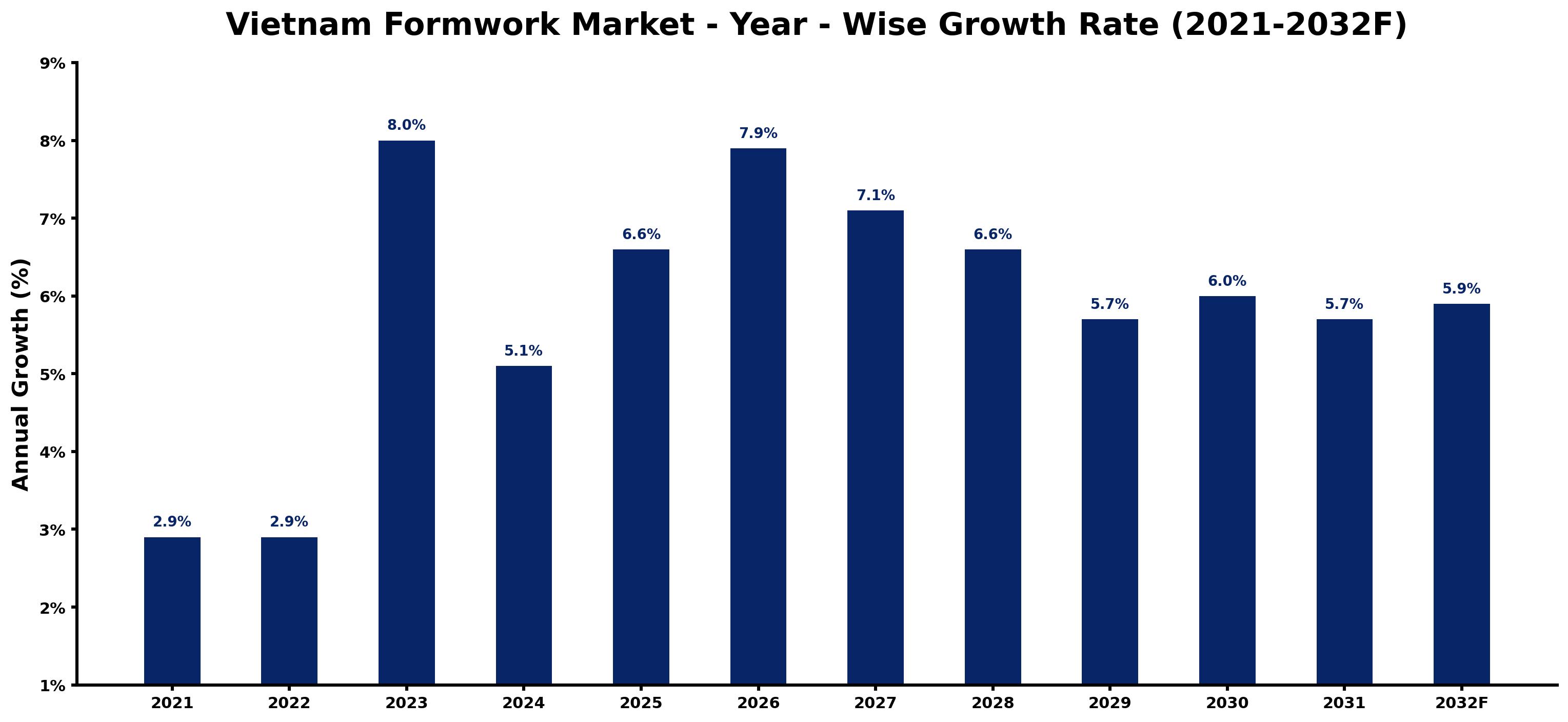
The table below presents the year wise growth rates along with the key drivers influencing the market
| Year | Growth Rate | Major Drivers |
| 2021 | 2.9% | Construction activity rebounded in Vietnam, boosting the need for efficient formwork solutions. |
| 2022 | 2.9% | Manufacturing sectors increasingly relocated to Vietnam, requiring scalable construction frameworks. |
| 2023 | 8.0% | Urban infrastructure projects gained momentum, necessitating advanced formwork technologies for efficiency. |
| 2024 | 5.1% | Local construction firms embraced innovation, enhancing productivity through modern formwork systems. |
| 2025 | 6.6% | Government-led urbanization initiatives stimulated significant investments in affordable housing projects. |
| 2026 | 7.9% | Rural electrification efforts heightened demand for reliable construction materials, including formwork. |
| 2027 | 7.1% | Adoption of sustainable construction practices encouraged eco-friendly formwork material utilization. |
| 2028 | 6.6% | International partnerships flourished, introducing advanced formwork techniques to Vietnamese builders. |
| 2029 | 5.7% | Infrastructure financing increased, empowering larger scale development and construction endeavors. |
| 2030 | 6.0% | Technological integration in construction processes necessitated sophisticated and adaptable formwork solutions. |
| 2031 | 5.7% | Vietnam's economic growth attracted foreign investment, expanding the construction market significantly. |
| 2032 | 5.9% | Shifts toward modular construction methods reinforced the importance of versatile formwork options. |
Note - Market size estimations and growth projections presented in this report are based on 6Wresearch's advanced forecasting approach, validated with industry datasets as of June 2026.
Vietnam Formwork Market Synopsis
The Vietnam Formwork Market is projected to reach 7.9% and witness significant growth during the forecast period (2026-2032). This growth can be attributed to several converging factors that are reshaping the country's construction landscape. Urbanization continues to escalate, coupled with increasing industrialization, which has led to a surge in construction activities across Vietnam. As development accelerates, the demand for advanced formwork products is anticipated to rise sharply, supported by substantial foreign investments aimed at bolstering infrastructure projects.
Vietnam Formwork Market Growth Drivers
A variety of factors are driving growth in the Vietnam formwork market. First, the rapid pace of urbanization has necessitated the construction of residential and commercial buildings, thereby increasing the need for formwork solutions. Second, industrial growth has led to heightened construction activities, particularly in infrastructure and industrial projects, requiring robust formwork systems to support complex builds. Third, the influx of foreign capital into Vietnam's infrastructure sector is augmenting the formwork demand as these projects often adhere to international standards necessitating innovative solutions. Fourth, the government's focus on sustainable building practices aligns with the growing popularity of eco-friendly formwork systems, which are more energy-efficient. Lastly, the evolution of technology has encouraged manufacturers to innovate, introducing modern alternatives such as plastic panels, which provide efficient solutions compared to traditional wood and steel options.
Vietnam Formwork Market Trends and Opportunities
The Vietnam formwork market is characterized by key trends and numerous opportunities. One notable trend is the increasing shift towards green building materials, prompted by government initiatives aimed at promoting sustainability in construction. This pivot not only addresses environmental concerns but also enhances energy efficiency in structures. Additionally, there is a rising preference for modular and prefabricated building solutions, which are gaining popularity due to their time-saving and cost-effective benefits. Furthermore, the development of digital tools in construction management is expected to streamline formwork design and installation processes, enhancing operational efficiencies. Alongside this, there exists an opportunity for companies to penetrate the market with innovative and cost-effective solutions tailored to meet the dynamic needs of builders.
Vietnam Formwork Market Challenges and Restraints
Despite the positive outlook, several challenges may hinder the growth of the Vietnam formwork market. One critical barrier is the fluctuating price of raw materials used in formwork production, which can impact overall project costs. Additionally, the availability of skilled labor remains a challenge, as the construction sector grapples with a workforce that is not fully equipped to handle advanced technologies. Moreover, inconsistent regulatory frameworks may pose obstacles for foreign investments, creating uncertainties in market entry and operational strategies. Furthermore, competition from traditional building methods might restrict market expansion, as some construction companies might be hesitant to transition to modern formwork solutions. Lastly, economic fluctuations may affect public and private spending in construction, potentially limiting future growth prospects.
Vietnam Formwork Market Government Investment and Initiatives
The Vietnamese government is proactively investing in infrastructure development, which plays a crucial role in propelling the formwork market forward. There are several key initiatives aimed at promoting construction projects, including increased public spending on transportation and urban infrastructure. These efforts are further bolstered by policies encouraging private sector participation and foreign investment in large-scale construction developments. The government is also emphasizing green building practices, supported by incentives for using environmentally friendly materials and technologies. These initiatives not only aim to enhance the quality of buildings but also contribute towards sustainable urban growth. Furthermore, the establishment of various development plans and frameworks underscores the government's commitment to improving the overall construction sector, reinforcing the demand for efficient formwork solutions.
Vietnam Formwork Market Latest Developments (May 2025 - June 2026)
Recent developments within the Vietnam formwork market between May 2025 and June 2026 indicate a noteworthy trend towards the adoption of advanced technologies. Companies have begun integrating digital tools for formwork design and planning, resulting in optimized project timelines and reduced costs. The introduction of new materials that are lighter yet stronger has also been a focal point, enhancing the overall efficiency of construction works. Furthermore, increased collaboration between local contractors and international firms has led to knowledge transfer and the adoption of best practices in formwork applications. This period has also witnessed an uptick in government initiatives aimed at encouraging sustainability in construction, providing more opportunities for innovative formwork solutions to thrive. Overall, these developments signal a forward momentum in the Vietnam formwork market, characterized by innovation and a focus on sustainable practices.
Vietnam Formwork Market - Key Attractiveness of the Report
- 10 Years of Market Numbers
- Historical Data Starting from 2022 to 2025
- Base Year: 2025
- Forecast Data until 2032
- Key Performance Indicators Impacting the Market
- Major Upcoming Developments and Projects
Key Highlights of the Report:
- Vietnam Formwork Market Outlook
- Market Size of Vietnam Formwork Market, 2025
- Forecast of Vietnam Formwork Market, 2032F
- Historical Data and Forecast of Vietnam Formwork Revenues & Volume for the Period 2022-2032F
- Vietnam Formwork Market Trend Evolution
- Vietnam Formwork Market Drivers and Challenges
- Vietnam Formwork Price Trends
- Vietnam Formwork Porter's Five Forces
- Vietnam Formwork Industry Life Cycle
- Historical Data and Forecast of Vietnam Formwork Market Revenues & Volume By Product Type for the Period 2022-2032F
- Historical Data and Forecast of Vietnam Formwork Market Revenues & Volume By Traditional timber formwork for the Period 2022-2032F
- Historical Data and Forecast of Vietnam Formwork Market Revenues & Volume By Engineered Formwork System for the Period 2022-2032F
- Historical Data and Forecast of Vietnam Formwork Market Revenues & Volume By Re-usable plastic formwork for the Period 2022-2032F
- Historical Data and Forecast of Vietnam Formwork Market Revenues & Volume By Others for the Period 2022-2032F
- Historical Data and Forecast of Vietnam Formwork Market Revenues & Volume By Applications for the Period 2022-2032F
- Historical Data and Forecast of Vietnam Formwork Market Revenues & Volume By Buildings for the Period 2022-2032F
- Historical Data and Forecast of Vietnam Formwork Market Revenues & Volume By Transportation for the Period 2022-2032F
- Historical Data and Forecast of Vietnam Formwork Market Revenues & Volume By Industrial Facilities for the Period 2022-2032F
- Vietnam Formwork Import Export Trade Statistics
- Market Opportunity Assessment By Product Type
- Market Opportunity Assessment By Applications
- Vietnam Formwork Top Companies Market Share
- Vietnam Formwork Competitive Benchmarking By Technical and Operational Parameters
- Vietnam Formwork Company Profiles
- Vietnam Formwork Key Strategic Recommendations






































