Vietnam Fruit Juices Market Summary
The vietnam fruit juices market was estimated at USD 217 Million in 2025 and is projected to reach USD 307 Million by 2032, growing at a CAGR of 7.8% from 2026 to 2032.
Vietnam Fruit Juices Market Year-wise Growth Rate and Key Drivers
This graph highlights how the Vietnam Fruit Juices Market has steadily grown over the past five years, supported by major growth factors.
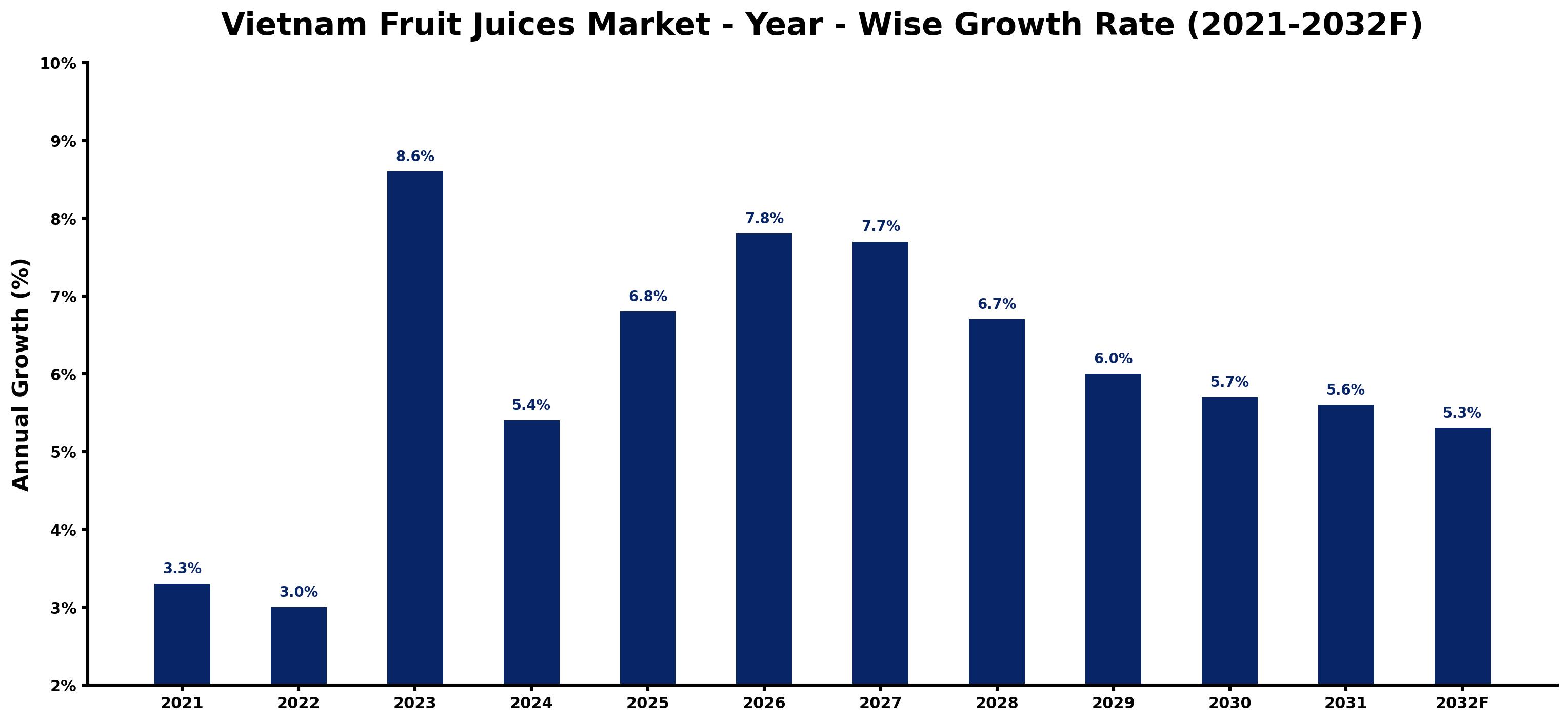
The table below presents the year wise growth rates along with the key drivers influencing the market
| Year | Growth Rate | Major Drivers |
| 2021 | 3.3% | Vietnam's urbanization spurred more fruit juice consumption in metropolitan areas. |
| 2022 | 3.0% | Consumer awareness about health benefits boosted sales of natural fruit juices. |
| 2023 | 8.6% | Local farms increasingly supply fresh ingredients for juice production effectively. |
| 2024 | 5.4% | Innovative marketing strategies attract younger demographics towards juice brands. |
| 2025 | 6.8% | Major retailers expand juice product lines to meet evolving consumer preferences. |
| 2026 | 7.8% | E-commerce platforms facilitate wider distribution of fruit juices across the nation. |
| 2027 | 7.7% | Rural agricultural initiatives enhance the quality and accessibility of fruits. |
| 2028 | 6.7% | International brands enter the market, introducing diverse flavor options. |
| 2029 | 6.0% | Sustainability trends influence packaging innovations within the juice sector. |
| 2030 | 5.7% | Health-focused product lines gain traction among health-conscious Vietnamese consumers. |
| 2031 | 5.6% | Collaborations between fruit farmers and manufacturers improve supply chain efficiencies. |
| 2032 | 5.3% | Increased investment in juice processing technology enhances product quality significantly. |
Note - Market size estimations and growth projections presented in this report are based on 6Wresearch's advanced forecasting approach, validated with industry datasets as of June 2026.
Vietnam Fruit Juices Market Synopsis
The Vietnam Fruit Juices Market is projected to reach 7.8% and witness significant growth during the forecast period (2026-2032). This growth is primarily driven by increasing urbanization, a rise in disposable incomes, and evolving consumer preferences that lean towards healthier beverage options. Fruit juices, derived from fresh fruits or concentrates, are favored for their refreshing flavors and nutritional advantages. As lifestyle changes continue to take hold in Vietnam, the market for fruit juices is set for steady expansion.
Vietnam Fruit Juices Market Growth Drivers
The growth of the Vietnam fruit juices market is influenced by several key drivers:
- The emergence of a growing middle-class population in Vietnam has increased the demand for healthier beverages, prompting consumers to shift from carbonated drinks to natural fruit juices.
- Heightened health awareness among consumers has driven the preference for nutritious beverage alternatives, further bolstering the consumption of fruit juices.
- The rising popularity of ready-to-drink and convenience-oriented beverages has played a significant role in the increased adoption of packaged fruit juices across various retail platforms.
- Vietnam's rich agricultural landscape, characterized by an abundance of tropical fruits, provides a robust supply chain for fruit juice production, thereby enhancing local fruit processing capabilities.
- The growing trend of health-conscious eating and drinking habits is leading consumers to seek products that offer both taste and nutritional benefits, which fruit juices can fulfill.
Vietnam Fruit Juices Market Challenges and Restraints
Despite its promising growth, the Vietnam fruit juices market encounters several challenges that could impede its progress:
- Intense competition from alternative non-alcoholic beverages, such as carbonated soft drinks and bottled water, poses a significant challenge as consumers opt for diverse beverage choices.
- Maintaining the quality and freshness of fruit juices without relying on artificial additives or preservatives is crucial for manufacturers aiming to meet consumer expectations.
- Economic fluctuations and changes in consumer spending habits, especially concerning premium-priced fruit juices, can lead to varying demand patterns in the market.
- Supply chain vulnerabilities highlighted by recent global events necessitate a focus on enhancing the resilience of fruit juice production and distribution networks.
- Consumer skepticism towards product labeling and authenticity can complicate marketing efforts for fruit juice manufacturers, requiring transparency and trust-building strategies.
Vietnam Fruit Juices Market COVID-19 Impact
The Covid-19 pandemic, which significantly influenced consumer behavior in 2025, had notable implications for the Vietnam fruit juices market. The crisis catalyzed an increasing preference for health-oriented products, with a notable rise in demand for immunity-boosting beverages such as fruit juices. Additionally, the pandemic accelerated the shift towards e-commerce and online grocery shopping, prompting a transformation in distribution channels and consumer purchasing habits. Economic repercussions of the pandemic may have impacted expenditure levels on non-essential items, resulting in fluctuations in demand for premium fruit juice products. Furthermore, the crisis shed light on the necessity for supply chain resilience and the importance of local sourcing, encouraging a focus on domestic fruit production and processing capabilities.
Vietnam Fruit Juices Market Government Investment and Initiatives
The Vietnamese government has acknowledged the importance of the fruit juices market and has initiated several investments and policies to support its growth. These include initiatives aimed at enhancing agricultural productivity through the development of better farming practices and technologies for fruit cultivation. Public spending is also directed towards improving infrastructure related to food processing and supply chains, thereby facilitating the efficient distribution of fruit juice products. Additionally, government incentives encourage local fruit producers and processors to innovate and maintain high-quality standards in their products. Furthermore, efforts to promote organic farming practices contribute positively to the sustainability of the fruit juices market.
Vietnam Fruit Juices Market Latest Developments (May 2025 - June 2026)
Recent developments in the Vietnam fruit juices market from May 2025 to June 2026 reflect industry trends focused on health-conscious offerings and sustainability. Manufacturers have increasingly adopted eco-friendly packaging solutions in response to consumer demand for environmentally responsible products. Additionally, there has been a surge in innovative product launches featuring exotic fruit blends and functional beverages that cater to specific health benefits. Distribution channels have also evolved, with a significant uptick in online sales as consumer preferences have shifted towards digital shopping platforms. Overall, the industry is adapting to the changing landscape by aligning with consumer expectations and regulatory frameworks.
Vietnam Fruit Juices Market - Key Attractiveness of the Report
- 10 Years of Market Numbers
- Historical Data Starting from 2022 to 2025
- Base Year: 2025
- Forecast Data until 2032
- Key Performance Indicators Impacting the Market
- Major Upcoming Developments and Projects
Key Highlights of the Report:
- Vietnam Fruit Juices Market Outlook
- Market Size of Vietnam Fruit Juices Market, 2025
- Forecast of Vietnam Fruit Juices Market, 2032
- Historical Data and Forecast of Vietnam Fruit Juices Revenues & Volume for the Period 2022-2032F
- Vietnam Fruit Juices Market Trend Evolution
- Vietnam Fruit Juices Market Drivers and Challenges
- Vietnam Fruit Juices Price Trends
- Vietnam Fruit Juices Porter's Five Forces
- Vietnam Fruit Juices Industry Life Cycle
- Historical Data and Forecast of Vietnam Fruit Juices Market Revenues & Volume By ?Product Type for the Period 2022-2032F
- Historical Data and Forecast of Vietnam Fruit Juices Market Revenues & Volume By Carbonated Juices for the Period 2022-2032F
- Historical Data and Forecast of Vietnam Fruit Juices Market Revenues & Volume By Naturally Sweetened for the Period 2022-2032F
- Historical Data and Forecast of Vietnam Fruit Juices Market Revenues & Volume By Health Juice for the Period 2022-2032F
- Historical Data and Forecast of Vietnam Fruit Juices Market Revenues & Volume By Fruit Juice for the Period 2022-2032F
- Historical Data and Forecast of Vietnam Fruit Juices Market Revenues & Volume By Pre-Biotic And Pro-Biotic for the Period 2022-2032F
- Historical Data and Forecast of Vietnam Fruit Juices Market Revenues & Volume By Others for the Period 2022-2032F
- Historical Data and Forecast of Vietnam Fruit Juices Market Revenues & Volume By Concentration Type for the Period 2022-2032F
- Historical Data and Forecast of Vietnam Fruit Juices Market Revenues & Volume By Concentrated for the Period 2022-2032F
- Historical Data and Forecast of Vietnam Fruit Juices Market Revenues & Volume By Non-Concentrated for the Period 2022-2032F
- Historical Data and Forecast of Vietnam Fruit Juices Market Revenues & Volume By Packaging Type for the Period 2022-2032F
- Historical Data and Forecast of Vietnam Fruit Juices Market Revenues & Volume By PET/Plastic? for the Period 2022-2032F
- Historical Data and Forecast of Vietnam Fruit Juices Market Revenues & Volume By Metal can for the Period 2022-2032F
- Historical Data and Forecast of Vietnam Fruit Juices Market Revenues & Volume By Tetrapaks? for the Period 2022-2032F
- Historical Data and Forecast of Vietnam Fruit Juices Market Revenues & Volume By Glass? for the Period 2022-2032F
- Historical Data and Forecast of Vietnam Fruit Juices Market Revenues & Volume By Other? for the Period 2022-2032F
- Historical Data and Forecast of Vietnam Fruit Juices Market Revenues & Volume By Distribution Channel for the Period 2022-2032F
- Historical Data and Forecast of Vietnam Fruit Juices Market Revenues & Volume By Online for the Period 2022-2032F
- Historical Data and Forecast of Vietnam Fruit Juices Market Revenues & Volume By Offline for the Period 2022-2032F
- Vietnam Fruit Juices Import Export Trade Statistics
- Market Opportunity Assessment By ?Product Type
- Market Opportunity Assessment By Concentration Type
- Market Opportunity Assessment By Distribution Channel
- Vietnam Fruit Juices Top Companies Market Share
- Vietnam Fruit Juices Competitive Benchmarking By Technical and Operational Parameters
- Vietnam Fruit Juices Company Profiles
- Vietnam Fruit Juices Key Strategic Recommendations






































