Vietnam Fruit Pulp Market Size, Share & Growth Rate
The Vietnam Fruit Pulp Market was estimated at USD 813 Million in 2025 and is projected to reach USD 1153 Million by 2032, growing at a CAGR of 5.1% from 2026 to 2032. This robust growth trajectory is driven primarily by the rising consumer demand for natural and flavorful ingredients, particularly among health-conscious individuals. Additionally, the expansion of the food and beverage sector in Vietnam, with increasing applications of fruit pulp in innovative products such as smoothies and desserts, further propels market dynamics.
Vietnam Fruit Pulp Market Year-wise Growth Rate and Key Drivers
This graph highlights how the Vietnam Fruit Pulp Market has steadily grown over the years, supported by major growth factors.
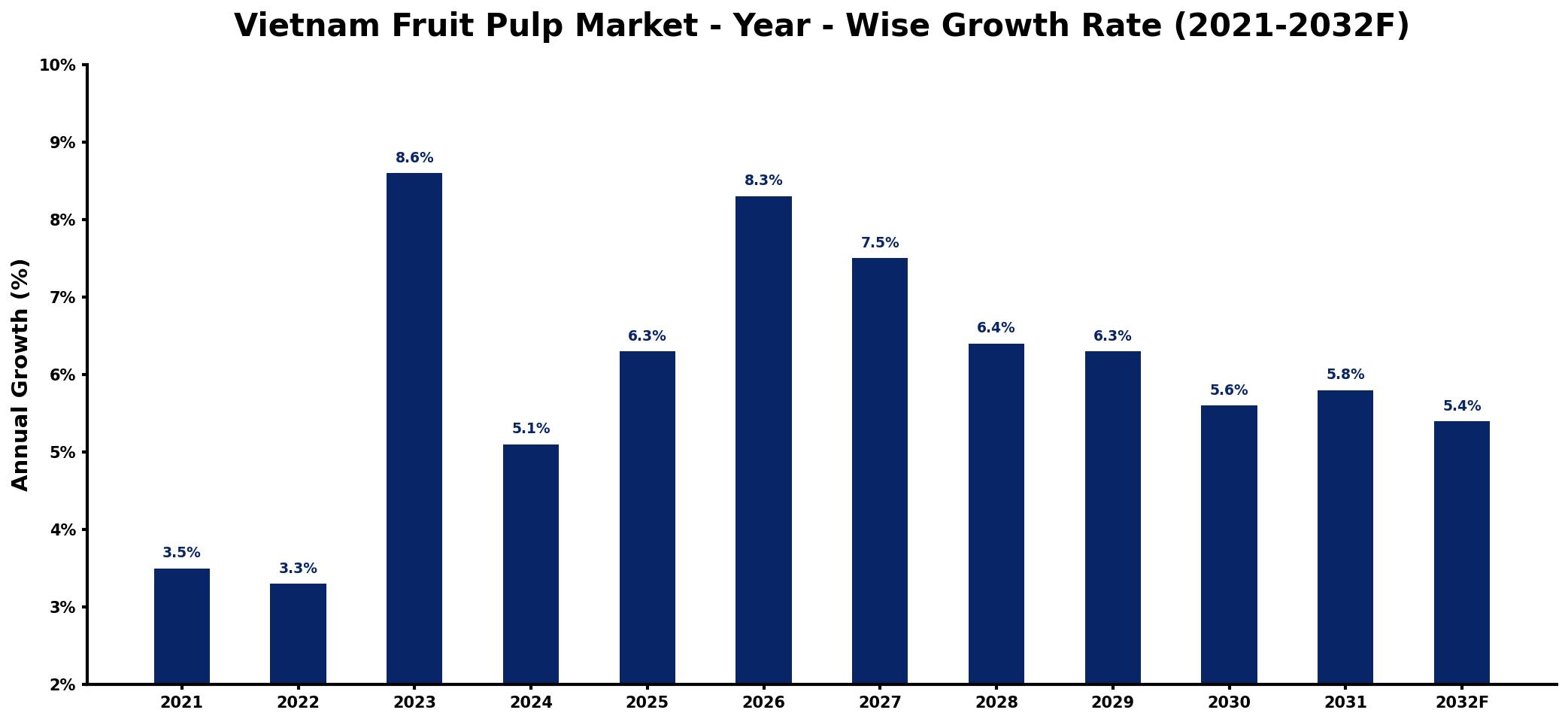
The table below presents the year‑wise growth rates along with the key drivers influencing the market
| Year | Growth Rate | Major Drivers |
| 2021 | 3.5% | Rising health consciousness among consumers |
| 2022 | 3.3% | Expansion of retail distribution channels |
| 2023 | 8.6% | Increased demand for natural ingredients |
| 2024 | 5.1% | Growth in beverage industry applications |
| 2025 | 6.3% | Emerging trends in plant-based diets |
| 2026 | 8.3% | Investment in processing technologies |
| 2027 | 7.5% | Growing popularity of organic products |
| 2028 | 6.4% | Surge in online grocery shopping |
| 2029 | 6.3% | Innovations in packaging solutions |
| 2030 | 5.6% | Focus on sustainable sourcing practices |
| 2031 | 5.8% | Rising export opportunities in Asia |
| 2032 | 5.4% | growing regional consumption patterns |
Note: Market size estimations and growth projections presented in this report are based on 6Wresearch's proprietary forecasting methodology, utilizing the latest available industry data, government publications, and primary research inputs.
Vietnam Fruit Pulp Market Synopsis
The strongest force currently shaping the Vietnam Fruit Pulp Market is the growing inclination of consumers toward natural ingredients in their culinary practices. As health trends dominate, the demand for fruit pulps, known for their authenticity and taste, has surged across various food applications, making them indispensable for manufacturers.
In Vietnam, the rich variety of tropical fruits provides a unique advantage for the fruit pulp market, enabling producers to cater to diverse consumer preferences. This versatility supports the incorporation of fruit pulp in an array of products, from ice creams to dairy offerings, amplifying its role in enhancing both flavor and texture.
Vietnam Fruit Pulp Market Key Takeaways
- The market is projected to experience significant growth, driven by increasing consumer health consciousness and demand for natural ingredients.
- Fruit pulp serves as a versatile ingredient across multiple applications, including beverages, desserts, and dairy products.
- The abundance of tropical fruit varieties in Vietnam offers a competitive edge in the fruit pulp production landscape.
- Shifts in consumer preferences during the pandemic have influenced purchasing behaviors, steering attention towards essential products.
- Domestic and international suppliers play pivotal roles in shaping the market by offering a wide range of fruit pulp options.
Evaluation of Restraints in Vietnam Fruit Pulp Market
Despite the positive outlook, the Vietnam Fruit Pulp Market faces notable restraints. Seasonal supply variations significantly impact production capabilities, leading to potential shortages. Additionally, consumer preferences for whole fruits can hinder the market's expansion. Manufacturers must therefore prioritize quality assurance and innovative marketing strategies to differentiate fruit pulp products from fresh fruit alternatives, highlighting their versatility and convenience in modern culinary applications.
Vietnam Fruit Pulp Market Trends
Emerging trends in the Vietnam Fruit Pulp Market include a notable shift towards organic and sustainably sourced fruit pulps as consumers become increasingly environmentally conscious. The rise of the health food movement has also led to a growing interest in functional foods, pushing manufacturers to develop products with added nutritional benefits. Additionally, the integration of advanced processing technologies is enhancing the flavor retention and quality of fruit pulps, enabling them to meet evolving consumer expectations.
Vietnam Fruit Pulp Market Opportunities
The market presents numerous growth and investment opportunities, particularly in product innovation and diversification. Companies can explore partnerships with local farmers to ensure a steady supply of high-quality tropical fruits while also investing in processing capabilities that enhance the shelf life and usability of fruit pulps. Furthermore, the increasing global demand for exotic fruit flavors opens avenues for exports, allowing Vietnamese manufacturers to expand their reach beyond local markets.
Government Initiatives in the Vietnam Fruit Pulp Market
The Vietnamese government has been proactive in supporting the agricultural sector, including fruit processing initiatives. Policies aimed at promoting sustainable farming practices and improving food safety standards are integral to the governments strategy. Public investment in agricultural technology and infrastructure is also enhancing the capabilities of local fruit processors, enabling them to better compete in the fruit pulp market both domestically and internationally.
Future Insights of the Vietnam Fruit Pulp Market
Looking forward to 2026-2032, the Vietnam Fruit Pulp Market is set to evolve as consumer preferences continue to shift towards healthy and convenient food options. The anticipated growth will be supported by ongoing investments in processing technologies and innovative product development, positioning Vietnamese fruit pulp as a key ingredient in the global food landscape. Sustainable practices and quality assurance will become critical differentiators, further solidifying the market's foundation for long-term success.
Vietnam Fruit Pulp Market Latest Developments (2025 - 2026)
In recent months, the Vietnam Fruit Pulp Market has witnessed an uptick in collaborations between domestic producers and international suppliers, aiming to enhance product offerings and distribution channels. Advances in processing technology have been implemented, allowing for improved flavor retention in fruit pulp products. Additionally, marketing campaigns focusing on the health benefits and versatility of fruit pulps have gained traction, encouraging broader consumer acceptance and increased demand.
Vietnam Fruit Pulp Market - Key Attractiveness of the Report
- 10 Years of Market Numbers
- Historical Data Starting from 2022 to 2025
- Base Year: 2025
- Forecast Data until 2032
- Key Performance Indicators Impacting the Market
- Major Upcoming Developments and Projects
Key Highlights of the Report:
- Vietnam Fruit Pulp Market Outlook
- Market Size of Vietnam Fruit Pulp Market, 2025
- Forecast of Vietnam Fruit Pulp Market, 2032
- Historical Data and Forecast of Vietnam Fruit Pulp Revenues & Volume for the Period 2022-2032F
- Vietnam Fruit Pulp Market Trend Evolution
- Vietnam Fruit Pulp Market Drivers and Challenges
- Vietnam Fruit Pulp Price Trends
- Vietnam Fruit Pulp Porter's Five Forces
- Vietnam Fruit Pulp Industry Life Cycle
- Historical Data and Forecast of Vietnam Fruit Pulp Market Revenues & Volume By Fruit Type for the Period 2022-2032F
- Historical Data and Forecast of Vietnam Fruit Pulp Market Revenues & Volume By Mango for the Period 2022-2032F
- Historical Data and Forecast of Vietnam Fruit Pulp Market Revenues & Volume By Strawberry for the Period 2022-2032F
- Historical Data and Forecast of Vietnam Fruit Pulp Market Revenues & Volume By Apple for the Period 2022-2032F
- Historical Data and Forecast of Vietnam Fruit Pulp Market Revenues & Volume By Guava for the Period 2022-2032F
- Historical Data and Forecast of Vietnam Fruit Pulp Market Revenues & Volume By Berries for the Period 2022-2032F
- Historical Data and Forecast of Vietnam Fruit Pulp Market Revenues & Volume By Citrus Fruits for the Period 2022-2032F
- Historical Data and Forecast of Vietnam Fruit Pulp Market Revenues & Volume By Others for the Period 2022-2032F
- Historical Data and Forecast of Vietnam Fruit Pulp Market Revenues & Volume By Form for the Period 2022-2032F
- Historical Data and Forecast of Vietnam Fruit Pulp Market Revenues & Volume By Liquid for the Period 2022-2032F
- Historical Data and Forecast of Vietnam Fruit Pulp Market Revenues & Volume By Powder for the Period 2022-2032F
- Historical Data and Forecast of Vietnam Fruit Pulp Market Revenues & Volume By Application for the Period 2022-2032F
- Historical Data and Forecast of Vietnam Fruit Pulp Market Revenues & Volume By Food and Beverages for the Period 2022-2032F
- Historical Data and Forecast of Vietnam Fruit Pulp Market Revenues & Volume By Distribution for the Period 2022-2032F
- Historical Data and Forecast of Vietnam Fruit Pulp Market Revenues & Volume By E-Commerce for the Period 2022-2032F
- Historical Data and Forecast of Vietnam Fruit Pulp Market Revenues & Volume By Convenience Stores for the Period 2022-2032F
- Historical Data and Forecast of Vietnam Fruit Pulp Market Revenues & Volume By Supermarkets/Hypermarkets for the Period 2022-2032F
- Historical Data and Forecast of Vietnam Fruit Pulp Market Revenues & Volume By Specialty Stores for the Period 2022-2032F
- Historical Data and Forecast of Vietnam Fruit Pulp Market Revenues & Volume By Others for the Period 2022-2032F
- Vietnam Fruit Pulp Import Export Trade Statistics
- Market Opportunity Assessment By Fruit Type
- Market Opportunity Assessment By Form
- Market Opportunity Assessment By Application
- Market Opportunity Assessment By Distribution
- Vietnam Fruit Pulp Top Companies Market Share
- Vietnam Fruit Pulp Competitive Benchmarking By Technical and Operational Parameters
- Vietnam Fruit Pulp Company Profiles
- Vietnam Fruit Pulp Key Strategic Recommendations






































