Vietnam Fuel Station Market Size, Share & Growth Rate
The Vietnam Fuel Station Market was estimated at USD 1335 Million in 2025 and is projected to reach USD 1897 Million by 2032, growing at a CAGR of 5.1% from 2026 to 2032. This growth trajectory is primarily fueled by rising vehicle ownership, urbanization, and the expanding road networks. With the governments focus on enhancing fuel distribution infrastructure, the market is poised for significant advancement.
Vietnam Fuel Station Market Year-wise Growth Rate and Key Drivers
This graph highlights how the Vietnam Fuel Station Market has steadily grown over the years, supported by major growth factors.
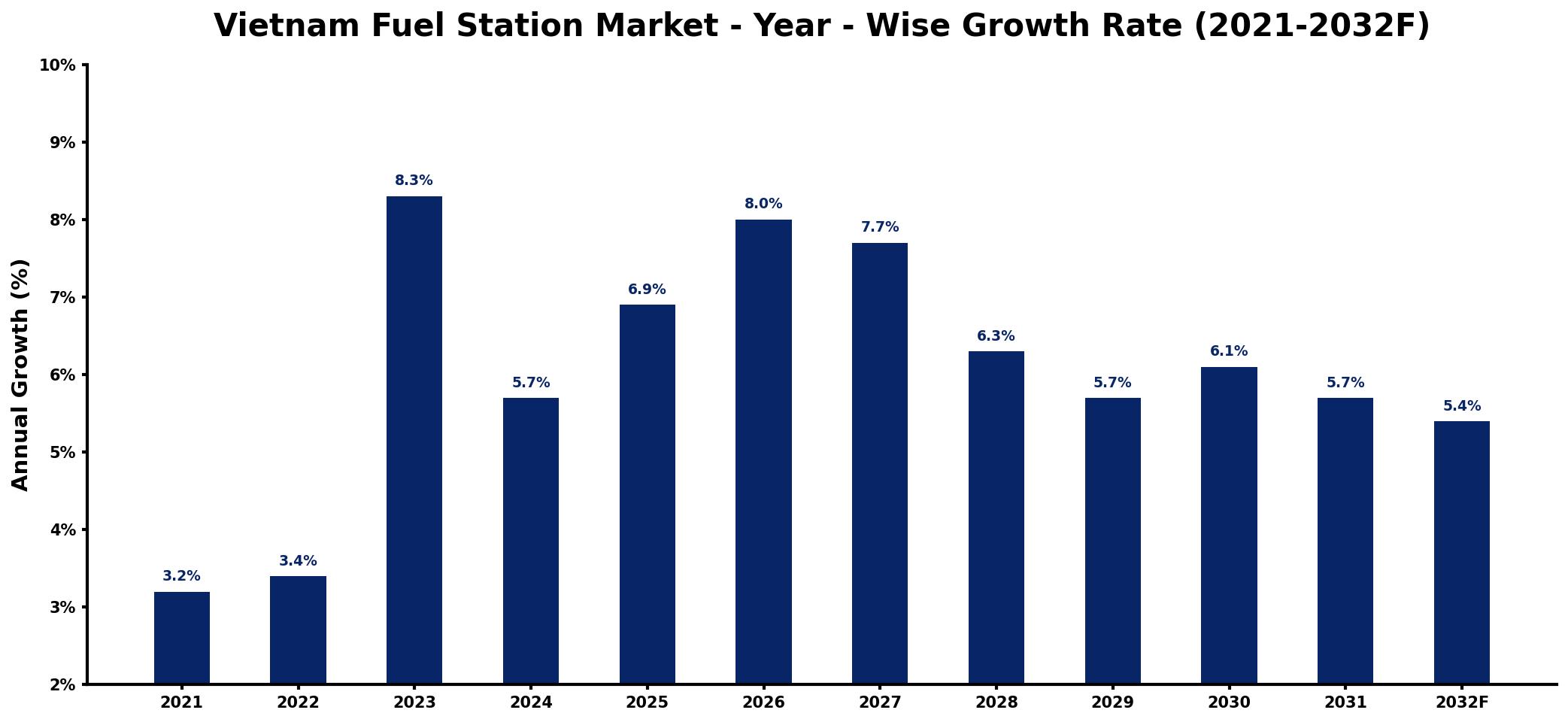
The table below presents the year‑wise growth rates along with the key drivers influencing the market
| Year | Growth Rate | Major Drivers |
| 2021 | 3.2% | Rising consumer mobility trends |
| 2022 | 3.4% | Increased transportation infrastructure projects |
| 2023 | 8.3% | Growing electric vehicle adoption |
| 2024 | 5.7% | Expansion of logistics networks |
| 2025 | 6.9% | Higher urban population density |
| 2026 | 8.0% | Investment in renewable energy sources |
| 2027 | 7.7% | Boost in tourism activities |
| 2028 | 6.3% | Enhanced regional trade agreements |
| 2029 | 5.7% | Growing demand for convenience services |
| 2030 | 6.1% | Development of smart city initiatives |
| 2031 | 5.7% | Increase in domestic travel frequency |
| 2032 | 5.4% | Surge in e-commerce deliveries |
Note: Market size estimations and growth projections presented in this report are based on 6Wresearch's proprietary forecasting methodology, utilizing the latest available industry data, government publications, and primary research inputs.
Vietnam Fuel Station Market Synopsis
The primary force driving the Vietnam Fuel Station Market is the rapid urbanization and increasing vehicle ownership across the nation. As more citizens acquire vehicles, the demand for accessible and modern fueling stations escalates, prompting an expansion of the fuel station network.
Moreover, the rise in transportation services has created a pressing need for fuel stations, not just in urban regions but also in rural areas. This expansion is complemented by a growing interest in cleaner fuel options and the introduction of alternative fueling infrastructures, such as electric charging stations and compressed natural gas (CNG) facilities.
Vietnam Fuel Station Market Key Takeaways
- The market is driven by increasing vehicle ownership and urban growth.
- Investment in modern infrastructure is crucial for competitiveness.
- There is a growing trend towards cleaner and alternative fuels.
- Post-pandemic recovery has spurred increased fuel demand.
- Strategic location selection is vital for market share capture.
Evaluation of Restraints in Vietnam Fuel Station Market
While the Vietnam Fuel Station Market is on an upward trajectory, certain restraints exist that can hinder growth. Key challenges include the need for significant investment in modern infrastructure to meet both safety standards and consumer convenience. The ongoing energy transition towards cleaner fuels requires operators to adapt swiftly, which can be resource-intensive. Additionally, fluctuations in market demand and energy trends can create uncertainties for operators, requiring them to remain agile in their strategies.
Vietnam Fuel Station Market Trends
Recent trends in the Vietnam Fuel Station Market reflect a shift towards diversification in fuel offerings. The growing interest in electric vehicles (EVs) is prompting fuel station operators to incorporate electric charging facilities into their service range. Moreover, the adoption of alternative fuels such as CNG is gradually increasing, appealing to environmentally conscious consumers. Furthermore, the integration of technology in fuel stations is enhancing operational efficiency and customer experience.
Vietnam Fuel Station Market Opportunities
There are substantial growth opportunities within the Vietnam Fuel Station Market, particularly in the development of green fueling options and modern infrastructure. As consumer preferences shift towards sustainability, stations that offer eco-friendly fuel types are likely to attract more customers. Moreover, enhancing service offerings, such as convenience stores or vehicle maintenance services at fuel stations, presents avenues for increased revenue generation.
Government Initiatives in the Vietnam Fuel Station Market
The Vietnamese government is actively promoting the expansion of fueling infrastructure through various initiatives and public spending programs. Policies aimed at modernizing fuel distribution networks and encouraging the use of alternative energy sources are in place. Additionally, incentives for investments in cleaner technologies and infrastructure developments are encouraging companies to adopt greener practices, which are essential for meeting international environmental standards.
Future Insights of the Vietnam Fuel Station Market
Looking ahead to 2026-2032, the Vietnam Fuel Station Market is expected to evolve significantly. Increased vehicle ownership and urbanization will continue to drive the demand for fuel stations. The ongoing transition towards alternative fuels and the incorporation of advanced technologies will also reshape the landscape. Companies that strategically adapt to these changes and invest in diversified fuel options will be well-positioned to thrive in the competitive environment.
Vietnam Fuel Station Market Latest Developments (2025 - 2026)
In recent months, the industry has witnessed a surge in investments aimed at modernizing fuel station infrastructures. Companies are prioritizing the introduction of electric vehicle charging stations, reflecting the growing trend towards sustainability. Additionally, partnerships are emerging between fuel station operators and technology firms to enhance customer experience through digital solutions. These developments are crucial for adapting to market demands and remaining competitive.
Vietnam Fuel Station Market - Key Attractiveness of the Report
- 10 Years of Market Numbers
- Historical Data Starting from 2022 to 2025
- Base Year: 2025
- Forecast Data until 2032
- Key Performance Indicators Impacting the Market
- Major Upcoming Developments and Projects
Key Highlights of the Report:
- Vietnam Fuel Station Market Outlook
- Market Size of Vietnam Fuel Station Market, 2025
- Forecast of Vietnam Fuel Station Market, 2032
- Historical Data and Forecast of Vietnam Fuel Station Revenues & Volume for the Period 2022-2032F
- Vietnam Fuel Station Market Trend Evolution
- Vietnam Fuel Station Market Drivers and Challenges
- Vietnam Fuel Station Price Trends
- Vietnam Fuel Station Porter's Five Forces
- Vietnam Fuel Station Industry Life Cycle
- Historical Data and Forecast of Vietnam Fuel Station Market Revenues & Volume By Fuel for the Period 2022-2032F
- Historical Data and Forecast of Vietnam Fuel Station Market Revenues & Volume By Gasoline for the Period 2022-2032F
- Historical Data and Forecast of Vietnam Fuel Station Market Revenues & Volume By Diesel for the Period 2022-2032F
- Historical Data and Forecast of Vietnam Fuel Station Market Revenues & Volume By Gas for the Period 2022-2032F
- Historical Data and Forecast of Vietnam Fuel Station Market Revenues & Volume By others for the Period 2022-2032F
- Historical Data and Forecast of Vietnam Fuel Station Market Revenues & Volume By End-User for the Period 2022-2032F
- Historical Data and Forecast of Vietnam Fuel Station Market Revenues & Volume By Road Transport Vehicles for the Period 2022-2032F
- Historical Data and Forecast of Vietnam Fuel Station Market Revenues & Volume By Air Transport Vehicles for the Period 2022-2032F
- Historical Data and Forecast of Vietnam Fuel Station Market Revenues & Volume By Water Transport Vehicles for the Period 2022-2032F
- Vietnam Fuel Station Import Export Trade Statistics
- Market Opportunity Assessment By Fuel
- Market Opportunity Assessment By End-User
- Vietnam Fuel Station Top Companies Market Share
- Vietnam Fuel Station Competitive Benchmarking By Technical and Operational Parameters
- Vietnam Fuel Station Company Profiles
- Vietnam Fuel Station Key Strategic Recommendations






































