Vietnam Glass Beads Market Size, Share & Growth Rate
The Vietnam Glass Beads Market was estimated at USD 175 Million in 2025 and is projected to reach USD 247 Million by 2032, growing at a CAGR of 5.0% from 2026 to 2032. This growth trajectory is primarily fueled by the rising applications of glass beads across various sectors, including road safety and construction. As Vietnam's infrastructure projects ramp up, and the demand for reflective materials increases, the glass beads market is set to experience substantial upward momentum.
Vietnam Glass Beads Market Year-wise Growth Rate and Key Drivers
This graph highlights how the Vietnam Glass Beads Market has steadily grown over the years, supported by major growth factors.
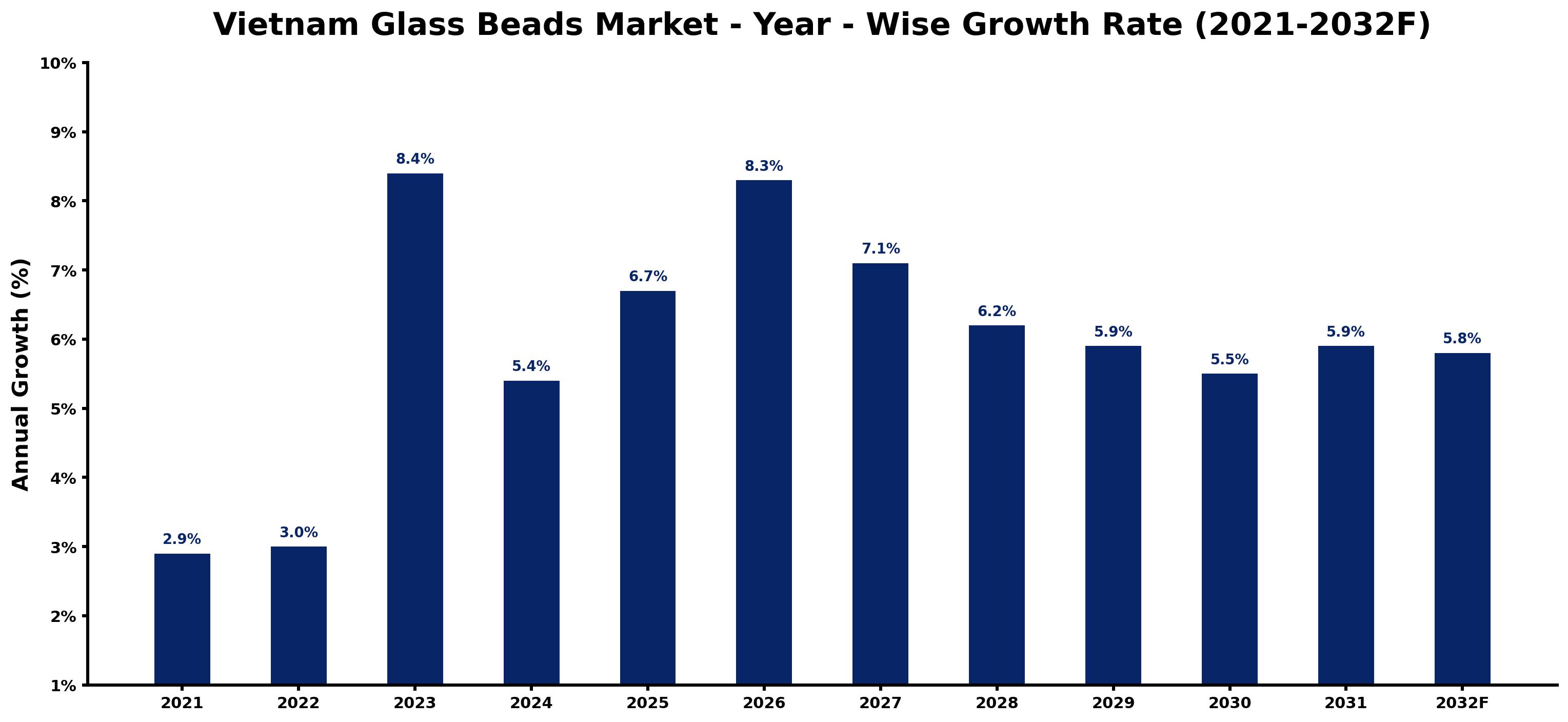
The table below presents the year‑wise growth rates along with the key drivers influencing the market
| Year | Growth Rate | Major Drivers |
| 2021 | 2.9% | Increasing smart city development projects |
| 2022 | 3.0% | Increasing industrial infrastructure investments |
| 2023 | 8.4% | Rising electricity demand across industries |
| 2024 | 5.4% | Growing renewable energy integration projects |
| 2025 | 6.7% | Increasing industrial automation investments |
| 2026 | 8.3% | Government infrastructure modernization initiatives |
| 2027 | 7.1% | Expansion of commercial construction activities |
| 2028 | 6.2% | Increasing industrial infrastructure investments |
| 2029 | 5.9% | Growing renewable energy integration projects |
| 2030 | 5.5% | Increasing industrial automation investments |
| 2031 | 5.9% | Growing renewable energy integration projects |
| 2032 | 5.8% | Increasing adoption of advanced technologies |
Note - Market size estimations and growth projections presented in this report are based on 6Wresearch's advanced forecasting approach, validated with industry datasets as of June 2026.
Vietnam Glass Beads Market Synopsis
In recent years, the Vietnam Glass Beads Market has gained traction, particularly due to a heightened focus on road safety and industrial applications. Despite initial pandemic-induced disruptions, the market has shown resilience and adaptability, leading to a robust recovery as economic activities resume.
Looking ahead, the market is poised for continued expansion, bolstered by advancements in manufacturing technologies and the increased use of glass beads in innovative applications. As sectors such as aerospace and automotive evolve, the integration of glass beads is likely to become more prevalent, positioning the market for promising growth.
Vietnam Glass Beads Market Key Takeaways
- The Vietnam Glass Beads Market is projected to grow from USD 175 Million in 2025 to USD 247 Million by 2032, with a CAGR of 5.0% from 2026 to 2032.
- Increasing applications in reflective road markings and safety materials are driving market demand.
- The recovery of the construction industry post-pandemic is expected to significantly boost the glass beads market.
- Ongoing advancements in manufacturing processes are likely to enhance product quality and application versatility.
- Competition from alternative reflective materials remains a key consideration for market players.
Evaluation of Restraints in Vietnam Glass Beads Market
While the Vietnam Glass Beads Market is on an upward trajectory, it faces certain constraints that could hinder its potential. Competition from alternative reflective materials poses a significant challenge, especially as new technologies emerge, offering similar functionalities at potentially lower costs. Moreover, the need to consistently meet international quality and safety standards remains a critical area of concern for manufacturers. Ensuring compliance can be resource-intensive and may impact overall market performance, especially for smaller players striving to establish a foothold.
Vietnam Glass Beads Market Trends
Several trends are currently shaping the Vietnam Glass Beads Market. Firstly, the increasing emphasis on road safety is driving demand for high-quality reflective materials, particularly in urban areas with growing traffic. Secondly, the construction sector's expansion is leading to innovative applications, where glass beads are utilized in coatings and surface treatments to enhance durability and safety. Additionally, sustainability trends are influencing manufacturers to adopt eco-friendly production processes, further enhancing the market's appeal to environmentally-conscious consumers.
Vietnam Glass Beads Market Opportunities
The Vietnam Glass Beads Market presents multiple growth and investment opportunities. As infrastructure development accelerates, the demand for reflective road safety materials is expected to surge. Furthermore, the automotive industry's continuous innovation may lead to increased adoption of glass beads in various applications, including decorative elements and coatings. Manufacturers focusing on R&D to explore advanced applications in areas like aerospace can also tap into lucrative niche markets, propelling overall growth.
Government Initiatives in the Vietnam Glass Beads Market
The Vietnamese government is actively promoting infrastructure development, which indirectly supports the glass beads market. Policies aimed at enhancing road safety and urbanization initiatives encourage the adoption of reflective materials, including glass beads. Public spending on infrastructure projects, combined with various incentives for manufacturers, aims to foster a conducive environment for market growth. Such initiatives are crucial for positioning Vietnam as a competitive player in the regional glass beads landscape.
Future Insights of the Vietnam Glass Beads Market
Looking forward to 2026-2032, the Vietnam Glass Beads Market is expected to flourish, driven by ongoing industrial expansion and infrastructural investments. As safety regulations become stricter, the demand for high-quality reflective materials will likely increase. Innovations in production technologies and a focus on sustainability will also play a pivotal role in shaping market dynamics, allowing companies that prioritize quality and environmental impact to thrive. Overall, the outlook is promising, with various factors poised to contribute to sustained market growth.
Vietnam Glass Beads Market Latest Developments (May 2025 - June 2026)
In the latest developments within the Vietnam Glass Beads Market, a noticeable shift towards automation in manufacturing processes has emerged, enhancing production efficiency and product quality. Additionally, collaborations between manufacturers and technology firms are driving innovation, leading to the introduction of advanced reflective materials. Furthermore, the construction sector has seen a resurgence, as major infrastructure projects commence, increasing the demand for glass beads in coatings and other applications.
Vietnam Glass Beads Market - Key Attractiveness of the Report
- 10 Years of Market Numbers
- Historical Data Starting from 2022 to 2025
- Base Year: 2025
- Forecast Data until 2032
- Key Performance Indicators Impacting the Market
- Major Upcoming Developments and Projects
The market is expected to grow at a CAGR of 5.0% from 2026 to 2032, reaching an estimated USD 247 Million by 2032.
Government policies focused on enhancing infrastructure and road safety are significantly driving the demand for glass beads, especially in reflective applications.
Key challenges include intense competition from alternative materials and the need to maintain high-quality standards that comply with international regulations.
Glass beads are primarily used in reflective road markings, surface preparation in construction, and various jewelry and craft applications, driven by industry growth.
Sustainability trends have prompted manufacturers to adopt eco-friendly practices in production, enhancing the appeal of glass beads in environmentally-conscious markets.
Key Highlights of the Report:
- Vietnam Glass Beads? Market Outlook
- Market Size of Vietnam Glass Beads? Market, 2025
- Forecast of Vietnam Glass Beads? Market, 2032
- Historical Data and Forecast of Vietnam Glass Beads? Revenues & Volume for the Period 2022-2032F
- Vietnam Glass Beads? Market Trend Evolution
- Vietnam Glass Beads? Market Drivers and Challenges
- Vietnam Glass Beads? Price Trends
- Vietnam Glass Beads? Porter's Five Forces
- Vietnam Glass Beads? Industry Life Cycle
- Historical Data and Forecast of Vietnam Glass Beads? Market Revenues & Volume By Type for the Period 2022-2032F
- Historical Data and Forecast of Vietnam Glass Beads? Market Revenues & Volume By Soild for the Period 2022-2032F
- Historical Data and Forecast of Vietnam Glass Beads? Market Revenues & Volume By Hollow for the Period 2022-2032F
- Historical Data and Forecast of Vietnam Glass Beads? Market Revenues & Volume By Other for the Period 2022-2032F
- Historical Data and Forecast of Vietnam Glass Beads? Market Revenues & Volume By Application for the Period 2022-2032F
- Historical Data and Forecast of Vietnam Glass Beads? Market Revenues & Volume By Reflective meterial for the Period 2022-2032F
- Historical Data and Forecast of Vietnam Glass Beads? Market Revenues & Volume By Industry polishing& meterial for the Period 2022-2032F
- Historical Data and Forecast of Vietnam Glass Beads? Market Revenues & Volume By Thermal insulating meterial for the Period 2022-2032F
- Historical Data and Forecast of Vietnam Glass Beads? Market Revenues & Volume By Other for the Period 2022-2032F
- Vietnam Glass Beads? Import Export Trade Statistics
- Market Opportunity Assessment By Type
- Market Opportunity Assessment By Application
- Vietnam Glass Beads? Top Companies Market Share
- Vietnam Glass Beads? Competitive Benchmarking By Technical and Operational Parameters
- Vietnam Glass Beads? Company Profiles
- Vietnam Glass Beads? Key Strategic Recommendations






































