Vietnam Glass Ceramics Market Size, Share & Growth Rate
The Vietnam Glass Ceramics Market was estimated at USD 308 Million in 2025 and is projected to reach USD 433 Million by 2032, growing at a CAGR of 5.0% from 2026 to 2032. This growth trajectory is primarily fueled by the booming construction sector and the rising demand for durable materials in electronics manufacturing. As the Vietnamese economy continues to expand, both residential and commercial projects are increasingly utilizing glass ceramics for their thermal stability and aesthetic appeal.
Vietnam Glass Ceramics Market Year-wise Growth Rate and Key Drivers
This graph highlights how the Vietnam Glass Ceramics Market has steadily grown over the years, supported by major growth factors.
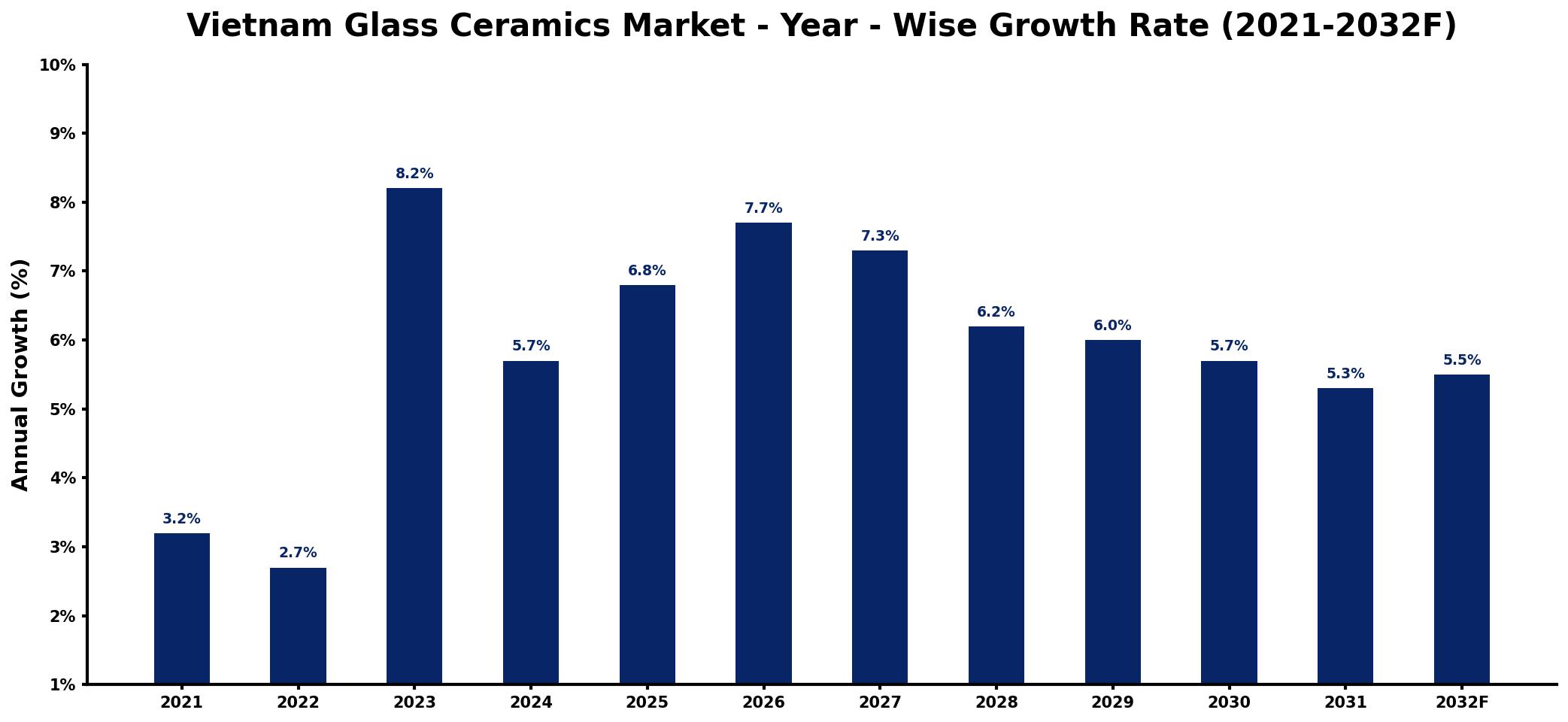
The table below presents the year‑wise growth rates along with the key drivers influencing the market
| Year | Growth Rate | Major Drivers |
| 2021 | 3.2% | Rising demand in construction sector |
| 2022 | 2.7% | Increased investment in infrastructure projects |
| 2023 | 8.2% | Growing popularity of home decor |
| 2024 | 5.7% | Expansion of hospitality industry investments |
| 2025 | 6.8% | Surge in eco-friendly building materials |
| 2026 | 7.7% | Advancements in manufacturing technologies |
| 2027 | 7.3% | Enhanced consumer spending on renovations |
| 2028 | 6.2% | Strengthened export opportunities in Asia |
| 2029 | 6.0% | Increased urbanization driving demand |
| 2030 | 5.7% | Growing focus on sustainable design |
| 2031 | 5.3% | Rise in luxury home developments |
| 2032 | 5.5% | Emerging trends in interior aesthetics |
Note: Market size estimations and growth projections presented in this report are based on 6Wresearch's proprietary forecasting methodology, utilizing the latest available industry data, government publications, and primary research inputs.
Vietnam Glass Ceramics Market Synopsis
The most significant force shaping the Vietnam Glass Ceramics Market today is the rapid expansion of the construction industry. With a growing urban population and a surge in infrastructure projects, glass ceramics are being integrated into architectural designs for both functional and decorative purposes.
Additionally, the electronics sector is propelling market dynamics as manufacturers seek materials that can withstand extreme temperatures and provide reliable performance. This dual demand from construction and electronics is redefining the landscape of glass ceramics, leading to innovative applications and formulations.
Vietnam Glass Ceramics Market Key Takeaways
- The market is driven by significant investments in construction and urban development.
- There is increasing utilization of glass ceramics in electronics, particularly for circuit boards.
- Innovations are focusing on sustainability and eco-friendly manufacturing processes.
- Market recovery post-COVID-19 has been robust, driven by home improvement projects.
- Durability and thermal resistance of glass ceramics are pivotal in diverse applications.
Evaluation of Restraints in Vietnam Glass Ceramics Market
Despite its promising growth, the Vietnam Glass Ceramics Market faces notable restraints, particularly regarding environmental sustainability. As consumer awareness around eco-friendly products rises, there is escalating pressure on manufacturers to adapt their processes to minimize environmental impact. The production of glass ceramics is also energy-intensive, which not only affects operational costs but could also become a barrier to entry for new players aiming to innovate in this space. These factors could slow down market growth if not adequately addressed by industry stakeholders.
Vietnam Glass Ceramics Market Trends
Several trends are shaping the future of the Vietnam Glass Ceramics Market. The push for sustainable materials is prompting manufacturers to explore eco-friendly alternatives and production processes. Additionally, advancements in technology are enabling the creation of higher-performing glass ceramics tailored for specific applications, such as energy-efficient cooktops and durable architectural solutions. Aesthetic considerations are also becoming increasingly important, with consumers favoring visually appealing designs in both cookware and building materials.
Vietnam Glass Ceramics Market Opportunities
The Vietnam Glass Ceramics Market presents several growth and investment opportunities. The ongoing urbanization and rising disposable incomes are likely to spur demand for high-quality glass ceramics in residential and commercial constructions. Furthermore, the expansion of the electronics manufacturing sector provides a ripe landscape for innovative applications, particularly in high-tech industries such as telecommunications and renewable energy. These sectors are eager for durable materials that can support their performance and sustainability goals.
Government Initiatives in the Vietnam Glass Ceramics Market
The Vietnamese government has been active in fostering the growth of the glass ceramics market through various initiatives. Policies aimed at promoting sustainable construction practices and eco-friendly manufacturing processes are becoming more prevalent. Public spending on infrastructure projects is also contributing to the increased demand for glass ceramics, as authorities prioritize investments that enhance urban living standards and environmental sustainability.
Future Insights of the Vietnam Glass Ceramics Market
Looking ahead to 2026-2032, the Vietnam Glass Ceramics Market is set to experience significant transformations. The continued focus on sustainability will likely lead to advancements in materials science, yielding products that are not only efficient but also environmentally friendly. As the construction sector evolves, the integration of smart technologies into glass ceramics will further drive demand, positioning this market as a pivotal player in Vietnam's economic landscape.
Vietnam Glass Ceramics Market Latest Developments (2025 - 2026)
Recent developments in the Vietnam Glass Ceramics Market indicate a robust shift towards innovative product offerings and sustainable practices. Manufacturers are increasingly focusing on developing eco-friendly alternatives while leveraging advanced technologies to improve durability and functionality. Collaborative efforts between industry stakeholders and research institutions are also paving the way for breakthroughs in applications across construction and electronics, setting a dynamic pace for market evolution.
Vietnam Glass Ceramics Market - Key Attractiveness of the Report
- 10 Years of Market Numbers
- Historical Data Starting from 2022 to 2025
- Base Year: 2025
- Forecast Data until 2032
- Key Performance Indicators Impacting the Market
- Major Upcoming Developments and Projects
Key Highlights of the Report:
- Vietnam Glass Ceramics Market Outlook
- Market Size of Vietnam Glass Ceramics Market, 2025
- Forecast of Vietnam Glass Ceramics Market, 2032
- Historical Data and Forecast of Vietnam Glass Ceramics Revenues & Volume for the Period 2022-2032F
- Vietnam Glass Ceramics Market Trend Evolution
- Vietnam Glass Ceramics Market Drivers and Challenges
- Vietnam Glass Ceramics Price Trends
- Vietnam Glass Ceramics Porter's Five Forces
- Vietnam Glass Ceramics Industry Life Cycle
- Historical Data and Forecast of Vietnam Glass Ceramics Market Revenues & Volume By Material for the Period 2022-2032F
- Historical Data and Forecast of Vietnam Glass Ceramics Market Revenues & Volume By Lithium for the Period 2022-2032F
- Historical Data and Forecast of Vietnam Glass Ceramics Market Revenues & Volume By Mangnesium for the Period 2022-2032F
- Historical Data and Forecast of Vietnam Glass Ceramics Market Revenues & Volume By Zinc for the Period 2022-2032F
- Historical Data and Forecast of Vietnam Glass Ceramics Market Revenues & Volume By Application for the Period 2022-2032F
- Historical Data and Forecast of Vietnam Glass Ceramics Market Revenues & Volume By Building and Construction for the Period 2022-2032F
- Historical Data and Forecast of Vietnam Glass Ceramics Market Revenues & Volume By Electrical & Electronics for the Period 2022-2032F
- Historical Data and Forecast of Vietnam Glass Ceramics Market Revenues & Volume By Healthcare for the Period 2022-2032F
- Historical Data and Forecast of Vietnam Glass Ceramics Market Revenues & Volume By Aerospace for the Period 2022-2032F
- Historical Data and Forecast of Vietnam Glass Ceramics Market Revenues & Volume By Optical for the Period 2022-2032F
- Vietnam Glass Ceramics Import Export Trade Statistics
- Market Opportunity Assessment By Material
- Market Opportunity Assessment By Application
- Vietnam Glass Ceramics Top Companies Market Share
- Vietnam Glass Ceramics Competitive Benchmarking By Technical and Operational Parameters
- Vietnam Glass Ceramics Company Profiles
- Vietnam Glass Ceramics Key Strategic Recommendations






































