Vietnam Glass Vacuum Flask Market Size, Share & Growth Rate
The Vietnam Glass Vacuum Flask Market was estimated at USD 484 Million in 2025 and is projected to reach USD 683 Million by 2032, growing at a CAGR of 5.0% from 2026 to 2032. This steady growth trajectory is underpinned by a rising consumer inclination toward sustainable and reusable products, especially in urban centers. With increasing awareness of environmental issues, many Vietnamese consumers are turning to glass vacuum flasks, attracted by their durability and eco-friendliness.
Vietnam Glass Vacuum Flask Market Year-wise Growth Rate and Key Drivers
This graph highlights how the Vietnam Glass Vacuum Flask Market has steadily grown over the years, supported by major growth factors.
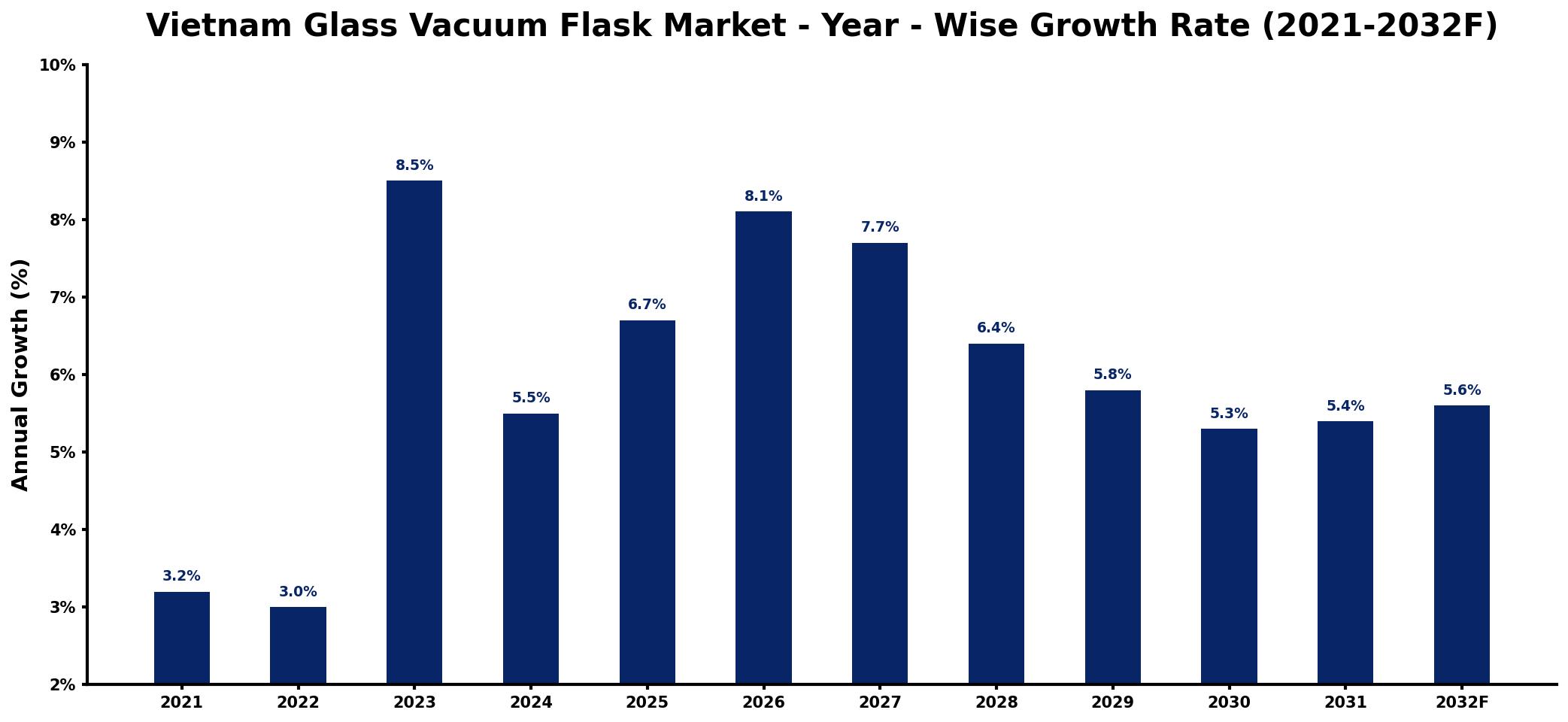
The table below presents the year‑wise growth rates along with the key drivers influencing the market
| Year | Growth Rate | Major Drivers |
| 2021 | 3.2% | Rising consumer health consciousness |
| 2022 | 3.0% | Increased outdoor recreational activities |
| 2023 | 8.5% | Expansion of e-commerce platforms |
| 2024 | 5.5% | Growing demand for sustainable products |
| 2025 | 6.7% | Surge in travel and tourism |
| 2026 | 8.1% | Innovations in product design |
| 2027 | 7.7% | Enhancements in manufacturing technology |
| 2028 | 6.4% | Increased corporate gifting trends |
| 2029 | 5.8% | Rising interest in fitness lifestyle |
| 2030 | 5.3% | Growth of personalized merchandise market |
| 2031 | 5.4% | growing automotive sector requirements |
| 2032 | 5.6% | Increased awareness of hydration benefits |
Note: Market size estimations and growth projections presented in this report are based on 6Wresearch's proprietary forecasting methodology, utilizing the latest available industry data, government publications, and primary research inputs.
Vietnam Glass Vacuum Flask Market Synopsis
In recent years, the Vietnam glass vacuum flask market has gained traction, with a noticeable increase in consumer demand for insulated beverage containers. The ability of glass flasks to maintain beverage temperature while being environmentally friendly makes them a preferred choice for health-conscious individuals.
As outdoor activities have surged in popularity, particularly post-COVID-19, glass vacuum flasks have become essential companions for many. The market is thus responding to the evolving lifestyle needs of consumers who prioritize both functionality and aesthetics in their beverage containers.
Vietnam Glass Vacuum Flask Market Key Takeaways
- The market is driven by increasing consumer demand for sustainable and reusable beverage solutions.
- Innovations in design and functionality are attracting a wider consumer base.
- Urbanization in Vietnam is contributing to a growing appetite for stylish and practical thermal containers.
- Post-pandemic outdoor leisure activities have revived interest in portable beverage solutions.
- The competitive landscape continues to evolve, highlighting the importance of quality and brand reputation.
Evaluation of Restraints in Vietnam Glass Vacuum Flask Market
While the market is on an upward trajectory, several restraints could potentially hinder growth. One primary concern revolves around ensuring the safety and quality of glass products, as consumers are increasingly vigilant about materials that can withstand heat without leaching harmful substances. Additionally, maintaining cost-effectiveness while delivering high-quality thermal insulation poses challenges for manufacturers. Adapting to rapidly changing design preferences and adhering to stricter safety standards further complicates the market landscape.
Vietnam Glass Vacuum Flask Market Trends
A significant trend in the Vietnam glass vacuum flask market is the shift toward innovative designs that not only improve functionality but also cater to aesthetic preferences. Sleek, minimalist designs are gaining popularity among younger consumers, reflecting a broader lifestyle choice that favors both style and sustainability. Moreover, the integration of smart technology into vacuum flasks is beginning to emerge, with features such as temperature monitoring and mobile connectivity appealing to tech-savvy consumers.
Vietnam Glass Vacuum Flask Market Opportunities
As the market evolves, several growth opportunities present themselves. Companies that invest in research and development can lead the way in producing innovative features that differentiate their products. Furthermore, expanding distribution channels, including online platforms and eco-focused retail outlets, can enhance market reach. Collaborations with lifestyle brands and influencers may also boost visibility and appeal to target demographics, especially the younger generation.
Government Initiatives in the Vietnam Glass Vacuum Flask Market
The Vietnamese government has taken initiatives aimed at promoting eco-friendly practices, which naturally supports the glass vacuum flask market. Policy measures focusing on reducing single-use plastics and encouraging sustainable product choices are gaining momentum. Additionally, public spending on environmental campaigns may further bolster consumer awareness and interest in reusable products, contributing to market growth.
Future Insights of the Vietnam Glass Vacuum Flask Market
Looking ahead to the 2026-2032 period, the Vietnam glass vacuum flask market is expected to witness robust growth driven by continuous innovation and an increasing consumer shift toward sustainability. As awareness regarding the environmental impact of disposable products persists, glass vacuum flasks will likely become a staple for many households. Furthermore, the expanding middle class and urbanization trends will create a larger consumer base, pushing demand for high-quality, aesthetically pleasing, and functional thermal containers.
Vietnam Glass Vacuum Flask Market Latest Developments (2025 - 2026)
Recent industry trends indicate a growing focus on product diversification within the Vietnam glass vacuum flask market. Manufacturers are increasingly exploring collaborations to integrate smart technology into flasks, enhancing their appeal to tech-savvy consumers. Additionally, heightened marketing efforts aimed at promoting the environmental benefits of glass over plastic are underway, particularly through social media channels. Such initiatives are expected to reshape consumer perceptions and increase market penetration.
Vietnam Glass Vacuum Flask Market - Key Attractiveness of the Report
- 10 Years of Market Numbers
- Historical Data Starting from 2022 to 2025
- Base Year: 2025
- Forecast Data until 2032
- Key Performance Indicators Impacting the Market
- Major Upcoming Developments and Projects
Key Highlights of the Report:
- Vietnam Glass Vacuum Flask Market Outlook
- Market Size of Vietnam Glass Vacuum Flask Market, 2025
- Forecast of Vietnam Glass Vacuum Flask Market, 2032
- Historical Data and Forecast of Vietnam Glass Vacuum Flask Revenues & Volume for the Period 2022-2032F
- Vietnam Glass Vacuum Flask Market Trend Evolution
- Vietnam Glass Vacuum Flask Market Drivers and Challenges
- Vietnam Glass Vacuum Flask Price Trends
- Vietnam Glass Vacuum Flask Porter's Five Forces
- Vietnam Glass Vacuum Flask Industry Life Cycle
- Historical Data and Forecast of Vietnam Glass Vacuum Flask Market Revenues & Volume By Type for the Period 2022-2032F
- Historical Data and Forecast of Vietnam Glass Vacuum Flask Market Revenues & Volume By 0.5 L for the Period 2022-2032F
- Historical Data and Forecast of Vietnam Glass Vacuum Flask Market Revenues & Volume By 0.6 L-1L for the Period 2022-2032F
- Historical Data and Forecast of Vietnam Glass Vacuum Flask Market Revenues & Volume By 1.1 L-1.5 L for the Period 2022-2032F
- Historical Data and Forecast of Vietnam Glass Vacuum Flask Market Revenues & Volume By 1.6L-2L for the Period 2022-2032F
- Historical Data and Forecast of Vietnam Glass Vacuum Flask Market Revenues & Volume By >2L for the Period 2022-2032F
- Historical Data and Forecast of Vietnam Glass Vacuum Flask Market Revenues & Volume By Application for the Period 2022-2032F
- Historical Data and Forecast of Vietnam Glass Vacuum Flask Market Revenues & Volume By Supermarkets/Hypermarkets for the Period 2022-2032F
- Historical Data and Forecast of Vietnam Glass Vacuum Flask Market Revenues & Volume By Departmental Stores for the Period 2022-2032F
- Historical Data and Forecast of Vietnam Glass Vacuum Flask Market Revenues & Volume By Specialty Stores for the Period 2022-2032F
- Historical Data and Forecast of Vietnam Glass Vacuum Flask Market Revenues & Volume By Online Retail for the Period 2022-2032F
- Vietnam Glass Vacuum Flask Import Export Trade Statistics
- Market Opportunity Assessment By Type
- Market Opportunity Assessment By Application
- Vietnam Glass Vacuum Flask Top Companies Market Share
- Vietnam Glass Vacuum Flask Competitive Benchmarking By Technical and Operational Parameters
- Vietnam Glass Vacuum Flask Company Profiles
- Vietnam Glass Vacuum Flask Key Strategic Recommendations






































