Vietnam Greasy Wool Market Size, Share & Growth Rate
The Vietnam Greasy Wool Market was estimated at USD 346 Million in 2025 and is projected to reach USD 491 Million by 2032, growing at a CAGR of 5.1% from 2026 to 2032. This growth trajectory is primarily propelled by the surging demand from the textile industry, coupled with a strong emphasis on high-quality raw materials. As manufacturers increasingly prioritize sustainability, the natural properties of greasy wool are becoming more attractive, further enhancing its appeal in a competitive market.
Vietnam Greasy Wool Market Year-wise Growth Rate and Key Drivers
This graph highlights how the Vietnam Greasy Wool Market has steadily grown over the years, supported by major growth factors.
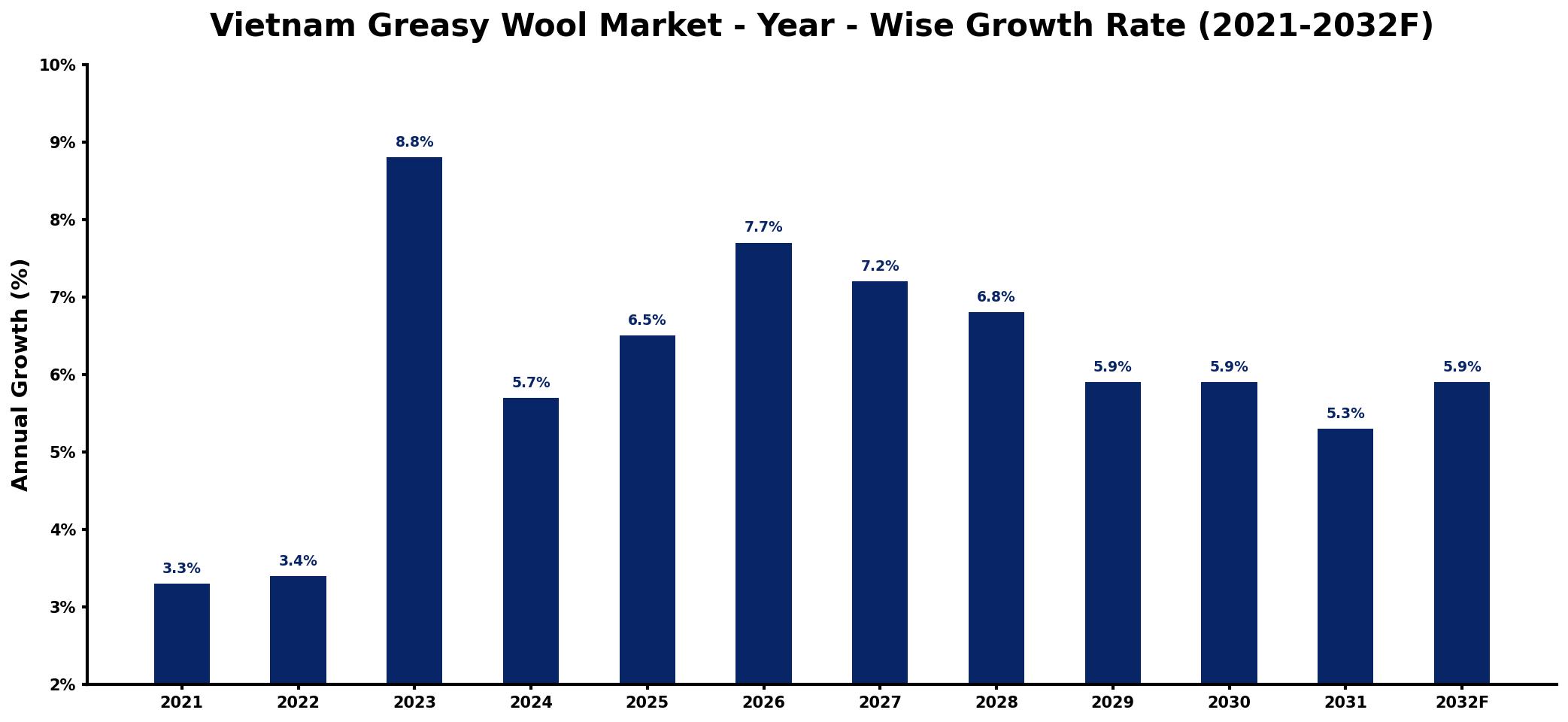
The table below presents the year‑wise growth rates along with the key drivers influencing the market
| Year | Growth Rate | Major Drivers |
| 2021 | 3.3% | Rising demand from textile industry |
| 2022 | 3.4% | Increased investment in manufacturing |
| 2023 | 8.8% | Expansion of export markets |
| 2024 | 5.7% | Growing consumer interest in sustainability |
| 2025 | 6.5% | Technological advancements in processing |
| 2026 | 7.7% | Strengthened supply chain efficiencies |
| 2027 | 7.2% | Higher production capacity utilization |
| 2028 | 6.8% | Emergence of eco-friendly alternatives |
| 2029 | 5.9% | Increasing global trade partnerships |
| 2030 | 5.9% | Growing awareness of natural fibers |
| 2031 | 5.3% | Enhanced marketing strategies adopted |
| 2032 | 5.9% | Rising popularity of artisanal products |
Note: Market size estimations and growth projections presented in this report are based on 6Wresearch's proprietary forecasting methodology, utilizing the latest available industry data, government publications, and primary research inputs.
Vietnam Greasy Wool Market Synopsis
The strong drive for sustainable fashion practices is currently shaping the Vietnam greasy wool market. As consumers gravitate towards eco-friendly products, greasy wools inherent biodegradable qualities position it as a favorable option for textile manufacturers aiming to meet this growing demand.
In addition, Vietnam's strategic investments in its textile infrastructure support the expansion of the greasy wool market. The governments initiatives to bolster the textile sector encourage a thriving environment for importing and processing this vital raw material, aligning with global market trends.
Vietnam Greasy Wool Market Key Takeaways
- The market is underpinned by the robust growth of Vietnam's textile industry.
- Sustainability is becoming a central theme, enhancing the demand for greasy wool.
- Government support and infrastructure investment are critical drivers of market growth.
- Challenges related to quality maintenance and processing capabilities need addressing.
- Supply chain disruptions and pricing volatility pose potential risks to market stability.
Evaluation of Restraints in Vietnam Greasy Wool Market
The Vietnam greasy wool market grapples with several restraints that inhibit its potential. First and foremost, the sourcing of high-quality greasy wool can be hampered by fluctuating global prices and inconsistent supply chains. The requirement for specialized processing techniques presents another challenge, as many local facilities may not possess the technology needed to handle greasy wool effectively. This creates a reliance on imports, making the market vulnerable to international supply issues. Additionally, competition from synthetic fibers and alternative wool types compounds the challenges, necessitating that businesses innovate to differentiate their products.
Vietnam Greasy Wool Market Trends
Current trends indicate a growing consumer preference for natural fibers, with greasy wool emerging as a sought-after choice in sustainable fashion. Theres an increasing focus on traceability in wool sourcing, prompting brands to adopt transparent supply chains. Technological advancements in processing are also transforming how greasy wool is utilized, allowing for improved product quality and efficiency. Furthermore, the global drive towards ethical production is encouraging Vietnamese manufacturers to enhance their sustainability practices, ultimately influencing the market landscape.
Vietnam Greasy Wool Market Opportunities
Significant growth opportunities lie in enhancing the processing capabilities of greasy wool in Vietnam. Investments in technology to upgrade processing facilities can lead to better quality control and product differentiation. Furthermore, as global demand for sustainable textiles increases, Vietnamese manufacturers can leverage this trend by promoting locally sourced greasy wool as a premium product. Partnerships with international brands committed to sustainability can also open new avenues for growth in export markets, further capitalizing on the emerging eco-conscious consumer base.
Government Initiatives in the Vietnam Greasy Wool Market
The Vietnamese government has actively supported the textile sector through various initiatives aimed at modernization and sustainability. Programs to improve manufacturing infrastructure and enhance workforce skills are critical to meeting the growing demand for high-quality textiles, including greasy wool. Additionally, there are incentives for adopting environmentally friendly practices, which align with global sustainability goals. These initiatives not only bolster domestic production capabilities but also position Vietnam favorably within the international textile market.
Future Insights of the Vietnam Greasy Wool Market
Looking ahead to 2026-2032, the Vietnam greasy wool market is poised for continued growth as the textile industry matures. An ongoing shift towards sustainability and natural fibers will likely expand the market's base, while technological advancements in processing will enhance the efficiency and quality of greasy wool products. Additionally, a robust domestic textile industry, driven by both government support and increasing consumer awareness, will create a fertile ground for innovations that further elevate the standing of greasy wool in Vietnams textile ecosystem.
Vietnam Greasy Wool Market Latest Developments (2025 - 2026)
Recent developments in the Vietnam greasy wool market indicate a shift towards greater integration of sustainable practices among textile manufacturers. Companies are increasingly investing in technologies that enhance the quality of greasy wool processing. Collaborations with international entities focused on sustainable fashion are also becoming more common, as local manufacturers seek to strengthen their market position. These trends reflect a concerted effort to align with global standards and consumer expectations in the textile sector.
Vietnam Greasy Wool Market - Key Attractiveness of the Report
- 10 Years of Market Numbers
- Historical Data Starting from 2022 to 2025
- Base Year: 2025
- Forecast Data until 2032
- Key Performance Indicators Impacting the Market
- Major Upcoming Developments and Projects
Key Highlights of the Report:
- Vietnam Greasy Wool Market Outlook
- Market Size of Vietnam Greasy Wool Market, 2025
- Forecast of Vietnam Greasy Wool Market, 2032
- Historical Data and Forecast of Vietnam Greasy Wool Revenues & Volume for the Period 2022-2032F
- Vietnam Greasy Wool Market Trend Evolution
- Vietnam Greasy Wool Market Drivers and Challenges
- Vietnam Greasy Wool Price Trends
- Vietnam Greasy Wool Porter's Five Forces
- Vietnam Greasy Wool Industry Life Cycle
- Historical Data and Forecast of Vietnam Greasy Wool Market Revenues & Volume By Application for the Period 2022-2032F
- Historical Data and Forecast of Vietnam Greasy Wool Market Revenues & Volume By Apparel for the Period 2022-2032F
- Historical Data and Forecast of Vietnam Greasy Wool Market Revenues & Volume By Sports for the Period 2022-2032F
- Historical Data and Forecast of Vietnam Greasy Wool Market Revenues & Volume By Blazers for the Period 2022-2032F
- Historical Data and Forecast of Vietnam Greasy Wool Market Revenues & Volume By Jacketing for the Period 2022-2032F
- Historical Data and Forecast of Vietnam Greasy Wool Market Revenues & Volume By Others for the Period 2022-2032F
- Historical Data and Forecast of Vietnam Greasy Wool Market Revenues & Volume By Upholstery Fabrics for the Period 2022-2032F
- Historical Data and Forecast of Vietnam Greasy Wool Market Revenues & Volume By Blankets for the Period 2022-2032F
- Historical Data and Forecast of Vietnam Apparel Greasy Wool Market Revenues & Volume By Flooring for the Period 2022-2032F
- Vietnam Greasy Wool Import Export Trade Statistics
- Market Opportunity Assessment By Application
- Vietnam Greasy Wool Top Companies Market Share
- Vietnam Greasy Wool Competitive Benchmarking By Technical and Operational Parameters
- Vietnam Greasy Wool Company Profiles
- Vietnam Greasy Wool Key Strategic Recommendations






































