Vietnam Greenhouse Horticulture Market Size, Share & Growth Rate
The Vietnam Greenhouse Horticulture Market was estimated at USD 763 Million in 2025 and is projected to reach USD 1088 Million by 2032, growing at a CAGR of 5.2% from 2026 to 2032. This growth is fueled by the rising urbanization, as limited arable land forces a transition towards controlled agricultural environments. In addition, the increasing consumer preference for high-quality, pesticide-free produce is driving more farmers to adopt greenhouse technology, thereby enhancing product quality and availability.
Vietnam Greenhouse Horticulture Market Year-wise Growth Rate and Key Drivers
This graph highlights how the Vietnam Greenhouse Horticulture Market has steadily grown over the years, supported by major growth factors.
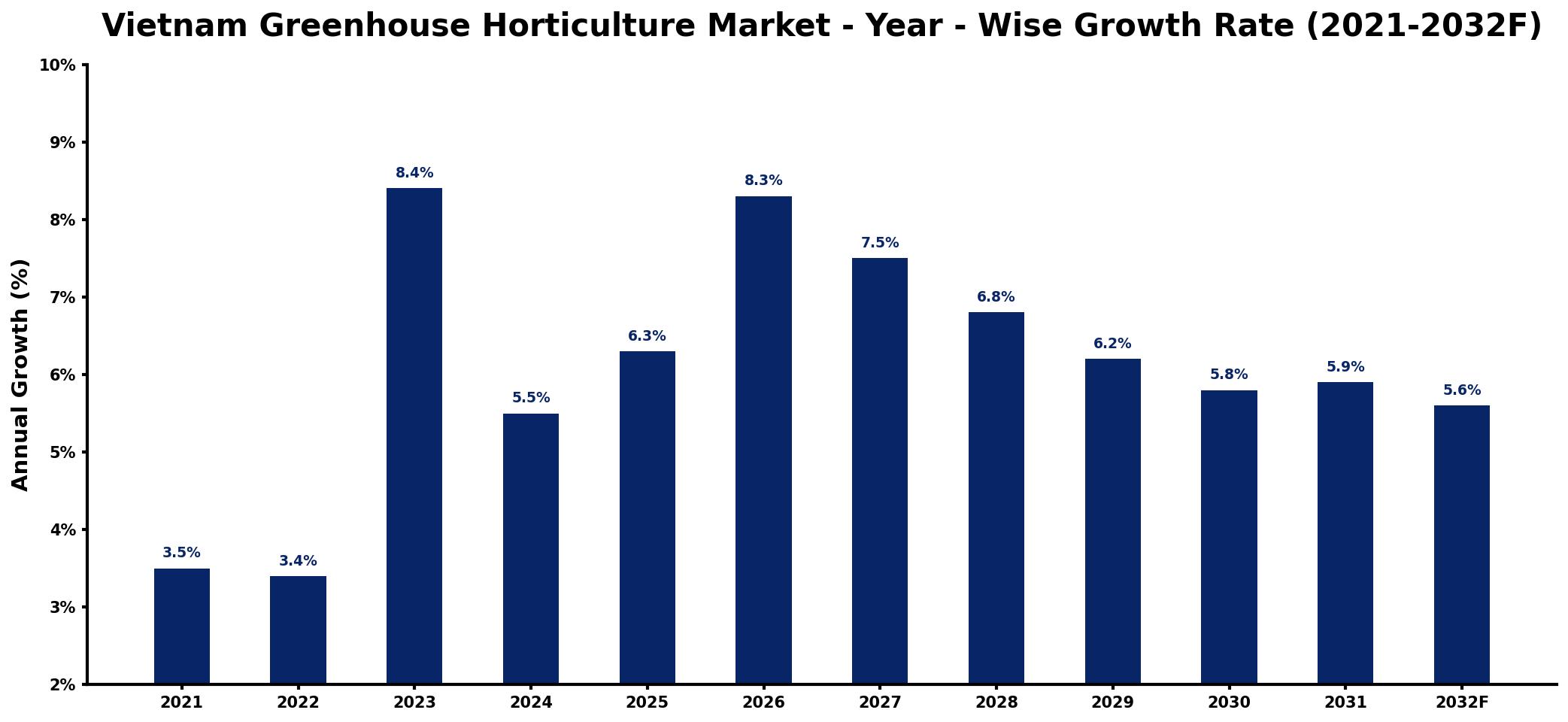
The table below presents the year‑wise growth rates along with the key drivers influencing the market
| Year | Growth Rate | Major Drivers |
| 2021 | 3.5% | Rising consumer health consciousness |
| 2022 | 3.4% | Increased urban agriculture initiatives |
| 2023 | 8.4% | Growing demand for organic produce |
| 2024 | 5.5% | Expansion of agricultural technology adoption |
| 2025 | 6.3% | Higher investment in sustainable farming |
| 2026 | 8.3% | Increased focus on food security |
| 2027 | 7.5% | Surge in export opportunities |
| 2028 | 6.8% | Development of eco-friendly practices |
| 2029 | 6.2% | Government support for agritech innovation |
| 2030 | 5.8% | Growing popularity of local sourcing |
| 2031 | 5.9% | Rising awareness of environmental impact |
| 2032 | 5.6% | Strengthening of supply chain networks |
Note: Market size estimations and growth projections presented in this report are based on 6Wresearch's proprietary forecasting methodology, utilizing the latest available industry data, government publications, and primary research inputs.
Vietnam Greenhouse Horticulture Market Synopsis
The Vietnam greenhouse horticulture market has recently experienced a surge in momentum, fueled by innovative agricultural techniques that enhance crop yields. As farmers shift towards modern practices, they are strategically positioning themselves to meet the growing demand for sustainable and high-quality fresh produce.
Looking ahead, the market is set to evolve with increasing investments in automation and eco-friendly technologies. These advancements not only aim to improve efficiency but also address the critical challenges related to energy consumption and environmental sustainability, establishing a robust framework for future growth.
Vietnam Greenhouse Horticulture Market Key Takeaways
- The market is projected to reach USD 1088 Million by 2032, reflecting significant growth potential.
- Demand for pesticide-free produce is a primary driver, enhancing consumer confidence in greenhouse-grown products.
- Urbanization is compelling a shift towards controlled environments, making greenhouse cultivation increasingly viable.
- Government support initiatives are catalyzing the modernization of agricultural practices across the sector.
- Investment in automation and energy-efficient technologies is critical to overcoming operational challenges.
Evaluation of Restraints in Vietnam Greenhouse Horticulture Market
Despite its promising growth trajectory, the Vietnam greenhouse horticulture market is not without challenges. The significant energy requirements for heating, cooling, and lighting in greenhouse operations pose a substantial hurdle. Furthermore, the competition from traditional open-field farming practices continues to exert pressure on pricing and market share. Addressing these energy inefficiencies while maintaining product quality is essential for the sector's long-term viability.
Vietnam Greenhouse Horticulture Market Trends
Several trends are shaping the future of the greenhouse horticulture market in Vietnam. Firstly, the rising adoption of sustainable practices, such as integrated pest management and organic farming, is becoming increasingly important. Additionally, technological innovations like precision agriculture and data analytics are enhancing yield prediction and resource management, allowing for more efficient operations. Furthermore, consumer awareness around health and environmental impacts is pushing for greener production methods.
Vietnam Greenhouse Horticulture Market Opportunities
The market offers genuine growth opportunities, particularly in the realm of automation and smart farming technologies. As farmers seek to enhance operational efficiency, investments in robotics and AI-driven monitoring systems will likely gain traction. Moreover, the increasing popularity of urban gardening and local sourcing can lead to expanded market niches for greenhouse produce, catering to an environmentally conscious consumer base.
Government Initiatives in the Vietnam Greenhouse Horticulture Market
The Vietnamese government has recognized the importance of modernizing its agricultural sector and is actively implementing policies to support greenhouse horticulture. Initiatives include financial incentives for adopting advanced farming techniques, promoting research and development in sustainable practices, and providing training programs for farmers. These efforts are designed to enhance food security while promoting environmental sustainability across the agricultural landscape.
Future Insights of the Vietnam Greenhouse Horticulture Market
Looking towards 2026-2032, the Vietnam greenhouse horticulture market is set for substantial evolution driven by technological advancements and changing consumer behaviors. The integration of automation will enhance production efficiency, while the focus on sustainability will reshape farming practices. Additionally, as domestic and global demand for quality produce rises, the sector is positioned to leverage these trends, ensuring a sustainable future for Vietnamese horticulture.
Vietnam Greenhouse Horticulture Market Latest Developments (2025 - 2026)
In recent months, the Vietnamese greenhouse horticulture sector has seen a notable increase in investment focused on advanced technologies. Innovations in automated irrigation and climate control systems are gaining attention, with more farmers looking to integrate these solutions into their operations. Moreover, partnerships between research institutions and agricultural firms are fostering the development of sustainable practices tailored for local conditions, contributing to the overall advancement of the industry.
Vietnam Greenhouse Horticulture Market - Key Attractiveness of the Report
- 10 Years of Market Numbers
- Historical Data Starting from 2022 to 2025
- Base Year: 2025
- Forecast Data until 2032
- Key Performance Indicators Impacting the Market
- Major Upcoming Developments and Projects
Key Highlights of the Report:
- Vietnam Greenhouse Horticulture Market Outlook
- Market Size of Vietnam Greenhouse Horticulture Market, 2025
- Forecast of Vietnam Greenhouse Horticulture Market, 2032
- Historical Data and Forecast of Vietnam Greenhouse Horticulture Revenues & Volume for the Period 2022-2032F
- Vietnam Greenhouse Horticulture Market Trend Evolution
- Vietnam Greenhouse Horticulture Market Drivers and Challenges
- Vietnam Greenhouse Horticulture Price Trends
- Vietnam Greenhouse Horticulture Porter's Five Forces
- Vietnam Greenhouse Horticulture Industry Life Cycle
- Historical Data and Forecast of Vietnam Greenhouse Horticulture Market Revenues & Volume By Material Type for the Period 2022-2032F
- Historical Data and Forecast of Vietnam Greenhouse Horticulture Market Revenues & Volume By Glass for the Period 2022-2032F
- Historical Data and Forecast of Vietnam Greenhouse Horticulture Market Revenues & Volume By Plastic for the Period 2022-2032F
- Historical Data and Forecast of Vietnam Greenhouse Horticulture Market Revenues & Volume By Crop Type for the Period 2022-2032F
- Historical Data and Forecast of Vietnam Greenhouse Horticulture Market Revenues & Volume By Fruits and Vegetables for the Period 2022-2032F
- Historical Data and Forecast of Vietnam Greenhouse Horticulture Market Revenues & Volume By Flowers and Ornamentals for the Period 2022-2032F
- Historical Data and Forecast of Vietnam Greenhouse Horticulture Market Revenues & Volume By Nursery Crops for the Period 2022-2032F
- Historical Data and Forecast of Vietnam Greenhouse Horticulture Market Revenues & Volume By Others for the Period 2022-2032F
- Historical Data and Forecast of Vietnam Greenhouse Horticulture Market Revenues & Volume By Technology for the Period 2022-2032F
- Historical Data and Forecast of Vietnam Greenhouse Horticulture Market Revenues & Volume By Heating System for the Period 2022-2032F
- Historical Data and Forecast of Vietnam Greenhouse Horticulture Market Revenues & Volume By Cooling System for the Period 2022-2032F
- Vietnam Greenhouse Horticulture Import Export Trade Statistics
- Market Opportunity Assessment By Material Type
- Market Opportunity Assessment By Crop Type
- Market Opportunity Assessment By Technology
- Vietnam Greenhouse Horticulture Top Companies Market Share
- Vietnam Greenhouse Horticulture Competitive Benchmarking By Technical and Operational Parameters
- Vietnam Greenhouse Horticulture Company Profiles
- Vietnam Greenhouse Horticulture Key Strategic Recommendations






































