Vietnam Greenhouse, Nursery, And Flowers Market Size, Share & Growth Rate
The Vietnam Greenhouse, Nursery, And Flowers Market was estimated at USD 477 Million in 2025 and is projected to reach USD 676 Million by 2032, growing at a CAGR of 5.1% from 2026 to 2032. This growth trajectory is significantly driven by an expanding middle-class demographic that has increased disposable income, enabling greater consumption of ornamental plants and flowers. Furthermore, the country's urbanization continues to fuel demand for landscaping and decorative arrangements, enhancing the overall market potential.
Vietnam Greenhouse, Nursery, And Flowers Market Year-wise Growth Rate and Key Drivers
This graph highlights how the Vietnam Greenhouse, Nursery, And Flowers Market has steadily grown over the years, supported by major growth factors.
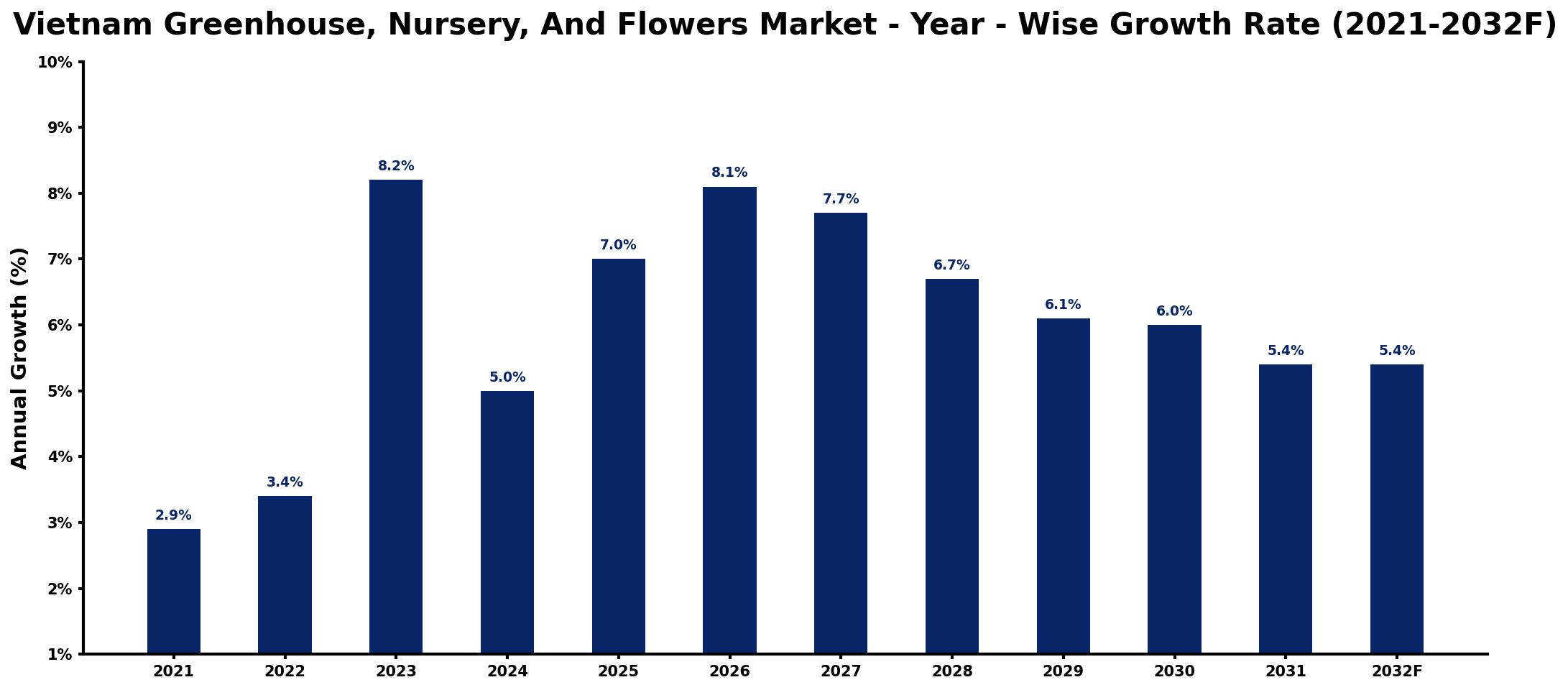
The table below presents the year‑wise growth rates along with the key drivers influencing the market
| Year | Growth Rate | Major Drivers |
| 2021 | 2.9% | Rising consumer interest in gardening |
| 2022 | 3.4% | Increased urban gardening initiatives |
| 2023 | 8.2% | Surge in eco-friendly practices |
| 2024 | 5.0% | Growing landscape development projects |
| 2025 | 7.0% | Expansion of agricultural technology investments |
| 2026 | 8.1% | Heightened focus on sustainability trends |
| 2027 | 7.7% | Boost in home improvement spending |
| 2028 | 6.7% | Emergence of vertical farming solutions |
| 2029 | 6.1% | Growth in local organic markets |
| 2030 | 6.0% | Increasing popularity of indoor plants |
| 2031 | 5.4% | Rising demand for landscaping services |
| 2032 | 5.4% | Enhanced community gardening programs |
Note: Market size estimations and growth projections presented in this report are based on 6Wresearch's proprietary forecasting methodology, utilizing the latest available industry data, government publications, and primary research inputs.
Vietnam Greenhouse, Nursery, And Flowers Market Synopsis
The Vietnamese market for greenhouse-grown ornamental plants is uniquely positioned thanks to the country's rich biodiversity and favorable climatic conditions. With a growing domestic preference for high-value flowers, local nurseries are increasingly focused on cultivating exotic varieties that cater to both national and international markets.
As urban centers expand, the demand for greenery in residential and commercial spaces is on the rise. This trend encourages the development of innovative greenhouse technologies aimed at sustaining high production levels while maintaining environmental responsibility, thus allowing producers to meet the evolving preferences of consumers.
Vietnam Greenhouse, Nursery, And Flowers Market Key Takeaways
- The market is expected to grow significantly due to increasing urbanization and rising consumer incomes.
- Government initiatives in floriculture promote investment and development within the sector.
- The COVID-19 pandemic has accelerated trends such as online sales and home delivery services in the floral industry.
- Efforts towards sustainable practices are becoming increasingly necessary to address environmental concerns.
- The competitive edge of Vietnamese producers is enhanced by the country's diverse flora and favorable cultivation conditions.
Evaluation of Restraints in Vietnam Greenhouse, Nursery, And Flowers Market
Despite its robust growth, the Vietnam Greenhouse, Nursery, And Flowers Market faces notable restraints, particularly regarding energy consumption and environmental sustainability. As greenhouse operations expand, the demand for energy rises, posing challenges in terms of ecological impact. Additionally, fulfilling consumer preferences for eco-friendly and locally-sourced products necessitates innovative approaches to cultivation and resource management. Producers must navigate these complexities while seeking to maintain competitive pricing and production efficiency.
Vietnam Greenhouse, Nursery, And Flowers Market Trends
Several trends are emerging in the Vietnam Greenhouse, Nursery, And Flowers Market that are shaping its future. There is a growing inclination towards organic and sustainably grown plants as consumers become more environmentally conscious. Moreover, the integration of technology in greenhouse operations, including automation and climate control systems, is enhancing productivity. The rise in e-commerce and digital marketing strategies has also transformed the way flowers are marketed and sold, making them more accessible to consumers.
Vietnam Greenhouse, Nursery, And Flowers Market Opportunities
Opportunities for growth in the Vietnam Greenhouse, Nursery, And Flowers Market are abundant. Investments in advanced greenhouse technologies can significantly boost productivity and product quality. Additionally, tapping into the international market for ornamental plants and flowers presents a lucrative avenue for exporters. Collaborations with urban developers for landscape projects can further broaden the scope for nurseries, enhancing their visibility and revenue potential.
Government Initiatives in the Vietnam Greenhouse, Nursery, And Flowers Market
The Vietnamese government is actively promoting initiatives to bolster the floriculture and horticulture sectors. Various programs aim to facilitate funding and investments into greenhouse technology, as well as sustainable practices that align with environmental standards. Policies designed to enhance the export potential of Vietnamese floral products are being implemented, focusing on improving quality and international competitiveness.
Future Insights of the Vietnam Greenhouse, Nursery, And Flowers Market
Looking ahead to 2026-2032, the Vietnam Greenhouse, Nursery, And Flowers Market is poised for substantial growth. The increasing integration of technology in production processes will drive efficiencies, while the ongoing urbanization will sustain the demand for ornamental plants. A shift towards sustainable and eco-friendly practices is likely to redefine consumer preferences, propelling producers to adapt and innovate in response. The overall market landscape will evolve, positioning Vietnam as a significant player on the global stage.
Vietnam Greenhouse, Nursery, And Flowers Market Latest Developments (2025 - 2026)
In recent months, the Vietnamese floral industry has witnessed a surge in the adoption of online sales platforms, enabling nurseries to reach a broader consumer base. Many businesses have also begun exploring partnerships with local hotels and event planners to expand their market reach. Sustainability initiatives are gaining traction, with several nurseries implementing eco-friendly practices to meet consumer demands for greener products. Overall, the market is adapting to contemporary challenges while paving the way for future growth.
Vietnam Greenhouse, Nursery, And Flowers Market - Key Attractiveness of the Report
- 10 Years of Market Numbers
- Historical Data Starting from 2022 to 2025
- Base Year: 2025
- Forecast Data until 2032
- Key Performance Indicators Impacting the Market
- Major Upcoming Developments and Projects
Key Highlights of the Report:
- Vietnam Greenhouse, Nursery, And Flowers Market Outlook
- Market Size of Vietnam Greenhouse, Nursery, And Flowers Market, 2025
- Forecast of Vietnam Greenhouse, Nursery, And Flowers Market, 2032
- Historical Data and Forecast of Vietnam Greenhouse, Nursery, And Flowers Revenues & Volume for the Period 2022-2032F
- Vietnam Greenhouse, Nursery, And Flowers Market Trend Evolution
- Vietnam Greenhouse, Nursery, And Flowers Market Drivers and Challenges
- Vietnam Greenhouse, Nursery, And Flowers Price Trends
- Vietnam Greenhouse, Nursery, And Flowers Porter's Five Forces
- Vietnam Greenhouse, Nursery, And Flowers Industry Life Cycle
- Historical Data and Forecast of Vietnam Greenhouse, Nursery, And Flowers Market Revenues & Volume By Type for the Period 2022-2032F
- Historical Data and Forecast of Vietnam Greenhouse, Nursery, And Flowers Market Revenues & Volume By Food Crops Grown Under Cover for the Period 2022-2032F
- Historical Data and Forecast of Vietnam Greenhouse, Nursery, And Flowers Market Revenues & Volume By Nursery and Floriculture Production for the Period 2022-2032F
- Historical Data and Forecast of Vietnam Greenhouse, Nursery, And Flowers Market Revenues & Volume By End-User for the Period 2022-2032F
- Historical Data and Forecast of Vietnam Greenhouse, Nursery, And Flowers Market Revenues & Volume By B2B for the Period 2022-2032F
- Historical Data and Forecast of Vietnam Greenhouse, Nursery, And Flowers Market Revenues & Volume By B2C for the Period 2022-2032F
- Vietnam Greenhouse, Nursery, And Flowers Import Export Trade Statistics
- Market Opportunity Assessment By Type
- Market Opportunity Assessment By End-User
- Vietnam Greenhouse, Nursery, And Flowers Top Companies Market Share
- Vietnam Greenhouse, Nursery, And Flowers Competitive Benchmarking By Technical and Operational Parameters
- Vietnam Greenhouse, Nursery, And Flowers Company Profiles
- Vietnam Greenhouse, Nursery, And Flowers Key Strategic Recommendations






































