Vietnam Guillotine Market Size, Share & Growth Rate
The Vietnam Guillotine Market was estimated at USD 317 Million in 2025 and is projected to reach USD 449 Million by 2032, growing at a CAGR of 5.1% from 2026 to 2032. This growth trajectory is primarily fueled by the expanding industrial and construction sectors within the country, which increasingly rely on precise cutting solutions for various materials. The trend towards automation and improved manufacturing processes further accelerates the demand for guillotine machinery, enabling companies to enhance efficiency and quality in production.
Vietnam Guillotine Market Year-wise Growth Rate and Key Drivers
This graph highlights how the Vietnam Guillotine Market has steadily grown over the years, supported by major growth factors.
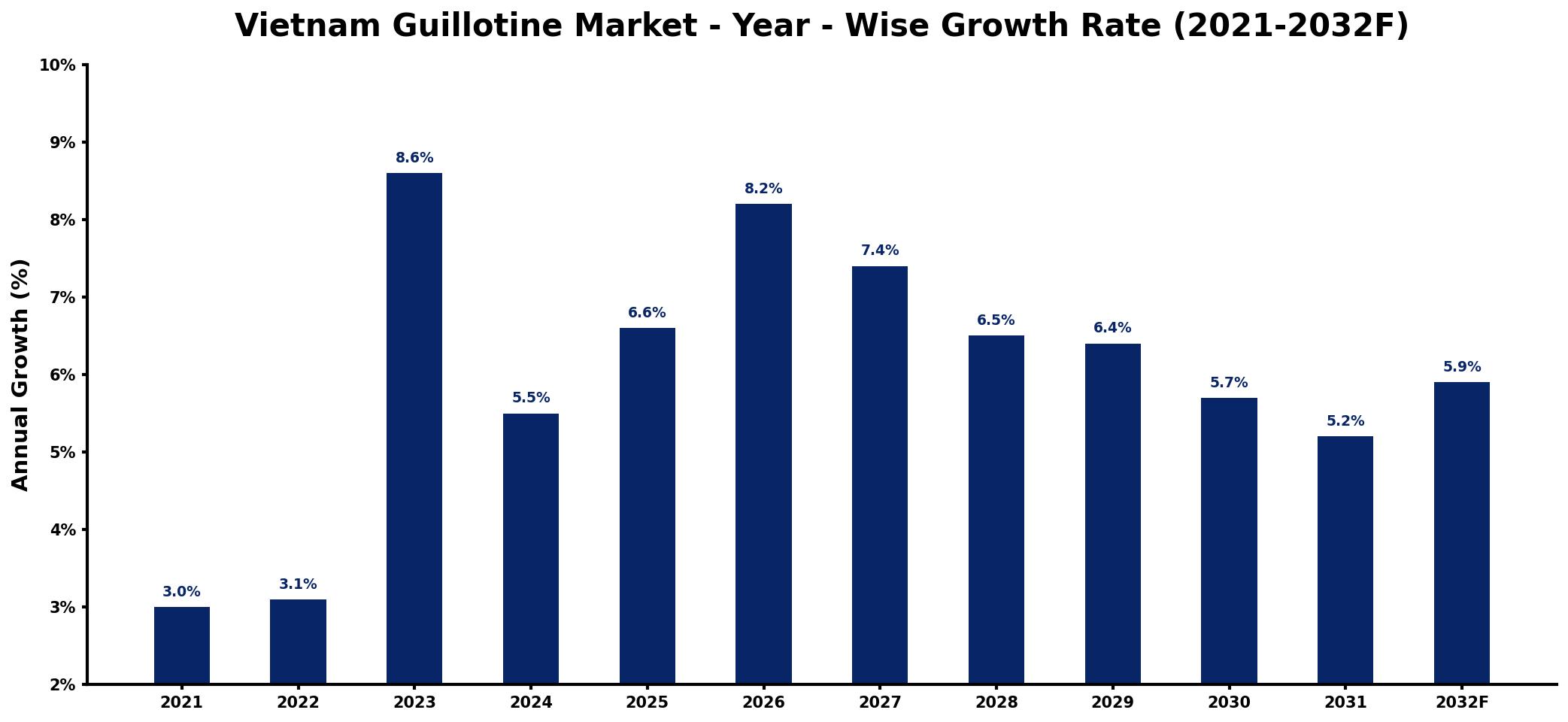
The table below presents the year‑wise growth rates along with the key drivers influencing the market
| Year | Growth Rate | Major Drivers |
| 2021 | 3.0% | Increase in packaging sector demand |
| 2022 | 3.1% | Expansion of printing industry capacity |
| 2023 | 8.6% | Rise in educational institutions investments |
| 2024 | 5.5% | Growth in manufacturing output requirements |
| 2025 | 6.6% | Surge in small business startups |
| 2026 | 8.2% | Boost in eco-friendly material usage |
| 2027 | 7.4% | Increased automation in production lines |
| 2028 | 6.5% | Higher demand for customized solutions |
| 2029 | 6.4% | growing automotive sector requirements |
| 2030 | 5.7% | strengthening international trade flows |
| 2031 | 5.2% | expanding healthcare application demand |
| 2032 | 5.9% | improved processing technologies adoption |
Note: Market size estimations and growth projections presented in this report are based on 6Wresearch's proprietary forecasting methodology, utilizing the latest available industry data, government publications, and primary research inputs.
Vietnam Guillotine Market Synopsis
A robust industrial sector is currently the strongest force shaping the Vietnam guillotine market. The adoption of advanced cutting technologies, alongside an increasing need for high-volume production in industries such as printing, packaging, and metal fabrication, is driving substantial demand for guillotine machines.
As Vietnam progresses in its manufacturing capabilities, the guillotine market is expected to expand, reflecting the broader economic growth. Companies are increasingly investing in automation, pushing for more sophisticated and efficient cutting machinery that aligns with modern manufacturing practices.
Vietnam Guillotine Market Key Takeaways
- The market is poised for steady growth, fueled by the country's industrial advancements.
- Automation and precision cutting technologies are gaining traction among manufacturers.
- Guillotines are crucial for efficient operations in various sectors, including construction and metal fabrication.
- Safety regulations present ongoing challenges that companies must navigate for compliance.
- Skilled technicians are increasingly needed to ensure operational reliability and safety.
Evaluation of Restraints in Vietnam Guillotine Market
Despite its growth potential, the Vietnam guillotine market faces significant restraints primarily tied to safety regulations and compliance challenges. The nature of guillotine machinery, involving heavy components and sharp cutting tools, inherently carries risks that demand rigorous adherence to safety standards. This complexity not only requires continuous monitoring but also regular updates to conform to changing regulatory landscapes. Moreover, the market is hindered by a shortage of skilled technicians who are essential for maintenance and repair, thereby impacting operational efficiency and safety.
Vietnam Guillotine Market Trends
Currently, there is a distinct shift towards automation in the guillotine market, driven by the need for improved production efficiency. Companies are increasingly integrating smart technologies that offer real-time analytics and remote monitoring capabilities. Furthermore, sustainability trends are influencing demand as manufacturers seek energy-efficient solutions and eco-friendly materials. The evolution of lightweight yet durable materials is also reshaping the design and functionality of guillotine machinery, catering to diverse industrial applications.
Vietnam Guillotine Market Opportunities
Genuine growth opportunities in the Vietnam guillotine market lie in the ongoing industrialization and infrastructural developments across the country. Investment in cutting-edge technologies presents avenues for manufacturers to differentiate themselves through enhanced efficiency and precision. Additionally, sectors such as packaging are rapidly evolving, where innovative cutting solutions are essential to meet diverse consumer demands. The potential for international partnerships and technology transfer is also significant, facilitating the introduction of advanced guillotine systems that align with global best practices.
Government Initiatives in the Vietnam Guillotine Market
The Vietnamese government has been actively promoting industrialization, which includes investments in manufacturing technology and infrastructure. Policy initiatives aimed at enhancing productivity and fostering innovation are creating a conducive environment for the guillotine market to thrive. Public spending on infrastructure projects, particularly in construction, further supports the demand for cutting machinery. Various programs are being implemented to encourage automation, helping companies upgrade their equipment and improve operational standards.
Future Insights of the Vietnam Guillotine Market
Looking ahead to 2026-2032, the Vietnam guillotine market is set to benefit from a confluence of factors. As the industrial and construction sectors continue to expand, the demand for precision cutting tools is expected to rise. Furthermore, the ongoing push for digitalization and automation will likely spur further investment in advanced guillotine technologies. With a proactive approach to regulatory compliance and a focus on workforce training, companies can position themselves to capture emerging opportunities in this evolving landscape.
Vietnam Guillotine Market Latest Developments (2025 - 2026)
In recent months, the Vietnam guillotine market has observed a notable shift towards the adoption of automated solutions, with several manufacturers announcing plans to enhance their machinery capabilities. As businesses adapt to evolving consumer demands, there has been an uptick in innovative designs that focus on energy efficiency. Additionally, collaborations between industry players and technology providers are increasing, aiming to integrate cutting-edge features into guillotines that further improve productivity and precision.
Vietnam Guillotine Market - Key Attractiveness of the Report
- 10 Years of Market Numbers
- Historical Data Starting from 2022 to 2025
- Base Year: 2025
- Forecast Data until 2032
- Key Performance Indicators Impacting the Market
- Major Upcoming Developments and Projects
Key Highlights of the Report:
- Vietnam Guillotine Market Outlook
- Market Size of Vietnam Guillotine Market, 2025
- Forecast of Vietnam Guillotine Market, 2032
- Historical Data and Forecast of Vietnam Guillotine Revenues & Volume for the Period 2022-2032F
- Vietnam Guillotine Market Trend Evolution
- Vietnam Guillotine Market Drivers and Challenges
- Vietnam Guillotine Price Trends
- Vietnam Guillotine Porter's Five Forces
- Vietnam Guillotine Industry Life Cycle
- Historical Data and Forecast of Vietnam Guillotine Market Revenues & Volume By Product Type for the Period 2022-2032F
- Historical Data and Forecast of Vietnam Guillotine Market Revenues & Volume By Semi-automatic Guillotines for the Period 2022-2032F
- Historical Data and Forecast of Vietnam Guillotine Market Revenues & Volume By Automatic Guillotines for the Period 2022-2032F
- Historical Data and Forecast of Vietnam Guillotine Market Revenues & Volume By Applications for the Period 2022-2032F
- Historical Data and Forecast of Vietnam Guillotine Market Revenues & Volume By Metal Truncation for the Period 2022-2032F
- Historical Data and Forecast of Vietnam Guillotine Market Revenues & Volume By Plastic Truncation for the Period 2022-2032F
- Historical Data and Forecast of Vietnam Guillotine Market Revenues & Volume By Wood Truncation for the Period 2022-2032F
- Historical Data and Forecast of Vietnam Guillotine Market Revenues & Volume By Others for the Period 2022-2032F
- Historical Data and Forecast of Vietnam Guillotine Market Revenues & Volume By Price for the Period 2022-2032F
- Historical Data and Forecast of Vietnam Guillotine Market Revenues & Volume By Low for the Period 2022-2032F
- Historical Data and Forecast of Vietnam Guillotine Market Revenues & Volume By Medium for the Period 2022-2032F
- Historical Data and Forecast of Vietnam Guillotine Market Revenues & Volume By High for the Period 2022-2032F
- Historical Data and Forecast of Vietnam Guillotine Market Revenues & Volume By Distribution Channel for the Period 2022-2032F
- Historical Data and Forecast of Vietnam Guillotine Market Revenues & Volume By Direct for the Period 2022-2032F
- Historical Data and Forecast of Vietnam Guillotine Market Revenues & Volume By Indirect for the Period 2022-2032F
- Vietnam Guillotine Import Export Trade Statistics
- Market Opportunity Assessment By Product Type
- Market Opportunity Assessment By Applications
- Market Opportunity Assessment By Price
- Market Opportunity Assessment By Distribution Channel
- Vietnam Guillotine Top Companies Market Share
- Vietnam Guillotine Competitive Benchmarking By Technical and Operational Parameters
- Vietnam Guillotine Company Profiles
- Vietnam Guillotine Key Strategic Recommendations






































