Vietnam Hand Dryers Market Summary
The vietnam hand dryers market was estimated at USD 159 Million in 2025 and is projected to reach USD 224 Million by 2032, growing at a CAGR of 8.0% from 2026 to 2032.
Vietnam Hand Dryers Market Year-wise Growth Rate and Key Drivers
This graph highlights how the Vietnam Hand Dryers Market has steadily grown over the past five years, supported by major growth factors.
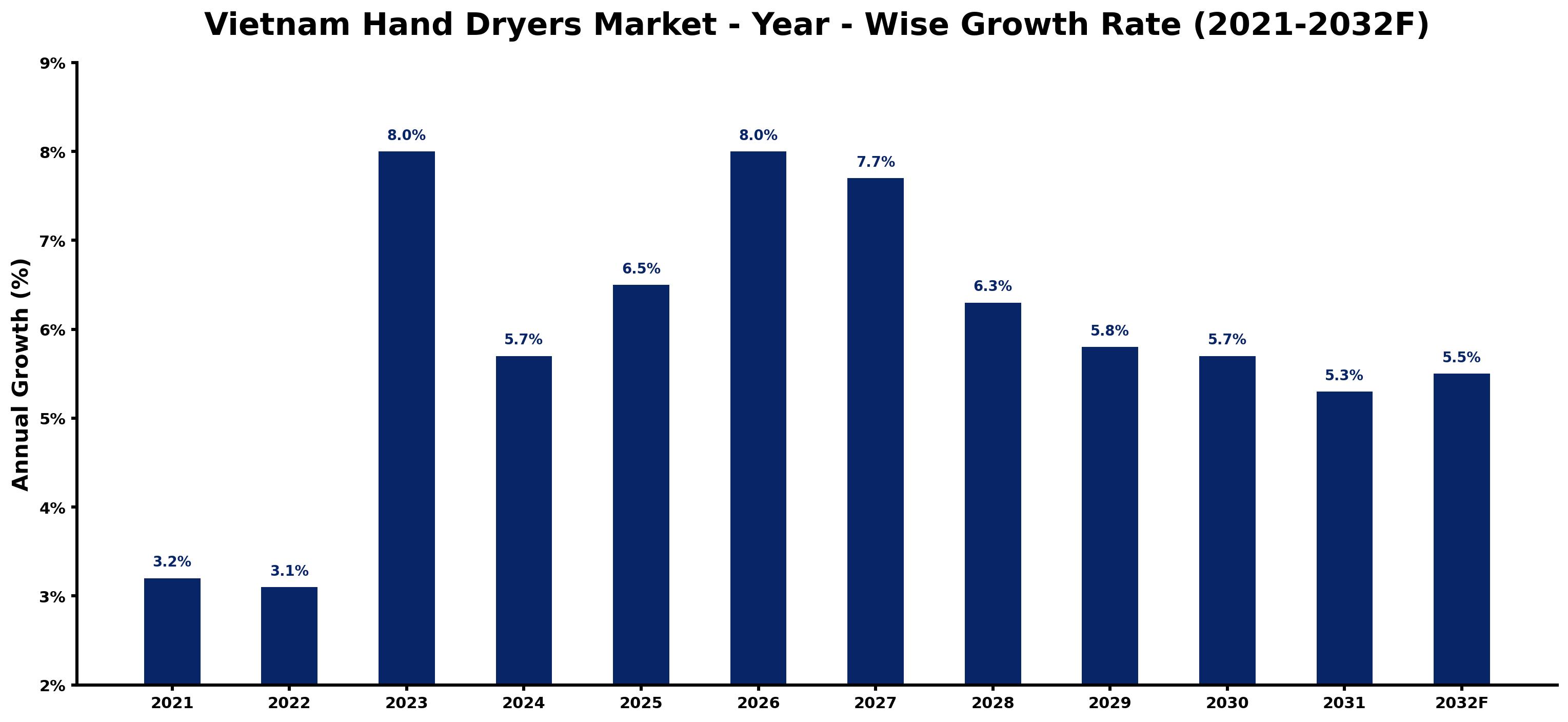
The table below presents the year wise growth rates along with the key drivers influencing the market
| Year | Growth Rate | Major Drivers |
| 2021 | 3.2% | Post-lockdown recovery shifted focus to hygiene, boosting hand dryer demand significantly. |
| 2022 | 3.1% | Rising urbanization fueled the need for modern restroom facilities in public spaces. |
| 2023 | 8.0% | Manufacturers increasingly localize production to reduce costs and improve supply chains. |
| 2024 | 5.7% | Innovations in energy-efficient technologies attract environmentally conscious consumers and businesses. |
| 2025 | 6.5% | The hospitality sector sees significant investment in upgrading restroom amenities and designs. |
| 2026 | 8.0% | Corporate sustainability goals lead to expanded use of eco-friendly hand dryer solutions. |
| 2027 | 7.7% | Growing awareness of hygiene practices results in higher demand for touchless technology. |
| 2028 | 6.3% | Infrastructure development projects in cities further enhance the demand for hand dryer installations. |
| 2029 | 5.8% | Emerging markets in rural areas begin adopting hand dryers to elevate sanitation standards. |
| 2030 | 5.7% | International collaborations promote technology transfer, enhancing product offerings in Vietnam. |
| 2031 | 5.3% | Consumer preferences shift toward stylish designs, merging function with aesthetic appeal. |
| 2032 | 5.5% | Investment in smart restroom technology creates new opportunities for advanced hand dryer features. |
Note - Market size estimations and growth projections presented in this report are based on 6Wresearch's advanced forecasting approach, validated with industry datasets as of June 2026.
Vietnam Hand Dryers Market Synopsis
The Vietnam Hand Dryers Market is projected to reach 8.0% and witness significant growth during the forecast period (2026-2032). The demand for hand dryers in Vietnam is being fueled by heightened awareness of hygiene and sanitation, as well as a push towards sustainable practices in both public and private spaces. These factors combined are paving the way for the adoption of advanced technologies in hand-drying solutions.
Vietnam Hand Dryers Market Growth Drivers
Several key drivers are propelling the Vietnam hand dryers market. Firstly, the rising importance of hand hygiene in preventing the spread of infections has increased the demand for hand dryers, particularly in high-traffic public areas. Secondly, the eco-friendly nature of hand dryers, which are more sustainable compared to paper towels, has made them a preferred choice for many establishments. Additionally, the potential cost savings associated with hand dryers, which can outstrip long-term expenses related to paper towel usage, present a compelling financial argument for businesses. Furthermore, the modernization of public facilities and private enterprises in Vietnam is leading to increased installations of hand dryers, aligning with contemporary standards of hygiene and convenience. Lastly, the influence of global trends towards environmentally sustainable practices contributes to the expanded market appeal of hand dryers.
Vietnam Hand Dryers Market Challenges and Restraints
While the Vietnam hand dryers market experiences positive growth, there are significant challenges that must be addressed. One primary challenge is the initial investment required for installing hand dryers, which may deter smaller businesses from making the transition. Moreover, ensuring the regular maintenance and reliability of hand dryers is crucial for their effective and long-term operation, presenting additional operational challenges for establishments. The enduring popularity of traditional hand-drying methods, such as paper towels, continues to pose competition to modern hand dryers, necessitating concerted efforts to promote their benefits. Additionally, consumer education about the advantages of hand dryers over traditional methods is critical to increasing adoption rates. Finally, the lingering effects of the COVID-19 pandemic, which raised concerns about hygiene and aerosol dispersion from air dryers, further complicate market penetration strategies.
Vietnam Hand Dryers Market Government Investment and Initiatives
The Vietnamese government has recognized the importance of hygiene and sanitation, particularly in public facilities. Various initiatives have been launched that promote the adoption of modern hygiene solutions, including hand dryers. Public spending aimed at upgrading infrastructure in schools, hospitals, and government buildings is fostering an environment conducive to the installation of hand dryers. Furthermore, policies encouraging eco-friendly practices are providing incentives for businesses to adopt sustainable solutions, which may include hand dryers as an alternative to single-use products. Development plans being implemented by the government also emphasize reducing waste and enhancing overall public health standards, reinforcing the need for effective hand-drying solutions in public spaces.
Vietnam Hand Dryers Market Latest Developments (May 2025 - June 2026)
The Vietnam hand dryers market has witnessed noteworthy developments between May 2025 and June 2026, reflecting the evolving landscape of hygiene and sanitation practices in the country. Businesses and public facilities have started incorporating advanced hand drying technologies that not only enhance hygiene but also reduce environmental impacts. Innovations in energy-efficient designs and touchless operations are becoming increasingly popular as establishments seek to improve user experience while aligning with eco-friendly practices. Furthermore, a surge in government contracts aimed at modernizing public infrastructure has facilitated higher demand for hand dryers, particularly in urban areas. This period has also seen a shift in consumer preferences, with a growing inclination towards products that emphasize both hygiene and sustainability. Overall, these developments signify a dynamic and adaptive market landscape moving forward.
Vietnam Hand Dryers Market - Key Attractiveness of the Report
- 10 Years of Market Numbers
- Historical Data Starting from 2022 to 2025
- Base Year: 2025
- Forecast Data until 2032
- Key Performance Indicators Impacting the Market
- Major Upcoming Developments and Projects
Key Highlights of the Report:
- Vietnam Hand Dryers Market Outlook
- Market Size of Vietnam Hand Dryers Market, 2025
- Forecast of Vietnam Hand Dryers Market, 2032
- Historical Data and Forecast of Vietnam Hand Dryers Revenues & Volume for the Period 2022-2032F
- Vietnam Hand Dryers Market Trend Evolution
- Vietnam Hand Dryers Market Drivers and Challenges
- Vietnam Hand Dryers Price Trends
- Vietnam Hand Dryers Porter's Five Forces
- Vietnam Hand Dryers Industry Life Cycle
- Historical Data and Forecast of Vietnam Hand Dryers Market Revenues & Volume By Product Type for the Period 2022-2032F
- Historical Data and Forecast of Vietnam Hand Dryers Market Revenues & Volume By Jet Air for the Period 2022-2032F
- Historical Data and Forecast of Vietnam Hand Dryers Market Revenues & Volume By Hot Air for the Period 2022-2032F
- Historical Data and Forecast of Vietnam Hand Dryers Market Revenues & Volume By Operation Mode for the Period 2022-2032F
- Historical Data and Forecast of Vietnam Hand Dryers Market Revenues & Volume By Manual On-Automatic Off for the Period 2022-2032F
- Historical Data and Forecast of Vietnam Hand Dryers Market Revenues & Volume By Fully Automatic for the Period 2022-2032F
- Historical Data and Forecast of Vietnam Hand Dryers Market Revenues & Volume By Mounting Technique for the Period 2022-2032F
- Historical Data and Forecast of Vietnam Hand Dryers Market Revenues & Volume By Surface Mounted for the Period 2022-2032F
- Historical Data and Forecast of Vietnam Hand Dryers Market Revenues & Volume By Wall Mounted for the Period 2022-2032F
- Historical Data and Forecast of Vietnam Hand Dryers Market Revenues & Volume By End-users for the Period 2022-2032F
- Historical Data and Forecast of Vietnam Hand Dryers Market Revenues & Volume By Airports for the Period 2022-2032F
- Historical Data and Forecast of Vietnam Hand Dryers Market Revenues & Volume By Hotel & Restaurants for the Period 2022-2032F
- Historical Data and Forecast of Vietnam Hand Dryers Market Revenues & Volume By Hospitals for the Period 2022-2032F
- Historical Data and Forecast of Vietnam Hand Dryers Market Revenues & Volume By Offices for the Period 2022-2032F
- Historical Data and Forecast of Vietnam Hand Dryers Market Revenues & Volume By Shopping Malls for the Period 2022-2032F
- Historical Data and Forecast of Vietnam Hand Dryers Market Revenues & Volume By Others for the Period 2022-2032F
- Vietnam Hand Dryers Import Export Trade Statistics
- Market Opportunity Assessment By Product Type
- Market Opportunity Assessment By Operation Mode
- Market Opportunity Assessment By Mounting Technique
- Market Opportunity Assessment By End-users
- Vietnam Hand Dryers Top Companies Market Share
- Vietnam Hand Dryers Competitive Benchmarking By Technical and Operational Parameters
- Vietnam Hand Dryers Company Profiles
- Vietnam Hand Dryers Key Strategic Recommendations






































