Vietnam Hay Making Machinery Market Size, Share & Growth Rate
The Vietnam Hay Making Machinery Market was estimated at USD 288 Million in 2025 and is projected to reach USD 405 Million by 2032, growing at a CAGR of 5.0% from 2026 to 2032. This growth trajectory is strongly supported by the increasing demand for livestock feed, driven by a rising population and enhanced meat and dairy consumption. As farmers adopt modern techniques to optimize their output, the transition towards advanced machinery is becoming a critical component of efficient agricultural practices.
Vietnam Hay Making Machinery Market Year-wise Growth Rate and Key Drivers
This graph highlights how the Vietnam Hay Making Machinery Market has steadily grown over the years, supported by major growth factors.
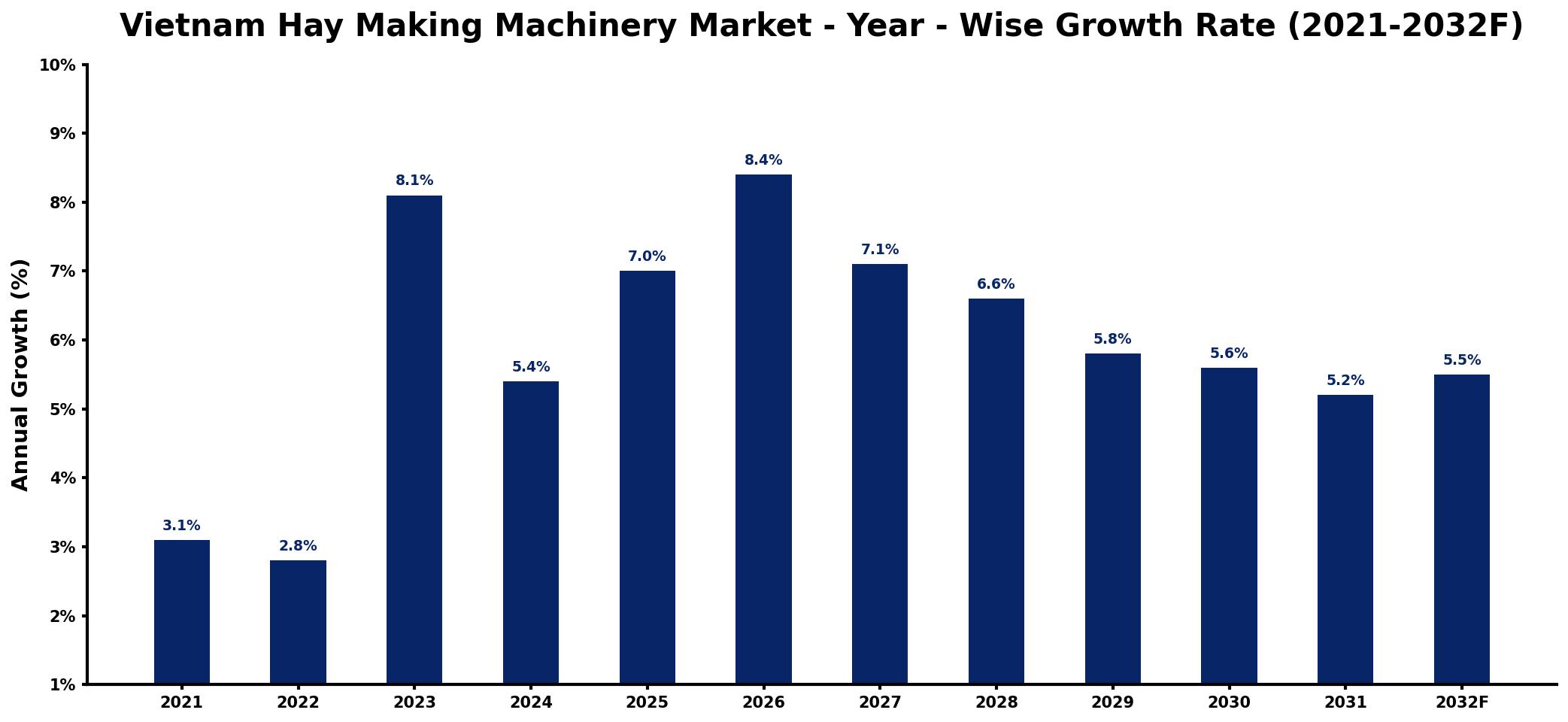
The table below presents the year‑wise growth rates along with the key drivers influencing the market
| Year | Growth Rate | Major Drivers |
| 2021 | 3.1% | Increased agricultural investment activities |
| 2022 | 2.8% | Rising demand for automation solutions |
| 2023 | 8.1% | Expansion of rural infrastructure projects |
| 2024 | 5.4% | Growth in export-oriented agriculture |
| 2025 | 7.0% | Technological advancements in farming |
| 2026 | 8.4% | Higher consumer demand for efficiency |
| 2027 | 7.1% | Emergence of eco-friendly practices |
| 2028 | 6.6% | Increased focus on crop diversification |
| 2029 | 5.8% | Growing popularity of precision agriculture |
| 2030 | 5.6% | Strengthened agricultural policy frameworks |
| 2031 | 5.2% | Enhanced farmer education initiatives |
| 2032 | 5.5% | Development of cooperative farming models |
Note: Market size estimations and growth projections presented in this report are based on 6Wresearch's proprietary forecasting methodology, utilizing the latest available industry data, government publications, and primary research inputs.
Vietnam Hay Making Machinery Market Synopsis
In Vietnam, the hay making machinery market is gaining momentum as farmers increasingly recognize the importance of efficiency in forage crop management. With agriculture remaining a backbone of the economy, the demand for sophisticated hay-making tools has surged, particularly among livestock farmers. This reflects a broader trend towards mechanization in agriculture.
As sustainability becomes a priority within the agricultural sector, there is a notable shift towards eco-friendly machinery designed to minimize environmental impact while maximizing productivity. The integration of innovative technologies in hay making machinery not only enhances operational efficiency but also aligns with the growing trend towards sustainable practices in Vietnamese agriculture.
Vietnam Hay Making Machinery Market Key Takeaways
- The market is poised for significant growth due to heightened livestock feed requirements driven by increasing meat and dairy consumption.
- Modern hay making machinery is essential for ensuring consistent quality and availability of forage crops for livestock.
- There is a critical shift toward environmentally friendly machinery, reflecting global trends in sustainable agriculture.
- Technological advancements are paving the way for improved operational efficiencies in the hay making process.
- Ongoing challenges related to farmer training and the adaptation of machinery to evolving agricultural practices remain central to market dynamics.
Evaluation of Restraints in Vietnam Hay Making Machinery Market
Despite the growth prospects, the Vietnam hay making machinery market faces several restraints that could impede its progress. One significant challenge is the ability to adapt machinery to the rapidly changing agricultural landscape. As farmers modify their practices and crop patterns, manufacturers must stay ahead of these shifts to remain relevant. Additionally, the lack of comprehensive training programs for farmers regarding the use and maintenance of modern machinery can lead to underutilization, limiting the potential benefits of advanced technology. Ensuring that farmers are well-supported and knowledgeable in using this equipment will be vital for the sustained growth of the market.
Vietnam Hay Making Machinery Market Trends
Current trends in the Vietnam hay making machinery market include the rise of automation and precision farming techniques. These innovations are becoming increasingly popular as farmers seek to maximize yields while minimizing labor costs. Furthermore, the integration of smart technologies, such as IoT sensors and AI-driven analytics, is beginning to revolutionize traditional hay making practices. This not only enhances the efficiency of operations but also contributes to better resource management and reduced waste, aligning with the broader agricultural trend towards sustainability.
Vietnam Hay Making Machinery Market Opportunities
The Vietnam hay making machinery market presents numerous opportunities for investment and growth. As the agricultural sector continues to modernize, there is a growing demand for advanced machinery that can significantly enhance productivity. Furthermore, the increasing focus on sustainability opens avenues for developing eco-friendly machinery solutions. Investment in research and development to create innovative products tailored to local agricultural practices will be pivotal. Additionally, establishing partnerships with farmers to ensure they receive the necessary training and support can strengthen market position and foster long-term growth.
Government Initiatives in the Vietnam Hay Making Machinery Market
The Vietnamese government has been proactive in supporting the agricultural sector through various initiatives aimed at modernization and sustainability. Public funding and programs focused on enhancing agricultural productivity are crucial in promoting the adoption of advanced machinery. Incentives for farmers to embrace mechanization and sustainable practices contribute to the growth of the hay making machinery market. Additionally, initiatives to improve training and education among farmers are vital to ensure effective utilization of new technologies, further driving market dynamics.
Future Insights of the Vietnam Hay Making Machinery Market
Looking ahead to 2026-2032, the Vietnam hay making machinery market is set to evolve significantly. The increasing focus on mechanization, coupled with advancements in technology, will likely drive the development of more sophisticated and eco-friendly machinery. As the demand for quality livestock feed continues to rise, the market will experience greater investments in innovative solutions. Additionally, aligning with sustainable agricultural practices will not only enhance productivity but also support the overall health of the environment, making this sector increasingly attractive to stakeholders.
Vietnam Hay Making Machinery Market Latest Developments (2025 - 2026)
Recent developments in the Vietnam hay making machinery market reflect a growing focus on innovation and sustainability. Manufacturers are investing in research and development to produce advanced machinery that reduces environmental impact while improving efficiency. Partnerships between agricultural tech companies and local farmers are emerging, fostering knowledge sharing and better resource management practices. Furthermore, government support for training programs is increasing, ensuring that farmers can effectively utilize new technologies, thus promoting enhanced productivity across the sector.
Vietnam Hay Making Machinery Market - Key Attractiveness of the Report
- 10 Years of Market Numbers
- Historical Data Starting from 2022 to 2025
- Base Year: 2025
- Forecast Data until 2032
- Key Performance Indicators Impacting the Market
- Major Upcoming Developments and Projects
Key Highlights of the Report:
- Vietnam Hay Making Machinery Market Outlook
- Market Size of Vietnam Hay Making Machinery Market, 2025
- Forecast of Vietnam Hay Making Machinery Market, 2032
- Historical Data and Forecast of Vietnam Hay Making Machinery Revenues & Volume for the Period 2022-2032F
- Vietnam Hay Making Machinery Market Trend Evolution
- Vietnam Hay Making Machinery Market Drivers and Challenges
- Vietnam Hay Making Machinery Price Trends
- Vietnam Hay Making Machinery Porter's Five Forces
- Vietnam Hay Making Machinery Industry Life Cycle
- Historical Data and Forecast of Vietnam Hay Making Machinery Market Revenues & Volume By Type for the Period 2022-2032F
- Historical Data and Forecast of Vietnam Hay Making Machinery Market Revenues & Volume By Mower for the Period 2022-2032F
- Historical Data and Forecast of Vietnam Hay Making Machinery Market Revenues & Volume By Balers for the Period 2022-2032F
- Historical Data and Forecast of Vietnam Hay Making Machinery Market Revenues & Volume By Tedder for the Period 2022-2032F
- Historical Data and Forecast of Vietnam Hay Making Machinery Market Revenues & Volume By Rakes for the Period 2022-2032F
- Vietnam Hay Making Machinery Import Export Trade Statistics
- Market Opportunity Assessment By Type
- Vietnam Hay Making Machinery Top Companies Market Share
- Vietnam Hay Making Machinery Competitive Benchmarking By Technical and Operational Parameters
- Vietnam Hay Making Machinery Company Profiles
- Vietnam Hay Making Machinery Key Strategic Recommendations






































