Vietnam Hepatitis Vaccine Market Size, Share & Growth Rate
The Vietnam Hepatitis Vaccine Market was estimated at USD 478 Million in 2025 and is projected to reach USD 671 Million by 2032, growing at a CAGR of 5.0% from 2026 to 2032. This growth trajectory is primarily driven by heightened public awareness regarding hepatitis prevention and robust government vaccination initiatives aimed at curtailing the disease's prevalence. Additionally, the continuous advancements in vaccine research and accessibility are fostering increased uptake across various demographics in Vietnam.
Vietnam Hepatitis Vaccine Market Year-wise Growth Rate and Key Drivers
This graph highlights how the Vietnam Hepatitis Vaccine Market has steadily grown over the years, supported by major growth factors.
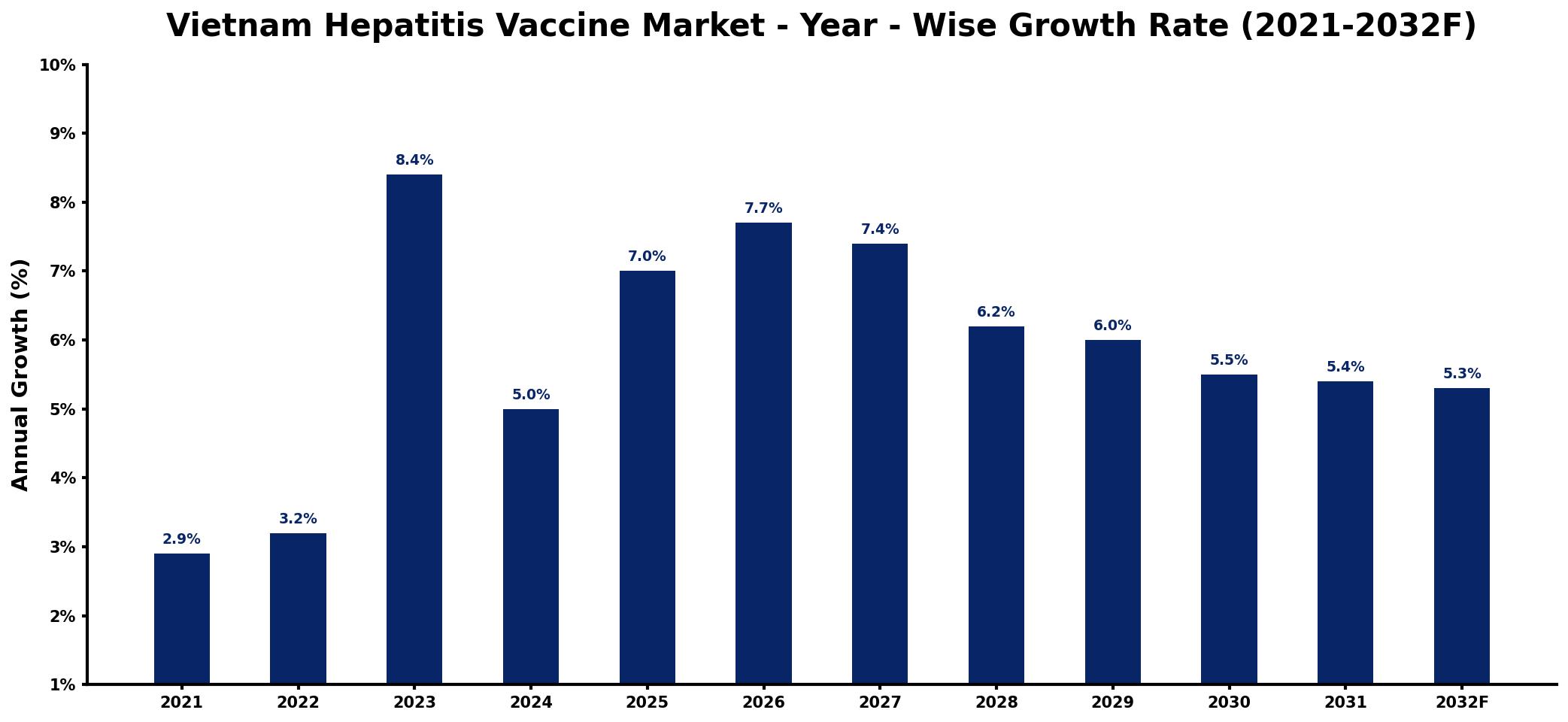
The table below presents the year‑wise growth rates along with the key drivers influencing the market
| Year | Growth Rate | Major Drivers |
| 2021 | 2.9% | Rising health awareness initiatives |
| 2022 | 3.2% | Increased government healthcare funding |
| 2023 | 8.4% | Expansion of healthcare infrastructure |
| 2024 | 5.0% | Growing demand for preventive care |
| 2025 | 7.0% | improved processing technologies adoption |
| 2026 | 7.7% | Strengthening public health policies |
| 2027 | 7.4% | Enhanced disease surveillance systems |
| 2028 | 6.2% | Adoption of new health technologies |
| 2029 | 6.0% | rising export shipment volumes |
| 2030 | 5.5% | Focus on chronic disease management |
| 2031 | 5.4% | Growing support from NGOs |
| 2032 | 5.3% | Development of local manufacturing capabilities |
Note: Market size estimations and growth projections presented in this report are based on 6Wresearch's proprietary forecasting methodology, utilizing the latest available industry data, government publications, and primary research inputs.
Vietnam Hepatitis Vaccine Market Synopsis
The Vietnam hepatitis vaccine market is witnessing significant momentum, fueled by concerted efforts from healthcare authorities and rising public health awareness. As the nation strives to enhance vaccination coverage, the landscape is evolving, highlighting a commitment to disease prevention and community health.
Looking forward, the market is positioned for continued growth, underpinned by ongoing research and innovations in vaccine technology. The interplay between governmental initiatives and an increasingly health-conscious populace is setting a strong foundation for future advancements in hepatitis vaccination.
Vietnam Hepatitis Vaccine Market Key Takeaways
- The market is projected to grow at a CAGR of 5.0%, reflecting increasing demand for hepatitis vaccines.
- Government initiatives are enhancing vaccination rates, directly impacting public health outcomes.
- Research and development efforts are leading to improved vaccine formulations and accessibility.
- Healthcare infrastructure improvements are making hepatitis vaccines more available to underserved populations.
- Public awareness campaigns play a critical role in driving vaccine uptake and preventing outbreaks.
Evaluation of Restraints in Vietnam Hepatitis Vaccine Market
Despite the optimistic growth outlook, the Vietnam hepatitis vaccine market faces notable challenges. Vaccine accessibility remains uneven, particularly in remote areas where healthcare resources are limited. Efforts to reach these underserved populations must be prioritized to mitigate the risk of hepatitis outbreaks. Moreover, enhancing public education about the importance of vaccination is essential to overcome skepticism and misinformation surrounding vaccines. Investments in research and development are needed to maintain safety and efficacy standards while ensuring vaccines are affordable for the general population.
Vietnam Hepatitis Vaccine Market Trends
Current trends indicate a shift towards more comprehensive vaccination strategies that incorporate educational outreach and community engagement. The integration of technology in healthcare, including mobile vaccination units and telemedicine consultations, is enhancing access to vaccinations. Additionally, there is a growing focus on developing combination vaccines that address multiple strains of hepatitis, further streamlining public health efforts. Increased collaboration between private and public sectors is also evident, driving innovation and distribution efficiencies.
Vietnam Hepatitis Vaccine Market Opportunities
Investment opportunities abound within the Vietnam hepatitis vaccine market. The ongoing demand for new and effective vaccine formulations presents a viable entry point for pharmaceutical companies. Additionally, partnerships with local healthcare providers can enhance distribution networks, particularly in rural areas. The recent emphasis on research innovation positions companies to capitalize on developing vaccines that are both affordable and highly effective, contributing to greater overall public health.
Government Initiatives in the Vietnam Hepatitis Vaccine Market
The Vietnamese government has prioritized hepatitis prevention through a series of strategic initiatives and vaccination programs aimed at increasing coverage rates. Public health campaigns are being launched to educate citizens about the dangers of hepatitis and the benefits of vaccination. Investment in healthcare infrastructure is also a focus, enabling better access to vaccines in underserved regions. These collective efforts underscore the government's commitment to combatting hepatitis as a public health threat.
Future Insights of the Vietnam Hepatitis Vaccine Market
Between 2026 and 2032, the Vietnam hepatitis vaccine market is expected to witness significant evolution, characterized by enhanced vaccine technology and greater public engagement. As awareness grows, the demand for more targeted and effective vaccines will likely increase, prompting ongoing investments in research. The collaborative landscape of healthcare, involving public institutions and private entities, is projected to further streamline vaccination programs, ensuring that the population is equipped with essential immunization against hepatitis.
Vietnam Hepatitis Vaccine Market Latest Developments (2025 - 2026)
Recent developments in the Vietnam hepatitis vaccine market have centered around the introduction of new vaccine formulations and the expansion of public health initiatives. There has been a notable increase in partnerships between government agencies and private sector stakeholders to enhance vaccine distribution networks. Additionally, ongoing research efforts are leading to promising advancements in vaccine efficacy and safety, reflecting a robust commitment to improving the health landscape of Vietnam.
Vietnam Hepatitis Vaccine Market - Key Attractiveness of the Report
- 10 Years of Market Numbers
- Historical Data Starting from 2022 to 2025
- Base Year: 2025
- Forecast Data until 2032
- Key Performance Indicators Impacting the Market
- Major Upcoming Developments and Projects
Key Highlights of the Report:
- Vietnam Hepatitis Vaccine Market Outlook
- Market Size of Vietnam Hepatitis Vaccine Market, 2025
- Forecast of Vietnam Hepatitis Vaccine Market, 2032
- Historical Data and Forecast of Vietnam Hepatitis Vaccine Revenues & Volume for the Period 2022-2032F
- Vietnam Hepatitis Vaccine Market Trend Evolution
- Vietnam Hepatitis Vaccine Market Drivers and Challenges
- Vietnam Hepatitis Vaccine Price Trends
- Vietnam Hepatitis Vaccine Porter's Five Forces
- Vietnam Hepatitis Vaccine Industry Life Cycle
- Historical Data and Forecast of Vietnam Hepatitis Vaccine Market Revenues & Volume By Indication for the Period 2022-2032F
- Historical Data and Forecast of Vietnam Hepatitis Vaccine Market Revenues & Volume By Hepatitis A for the Period 2022-2032F
- Historical Data and Forecast of Vietnam Hepatitis Vaccine Market Revenues & Volume By Hepatitis B for the Period 2022-2032F
- Historical Data and Forecast of Vietnam Hepatitis Vaccine Market Revenues & Volume By Vaccine Type for the Period 2022-2032F
- Historical Data and Forecast of Vietnam Hepatitis Vaccine Market Revenues & Volume By Recombinant Vaccine for the Period 2022-2032F
- Historical Data and Forecast of Vietnam Hepatitis Vaccine Market Revenues & Volume By Inactivated Vaccine for the Period 2022-2032F
- Historical Data and Forecast of Vietnam Hepatitis Vaccine Market Revenues & Volume By Distribution Channel for the Period 2022-2032F
- Historical Data and Forecast of Vietnam Hepatitis Vaccine Market Revenues & Volume By Hospitals for the Period 2022-2032F
- Historical Data and Forecast of Vietnam Hepatitis Vaccine Market Revenues & Volume By Retail Pharmacy for the Period 2022-2032F
- Historical Data and Forecast of Vietnam Hepatitis Vaccine Market Revenues & Volume By Online Pharmacy for the Period 2022-2032F
- Vietnam Hepatitis Vaccine Import Export Trade Statistics
- Market Opportunity Assessment By Indication
- Market Opportunity Assessment By Vaccine Type
- Market Opportunity Assessment By Distribution Channel
- Vietnam Hepatitis Vaccine Top Companies Market Share
- Vietnam Hepatitis Vaccine Competitive Benchmarking By Technical and Operational Parameters
- Vietnam Hepatitis Vaccine Company Profiles
- Vietnam Hepatitis Vaccine Key Strategic Recommendations






































