Vietnam Hollow Section Steel Market Size, Share & Growth Rate
The Vietnam Hollow Section Steel Market was estimated at USD 204 Million in 2025 and is projected to reach USD 288 Million by 2032, growing at a CAGR of 5.0% from 2026 to 2032. This growth trajectory is underpinned by the rapid urbanization and significant investments in infrastructure, including transportation networks and real estate projects. The ongoing transformation in Vietnam's construction landscape, where hollow section steel serves as a critical material, further propels demand and fuels market expansion.
Vietnam Hollow Section Steel Market Year-wise Growth Rate and Key Drivers
This graph highlights how the Vietnam Hollow Section Steel Market has steadily grown over the years, supported by major growth factors.
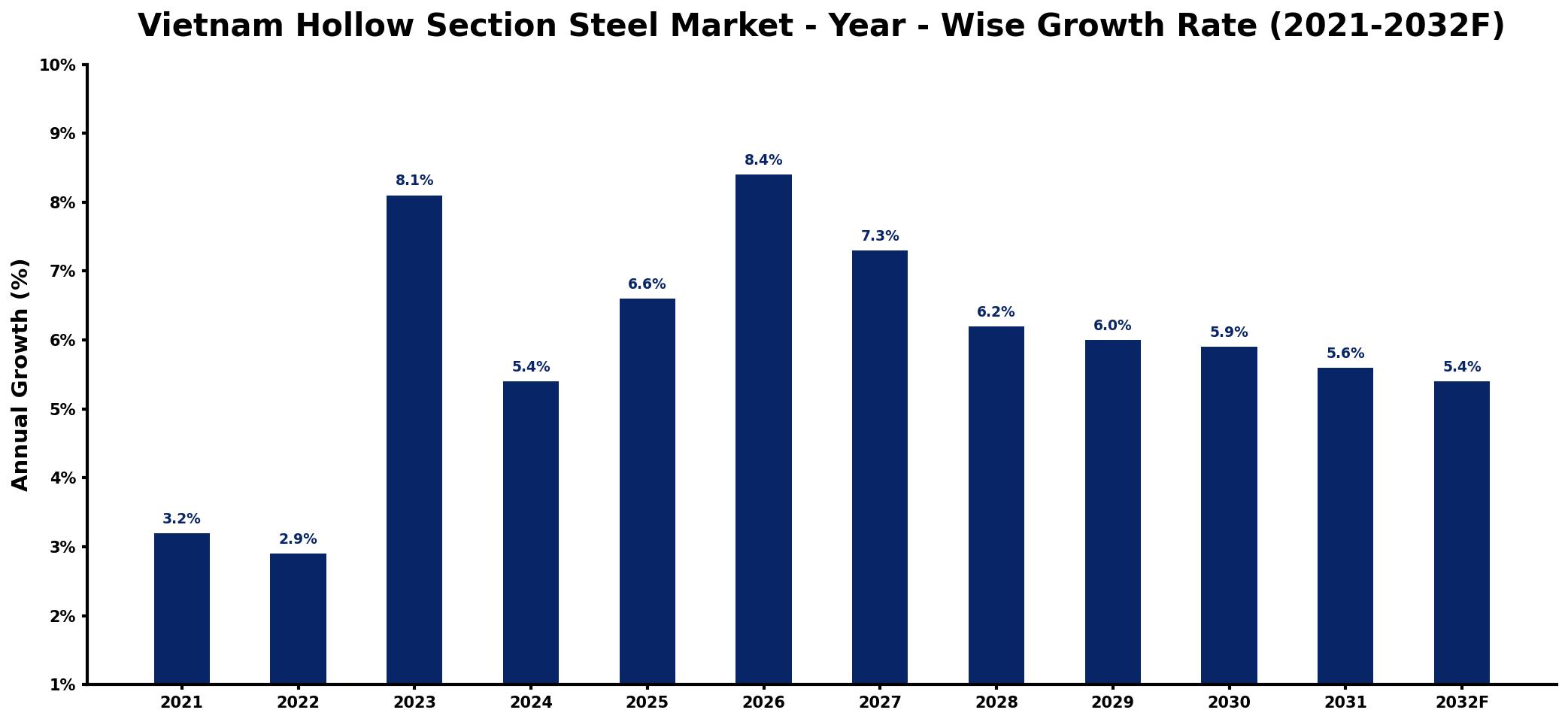
The table below presents the year‑wise growth rates along with the key drivers influencing the market
| Year | Growth Rate | Major Drivers |
| 2021 | 3.2% | Infrastructure projects driving demand |
| 2022 | 2.9% | Increased construction activity nationwide |
| 2023 | 8.1% | Rising investments in manufacturing |
| 2024 | 5.4% | Growing urbanization and housing needs |
| 2025 | 6.6% | Boost in renewable energy initiatives |
| 2026 | 8.4% | Expansion of transportation networks |
| 2027 | 7.3% | Enhanced industrial production capacity |
| 2028 | 6.2% | Development of smart cities initiatives |
| 2029 | 6.0% | Strengthening logistics and distribution |
| 2030 | 5.9% | Focus on sustainable construction practices |
| 2031 | 5.6% | Increasing foreign direct investments |
| 2032 | 5.4% | Technological advancements in construction |
Note: Market size estimations and growth projections presented in this report are based on 6Wresearch's proprietary forecasting methodology, utilizing the latest available industry data, government publications, and primary research inputs.
Vietnam Hollow Section Steel Market Synopsis
Vietnam's hollow section steel market is undergoing a notable evolution, driven by booming construction activities and infrastructure development. The versatile properties of hollow section steel, including strength and cost-effectiveness, make it an essential material for a variety of applications ranging from buildings to bridges.
As urbanization accelerates, the demand for robust infrastructure and housing solutions continues to rise. This dynamic sector is fostering a competitive landscape, where key players are increasingly focusing on product quality and customization to meet the diverse needs of clients across industries.
Vietnam Hollow Section Steel Market Key Takeaways
- The market is poised for significant growth, driven by urbanization and infrastructure expansion.
- Technological advancements in steel manufacturing are enhancing product offerings.
- Hollow section steel's versatility supports its widespread adoption in various sectors.
- Key industry players are prioritizing customization to cater to diverse market demands.
- The market landscape is influenced by fluctuating economic conditions and competition from alternative materials.
Evaluation of Restraints in Vietnam Hollow Section Steel Market
While the Vietnam hollow section steel market exhibits promising growth potential, it faces significant restraints. Fluctuations in construction activity, often influenced by economic conditions and government funding, can create volatility in demand. Furthermore, the increasing competition from alternative materials poses a challenge for market participants. Companies need to navigate these hurdles by diversifying their customer bases and exploring innovative product solutions to maintain their competitive edge.
Vietnam Hollow Section Steel Market Trends
Current trends in the Vietnam hollow section steel market include a growing emphasis on sustainability and eco-friendly manufacturing processes. Additionally, digital transformation is leading to enhanced precision in production, allowing manufacturers to tailor products to meet specific project needs. Moreover, an increasing focus on smart city initiatives is likely to drive the demand for high-quality hollow section steel products in urban infrastructure developments.
Vietnam Hollow Section Steel Market Opportunities
The Vietnam hollow section steel market is ripe with opportunities, particularly in the context of government initiatives promoting infrastructure development. Investment in renewable energy projects and the construction of high-tech facilities represent significant growth areas. Furthermore, as the automotive sector expands, there is increasing potential for hollow section steel in manufacturing automotive components, thereby diversifying applications.
Government Initiatives in the Vietnam Hollow Section Steel Market
The Vietnamese government is implementing various initiatives aimed at enhancing infrastructure development and modernization. These include public spending on transportation and housing projects, as well as incentives for domestic manufacturers to improve production capabilities. Additionally, policies aimed at promoting sustainable construction practices are expected to spur demand for hollow section steel products that meet environmental standards.
Future Insights of the Vietnam Hollow Section Steel Market
Looking ahead to 2026-2032, the Vietnam hollow section steel market is anticipated to continue its upward trajectory. Strong governmental support for infrastructure projects, coupled with increasing urbanization, will play a pivotal role in shaping market dynamics. Furthermore, as innovative manufacturing technologies evolve, they will likely enhance product quality and customization, positioning the market for sustained growth.
Vietnam Hollow Section Steel Market Latest Developments (2025 - 2026)
Recent developments in the Vietnam hollow section steel market indicate a shift towards greater technological integration, with manufacturers investing in advanced production capabilities to meet rising demand. Collaboration between industry players and construction firms is increasing, aiming to streamline supply chains and improve project execution efficiency. Additionally, awareness of sustainable practices is prompting companies to explore eco-friendly steel production methods.
Vietnam Hollow Section Steel Market - Key Attractiveness of the Report
- 10 Years of Market Numbers
- Historical Data Starting from 2022 to 2025
- Base Year: 2025
- Forecast Data until 2032
- Key Performance Indicators Impacting the Market
- Major Upcoming Developments and Projects
Key Highlights of the Report:
- Vietnam Hollow Section Steel Market Outlook
- Market Size of Vietnam Hollow Section Steel Market, 2025
- Forecast of Vietnam Hollow Section Steel Market, 2032
- Historical Data and Forecast of Vietnam Hollow Section Steel Revenues & Volume for the Period 2022-2032F
- Vietnam Hollow Section Steel Market Trend Evolution
- Vietnam Hollow Section Steel Market Drivers and Challenges
- Vietnam Hollow Section Steel Price Trends
- Vietnam Hollow Section Steel Porter's Five Forces
- Vietnam Hollow Section Steel Industry Life Cycle
- Historical Data and Forecast of Vietnam Hollow Section Steel Market Revenues & Volume By Type for the Period 2022-2032F
- Historical Data and Forecast of Vietnam Hollow Section Steel Market Revenues & Volume By Rectangular Hollow Section for the Period 2022-2032F
- Historical Data and Forecast of Vietnam Hollow Section Steel Market Revenues & Volume By Square Hollow Section for the Period 2022-2032F
- Historical Data and Forecast of Vietnam Hollow Section Steel Market Revenues & Volume By Circular Hollow Section for the Period 2022-2032F
- Historical Data and Forecast of Vietnam Hollow Section Steel Market Revenues & Volume By Other for the Period 2022-2032F
- Historical Data and Forecast of Vietnam Hollow Section Steel Market Revenues & Volume By Application for the Period 2022-2032F
- Historical Data and Forecast of Vietnam Hollow Section Steel Market Revenues & Volume By Agricultural for the Period 2022-2032F
- Historical Data and Forecast of Vietnam Hollow Section Steel Market Revenues & Volume By Construction for the Period 2022-2032F
- Historical Data and Forecast of Vietnam Hollow Section Steel Market Revenues & Volume By General Engineering for the Period 2022-2032F
- Historical Data and Forecast of Vietnam Hollow Section Steel Market Revenues & Volume By Mechanical Application for the Period 2022-2032F
- Historical Data and Forecast of Vietnam Hollow Section Steel Market Revenues & Volume By Others for the Period 2022-2032F
- Historical Data and Forecast of Vietnam Hollow Section Steel Market Revenues & Volume By Global Hollow Section Steel Market dynamics for the Period 2022-2032F
- Historical Data and Forecast of Vietnam Hollow Section Steel Market Revenues & Volume By Global Hollow Section Steel Market size for the Period 2022-2032F
- Historical Data and Forecast of Vietnam Hollow Section Steel Market Revenues & Volume By Supply & Demand for the Period 2022-2032F
- Vietnam Hollow Section Steel Import Export Trade Statistics
- Market Opportunity Assessment By Type
- Market Opportunity Assessment By Application
- Vietnam Hollow Section Steel Top Companies Market Share
- Vietnam Hollow Section Steel Competitive Benchmarking By Technical and Operational Parameters
- Vietnam Hollow Section Steel Company Profiles
- Vietnam Hollow Section Steel Key Strategic Recommendations






































