Vietnam Home Bedding Market Size Growth Rate
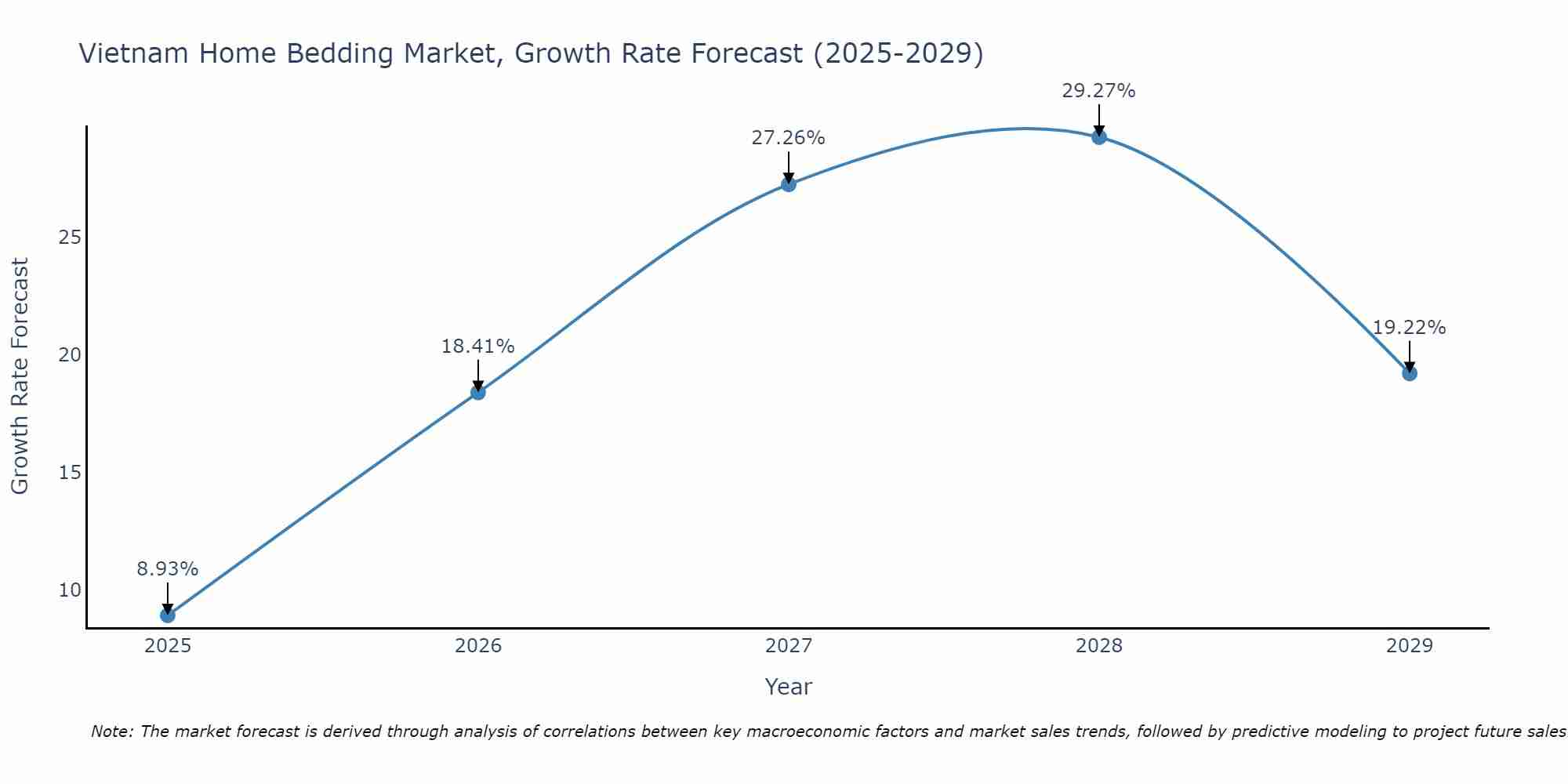
The Vietnam Home Bedding Market is projected to witness mixed growth rate patterns during 2025 to 2029. The growth rate begins at 8.93% in 2025, climbs to a high of 29.27% in 2028, and moderates to 19.22% by 2029.
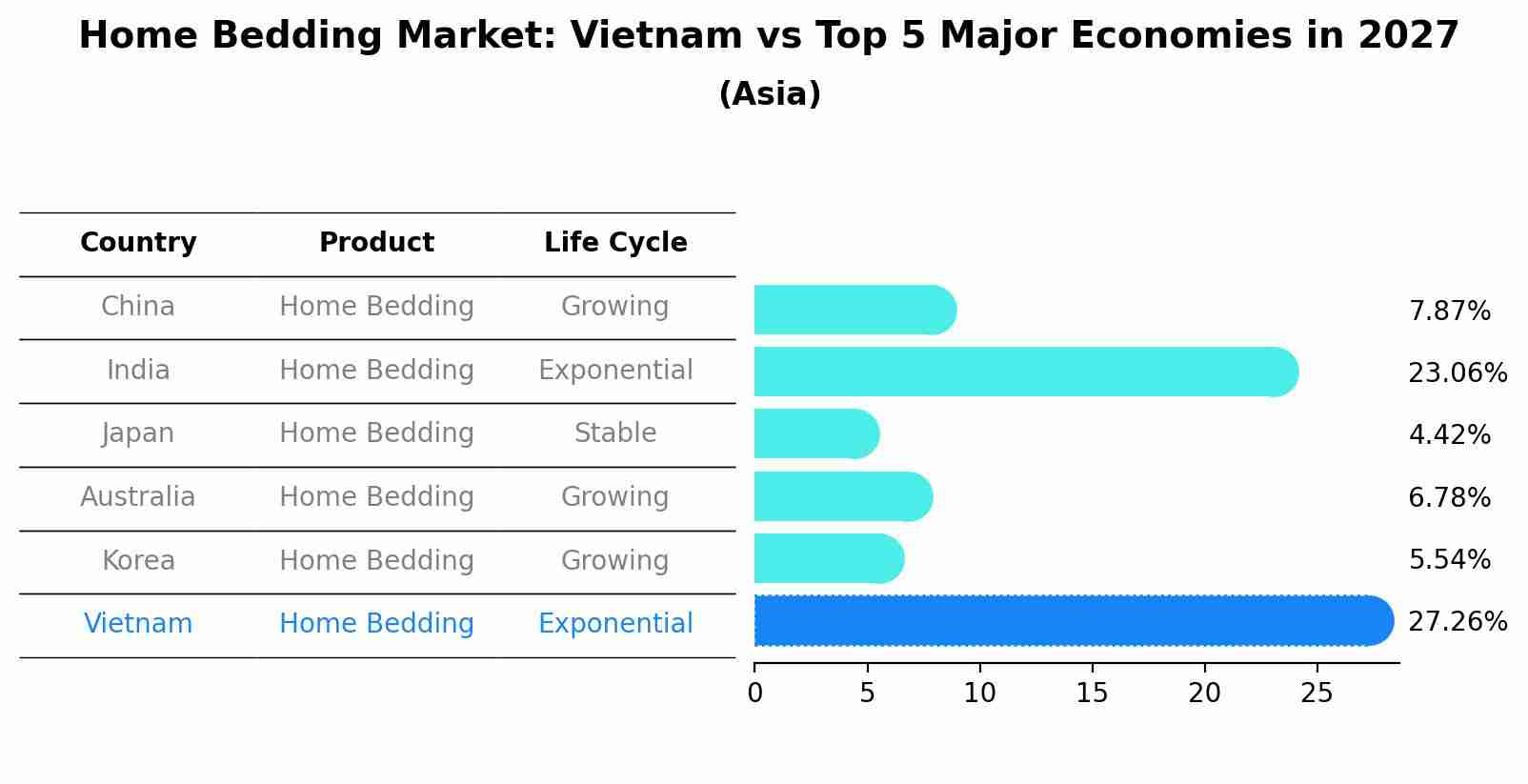
Home Bedding Market: Vietnam vs Top 5 Major Economies in 2027 (Asia)
By 2027, Vietnam's Home Bedding market is forecasted to achieve a exponential growth rate of 27.26%, with China leading the Asia region, followed by India, Japan, Australia and South Korea.
Vietnam Home Bedding Market Synopsis
The Vietnam home bedding market is flourishing as consumers increasingly prioritize sleep quality and bedroom aesthetics. Vietnamese households are investing in high-quality mattresses, bed linens, pillows, and other bedding products to improve their sleep experience. This market includes a wide range of products, from affordable options to luxury bedding brands. As consumers become more discerning, manufacturers are focusing on comfort, durability, and style, while also introducing innovations such as anti-allergenic materials and smart bedding solutions.
Drivers of the Market
The Vietnam home bedding market is expanding due to changing lifestyle preferences and an increasing focus on home comfort. As more people spend time at home, there is a growing demand for high-quality bedding products that provide comfort and relaxation. The market is also influenced by the desire for aesthetically pleasing and customizable bedding options. Consumers are looking for bedding materials that offer breathability, durability, and ease of maintenance. Additionally, the e-commerce boom in Vietnam has made it easier for consumers to access a wide range of home bedding products, further boosting market growth.
Challenges of the Market
The Vietnam home bedding market faces challenges related to changing consumer preferences and market dynamics. Keeping up with evolving design trends and materials preferences can be demanding for manufacturers. Moreover, price sensitivity among consumers can limit profit margins, especially in the face of rising production costs. Quality control and ensuring that products meet international safety and comfort standards are essential but can be resource-intensive. Additionally, competition from imported bedding products can put pressure on local manufacturers to maintain their market share.
COVID-19 Impact on the Market
The home bedding market in Vietnam saw a mixed impact during the pandemic. Initially, there was increased demand for bedding products as people spent more time at home. However, as economic uncertainty grew, consumers became more price-sensitive, impacting premium bedding segments. Supply chain disruptions affected the availability of certain bedding materials. Manufacturers had to adapt by offering online sales channels and emphasizing product quality and hygiene.
Key Players in the Market
In the Vietnam home bedding market, some of the leading players include Vinatex, Everpia JSC, and Me Kong Delta Co., Ltd. Vinatex, as a state-owned enterprise, dominates a significant portion of the market share with its extensive network of retail outlets and a wide range of bedding products. Everpia JSC is known for its innovative and eco-friendly bedding solutions, while Me Kong Delta Co., Ltd specializes in high-quality luxury bedding products catering to the upscale segment.
Key Highlights of the Report:
- Vietnam Home Bedding Market Outlook
- Market Size of Vietnam Home Bedding Market, 2024
- Forecast of Vietnam Home Bedding Market, 2031
- Historical Data and Forecast of Vietnam Home Bedding Revenues & Volume for the Period 2021-2031
- Vietnam Home Bedding Market Trend Evolution
- Vietnam Home Bedding Market Drivers and Challenges
- Vietnam Home Bedding Price Trends
- Vietnam Home Bedding Porter's Five Forces
- Vietnam Home Bedding Industry Life Cycle
- Historical Data and Forecast of Vietnam Home Bedding Market Revenues & Volume By Type for the Period 2021-2031
- Historical Data and Forecast of Vietnam Home Bedding Market Revenues & Volume By Bed Linen for the Period 2021-2031
- Historical Data and Forecast of Vietnam Home Bedding Market Revenues & Volume By Mattress for the Period 2021-2031
- Historical Data and Forecast of Vietnam Home Bedding Market Revenues & Volume By Pillows for the Period 2021-2031
- Historical Data and Forecast of Vietnam Home Bedding Market Revenues & Volume By Blankets for the Period 2021-2031
- Historical Data and Forecast of Vietnam Home Bedding Market Revenues & Volume By Others for the Period 2021-2031
- Historical Data and Forecast of Vietnam Home Bedding Market Revenues & Volume By Distribution Channel for the Period 2021-2031
- Historical Data and Forecast of Vietnam Home Bedding Market Revenues & Volume By Offline for the Period 2021-2031
- Historical Data and Forecast of Vietnam Home Bedding Market Revenues & Volume By Online for the Period 2021-2031
- Vietnam Home Bedding Import Export Trade Statistics
- Market Opportunity Assessment By Type
- Market Opportunity Assessment By Distribution Channel
- Vietnam Home Bedding Top Companies Market Share
- Vietnam Home Bedding Competitive Benchmarking By Technical and Operational Parameters
- Vietnam Home Bedding Company Profiles
- Vietnam Home Bedding Key Strategic Recommendations






































