Vietnam Home Furniture and Bedding Market Size, Share & Growth Rate
The Vietnam Home Furniture and Bedding Market was estimated at USD 704 Million in 2025 and is projected to reach USD 1003 Million by 2032, growing at a CAGR of 5.2% from 2026 to 2032. This robust growth trajectory is fueled by increasing urbanization and rising disposable incomes, as more consumers seek stylish yet functional furnishings to complement their evolving lifestyles. Additionally, the influence of contemporary design trends is prompting buyers to invest in quality products that not only enhance their living spaces but also reflect their personal taste.
Vietnam Home Furniture and Bedding Market Year-wise Growth Rate and Key Drivers
This graph highlights how the Vietnam Home Furniture and Bedding Market has steadily grown over the years, supported by major growth factors.
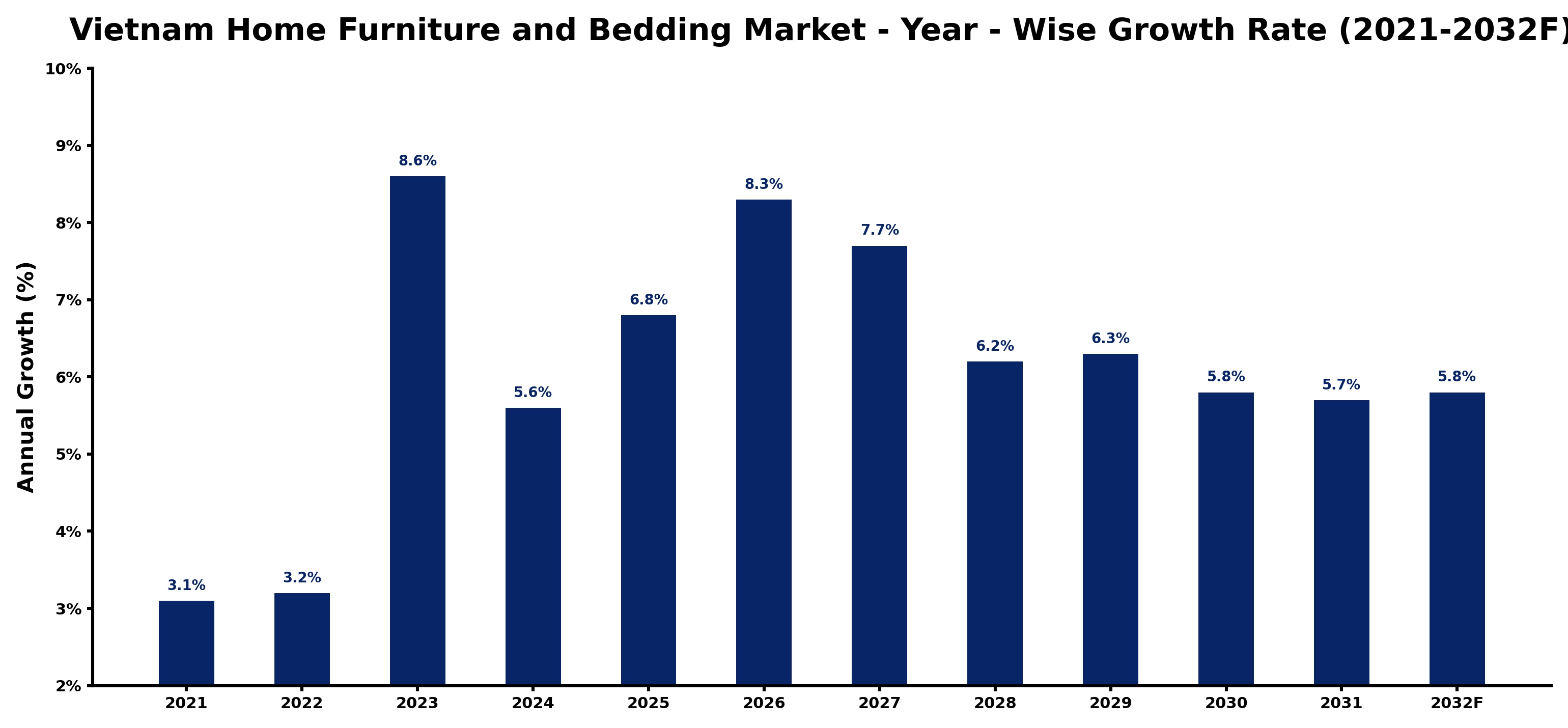
The table below presents the year‑wise growth rates along with the key drivers influencing the market
| Year | Growth Rate | Major Drivers |
| 2021 | 3.1% | Rising disposable income levels |
| 2022 | 3.2% | Urbanization driving home purchases |
| 2023 | 8.6% | E-commerce growth enhanced accessibility |
| 2024 | 5.6% | Sustainable materials gaining popularity |
| 2025 | 6.8% | Home renovation trends accelerating demand |
| 2026 | 8.3% | Smart home integration expanding offerings |
| 2027 | 7.7% | Increased focus on interior design |
| 2028 | 6.2% | Consumer preference for local products |
| 2029 | 6.3% | Health and wellness trends influencing |
| 2030 | 5.8% | Customization options attracting consumers |
| 2031 | 5.7% | Luxury furniture market expanding rapidly |
| 2032 | 5.8% | Technological advancements improving production |
Note - Market size estimations and growth projections presented in this report are based on 6Wresearch's advanced forecasting approach, validated with industry datasets as of June 2026.
Vietnam Home Furniture and Bedding Market Synopsis
In Vietnam, the demand for home furniture is intricately tied to the country's burgeoning real estate sector. As more families move into newly developed urban areas, there is a heightened need for attractive and practical furniture solutions that cater to modern living. The bedding segment is equally significant, with consumers increasingly prioritizing comfort and quality to ensure a good night's sleep.
On the supply side, a growing number of local manufacturers and retailers are emerging, eager to tap into the evolving market dynamics. These players are responding to the consumer shift toward e-commerce, providing online platforms that expand accessibility and convenience for discerning buyers. The integration of digital technologies is reshaping how consumers interact with furniture brands, creating a dynamic retail environment.
Vietnam Home Furniture and Bedding Market Key Takeaways
- Urbanization continues to drive demand for home furnishings, with consumers seeking both aesthetics and functionality.
- The online retail landscape is rapidly evolving, providing greater access to a variety of products for consumers.
- Quality and durability are becoming non-negotiable factors in purchasing decisions for both furniture and bedding.
- Innovative design trends are influencing consumer preferences, leaning towards modern and minimalist aesthetics.
- Local manufacturers are increasingly competing with international brands by offering tailored solutions that resonate with Vietnamese consumers.
Evaluation of Restraints in Vietnam Home Furniture and Bedding Market
Despite the promising growth, the Vietnam Home Furniture and Bedding Market grapples with significant restraints. Quality control remains a pressing issue, as the influx of substandard products can endanger consumer safety and satisfaction. Furthermore, the rapid pace of market expansion often complicates the enforcement of safety regulations, creating potential pitfalls for both manufacturers and buyers. Ensuring that quality standards are met while fostering a competitive environment presents a challenging balancing act for industry stakeholders.
Vietnam Home Furniture and Bedding Market Trends
Key trends are shaping the Vietnam Home Furniture and Bedding Market, particularly the growing preference for eco-friendly materials. Consumers are increasingly aware of sustainability, prompting brands to explore greener options in product design and sourcing. Additionally, technology integration is on the rise, with smart furniture gaining traction, appealing to the tech-savvy segment of the population seeking multifunctional living solutions. This convergence of technology and design is set to redefine consumer expectations and experiences.
Vietnam Home Furniture and Bedding Market Opportunities
The market presents substantial growth and investment opportunities, particularly for companies that can innovate and adapt to consumer preferences. With urbanization continuing to rise, there is ample potential for businesses that specialize in tailored solutions that accommodate smaller living spaces. Furthermore, the increasing popularity of e-commerce opens new avenues for market penetration, as brands leverage online platforms to reach a broader audience effectively.
Government Initiatives in the Vietnam Home Furniture and Bedding Market
The Vietnamese government is increasingly recognizing the importance of the home furnishings sector as a driver of economic growth. Initiatives to promote local manufacturing and attract foreign investment are paving the way for a more robust industry. Public policies supporting infrastructure development, such as improved transportation and logistics systems, are also critical in facilitating better supply chain operations for furniture manufacturers and retailers.
Future Insights of the Vietnam Home Furniture and Bedding Market
Looking ahead to 2026-2032, the Vietnam Home Furniture and Bedding Market is poised for dynamic evolution. As urbanization continues unabated, the demand for innovative and adaptable living solutions will grow. The fusion of technology and design is expected to create new product categories, particularly in smart home furniture. Brands that embrace these shifts while maintaining a commitment to quality and sustainability will likely thrive in this competitive landscape.
Vietnam Home Furniture and Bedding Market Latest Developments (May 2025 - June 2026)
The market has seen a notable increase in collaborations between local artisans and contemporary design firms, blending traditional craftsmanship with modern aesthetics. Moreover, advancements in logistics and supply chain management have enhanced product availability and reduced delivery times, making it easier for consumers to furnish their homes. E-commerce platforms are ramping up their offerings, further enriching the shopping experience and expanding brand reach.
Vietnam Home Furniture and Bedding Market - Key Attractiveness of the Report
- 10 Years of Market Numbers
- Historical Data Starting from 2022 to 2025
- Base Year: 2025
- Forecast Data until 2032
- Key Performance Indicators Impacting the Market
- Major Upcoming Developments and Projects
Key Highlights of the Report:
- Vietnam Home Furniture and Bedding Market Outlook
- Market Size of Vietnam Home Furniture and Bedding Market, 2025
- Forecast of Vietnam Home Furniture and Bedding Market, 2032
- Historical Data and Forecast of Vietnam Home Furniture and Bedding Revenues & Volume for the Period 2022-2032F
- Vietnam Home Furniture and Bedding Market Trend Evolution
- Vietnam Home Furniture and Bedding Market Drivers and Challenges
- Vietnam Home Furniture and Bedding Price Trends
- Vietnam Home Furniture and Bedding Porter's Five Forces
- Vietnam Home Furniture and Bedding Industry Life Cycle
- Historical Data and Forecast of Vietnam Home Furniture and Bedding Market Revenues & Volume By Product Type for the Period 2022-2032F
- Historical Data and Forecast of Vietnam Home Furniture and Bedding Market Revenues & Volume By Sofa for the Period 2022-2032F
- Historical Data and Forecast of Vietnam Home Furniture and Bedding Market Revenues & Volume By Bed for the Period 2022-2032F
- Historical Data and Forecast of Vietnam Home Furniture and Bedding Market Revenues & Volume By Chair for the Period 2022-2032F
- Historical Data and Forecast of Vietnam Home Furniture and Bedding Market Revenues & Volume By Cupboard for the Period 2022-2032F
- Historical Data and Forecast of Vietnam Home Furniture and Bedding Market Revenues & Volume By Others for the Period 2022-2032F
- Historical Data and Forecast of Vietnam Home Furniture and Bedding Market Revenues & Volume By Sales Channel for the Period 2022-2032F
- Historical Data and Forecast of Vietnam Home Furniture and Bedding Market Revenues & Volume By Online for the Period 2022-2032F
- Historical Data and Forecast of Vietnam Home Furniture and Bedding Market Revenues & Volume By Offline for the Period 2022-2032F
- Vietnam Home Furniture and Bedding Import Export Trade Statistics
- Market Opportunity Assessment By Product Type
- Market Opportunity Assessment By Sales Channel
- Vietnam Home Furniture and Bedding Top Companies Market Share
- Vietnam Home Furniture and Bedding Competitive Benchmarking By Technical and Operational Parameters
- Vietnam Home Furniture and Bedding Company Profiles
- Vietnam Home Furniture and Bedding Key Strategic Recommendations






































