Vietnam Hominy Feed Market Size, Share & Growth Rate
The Vietnam Hominy Feed Market was estimated at USD 262 Million in 2025 and is projected to reach USD 369 Million by 2032, growing at a CAGR of 5.0% from 2026 to 2032. This growth trajectory is primarily fueled by the rapid expansion of the livestock sector, as farmers increasingly rely on hominy feed for its nutritional benefits. Additionally, the rise in meat consumption and dairy production is pushing the demand for cost-effective and quality feed solutions across Vietnam's agricultural landscape.
Vietnam Hominy Feed Market Growth Rate Analysis (2021-2032)
The Vietnam hominy feed market has flourished over the past few years, showcasing a notable growth trajectory with a 3.0% rise in 2021 followed by a significant uptick of 8.6% in 2023. This growth can be attributed to increasing consumer demand for sustainable livestock feed alternatives, bolstered by advancements in agricultural technology and infrastructure improvements. The momentum is expected to persist, with projected growth rates of 5.4% in 2024 and peaking at 7.8% in 2026, driven by strategic investments and supportive government policies aimed at enhancing the agricultural sector. However, the market will face slight fluctuations, tapering off to 5.3% in 2032 as competition intensifies and market saturation occurs. Overall, the sector remains poised for robust expansion through 2031.
Vietnam Hominy Feed Market Year-wise Growth Rate and Key Drivers
This graph highlights how the Vietnam Hominy Feed Market has steadily grown over the past five years, supported by major growth factors.
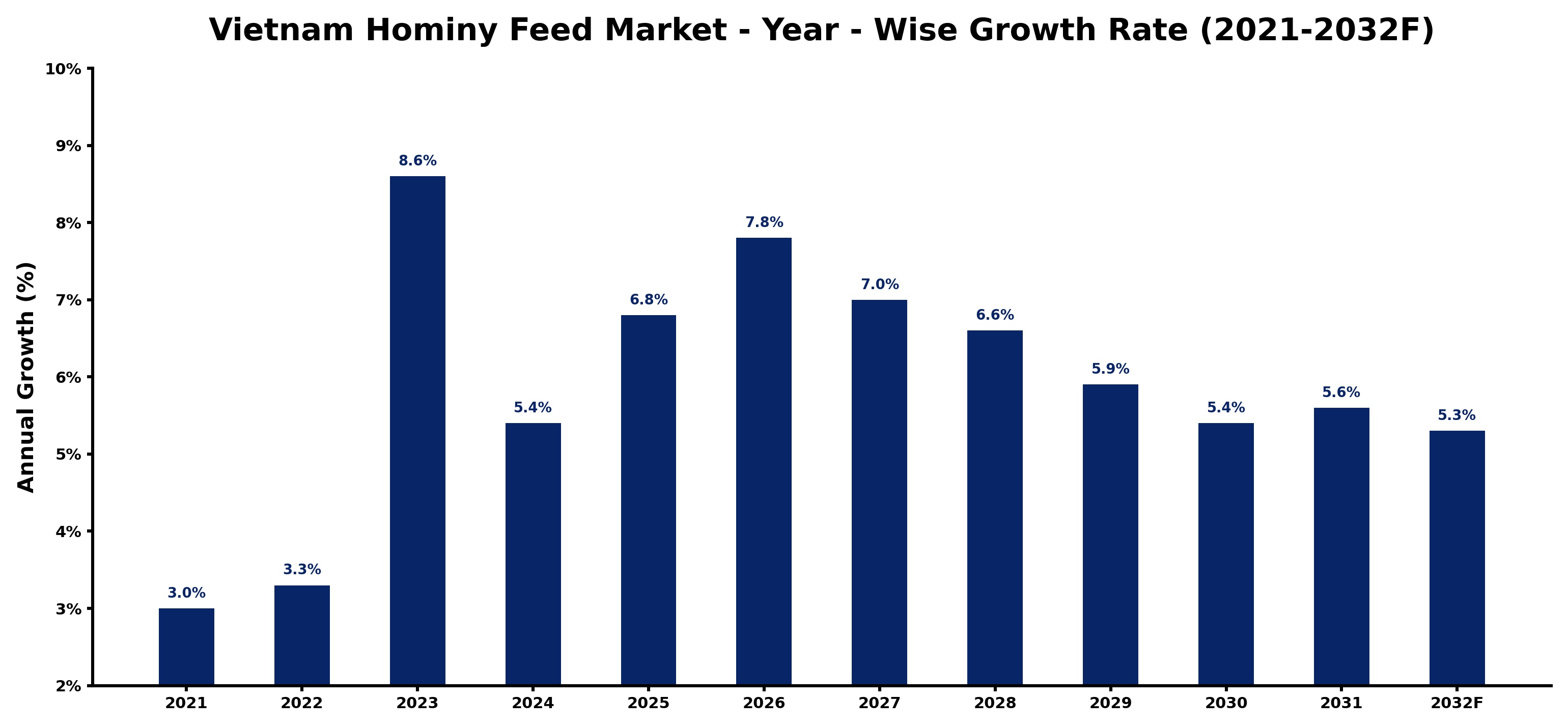
The table below presents the year‑wise growth rates along with the key drivers influencing the market
| Year | Growth Rate | Major Drivers |
| 2021 | 3.0% | Increased livestock production demands |
| 2022 | 3.3% | Rising consumer health awareness |
| 2023 | 8.6% | Export opportunities expanded significantly |
| 2024 | 5.4% | Technological advancements improved efficiency |
| 2025 | 6.8% | Sustainable farming practices gained traction |
| 2026 | 7.8% | Growing aquaculture industry demands feed |
| 2027 | 7.0% | Rising disposable incomes enhanced consumption |
| 2028 | 6.6% | Urbanization increased feed accessibility |
| 2029 | 5.9% | Nutritional product innovations attracted buyers |
| 2030 | 5.4% | Government support for agriculture increased |
| 2031 | 5.6% | Feed quality standards improved significantly |
| 2032 | 5.3% | Market consolidation enhanced competitive landscape |
Note - Market size estimations and growth projections presented in this report are based on 6Wresearch's advanced forecasting approach, validated with industry datasets as of June 2026.
Vietnam Hominy Feed Market Synopsis
The Vietnam Hominy Feed market has emerged as a crucial segment of the country's agricultural framework, showcasing a robust demand driven by both domestic and international consumption trends. As a byproduct of maize milling, hominy feed is recognized for its affordability and high nutritional content, making it a preferred choice among livestock farmers.
Current market dynamics indicate a shift towards sustainable livestock practices, where hominy feed plays an integral role in enhancing animal health. The ongoing advancements in feed processing technologies further cement its position as a valuable feed ingredient, promoting better growth rates and overall productivity in livestock.
Vietnam Hominy Feed Market Key Takeaways
- The market is projected to grow significantly, reaching USD 369 Million by 2032.
- Hominy feed is increasingly favored due to its cost-effectiveness and nutritional value.
- The demand for hominy feed is closely linked to the expansion of Vietnam's livestock sector.
- Technological advancements in feed processing are enhancing product quality.
- There is a growing awareness among farmers about the benefits of hominy feed for livestock nutrition.
Evaluation of Restraints in Vietnam Hominy Feed Market
Despite its potential, the Vietnam Hominy Feed market grapples with challenges related to production consistency. Fluctuations in maize supply can lead to variability in hominy feed availability and quality. This inconsistency can deter farmers from fully embracing hominy feed as a staple in their livestock diet. Additionally, competition from alternative feed sources such as soybean meal and rice bran adds complexity, as these alternatives often have established market presence and consumer loyalty. Thus, effective marketing and education on the benefits of hominy feed are vital for overcoming these obstacles.
Vietnam Hominy Feed Market Trends
Recent trends in the Vietnam Hominy Feed market indicate a significant shift towards more sustainable feeding practices. With rising concerns about animal health and environmental impact, farmers are increasingly seeking out feed options that promote both growth and welfare. Moreover, there is an upswing in research focusing on enhancing the nutritional profile of hominy feed, which promises to improve its attractiveness as a primary feed ingredient.
Additionally, the digital transformation within the agriculture sector is influencing how hominy feed is marketed and distributed. Online platforms are becoming essential for educating farmers about the advantages of hominy feed, thereby driving sales and facilitating greater adoption among livestock producers.
Vietnam Hominy Feed Market Opportunities
The evolving landscape of the Vietnam Hominy Feed market presents numerous growth opportunities for stakeholders. As demand for high-quality, nutritious animal feed escalates, suppliers can position hominy feed as a key ingredient that supports livestock health and productivity. Furthermore, expanding research initiatives focused on optimizing hominy feed formulations could enhance its market appeal.
Investments in technology that improve feed production processes will also be pivotal. Leveraging innovations could enable manufacturers to ensure consistent quality and availability of hominy feed, ultimately fostering trust among farmers and promoting wider usage across the livestock sector.
Government Initiatives in the Vietnam Hominy Feed Market
The Vietnamese government has undertaken various initiatives to support the agricultural sector, particularly in enhancing feed production practices. Policies aimed at promoting sustainable farming methods and improving the quality of animal feed are crucial to the growth of the hominy feed market. Additionally, public investments in agricultural research and development are expected to yield advancements that benefit feed quality and livestock health.
Future Insights of the Vietnam Hominy Feed Market
Looking ahead to 2026-2032, the Vietnam Hominy Feed market is poised for steady growth, driven by the increasing demand for livestock products. As consumer preferences evolve towards healthier and more sustainable food sources, the role of hominy feed will likely expand in importance. The ongoing recovery from the COVID-19 pandemic is also anticipated to bolster agricultural activities, contributing to a more resilient and dynamic market environment.
Vietnam Hominy Feed Market Latest Developments (May 2025 - June 2026)
Recent developments within the Vietnam Hominy Feed market reflect a greater focus on sustainability and technological enhancement. Industry participants are exploring innovative feed processing methods aimed at maximizing nutritional retention and minimizing waste. Furthermore, collaborations between agricultural organizations and technology providers are emerging to educate farmers and improve access to quality hominy feed solutions, setting the stage for robust market growth in the coming years.
Vietnam Hominy Feed Market - Key Attractiveness of the Report
- 10 Years of Market Numbers
- Historical Data Starting from 2022 to 2025
- Base Year: 2025
- Forecast Data until 2032
- Key Performance Indicators Impacting the Market
- Major Upcoming Developments and Projects
Key Highlights of the Report:
- Vietnam Hominy Feed Market Outlook
- Market Size of Vietnam Hominy Feed Market, 2025
- Forecast of Vietnam Hominy Feed Market, 2032F
- Historical Data and Forecast of Vietnam Hominy Feed Revenues & Volume for the Period 2022-2032F
- Vietnam Hominy Feed Market Trend Evolution
- Vietnam Hominy Feed Market Drivers and Challenges
- Vietnam Hominy Feed Price Trends
- Vietnam Hominy Feed Porter's Five Forces
- Vietnam Hominy Feed Industry Life Cycle
- Historical Data and Forecast of Vietnam Hominy Feed Market Revenues & Volume By Nature for the Period 2022-2032F
- Historical Data and Forecast of Vietnam Hominy Feed Market Revenues & Volume By Organic for the Period 2022-2032F
- Historical Data and Forecast of Vietnam Hominy Feed Market Revenues & Volume By Conventional for the Period 2022-2032F
- Historical Data and Forecast of Vietnam Hominy Feed Market Revenues & Volume By End-use for the Period 2022-2032F
- Historical Data and Forecast of Vietnam Hominy Feed Market Revenues & Volume By Livestock/Animal Feed for the Period 2022-2032F
- Historical Data and Forecast of Vietnam Hominy Feed Market Revenues & Volume By Pet Food manufacturers for the Period 2022-2032F
- Historical Data and Forecast of Vietnam Hominy Feed Market Revenues & Volume By Ethanol production for the Period 2022-2032F
- Historical Data and Forecast of Vietnam Hominy Feed Market Revenues & Volume By Distribution Channel for the Period 2022-2032F
- Historical Data and Forecast of Vietnam Hominy Feed Market Revenues & Volume By Direct for the Period 2022-2032F
- Historical Data and Forecast of Vietnam Hominy Feed Market Revenues & Volume By Indirect for the Period 2022-2032F
- Historical Data and Forecast of Vietnam Hominy Feed Market Revenues & Volume By Dairy farms for the Period 2022-2032F
- Historical Data and Forecast of Vietnam Hominy Feed Market Revenues & Volume By Specialty stores for the Period 2022-2032F
- Historical Data and Forecast of Vietnam Hominy Feed Market Revenues & Volume By Online retailers for the Period 2022-2032F
- Vietnam Hominy Feed Import Export Trade Statistics
- Market Opportunity Assessment By Nature
- Market Opportunity Assessment By End-use
- Market Opportunity Assessment By Distribution Channel
- Vietnam Hominy Feed Top Companies Market Share
- Vietnam Hominy Feed Competitive Benchmarking By Technical and Operational Parameters
- Vietnam Hominy Feed Company Profiles
- Vietnam Hominy Feed Key Strategic Recommendations






































