Vietnam Industrial Burner Market Size, Share & Growth Rate
The Vietnam Industrial Burner Market was estimated at USD 352 Million in 2025 and is projected to reach USD 500 Million by 2032, growing at a CAGR of 5.1% from 2026 to 2032. This growth is driven primarily by the increasing demand for energy-efficient heating solutions across various industrial sectors, including food processing and metalworking. As industries modernize and comply with stricter environmental regulations, the shift towards cleaner combustion technologies further fuels the adoption of advanced industrial burners.
Vietnam Industrial Burner Market Year-wise Growth Rate and Key Drivers
This graph highlights how the Vietnam Industrial Burner Market has steadily grown over the years, supported by major growth factors.
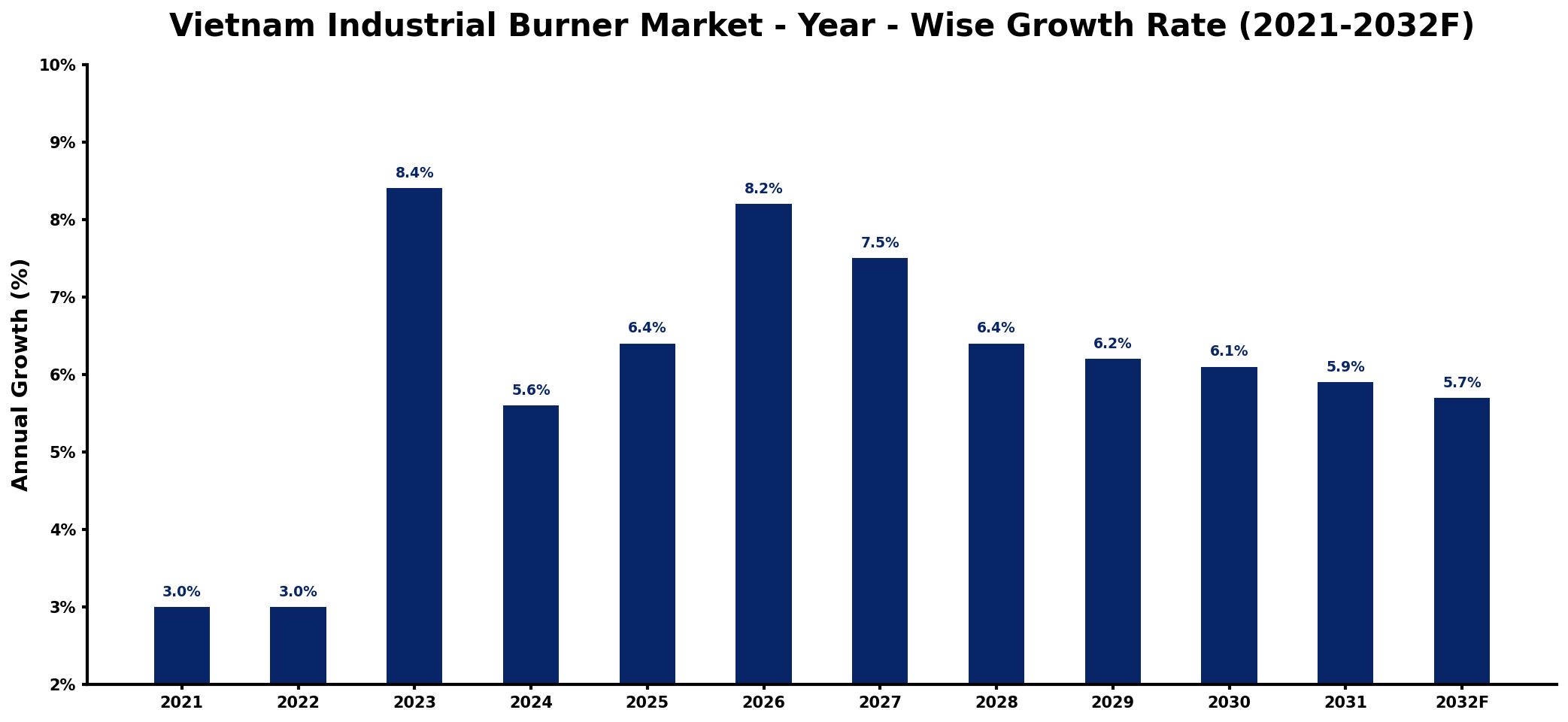
The table below presents the year‑wise growth rates along with the key drivers influencing the market
| Year | Growth Rate | Major Drivers |
| 2021 | 3.0% | Increased energy efficiency regulations |
| 2022 | 3.0% | Growth in manufacturing sector output |
| 2023 | 8.4% | Rising demand for sustainable solutions |
| 2024 | 5.6% | Expansion of food processing industries |
| 2025 | 6.4% | Investment in renewable energy projects |
| 2026 | 8.2% | Technological advancements in automation |
| 2027 | 7.5% | Higher production capacities planned |
| 2028 | 6.4% | Increased focus on environmental compliance |
| 2029 | 6.2% | Emergence of smart manufacturing trends |
| 2030 | 6.1% | Strengthening infrastructure development initiatives |
| 2031 | 5.9% | rising procurement volume requirements |
| 2032 | 5.7% | Rising consumer demand for efficiency |
Note: Market size estimations and growth projections presented in this report are based on 6Wresearch's proprietary forecasting methodology, utilizing the latest available industry data, government publications, and primary research inputs.
Vietnam Industrial Burner Market Synopsis
A fundamental force shaping the Vietnam Industrial Burner Market is the rapid expansion of the industrial sector, which drives the demand for efficient heating systems. Industrial burners are integral in various processes, enabling industries to enhance productivity while reducing their carbon footprint.
The market is also witnessing a notable shift towards sustainable technologies, with manufacturers focused on creating cleaner-burning solutions to comply with national and international environmental standards. As a result, innovations in burner design and efficiency are becoming paramount, allowing businesses to meet both performance and regulatory requirements.
Vietnam Industrial Burner Market Key Takeaways
- The market is poised for robust growth driven by industrial expansion and modernization.
- Energy efficiency and environmental compliance are key factors influencing burner design.
- Technological advancements in burner technology are reshaping industry standards.
- Significant demand is emerging from sectors such as food processing and chemical manufacturing.
- Investment in R&D is crucial for manufacturers to stay competitive amid global sustainability trends.
Evaluation of Restraints in Vietnam Industrial Burner Market
Despite its promising growth trajectory, the Vietnam Industrial Burner Market faces several restraints that could impede progress. Economic fluctuations may disrupt essential industries reliant on industrial burners, such as manufacturing and energy production, leading to unpredictable demand patterns. Moreover, intense competition from both domestic and international players necessitates cost-effective production and constant quality enhancements. Manufacturers must navigate these challenges while adhering to stringent safety and quality standards to avoid legal repercussions and maintain market credibility.
Vietnam Industrial Burner Market Trends
The market is currently trending towards the integration of smart technology into industrial burner systems, enabling real-time monitoring and optimization of combustion processes. Moreover, the focus on reducing emissions is prompting innovations in burner efficiency, particularly in sectors where environmental impact is heavily scrutinized. Additionally, as industries become more aware of the economic benefits of energy-efficient systems, there is a growing inclination towards adopting advanced burner technologies that reduce operational costs over time.
Vietnam Industrial Burner Market Opportunities
There are substantial growth opportunities within the Vietnam Industrial Burner Market, particularly for companies that specialize in sustainable technologies. As businesses increasingly prioritize environmental responsibility, manufacturers that can offer cleaner, more efficient burner options stand to benefit significantly. Furthermore, as the construction sector expands, there will be rising demand for heating solutions, creating additional avenues for market players to explore. Investing in R&D to develop next-generation burners could position companies favorably in an evolving marketplace.
Government Initiatives in the Vietnam Industrial Burner Market
The Vietnamese government is actively promoting industrial modernization through various initiatives aimed at enhancing energy efficiency and sustainability. Policies are being introduced to incentivize industries to adopt cleaner technologies, including financial support for upgrading equipment and reducing emissions. Additionally, government programs focused on regulatory compliance are encouraging manufacturers to innovate in their burner technologies, fostering a more environmentally-friendly industrial landscape.
Future Insights of the Vietnam Industrial Burner Market
Looking ahead to 2026-2032, the Vietnam Industrial Burner Market is set to evolve significantly as technological advancements pave the way for increased efficiency and reduced emissions. Industry players will likely focus on developing smart, connected systems that offer better operational insights and support sustainability goals. With the continued emphasis on energy efficiency and compliance with environmental regulations, businesses that can adapt swiftly and effectively will lead the way in a competitive landscape.
Vietnam Industrial Burner Market Latest Developments (2025 - 2026)
Recent developments in the Vietnam Industrial Burner Market indicate a strong trend towards automation and digital integration in burner operations. Companies are exploring partnerships for technology sharing to enhance product offerings and streamline operations. Additionally, there is a noticeable uptick in participation from international firms seeking to enter the Vietnamese market, driven by the country's favorable industrial growth environment. As industries begin to fully recover from the impacts of COVID-19, a renewed focus on production efficiency and sustainability is emerging, aligning with global market trends.
Vietnam Industrial Burner Market - Key Attractiveness of the Report
- 10 Years of Market Numbers
- Historical Data Starting from 2022 to 2025
- Base Year: 2025
- Forecast Data until 2032
- Key Performance Indicators Impacting the Market
- Major Upcoming Developments and Projects
Key Highlights of the Report:
- Vietnam Industrial Burner Market Outlook
- Market Size of Vietnam Industrial Burner Market, 2025
- Forecast of Vietnam Industrial Burner Market, 2032
- Historical Data and Forecast of Vietnam Industrial Burner Revenues & Volume for the Period 2022-2032F
- Vietnam Industrial Burner Market Trend Evolution
- Vietnam Industrial Burner Market Drivers and Challenges
- Vietnam Industrial Burner Price Trends
- Vietnam Industrial Burner Porter's Five Forces
- Vietnam Industrial Burner Industry Life Cycle
- Historical Data and Forecast of Vietnam Industrial Burner Market Revenues & Volume By Type for the Period 2022-2032F
- Historical Data and Forecast of Vietnam Industrial Burner Market Revenues & Volume By Cold Chamber Die Casting Machine for the Period 2022-2032F
- Historical Data and Forecast of Vietnam Industrial Burner Market Revenues & Volume By Hot Chamber Die Casting Machine for the Period 2022-2032F
- Historical Data and Forecast of Vietnam Industrial Burner Market Revenues & Volume By Gravity Die Casting Machine for the Period 2022-2032F
- Historical Data and Forecast of Vietnam Industrial Burner Market Revenues & Volume By Material for the Period 2022-2032F
- Historical Data and Forecast of Vietnam Industrial Burner Market Revenues & Volume By Aluminum for the Period 2022-2032F
- Historical Data and Forecast of Vietnam Industrial Burner Market Revenues & Volume By Zinc for the Period 2022-2032F
- Historical Data and Forecast of Vietnam Industrial Burner Market Revenues & Volume By Magnesium for the Period 2022-2032F
- Historical Data and Forecast of Vietnam Industrial Burner Market Revenues & Volume By End User for the Period 2022-2032F
- Historical Data and Forecast of Vietnam Industrial Burner Market Revenues & Volume By Transportation for the Period 2022-2032F
- Historical Data and Forecast of Vietnam Industrial Burner Market Revenues & Volume By Mechanical & Manufacturing Equipment for the Period 2022-2032F
- Historical Data and Forecast of Vietnam Industrial Burner Market Revenues & Volume By Building & Construction for the Period 2022-2032F
- Vietnam Industrial Burner Import Export Trade Statistics
- Market Opportunity Assessment By Type
- Market Opportunity Assessment By Material
- Market Opportunity Assessment By End User
- Vietnam Industrial Burner Top Companies Market Share
- Vietnam Industrial Burner Competitive Benchmarking By Technical and Operational Parameters
- Vietnam Industrial Burner Company Profiles
- Vietnam Industrial Burner Key Strategic Recommendations






































