Vietnam Industrial Dryers for Agricultural Products Market Size, Share & Growth Rate
The Vietnam Industrial Dryers for Agricultural Products Market was estimated at USD 1203 Million in 2025 and is projected to reach USD 1709 Million by 2032, growing at a CAGR of 5.1% from 2026 to 2032. This robust growth trajectory is largely fueled by the expanding agricultural sector in Vietnam, which necessitates advanced drying technologies to maintain product quality and minimize post-harvest losses. As the demand for high-quality dried products continues to rise, producers are increasingly investing in energy-efficient solutions that not only enhance productivity but also align with sustainable farming practices.
Vietnam Industrial Dryers for Agricultural Products Market Year-wise Growth Rate and Key Drivers
This graph highlights how the Vietnam Industrial Dryers for Agricultural Products Market has steadily grown over the years, supported by major growth factors.
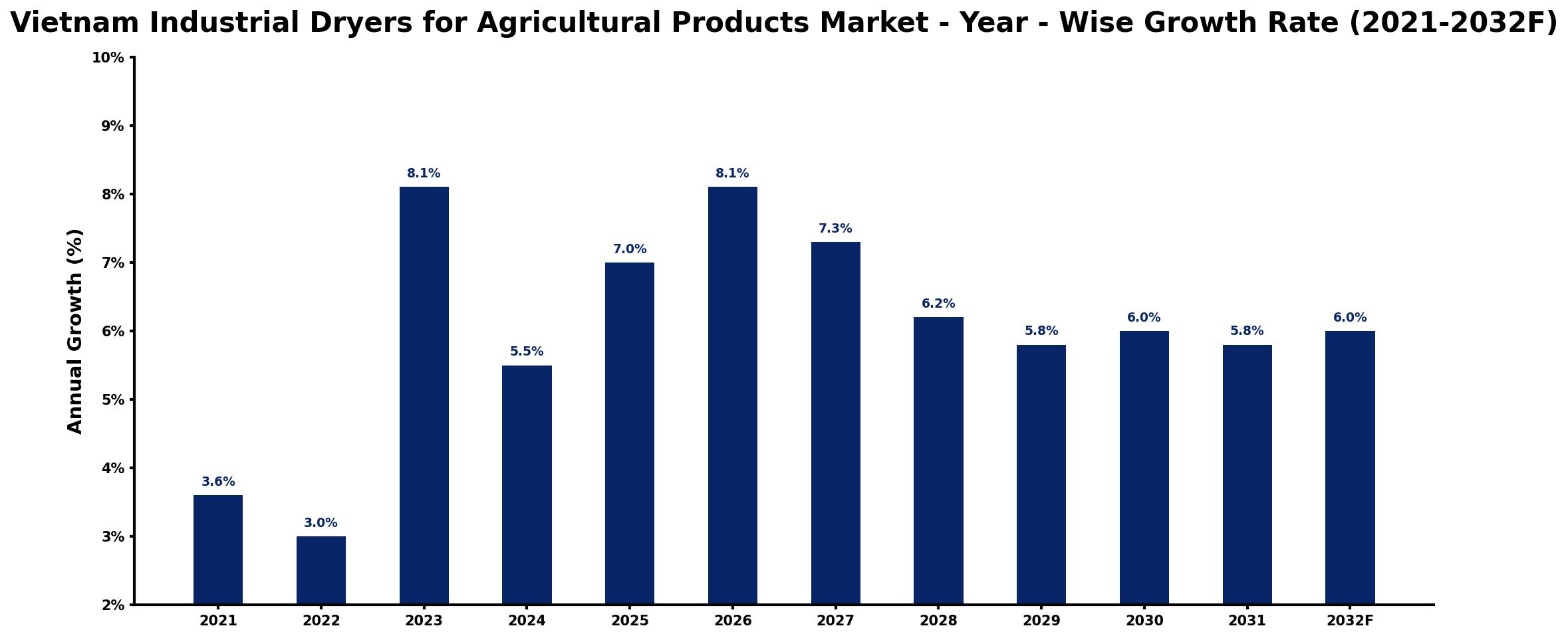
The table below presents the year‑wise growth rates along with the key drivers influencing the market
| Year | Growth Rate | Major Drivers |
| 2021 | 3.6% | Rise in food processing demand |
| 2022 | 3.0% | Increased investment in technology |
| 2023 | 8.1% | Expansion of export markets |
| 2024 | 5.5% | Growth in organic farming practices |
| 2025 | 7.0% | Surge in local production capacity |
| 2026 | 8.1% | Development of efficient supply chains |
| 2027 | 7.3% | Rising consumer health awareness |
| 2028 | 6.2% | Advancements in drying techniques |
| 2029 | 5.8% | rising export shipment volumes |
| 2030 | 6.0% | Improved infrastructure for logistics |
| 2031 | 5.8% | Increased focus on food safety |
| 2032 | 6.0% | Growth of cooperative farming initiatives |
Note: Market size estimations and growth projections presented in this report are based on 6Wresearch's proprietary forecasting methodology, utilizing the latest available industry data, government publications, and primary research inputs.
Vietnam Industrial Dryers for Agricultural Products Market Synopsis
In Vietnam, industrial dryers are becoming an indispensable asset for farmers and agricultural enterprises, particularly for crops like rice, coffee, and spices. Recent trends indicate a marked shift towards modern drying techniques, as stakeholders seek to optimize their operations and improve product quality, responding to both domestic and export market demands.
The increased focus on reducing post-harvest losses has driven investment in advanced drying technologies. Farmers, once reliant on traditional methods, are now recognizing the long-term benefits of industrial dryers, which promise better preservation of their products and enhanced market competitiveness.
Vietnam Industrial Dryers for Agricultural Products Market Key Takeaways
- The market is expanding due to rising demand for efficient drying solutions.
- Technological advancements are key to modernizing drying processes in agriculture.
- High-quality dried agricultural products are in increasing demand for both domestic and export markets.
- Climate change is pushing for more reliable and efficient drying methods.
- Investment in energy-efficient solutions is becoming a priority for many agricultural producers.
Evaluation of Restraints in Vietnam Industrial Dryers for Agricultural Products Market
Despite its growth, the Vietnam industrial dryers for agricultural products market faces notable challenges. Many farmers continue to rely on outdated drying methods due to financial limitations and a lack of awareness surrounding modern technologies. These traditional practices are often less efficient, leading to significant product losses during the drying phase. Bridging the gap between conventional approaches and contemporary solutions requires substantial outreach and education efforts to showcase the benefits of industrial dryers.
Vietnam Industrial Dryers for Agricultural Products Market Trends
Current trends in the Vietnam industrial dryers market point towards the adoption of smart technologies, including IoT integration and automated control systems. These innovations enable real-time monitoring and adjustments, optimizing drying processes and ensuring quality consistency. Furthermore, an increasing emphasis on sustainability is driving the development of eco-friendly dryers that minimize energy consumption while maximizing throughput. As the agricultural sector evolves, so too will the capabilities and functionalities of industrial drying technologies.
Vietnam Industrial Dryers for Agricultural Products Market Opportunities
Opportunities for growth in the Vietnam industrial dryers market abound, particularly as global demand for premium agricultural products escalates. Investors can find potential in collaborating with local farmers to provide tailored solutions that address specific drying needs. Additionally, as awareness of climate change impacts grows, there's a significant opportunity for developing dryers that enhance resilience against adverse weather conditions. Expanding access to financing options could further accelerate the adoption of modern drying technologies across the agricultural landscape.
Government Initiatives in the Vietnam Industrial Dryers for Agricultural Products Market
The Vietnamese government has recognized the importance of modernizing the agricultural sector to ensure food security and promote economic growth. Various initiatives and programs are being implemented to support farmers in adopting advanced agricultural technologies, including industrial drying solutions. These policies often include subsidies for purchasing equipment, training programs on efficient farming techniques, and incentives aimed at increasing the use of sustainable practices within the agricultural supply chain.
Future Insights of the Vietnam Industrial Dryers for Agricultural Products Market
Looking ahead to 2026-2032, the Vietnam industrial dryers for agricultural products market is poised for transformative growth. With ongoing investments in technology and infrastructure, coupled with a commitment to improving agricultural practices, we anticipate a stronger emphasis on innovative drying solutions. As climate variability continues to challenge traditional agricultural methods, the market will likely see an increasing number of stakeholders recognizing the necessity of efficient drying systems to protect their livelihoods and enhance product quality.
Vietnam Industrial Dryers for Agricultural Products Market Latest Developments (2025 - 2026)
Recent developments in the Vietnam industrial dryers market indicate a shift towards more sustainable and energy-efficient technologies. Industry players are exploring partnerships to enhance their offerings and expand their market reach. Additionally, efforts to improve supply chains have been observed, aimed at reducing the barriers faced by farmers in accessing advanced drying solutions. This proactive approach is expected to facilitate market recovery and growth as the agricultural sector continues to gain momentum.
Vietnam Industrial Dryers for Agricultural Products Market - Key Attractiveness of the Report
- 10 Years of Market Numbers
- Historical Data Starting from 2022 to 2025
- Base Year: 2025
- Forecast Data until 2032
- Key Performance Indicators Impacting the Market
- Major Upcoming Developments and Projects
Key Highlights of the Report:
- Vietnam Industrial Dryers for Agricultural Products Market Outlook
- Market Size of Vietnam Industrial Dryers for Agricultural Products Market, 2025
- Forecast of Vietnam Industrial Dryers for Agricultural Products Market, 2032
- Historical Data and Forecast of Vietnam Industrial Dryers for Agricultural Products Revenues & Volume for the Period 2022-2032F
- Vietnam Industrial Dryers for Agricultural Products Market Trend Evolution
- Vietnam Industrial Dryers for Agricultural Products Market Drivers and Challenges
- Vietnam Industrial Dryers for Agricultural Products Price Trends
- Vietnam Industrial Dryers for Agricultural Products Porter's Five Forces
- Vietnam Industrial Dryers for Agricultural Products Industry Life Cycle
- Historical Data and Forecast of Vietnam Industrial Dryers for Agricultural Products Market Revenues & Volume By Type for the Period 2022-2032F
- Historical Data and Forecast of Vietnam Industrial Dryers for Agricultural Products Market Revenues & Volume By Hot Air Drying Equipment for the Period 2022-2032F
- Historical Data and Forecast of Vietnam Industrial Dryers for Agricultural Products Market Revenues & Volume By Heated Surface Drying Equipment for the Period 2022-2032F
- Historical Data and Forecast of Vietnam Industrial Dryers for Agricultural Products Market Revenues & Volume By Application for the Period 2022-2032F
- Historical Data and Forecast of Vietnam Industrial Dryers for Agricultural Products Market Revenues & Volume By Conveyer Drying Equipment for the Period 2022-2032F
- Historical Data and Forecast of Vietnam Industrial Dryers for Agricultural Products Market Revenues & Volume By Cabinet Drying Equipment for the Period 2022-2032F
- Vietnam Industrial Dryers for Agricultural Products Import Export Trade Statistics
- Market Opportunity Assessment By Type
- Market Opportunity Assessment By Application
- Vietnam Industrial Dryers for Agricultural Products Top Companies Market Share
- Vietnam Industrial Dryers for Agricultural Products Competitive Benchmarking By Technical and Operational Parameters
- Vietnam Industrial Dryers for Agricultural Products Company Profiles
- Vietnam Industrial Dryers for Agricultural Products Key Strategic Recommendations






































