Vietnam Industrial Dryers Market Size, Share & Growth Rate
The Vietnam Industrial Dryers Market was estimated at USD 368 Million in 2025 and is projected to reach USD 520 Million by 2032, growing at a CAGR of 5.1% from 2026 to 2032. This growth trajectory is largely driven by the rapid expansion of the country's manufacturing sector, which increasingly relies on efficient drying solutions for various applications including food processing and chemicals. Furthermore, the rising emphasis on energy-efficient technologies is propelling investments in advanced industrial drying systems.
Vietnam Industrial Dryers Market Year-wise Growth Rate and Key Drivers
This graph highlights how the Vietnam Industrial Dryers Market has steadily grown over the years, supported by major growth factors.
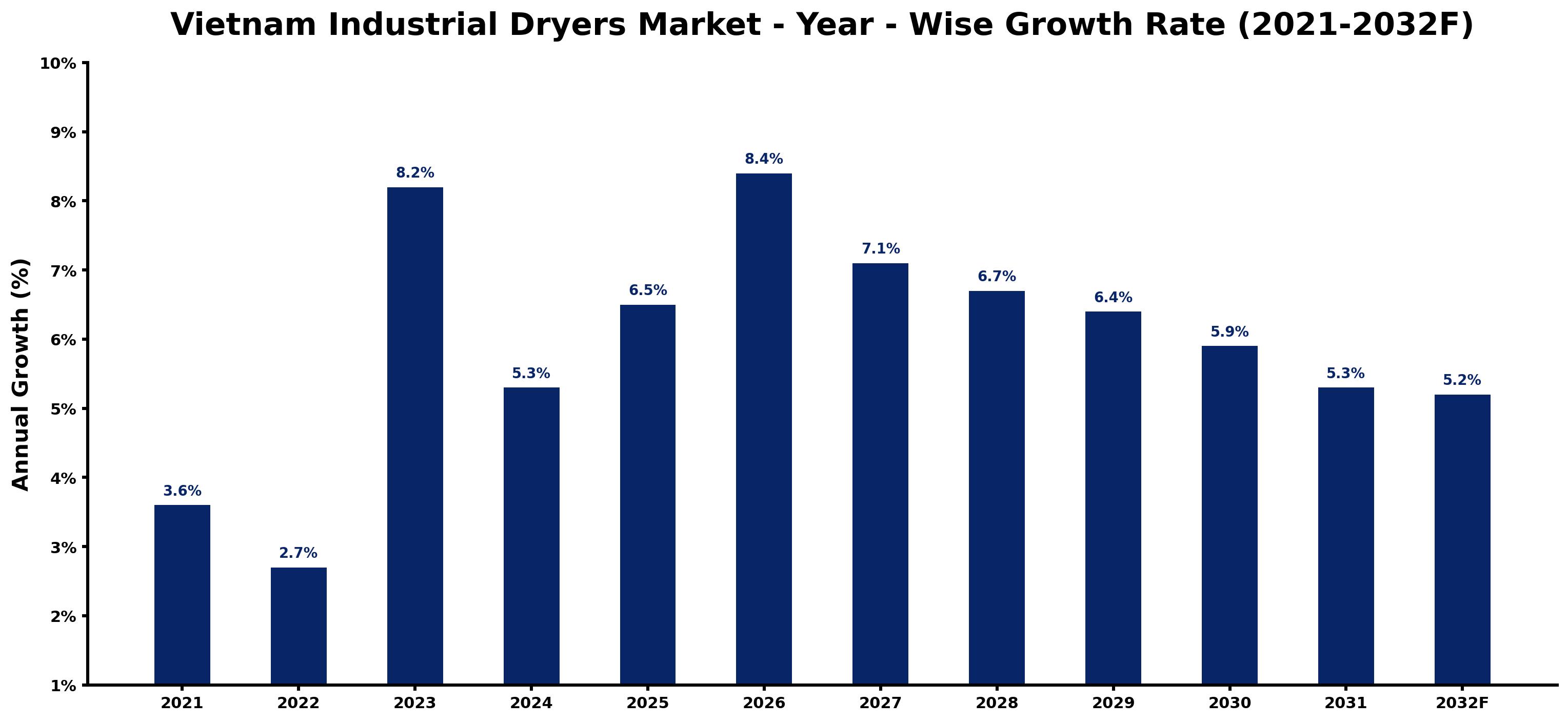
The table below presents the year‑wise growth rates along with the key drivers influencing the market
| Year | Growth Rate | Major Drivers |
| 2021 | 3.6% | Government infrastructure modernization initiatives |
| 2022 | 2.7% | Government infrastructure modernization initiatives |
| 2023 | 8.2% | Increasing adoption of advanced technologies |
| 2024 | 5.3% | Expansion of commercial construction activities |
| 2025 | 6.5% | Rising electricity demand across industries |
| 2026 | 8.4% | Increasing industrial automation investments |
| 2027 | 7.1% | Growing urbanization and commercial development |
| 2028 | 6.7% | Government infrastructure modernization initiatives |
| 2029 | 6.4% | Government infrastructure modernization initiatives |
| 2030 | 5.9% | Rising electricity demand across industries |
| 2031 | 5.3% | Expansion of manufacturing activities |
| 2032 | 5.2% | Expansion of manufacturing activities |
Note - Market size estimations and growth projections presented in this report are based on 6Wresearch’s advanced forecasting approach, validated with industry datasets as of June 2026.
Vietnam Industrial Dryers Market Synopsis
Currently, the Vietnam Industrial Dryers Market is at a pivotal juncture, characterized by increasing demand from diverse sectors like food, pharmaceuticals, and chemicals. Industrial dryers are vital for moisture removal, significantly enhancing product quality and production timelines, making them indispensable for manufacturers.
As Vietnam's industrial landscape evolves, companies are actively seeking modern drying technologies that align with sustainable practices. This shift not only improves operational efficiency but also meets growing environmental regulations, fostering a competitive edge in the market.
Vietnam Industrial Dryers Market Key Takeaways
- The market is projected to grow from USD 368 Million in 2025 to USD 520 Million by 2032.
- There is a strong demand for energy-efficient and sustainable drying technologies.
- Food processing, chemicals, and pharmaceuticals are the key sectors driving market growth.
- COVID-19 temporarily impacted demand, but recovery is underway as manufacturing resumes.
- Proper maintenance and optimization of dryer performance remain critical for users.
Evaluation of Restraints in Vietnam Industrial Dryers Market
Despite the positive growth outlook, the Vietnam Industrial Dryers Market faces significant restraints related to energy consumption and operational costs. Industrial dryers often require substantial energy, which can inflate overall production expenses, posing challenges for manufacturers. Companies are urged to focus on improving energy efficiency and reducing costs to remain competitive. Additionally, the need for regular maintenance and process optimization is essential to ensure maximum dryer performance and reduce downtime.
Vietnam Industrial Dryers Market Trends
Several trends are shaping the Vietnam Industrial Dryers Market. The increasing focus on sustainability is driving the development of eco-friendly drying technologies. Companies are investing in innovations that minimize energy consumption and waste. Furthermore, advancements in automation and smart technology are gaining traction, providing manufacturers with greater control over the drying process, thereby enhancing efficiency and product quality.
Vietnam Industrial Dryers Market Opportunities
The market presents numerous opportunities for growth and investment. As industries continue to expand, there is an increasing need for advanced drying solutions tailored to specific applications. Moreover, the push for sustainable practices opens avenues for technologies that not only reduce energy usage but also comply with environmental regulations. These factors create a favorable environment for new entrants and existing players looking to innovate.
Government Initiatives in the Vietnam Industrial Dryers Market
The Vietnamese government is actively promoting industrial development through various initiatives aimed at enhancing manufacturing capabilities. Public spending on infrastructure and technology upgrades is increasing, providing a conducive environment for industrial growth. Additionally, policies encouraging investments in energy-efficient technologies reflect the government's commitment to fostering a sustainable industrial ecosystem.
Future Insights of the Vietnam Industrial Dryers Market
Looking ahead to 2026-2032, the Vietnam Industrial Dryers Market is poised for significant advancements. As manufacturers seek to improve productivity and maintain competitive advantages, the integration of smart technologies into drying systems will likely become commonplace. This shift will enhance operational efficiency and product quality. Furthermore, the focus on sustainability will drive the demand for innovative drying solutions that reduce environmental impact while meeting the growing needs of various industries.
Vietnam Industrial Dryers Market Latest Developments (May 2025 - June 2026)
Recent developments in the Vietnam Industrial Dryers Market indicate a strong recovery trajectory post-COVID-19. As manufacturing resumes, companies are increasingly investing in modern drying technologies to enhance efficiency. There is a notable interest in developing energy-efficient solutions that align with global sustainability trends. Additionally, collaborations among stakeholders to innovate and optimize drying processes are becoming more prevalent, signifying a proactive approach to meeting evolving industry demands.
Vietnam Industrial Dryers Market - Key Attractiveness of the Report
- 10 Years of Market Numbers
- Historical Data Starting from 2022 to 2025
- Base Year: 2025
- Forecast Data until 2032
- Key Performance Indicators Impacting the Market
- Major Upcoming Developments and Projects
Key Highlights of the Report:
- Vietnam Industrial Dryers Market Outlook
- Market Size of Vietnam Industrial Dryers Market, 2025
- Forecast of Vietnam Industrial Dryers Market, 2032
- Historical Data and Forecast of Vietnam Industrial Dryers Revenues & Volume for the Period 2022-2032F
- Vietnam Industrial Dryers Market Trend Evolution
- Vietnam Industrial Dryers Market Drivers and Challenges
- Vietnam Industrial Dryers Price Trends
- Vietnam Industrial Dryers Porter's Five Forces
- Vietnam Industrial Dryers Industry Life Cycle
- Historical Data and Forecast of Vietnam Industrial Dryers Market Revenues & Volume By Product for the Period 2022-2032F
- Historical Data and Forecast of Vietnam Industrial Dryers Market Revenues & Volume By Direct Dryers for the Period 2022-2032F
- Historical Data and Forecast of Vietnam Industrial Dryers Market Revenues & Volume By Indirect Dryers for the Period 2022-2032F
- Historical Data and Forecast of Vietnam Industrial Dryers Market Revenues & Volume By Specialty Dryers for the Period 2022-2032F
- Historical Data and Forecast of Vietnam Industrial Dryers Market Revenues & Volume By Type for the Period 2022-2032F
- Historical Data and Forecast of Vietnam Industrial Dryers Market Revenues & Volume By Rotary Dryers for the Period 2022-2032F
- Historical Data and Forecast of Vietnam Industrial Dryers Market Revenues & Volume By Fluidized Bed Dryers for the Period 2022-2032F
- Historical Data and Forecast of Vietnam Industrial Dryers Market Revenues & Volume By Spray Dryers for the Period 2022-2032F
- Historical Data and Forecast of Vietnam Industrial Dryers Market Revenues & Volume By Flash Dryers for the Period 2022-2032F
- Historical Data and Forecast of Vietnam Industrial Dryers Market Revenues & Volume By Conveyor Dryers for the Period 2022-2032F
- Historical Data and Forecast of Vietnam Industrial Dryers Market Revenues & Volume By Drum Dryers for the Period 2022-2032F
- Historical Data and Forecast of Vietnam Industrial Dryers Market Revenues & Volume By Freeze Dryers for the Period 2022-2032F
- Historical Data and Forecast of Vietnam Industrial Dryers Market Revenues & Volume By Applications for the Period 2022-2032F
- Historical Data and Forecast of Vietnam Industrial Dryers Market Revenues & Volume By Food for the Period 2022-2032F
- Historical Data and Forecast of Vietnam Industrial Dryers Market Revenues & Volume By Pharmaceutical for the Period 2022-2032F
- Historical Data and Forecast of Vietnam Industrial Dryers Market Revenues & Volume By Fertilizer for the Period 2022-2032F
- Historical Data and Forecast of Vietnam Industrial Dryers Market Revenues & Volume By Chemicals for the Period 2022-2032F
- Historical Data and Forecast of Vietnam Industrial Dryers Market Revenues & Volume By Cement for the Period 2022-2032F
- Historical Data and Forecast of Vietnam Industrial Dryers Market Revenues & Volume By Others for the Period 2022-2032F
- Vietnam Industrial Dryers Import Export Trade Statistics
- Market Opportunity Assessment By Product
- Market Opportunity Assessment By Type
- Market Opportunity Assessment By Applications
- Vietnam Industrial Dryers Top Companies Market Share
- Vietnam Industrial Dryers Competitive Benchmarking By Technical and Operational Parameters
- Vietnam Industrial Dryers Company Profiles
- Vietnam Industrial Dryers Key Strategic Recommendations






































