Vietnam Industrial Gases Market Summary
The vietnam industrial gases market was estimated at USD 152 Million in 2025 and is projected to reach USD 214 Million by 2032, growing at a CAGR of 8.2% from 2026 to 2032.
Vietnam Industrial Gases Market Year-wise Growth Rate and Key Drivers
This graph highlights how the Vietnam Industrial Gases Market has steadily grown over the past five years, supported by major growth factors.
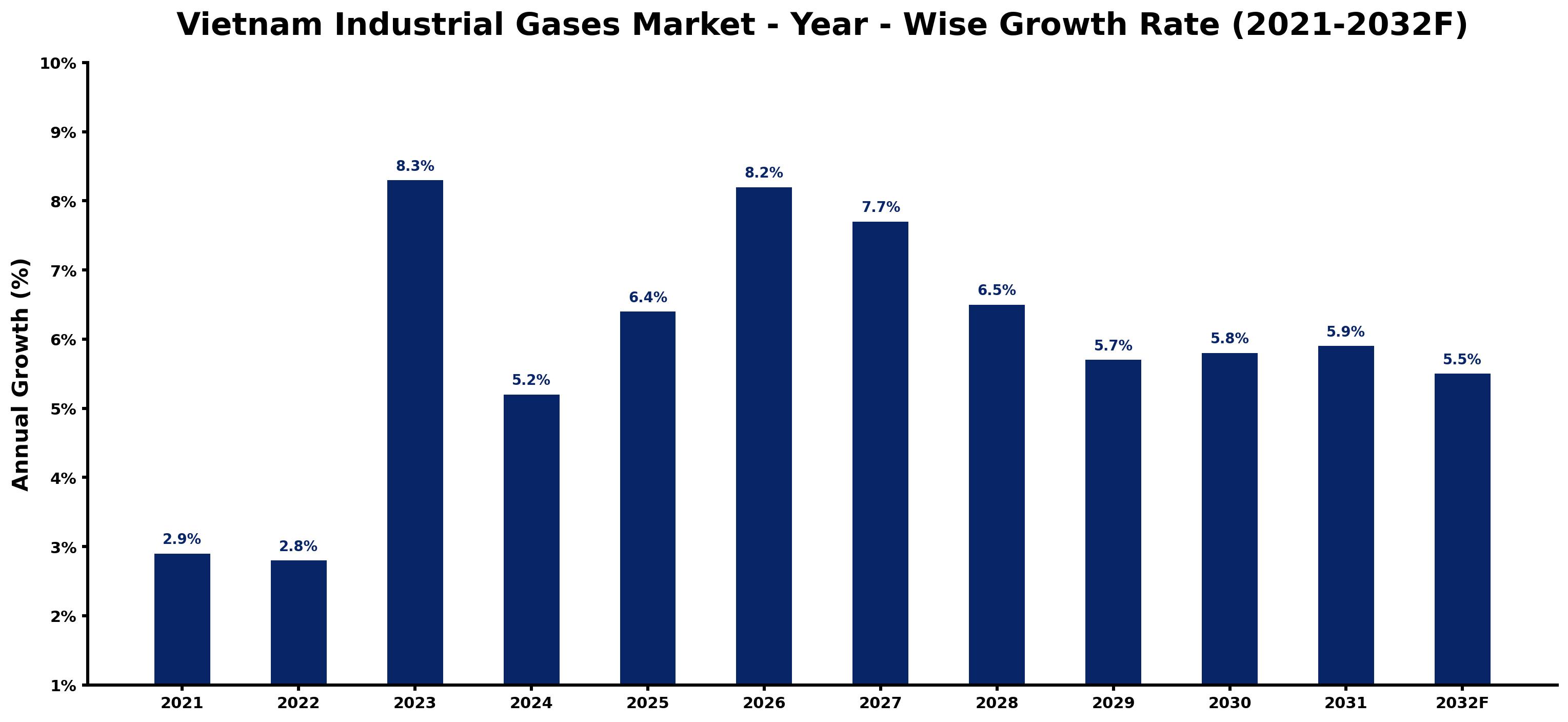
The table below presents the year wise growth rates along with the key drivers influencing the market
| Year | Growth Rate | Major Drivers |
| 2021 | 2.9% | Manufacturers increasingly seek efficiency, turning to industrial gases for optimized processes. |
| 2022 | 2.8% | Rural electrification efforts elevate the need for accessible industrial gas solutions nationwide. |
| 2023 | 8.3% | Emerging sectors, like renewable energy, generate additional demand for specialized gas applications. |
| 2024 | 5.2% | The automotive industry transitions to cleaner technologies, driving gas consumption in manufacturing. |
| 2025 | 6.4% | Construction projects expand, necessitating reliable gas supplies for various applications. |
| 2026 | 8.2% | International partnerships enable technology transfer, enhancing local gas production capabilities. |
| 2027 | 7.7% | Infrastructure developments align with urbanization trends, boosting industrial gas requirements significantly. |
| 2028 | 6.5% | Local enterprises focus on sustainability, increasing investments in eco-friendly gas technologies. |
| 2029 | 5.7% | Increased automation within factories prompts higher demand for precision gas applications. |
| 2030 | 5.8% | Health sector expansions require consistent supply chains for medical-grade industrial gases. |
| 2031 | 5.9% | Rapid urbanization leads to heightened competition among gas suppliers aiming for market share. |
| 2032 | 5.5% | Technological innovations in gas storage and transportation improve overall market efficiency. |
Note - Market size estimations and growth projections presented in this report are based on 6Wresearch's advanced forecasting approach, validated with industry datasets as of June 2026.
Vietnam Industrial Gases Market Synopsis
The Vietnam Industrial Gases Market is projected to reach 8.2% and witness significant growth during the forecast period (2026-2032). This market has seen consistent expansion, primarily fueled by the robust demand from sectors such as manufacturing, healthcare, electronics, and food processing. Industrial gases such as oxygen, nitrogen, carbon dioxide, and argon are integral to various industrial activities, including metal fabrication, welding, cooling processes, and the preservation of perishable goods. With the continued growth of Vietnam's manufacturing and industrial sectors, the demand for these vital gases is expected to escalate markedly.
Vietnam Industrial Gases Market Growth Drivers
Several factors contribute to the increasing demand for industrial gases within the Vietnam Industrial Gases Market. The growth trajectory of the manufacturing sector, particularly in automotive, electronics, and chemicals, has established a strong need for industrial gases across various applications. Some of the key drivers include:
- The automotive industry's expansion has heightened the demand for gases like nitrogen and argon, particularly in welding and metal fabrication applications.
- In the electronics sector, industrial gases are essential for semiconductor manufacturing, playing a crucial role in ensuring precision and efficiency in production.
- The healthcare sector's reliance on medical-grade gases, especially noted during the pandemic, has illustrated the critical importance of industrial gases in maintaining health services.
- Food processing and preservation industries are increasingly utilizing carbon dioxide and nitrogen for extending shelf life, thereby driving demand for these gases.
- The rise in construction activities has also contributed to the demand for gas used in welding and metal working processes, further augmenting the industrial gases market.
Vietnam Industrial Gases Market Challenges and Restraints
Despite its growth potential, the Vietnam Industrial Gases Market faces several challenges that could hinder its progress. Key constraints include:
- High initial capital investment for establishing gas production facilities and distribution networks can deter new entrants from entering the market.
- Existing players may struggle to expand their operational capacities, facing financial constraints that limit their ability to meet increasing demand.
- The volatility of raw material prices, particularly for oxygen and nitrogen, poses financial risks, impacting overall production costs and profit margins.
- Competition in the market can lead to pricing pressures, complicating profit stability and overall market dynamics.
- Supply chain disruptions and logistical challenges can affect the timely delivery of gases, especially in a rapidly evolving market climate.
Vietnam Industrial Gases Market COVID-19 Impact
The COVID-19 pandemic has had a multifaceted impact on the Vietnam Industrial Gases Market. Initially, the industry faced a downturn as lockdown measures led to decreased industrial production and manufacturing activities, particularly in the automotive and construction sectors. This resulted in a reduction in demand for industrial gases used for welding and metal fabrication. However, there were notable increases in certain segments:
- The medical gases segment experienced heightened demand, especially for oxygen and medical-grade gases, which were critical in healthcare facilities for treating COVID-19 patients.
- Despite the downturn in some industries, the food processing sector maintained demand for gases used in preservation and packaging, reflecting stable consumer focus on essential goods.
- Supply chain challenges arose due to disruptions in logistics and sourcing of raw materials, making it difficult for manufacturers to meet customer demand promptly.
- Health and safety protocols implemented during the pandemic complicated operational processes, affecting workforce capacities and delivery mechanisms.
- Nonetheless, the industrial gases industry played an essential role in supporting critical sectors, helping to navigate the challenges posed by the pandemic.
Vietnam Industrial Gases Market Government Investment and Initiatives
The Vietnamese government has recognized the significance of the industrial gases market in supporting economic growth and industrialisation. Various initiatives and policies have been instituted to foster investment in this sector, including:
- Public spending initiatives are focused on upgrading industrial infrastructure, which directly benefits the industrial gases sector by improving distribution capabilities.
- Government incentives aimed at facilitating foreign investment in manufacturing and processing industries result in increased demand for industrial gases.
- Regulatory frameworks have been established to ensure the safe handling and use of industrial gases, contributing to the overall growth and stability of the market.
- Support for renewable energy projects can result in increased demand for industrial gases in various applications, including energy storage and production.
- Engagement in international trade agreements is expected to enhance the competitive landscape, ultimately benefiting the industrial gases market within the economy.
Vietnam Industrial Gases Market Latest Developments (May 2025 - June 2026)
The period between May 2025 and June 2026 is marked by a number of significant developments within the Vietnam Industrial Gases Market. Companies are increasingly focusing on sustainability and efficiency, aligning with global trends towards reducing environmental impact. This includes investments in technologies that improve gas recovery and reduce emissions. Moreover, a growing emphasis on healthcare safety has led to enhanced standards for medical gases, prompting companies to innovate in their production and distribution processes. The demand for gases suitable for food preservation has remained strong, with ongoing advancements aimed at improving product quality and extending shelf life. Supply chain resilience has also become a priority, as market participants work to mitigate risks associated with logistics disruptions. Overall, these developments indicate a proactive approach by market stakeholders to adapt to evolving consumer needs and industry standards.
Vietnam Industrial Gases Market - Key Attractiveness of the Report
- 10 Years of Market Numbers
- Historical Data Starting from 2022 to 2025
- Base Year: 2025
- Forecast Data until 2032
- Key Performance Indicators Impacting the Market
- Major Upcoming Developments and Projects
Key Highlights of the Report:
- Vietnam Industrial Gases Market Outlook
- Market Size of Vietnam Industrial Gases Market, 2025
- Forecast of Vietnam Industrial Gases Market, 2032
- Historical Data and Forecast of Vietnam Industrial Gases Revenues & Volume for the Period 2022-2032F
- Vietnam Industrial Gases Market Trend Evolution
- Vietnam Industrial Gases Market Drivers and Challenges
- Vietnam Industrial Gases Price Trends
- Vietnam Industrial Gases Porter's Five Forces
- Vietnam Industrial Gases Industry Life Cycle
- Historical Data and Forecast of Vietnam Industrial Gases Market Revenues & Volume By Product Type for the Period 2022-2032F
- Historical Data and Forecast of Vietnam Industrial Gases Market Revenues & Volume By Oxygen for the Period 2022-2032F
- Historical Data and Forecast of Vietnam Industrial Gases Market Revenues & Volume By Nitrogen for the Period 2022-2032F
- Historical Data and Forecast of Vietnam Industrial Gases Market Revenues & Volume By Hydrogen for the Period 2022-2032F
- Historical Data and Forecast of Vietnam Industrial Gases Market Revenues & Volume By Carbon Dioxide for the Period 2022-2032F
- Historical Data and Forecast of Vietnam Industrial Gases Market Revenues & Volume By Acetylene for the Period 2022-2032F
- Historical Data and Forecast of Vietnam Industrial Gases Market Revenues & Volume By Argon for the Period 2022-2032F
- Historical Data and Forecast of Vietnam Industrial Gases Market Revenues & Volume By Others for the Period 2022-2032F
- Historical Data and Forecast of Vietnam Industrial Gases Market Revenues & Volume By Application for the Period 2022-2032F
- Historical Data and Forecast of Vietnam Industrial Gases Market Revenues & Volume By Healthcare for the Period 2022-2032F
- Historical Data and Forecast of Vietnam Industrial Gases Market Revenues & Volume By Manufacturing for the Period 2022-2032F
- Historical Data and Forecast of Vietnam Industrial Gases Market Revenues & Volume By Metallurgy & Glasses for the Period 2022-2032F
- Historical Data and Forecast of Vietnam Industrial Gases Market Revenues & Volume By Food & Beverage for the Period 2022-2032F
- Historical Data and Forecast of Vietnam Industrial Gases Market Revenues & Volume By Retail for the Period 2022-2032F
- Historical Data and Forecast of Vietnam Industrial Gases Market Revenues & Volume By Chemicals & Energy for the Period 2022-2032F
- Historical Data and Forecast of Vietnam Industrial Gases Market Revenues & Volume By Others for the Period 2022-2032F
- Historical Data and Forecast of Vietnam Industrial Gases Market Revenues & Volume By Distribution for the Period 2022-2032F
- Historical Data and Forecast of Vietnam Industrial Gases Market Revenues & Volume By On-site for the Period 2022-2032F
- Historical Data and Forecast of Vietnam Industrial Gases Market Revenues & Volume By Bulk (Liquid Gas Transport) for the Period 2022-2032F
- Historical Data and Forecast of Vietnam Industrial Gases Market Revenues & Volume By Cylinder (Merchant) for the Period 2022-2032F
- Vietnam Industrial Gases Import Export Trade Statistics
- Market Opportunity Assessment By Product Type
- Market Opportunity Assessment By Application
- Market Opportunity Assessment By Distribution
- Vietnam Industrial Gases Top Companies Market Share
- Vietnam Industrial Gases Competitive Benchmarking By Technical and Operational Parameters
- Vietnam Industrial Gases Company Profiles
- Vietnam Industrial Gases Key Strategic Recommendations






































