Vietnam Industrial machinery and equipment Market Summary
The vietnam industrial machinery and equipment market was estimated at USD 356 Million in 2025 and is projected to reach USD 500 Million by 2032, growing at a CAGR of 7.7% from 2026 to 2032.
Vietnam Industrial machinery and equipment Market Year-wise Growth Rate and Key Drivers
This graph highlights how the Vietnam Industrial machinery and equipment Market has steadily grown over the past five years, supported by major growth factors.
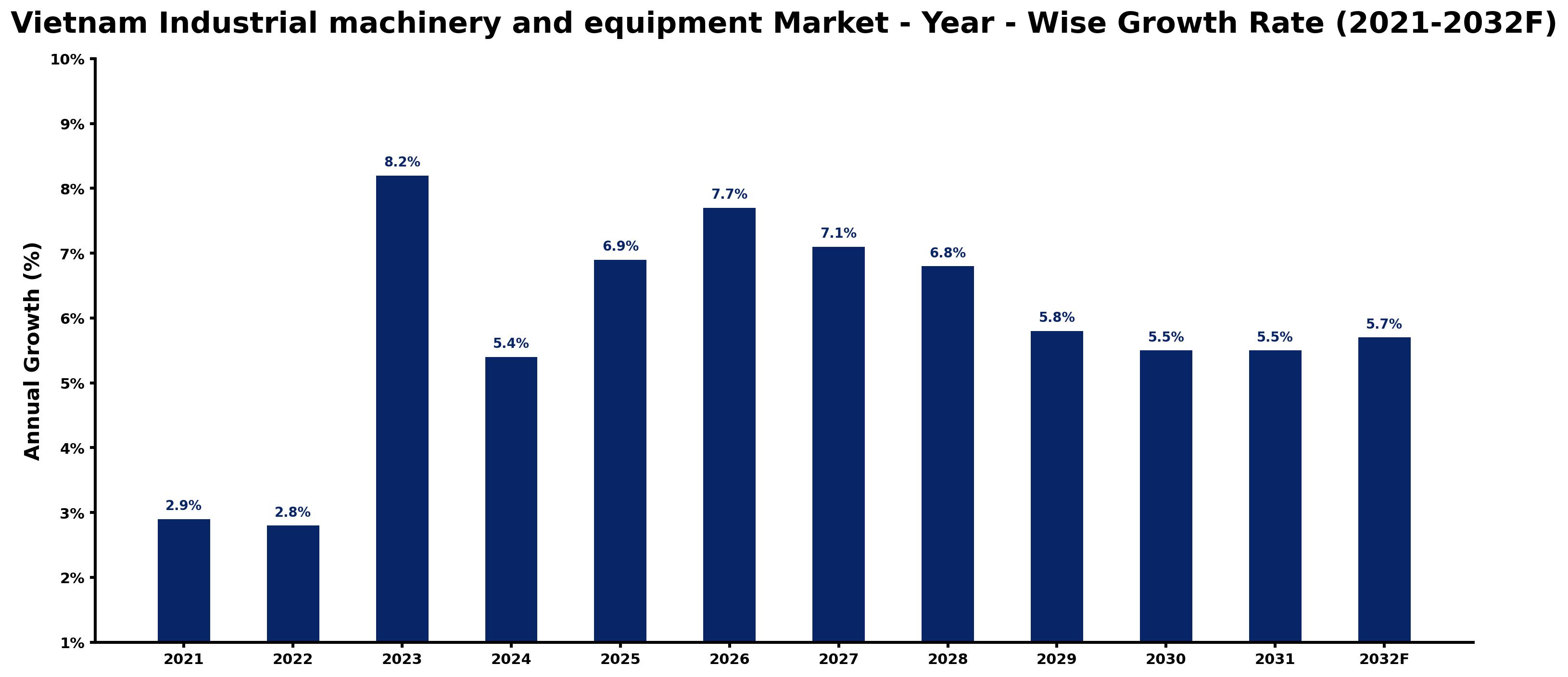
The table below presents the year wise growth rates along with the key drivers influencing the market
| Year | Growth Rate | Major Drivers |
| 2021 | 2.9% | Post-pandemic manufacturing recovery spurs demand for reliable industrial machinery. |
| 2022 | 2.8% | Foreign direct investment trends shift toward Vietnam's competitive labor market advantages. |
| 2023 | 8.2% | Local businesses increasingly prioritize automation to enhance operational efficiency and output. |
| 2024 | 5.4% | Energy-efficient machinery adoption aligns with global sustainability trends and regulations. |
| 2025 | 6.9% | Emerging tech integration in manufacturing enhances capabilities and attracts new investments. |
| 2026 | 7.7% | Infrastructure upgrades across urban centers improve logistics for machinery distribution. |
| 2027 | 7.1% | Vietnam's participation in global trade agreements enhances export opportunities for equipment. |
| 2028 | 6.8% | Technological innovations in machinery create advanced solutions for local industries' needs. |
| 2029 | 5.8% | Increased urbanization demands sophisticated machinery for construction and manufacturing sectors. |
| 2030 | 5.5% | Collaborations with international firms bolster knowledge transfer and skill development locally. |
| 2031 | 5.5% | Market diversification leads to tailored equipment solutions for niche industries in Vietnam. |
| 2032 | 5.7% | Sustained economic growth fosters long-term investments in cutting-edge industrial technologies. |
Note - Market size estimations and growth projections presented in this report are based on 6Wresearch's advanced forecasting approach, validated with industry datasets as of June 2026.
Vietnam Industrial machinery and equipment Market Synopsis
The Vietnam Industrial machinery and equipment Market is projected to reach 7.7% and witness significant growth during the forecast period (2026-2032). This market encompasses the manufacturing, distribution, and application of various machinery and equipment tailored for industrial operations across sectors such as manufacturing, construction, energy, and transportation. The country's ongoing industrialization, coupled with rapid infrastructure development efforts, continues to enhance the demand for diverse machinery and equipment in key sectors.
Vietnam Industrial machinery and equipment Market Growth Drivers
A multitude of factors contributes to the upward trajectory of the Vietnam Industrial machinery and equipment Market. Firstly, Vietnam's robust industrialization initiatives serve as a primary driver, creating substantial demand for advanced machinery to perform complex industrial processes efficiently. Secondly, the country's strategic allure as a favorable destination for foreign direct investments (FDI) stimulates demand for modern equipment, as foreign entities often seek to enhance their operational capabilities with technologically advanced solutions.
- The increasing labor costs in Vietnam are propelling businesses to adopt automation technologies, thereby driving the need for sophisticated machinery that can significantly improve operational productivity and efficiency.
- Innovative technologies in industrial machinery, such as automation, robotics, and IoT integration, are gaining traction, promoting market growth as enterprises strive for greater efficiency and competitiveness.
- The expanding construction sector, bolstered by government infrastructure projects and urbanization trends, necessitates a diverse range of machinery, from heavy equipment to manufacturing tools.
- Global market trends towards sustainable production and renewable energy have also influenced the industrial machinery landscape, encouraging investments in eco-friendly equipment and technologies.
- Finally, the emergence of local manufacturers in Vietnam is beginning to fill the gaps left by import reliance, boosting the availability of competitively priced machinery and stimulating market dynamics.
Vietnam Industrial machinery and equipment Market Challenges and Restraints
Despite the positive growth indicators, several challenges loom over the Vietnam Industrial machinery and equipment Market. The high initial investment required for acquiring advanced machinery can be particularly daunting for small and medium-sized enterprises (SMEs), potentially impeding their competitiveness in the market.
- The significant reliance on imported machinery exposes the market to external vulnerabilities, such as currency fluctuations and unpredictable import restrictions, which can hinder procurement strategies for local firms.
- The skills gap within the workforce presents another challenge, as the shortage of qualified personnel capable of operating and maintaining sophisticated industrial machinery may restrict the broader adoption of advanced technologies.
- Cyclical economic fluctuations and uncertainty, especially in the aftermath of the COVID-19 pandemic, can impact investment decisions and drive companies to delay equipment purchases.
- Regulatory hurdles and compliance costs associated with environmental standards and safety regulations can also act as barriers to market entry, creating additional challenges for new entrants.
- Lastly, the fast-paced evolution of technology necessitates continuous investment in upgrading equipment, placing pressure on companies to remain competitive while managing costs effectively.
Vietnam Industrial machinery and equipment Market Government Investment and Initiatives
The Vietnam government has been instrumental in fostering a conducive environment for the growth of the industrial machinery and equipment market through various initiatives and public spending programs. The government's focus on enhancing infrastructure, such as transportation networks and industrial parks, underpins the demand for advanced industrial tools.
Moreover, the government has implemented policies aiming to attract foreign investments in the manufacturing sector, with a particular emphasis on high-tech industries. This includes incentives for foreign companies investing in advanced industrial technologies, further facilitating the modernization of local manufacturing capabilities. Additionally, the promotion of vocational training programs is expected to address the skills gap in the workforce, equipping individuals with the necessary competencies to operate contemporary machinery.
Vietnam Industrial machinery and equipment Market Latest Developments (May 2025 - June 2026)
In the period from May 2025 to June 2026, the Vietnam Industrial machinery and equipment Market has experienced various developments that highlight industry dynamics. Noteworthy is the increase in local manufacturing capabilities, evidenced by the establishment of several new production facilities that focus on meeting domestic demand for machinery.
Additionally, technological advancements have become a focal point, as companies increasingly invest in automation and smart technologies to improve operational efficiency. There has also been a notable shift towards sustainability, with more firms adopting eco-friendly practices in manufacturing processes and equipment design.
Moreover, the response of the market to the tailwinds of recovery following the pandemic has been significant, as businesses recalibrate their strategies in light of changing consumer behaviors and economic conditions. Overall, these developments signal a constructive outlook for the Vietnam Industrial machinery and equipment Market.
Vietnam Industrial machinery and equipment Market - Key Attractiveness of the Report
- 10 Years of Market Numbers
- Historical Data Starting from 2022 to 2025
- Base Year: 2025
- Forecast Data until 2032
- Key Performance Indicators Impacting the Market
- Major Upcoming Developments and Projects
Key Highlights of the Report:
- Vietnam Industrial machinery and equipment Market Outlook
- Market Size of Vietnam Industrial machinery and equipment Market, 2025
- Forecast of Vietnam Industrial machinery and equipment Market, 2032
- Historical Data and Forecast of Vietnam Industrial machinery and equipment Revenues & Volume for the Period 2022-2032F
- Vietnam Industrial machinery and equipment Market Trend Evolution
- Vietnam Industrial machinery and equipment Market Drivers and Challenges
- Vietnam Industrial machinery and equipment Price Trends
- Vietnam Industrial machinery and equipment Porter's Five Forces
- Vietnam Industrial machinery and equipment Industry Life Cycle
- Historical Data and Forecast of Vietnam Industrial machinery and equipment Market Revenues & Volume By Types for the Period 2022-2032F
- Historical Data and Forecast of Vietnam Industrial machinery and equipment Market Revenues & Volume By Packaging Machinery for the Period 2022-2032F
- Historical Data and Forecast of Vietnam Industrial machinery and equipment Market Revenues & Volume By Food Processing Equipment for the Period 2022-2032F
- Historical Data and Forecast of Vietnam Industrial machinery and equipment Market Revenues & Volume By Plastics Processing Machinery for the Period 2022-2032F
- Historical Data and Forecast of Vietnam Industrial machinery and equipment Market Revenues & Volume By Metal Forming Machine Tools for the Period 2022-2032F
- Historical Data and Forecast of Vietnam Industrial machinery and equipment Market Revenues & Volume By Woodworking Machinery for the Period 2022-2032F
- Historical Data and Forecast of Vietnam Industrial machinery and equipment Market Revenues & Volume By Application for the Period 2022-2032F
- Historical Data and Forecast of Vietnam Industrial machinery and equipment Market Revenues & Volume By Agriculture for the Period 2022-2032F
- Historical Data and Forecast of Vietnam Industrial machinery and equipment Market Revenues & Volume By Construction for the Period 2022-2032F
- Historical Data and Forecast of Vietnam Industrial machinery and equipment Market Revenues & Volume By Packaging for the Period 2022-2032F
- Historical Data and Forecast of Vietnam Industrial machinery and equipment Market Revenues & Volume By Food processing for the Period 2022-2032F
- Historical Data and Forecast of Vietnam Industrial machinery and equipment Market Revenues & Volume By Mining for the Period 2022-2032F
- Historical Data and Forecast of Vietnam Industrial machinery and equipment Market Revenues & Volume By Others for the Period 2022-2032F
- Vietnam Industrial machinery and equipment Import Export Trade Statistics
- Market Opportunity Assessment By Types
- Market Opportunity Assessment By Application
- Vietnam Industrial machinery and equipment Top Companies Market Share
- Vietnam Industrial machinery and equipment Competitive Benchmarking By Technical and Operational Parameters
- Vietnam Industrial machinery and equipment Company Profiles
- Vietnam Industrial machinery and equipment Key Strategic Recommendations






































