Vietnam Industrial Mixers and Blenders Market Summary
The vietnam industrial mixers and blenders market was estimated at USD 1298 Million in 2025 and is projected to reach USD 1843 Million by 2032, growing at a CAGR of 7.9% from 2026 to 2032.
Vietnam Industrial Mixers and Blenders Market Year-wise Growth Rate and Key Drivers
This graph highlights how the Vietnam Industrial Mixers and Blenders Market has steadily grown over the past five years, supported by major growth factors.
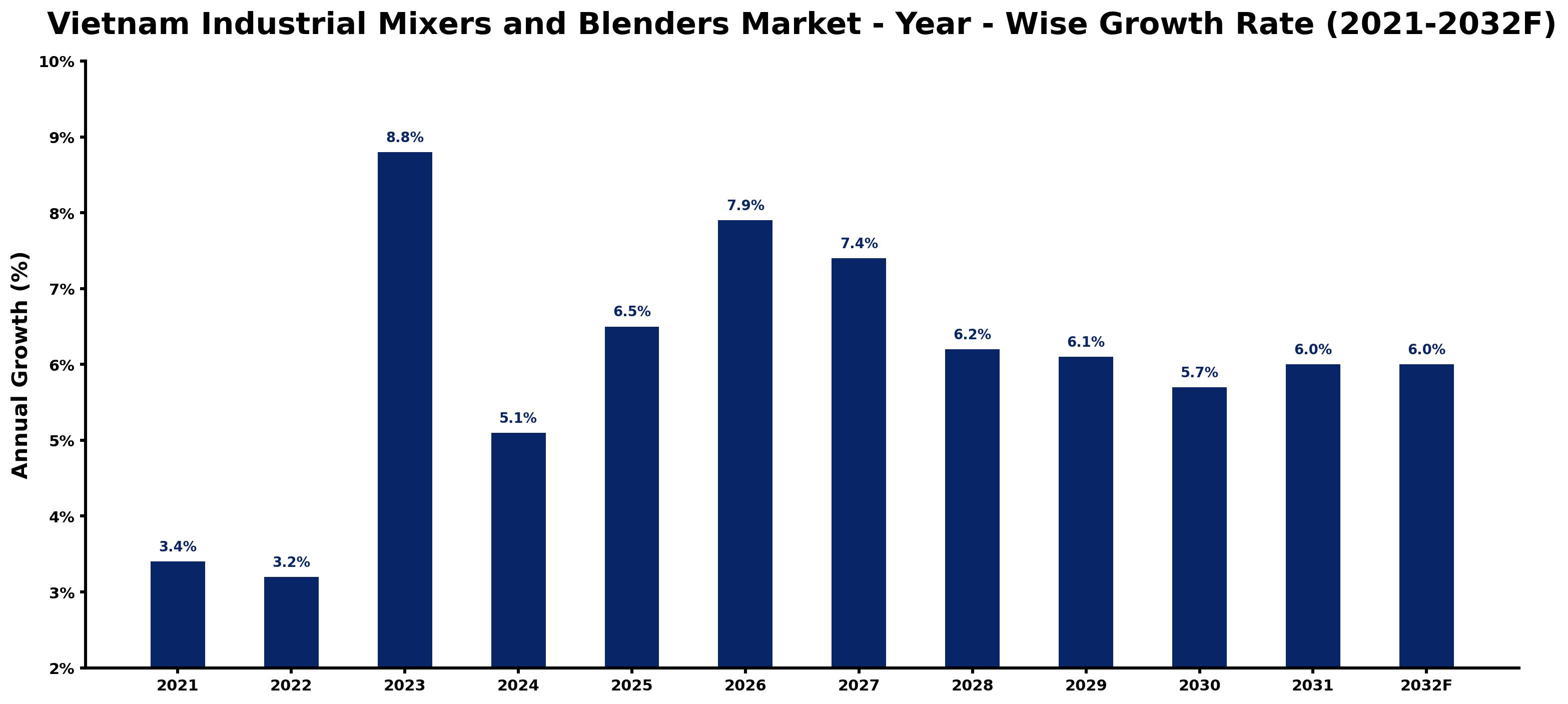
The table below presents the year wise growth rates along with the key drivers influencing the market
| Year | Growth Rate | Major Drivers |
| 2021 | 3.4% | Post-lockdown retail projects prompted manufacturers to enhance production efficiency with mixers. |
| 2022 | 3.2% | International brands recognize Vietnam as a strategic hub for manufacturing food products. |
| 2023 | 8.8% | Rising consumer preferences for processed foods stimulated demand for advanced blending technologies. |
| 2024 | 5.1% | Local manufacturers increasingly invest in innovative mixing solutions to improve product consistency. |
| 2025 | 6.5% | Vietnam's export-oriented economy encourages investment in high-capacity blending equipment. |
| 2026 | 7.9% | Urbanization trends drive the need for automation in food and beverage sectors. |
| 2027 | 7.4% | Increased competition in beverage manufacturing pushes companies to adopt advanced machinery. |
| 2028 | 6.2% | Sustainability practices encourage the use of energy-efficient industrial mixers and blenders. |
| 2029 | 6.1% | Emerging trends in health foods necessitate versatile blending solutions in production lines. |
| 2030 | 5.7% | Technological advancements in IoT create smarter, interconnected mixing systems for efficiency. |
| 2031 | 6.0% | Foreign direct investments bolster Vietnam's industrial capabilities, enhancing blender market growth. |
| 2032 | 6.0% | Economic diversification initiatives support the demand for specialized mixing equipment across sectors. |
Note - Market size estimations and growth projections presented in this report are based on 6Wresearch's advanced forecasting approach, validated with industry datasets as of June 2026.
Vietnam Industrial Mixers and Blenders Market Synopsis
The Vietnam Industrial Mixers and Blenders Market is projected to reach 7.9% and witness significant growth during the forecast period (2026-2032). This market encompasses a diverse range of equipment essential for various industries, including food and beverage, chemicals, pharmaceuticals, and cosmetics. The ongoing demand for efficiency and quality in production processes highlights the critical role of industrial mixers and blenders in enhancing material homogenization and blending, thereby improving overall manufacturing efficacy. Factors such as the rising consumer appetite for processed food, expansion in the chemical sector, and a heightened focus on product quality are major contributors to the upward trajectory of this market.
Vietnam Industrial Mixers and Blenders Market Growth Drivers
The growth of the Vietnam Industrial Mixers and Blenders Market is significantly driven by several noteworthy factors:
- The robust expansion of the food and beverage industry, fueled by changing consumer lifestyles and demands for convenient, high-quality products, necessitates advanced mixing and blending technologies.
- Significant investments in infrastructure have bolstered the chemical manufacturing sector, promoting the need for efficient blending solutions for various chemical processes.
- Pharmaceutical and cosmetic industries are increasingly prioritizing quality assurance and product uniformity, directly influencing the demand for sophisticated mixing technologies.
- Innovation in mixing and blending technologies, including automation and smart systems, is enhancing operational efficiencies across different sectors.
- The surge in demand for ready-to-eat and packaged food products during the pandemic has propelled the growth of efficient mixing equipment in the food processing industry.
Vietnam Industrial Mixers and Blenders Market Challenges and Restraints
Despite the promising growth potential, the Vietnam Industrial Mixers and Blenders Market faces several challenges:
- High initial investment costs for industrial mixers and blenders can deter small and medium-sized enterprises from upgrading their equipment.
- The technical complexity of industrial mixing and blending machinery necessitates skilled personnel for operation and maintenance, which may be in short supply.
- Some industries may prefer alternative solutions such as in-line mixers, which can pose challenges for traditional mixing technologies.
- Cost considerations in purchasing advanced equipment may lead to delayed adoption in certain sectors, particularly among budget-constrained manufacturers.
- The ongoing evolution of production processes may require continuous updates and modifications to existing equipment, increasing operational costs.
Vietnam Industrial Mixers and Blenders Market Government Investment and Initiatives
The Vietnamese government has recognized the importance of modernizing the industrial sector, including the market for industrial mixers and blenders. This has led to several strategic initiatives aimed at improving industrial capabilities:
- Government policies promoting foreign direct investment are helping to modernize production facilities, enhancing the adoption of advanced mixing technologies.
- Incentives and grants for research and development in manufacturing technology are fostering innovation, which can significantly impact the industrial mixers and blenders sector.
- Public spending on infrastructure projects is expected to stimulate growth in various industries, subsequently increasing the demand for efficient mixing and blending solutions.
- Support for small and medium-sized enterprises through funding programs aims to decrease the cost barriers associated with acquiring modern industrial equipment.
- The government's emphasis on regulatory compliance and quality assurance in production processes drives industries to invest in high-quality blending equipment.
Vietnam Industrial Mixers and Blenders Market Latest Developments (May 2025 - June 2026)
Recent developments within the Vietnam Industrial Mixers and Blenders Market have showcased numerous industry trends and shifts:
- The resurgence in demand for food processing equipment has led manufacturers to innovate their product lines, introducing more efficient and cost-effective blending solutions.
- Enhanced automation capabilities are becoming prevalent, allowing for improved efficiency and reduced labor costs in blending operations.
- Environmental sustainability initiatives are prompting producers to develop energy-efficient blending technologies that reduce waste and emissions.
- The pharmaceutical sector's growing need for precision in manufacturing processes is driving advancements in mixing technologies aimed at achieving higher consistency and quality.
- Collaboration between industry stakeholders and research institutions is fostering new technological advancements, thereby enhancing the overall capabilities of industrial mixing solutions.
Vietnam Industrial Mixers and Blenders Market - Key Attractiveness of the Report
- 10 Years of Market Numbers
- Historical Data Starting from 2022 to 2025
- Base Year: 2025
- Forecast Data until 2032
- Key Performance Indicators Impacting the Market
- Major Upcoming Developments and Projects
Key Highlights of the Report:
- Vietnam Industrial Mixers and Blenders Market Outlook
- Market Size of Vietnam Industrial Mixers and Blenders Market, 2025
- Forecast of Vietnam Industrial Mixers and Blenders Market, 2032
- Historical Data and Forecast of Vietnam Industrial Mixers and Blenders Revenues & Volume for the Period 2022-2032F
- Vietnam Industrial Mixers and Blenders Market Trend Evolution
- Vietnam Industrial Mixers and Blenders Market Drivers and Challenges
- Vietnam Industrial Mixers and Blenders Price Trends
- Vietnam Industrial Mixers and Blenders Porter's Five Forces
- Vietnam Industrial Mixers and Blenders Industry Life Cycle
- Historical Data and Forecast of Vietnam Industrial Mixers and Blenders Market Revenues & Volume By Product Type for the Period 2022-2032F
- Historical Data and Forecast of Vietnam Industrial Mixers and Blenders Market Revenues & Volume By Ribbon Blenders for the Period 2022-2032F
- Historical Data and Forecast of Vietnam Industrial Mixers and Blenders Market Revenues & Volume By High Shear Mixers for the Period 2022-2032F
- Historical Data and Forecast of Vietnam Industrial Mixers and Blenders Market Revenues & Volume By Shaft Mixers for the Period 2022-2032F
- Historical Data and Forecast of Vietnam Industrial Mixers and Blenders Market Revenues & Volume By Planetary Mixers for the Period 2022-2032F
- Historical Data and Forecast of Vietnam Industrial Mixers and Blenders Market Revenues & Volume By Conical Screw Mixers for the Period 2022-2032F
- Historical Data and Forecast of Vietnam Industrial Mixers and Blenders Market Revenues & Volume By Double Cone Blenders for the Period 2022-2032F
- Historical Data and Forecast of Vietnam Industrial Mixers and Blenders Market Revenues & Volume By End-users for the Period 2022-2032F
- Historical Data and Forecast of Vietnam Industrial Mixers and Blenders Market Revenues & Volume By Chemical for the Period 2022-2032F
- Historical Data and Forecast of Vietnam Industrial Mixers and Blenders Market Revenues & Volume By F&B for the Period 2022-2032F
- Historical Data and Forecast of Vietnam Industrial Mixers and Blenders Market Revenues & Volume By W&WW for the Period 2022-2032F
- Historical Data and Forecast of Vietnam Industrial Mixers and Blenders Market Revenues & Volume By Others? for the Period 2022-2032F
- Vietnam Industrial Mixers and Blenders Import Export Trade Statistics
- Market Opportunity Assessment By Product Type
- Market Opportunity Assessment By End-users
- Vietnam Industrial Mixers and Blenders Top Companies Market Share
- Vietnam Industrial Mixers and Blenders Competitive Benchmarking By Technical and Operational Parameters
- Vietnam Industrial Mixers and Blenders Company Profiles
- Vietnam Industrial Mixers and Blenders Key Strategic Recommendations






































