Vietnam Industrial Radiography Market Size Growth Rate
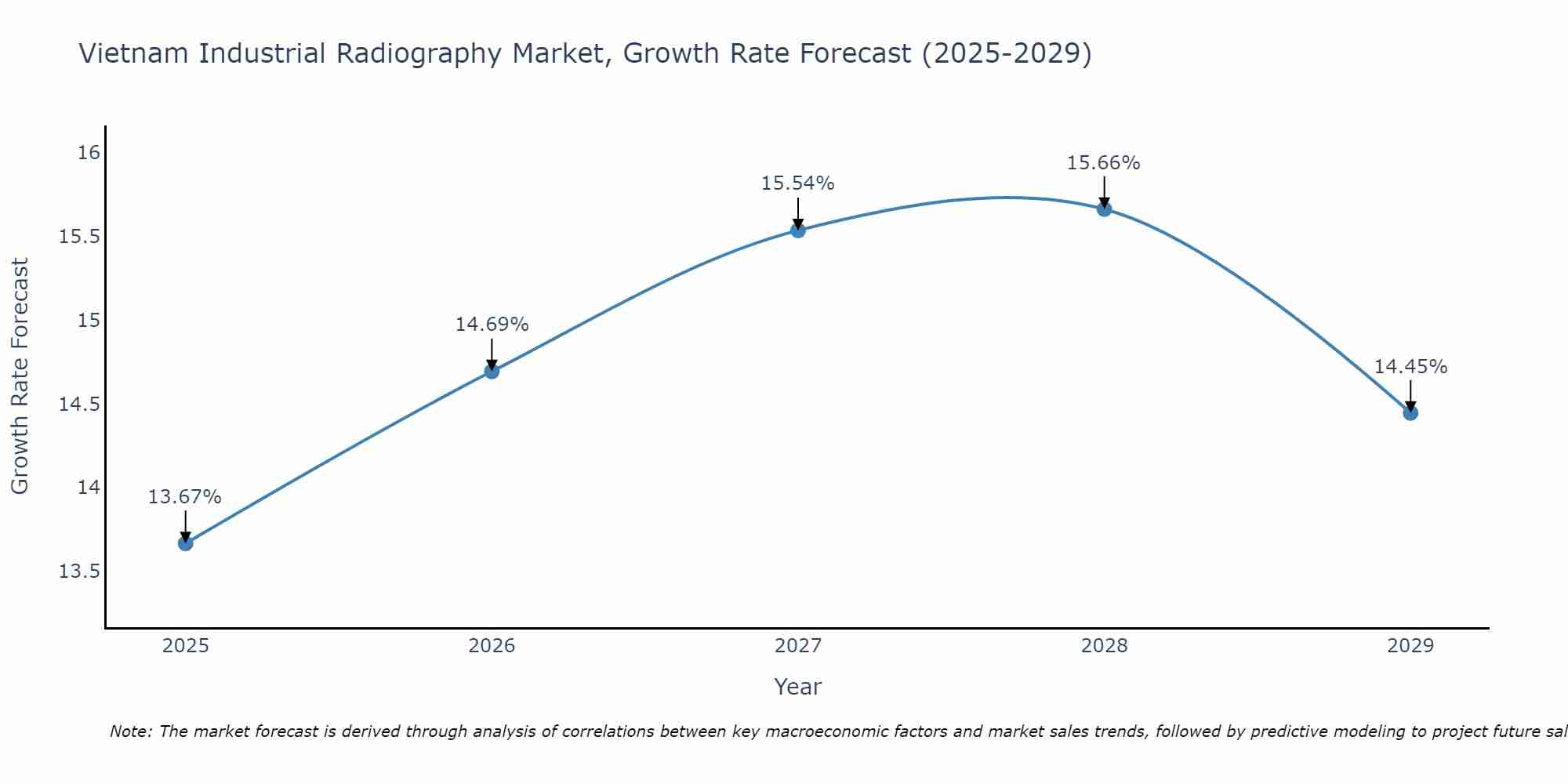
The Vietnam Industrial Radiography Market is projected to witness mixed growth rate patterns during 2025 to 2029. Growth accelerates to 15.66% in 2028, following an initial rate of 13.67%, before easing to 14.45% at the end of the period.
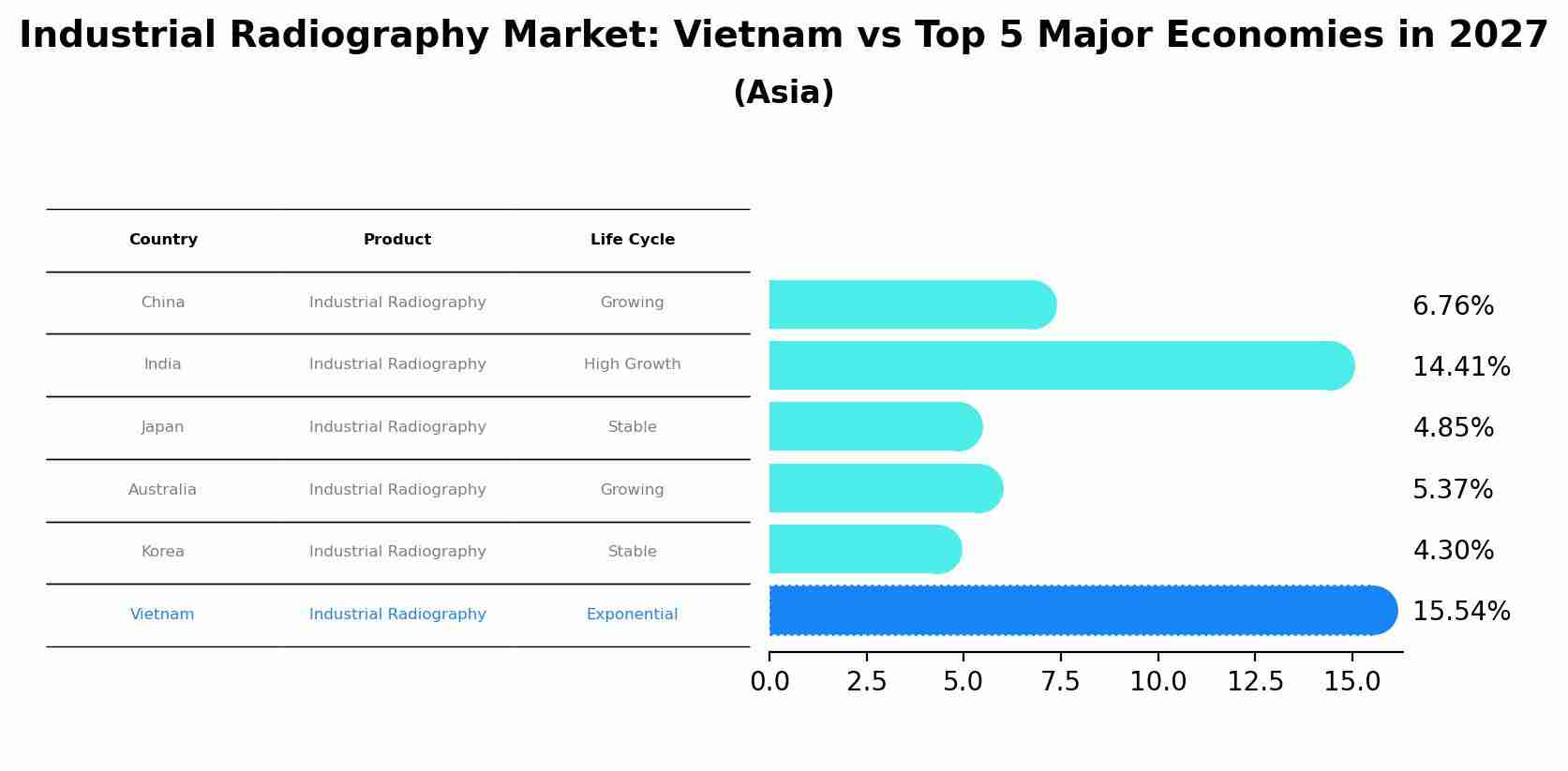
Industrial Radiography Market: Vietnam vs Top 5 Major Economies in 2027 (Asia)
By 2027, the Industrial Radiography market in Vietnam is anticipated to reach a growth rate of 15.54%, as part of an increasingly competitive Asia region, where China remains at the forefront, supported by India, Japan, Australia and South Korea, driving innovations and market adoption across sectors.
Vietnam Industrial Radiography Market Synopsis
The Vietnam industrial radiography market is essential for quality control and inspection in industries such as manufacturing, construction, and aerospace. Industrial radiography involves the use of X-rays or gamma rays to inspect and detect internal flaws or defects in materials and products. The market has grown in response to the need for non-destructive testing methods that ensure product integrity and safety. Increasing regulatory standards and safety requirements in various industries have further boosted the demand for industrial radiography services and equipment. Local and international companies provide radiographic equipment and services to support the quality assurance processes of businesses in Vietnam.
Drivers of the Market
The industrial radiography market in Vietnam is thriving as industries like oil and gas, construction, and manufacturing increasingly adopt non-destructive testing (NDT) methods. Stringent safety regulations and the need for quality control are propelling the demand for radiographic testing services. The expansion of infrastructure projects and the growing importance of ensuring structural integrity are also key drivers, with radiography playing a crucial role in identifying defects and ensuring safety standards are met.
Challenges of the Market
The Vietnam industrial radiography market grapples with regulatory compliance and safety concerns. The use of ionizing radiation in industrial radiography requires strict adherence to safety protocols and regulations. Any lapses can have severe consequences. Maintaining compliance and safety in this market is a perpetual challenge.
COVID-19 Impact on the Market
COVID-19 had a mixed impact on the industrial radiography market in Vietnam. While the initial phase of the pandemic led to project delays and reduced inspection activities, the need for non-destructive testing (NDT) and inspection solutions remained essential, particularly in sectors like manufacturing, construction, and energy. As safety regulations became more stringent, there was a growing emphasis on NDT, which contributed to the market`s recovery and growth.
Key Players in the Market
Industrial radiography is essential for non-destructive testing in various industries, and in Vietnam, companies like GE Inspection Technologies Vietnam, Olympus Vietnam, and YXLON Vietnam are prominent players. These companies specialize in manufacturing advanced radiography equipment and solutions that ensure the integrity and safety of industrial components and structures. Their cutting-edge technology and expertise in radiography contribute to the quality control and safety standards of industries such as oil and gas, aerospace, and manufacturing in Vietnam.
Key Highlights of the Report:
- Vietnam Industrial Radiography Market Outlook
- Market Size of Vietnam Industrial Radiography Market, 2024
- Forecast of Vietnam Industrial Radiography Market, 2031
- Historical Data and Forecast of Vietnam Industrial Radiography Revenues & Volume for the Period 2021-2031
- Vietnam Industrial Radiography Market Trend Evolution
- Vietnam Industrial Radiography Market Drivers and Challenges
- Vietnam Industrial Radiography Price Trends
- Vietnam Industrial Radiography Porter's Five Forces
- Vietnam Industrial Radiography Industry Life Cycle
- Historical Data and Forecast of Vietnam Industrial Radiography Market Revenues & Volume By Technology for the Period 2021-2031
- Historical Data and Forecast of Vietnam Industrial Radiography Market Revenues & Volume By Film Radiography for the Period 2021-2031
- Historical Data and Forecast of Vietnam Industrial Radiography Market Revenues & Volume By Computed Radiography for the Period 2021-2031
- Historical Data and Forecast of Vietnam Industrial Radiography Market Revenues & Volume By Direct Radiography for the Period 2021-2031
- Historical Data and Forecast of Vietnam Industrial Radiography Market Revenues & Volume By Computed Tomography for the Period 2021-2031
- Historical Data and Forecast of Vietnam Industrial Radiography Market Revenues & Volume By End-user Industry for the Period 2021-2031
- Historical Data and Forecast of Vietnam Industrial Radiography Market Revenues & Volume By Aerospace & Defense for the Period 2021-2031
- Historical Data and Forecast of Vietnam Industrial Radiography Market Revenues & Volume By Petrochemical & Gas for the Period 2021-2031
- Historical Data and Forecast of Vietnam Industrial Radiography Market Revenues & Volume By Energy & Power for the Period 2021-2031
- Historical Data and Forecast of Vietnam Industrial Radiography Market Revenues & Volume By Construction for the Period 2021-2031
- Historical Data and Forecast of Vietnam Industrial Radiography Market Revenues & Volume By Automotive & Transportation for the Period 2021-2031
- Historical Data and Forecast of Vietnam Industrial Radiography Market Revenues & Volume By Manufacturing for the Period 2021-2031
- Historical Data and Forecast of Vietnam Industrial Radiography Market Revenues & Volume By Other End-user Industries for the Period 2021-2031
- Vietnam Industrial Radiography Import Export Trade Statistics
- Market Opportunity Assessment By Technology
- Market Opportunity Assessment By End-user Industry
- Vietnam Industrial Radiography Top Companies Market Share
- Vietnam Industrial Radiography Competitive Benchmarking By Technical and Operational Parameters
- Vietnam Industrial Radiography Company Profiles
- Vietnam Industrial Radiography Key Strategic Recommendations






































