Vietnam Inorganic Acids Market Size, Share & Growth Rate
The Vietnam Inorganic Acids Market was estimated at USD 401 Million in 2025 and is projected to reach USD 562 Million by 2032, growing at a CAGR of 4.9% from 2026 to 2032. This anticipated growth is driven by the expanding industrial activities across Vietnam, particularly in sectors such as chemicals, metallurgy, and electronics. As manufacturing continues to evolve in the region, the need for reliable and high-quality inorganic acids is becoming increasingly critical to support various production processes.
Vietnam Inorganic Acids Market Year-wise Growth Rate and Key Drivers
This graph highlights how the Vietnam Inorganic Acids Market has steadily grown over the years, supported by major growth factors.
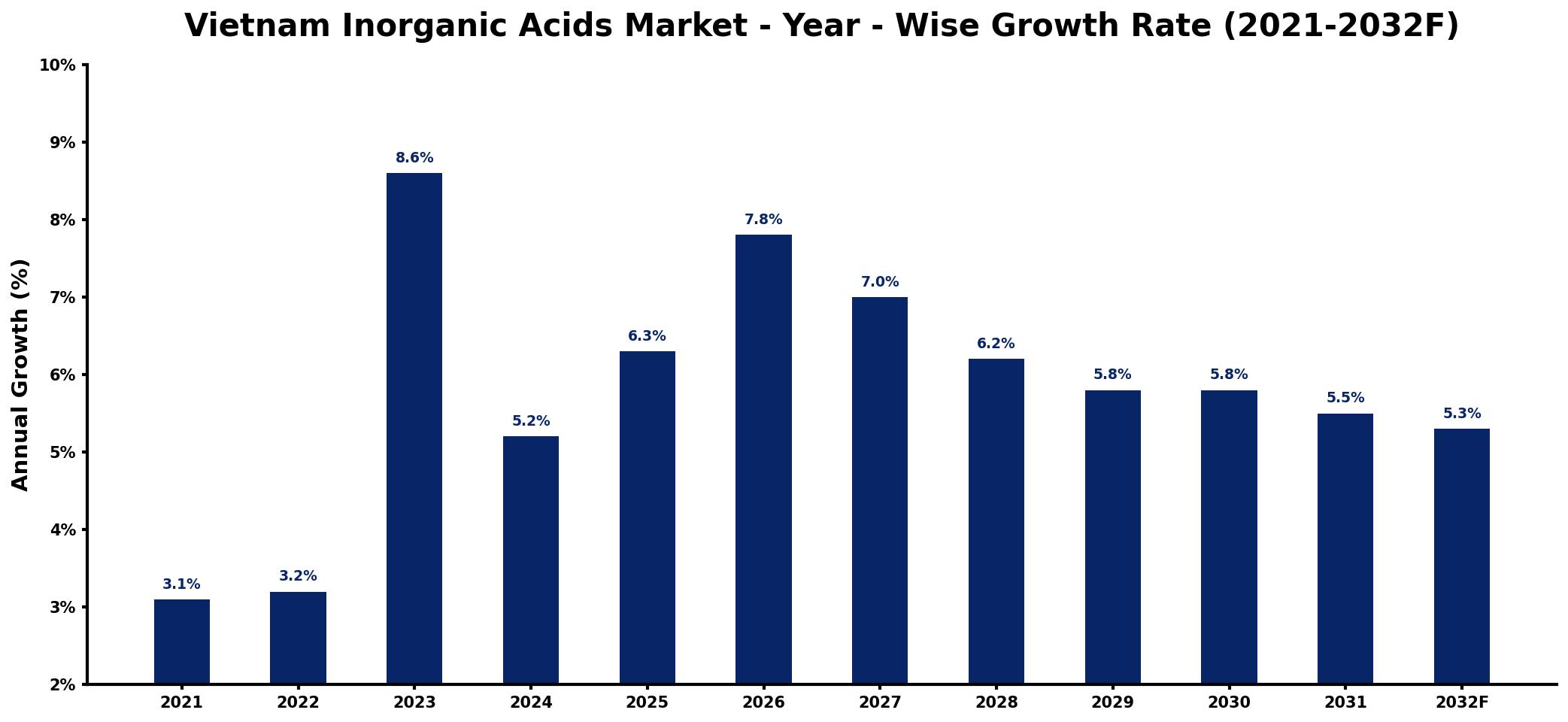
The table below presents the year‑wise growth rates along with the key drivers influencing the market
| Year | Growth Rate | Major Drivers |
| 2021 | 3.1% | Construction sector expansion drives demand |
| 2022 | 3.2% | Growing agricultural applications increase usage |
| 2023 | 8.6% | New manufacturing facilities boost consumption |
| 2024 | 5.2% | Emerging technologies enhance production efficiency |
| 2025 | 6.3% | rising export shipment volumes |
| 2026 | 7.8% | Increased industrial activities drive requirements |
| 2027 | 7.0% | Higher demand from automotive sector |
| 2028 | 6.2% | Sustainability initiatives promote alternative uses |
| 2029 | 5.8% | Pharmaceutical industry growth raises needs |
| 2030 | 5.8% | rising infrastructure development spending |
| 2031 | 5.5% | Research advancements create new applications |
| 2032 | 5.3% | Strengthened regulatory frameworks support industries |
Note: Market size estimations and growth projections presented in this report are based on 6Wresearch's proprietary forecasting methodology, utilizing the latest available industry data, government publications, and primary research inputs.
Vietnam Inorganic Acids Market Synopsis
The strongest force shaping the Vietnam inorganic acids market currently is the robust growth of the manufacturing sector. This sector's expansion is significantly increasing the demand for key inorganic acids, such as sulfuric and hydrochloric acid, which are essential for numerous industrial processes.
Moreover, the increasing focus on environmental sustainability is prompting manufacturers to enhance their production techniques. As a result, companies are investing in innovative applications and technologies to ensure quality and safety while meeting the rising market demands.
Vietnam Inorganic Acids Market Key Takeaways
- The market is experiencing a sustained increase in demand driven by various industrial applications.
- Price volatility remains a concern, influenced by fluctuating raw material costs and global demand dynamics.
- COVID-19 has accelerated the need for supply chain resilience among market participants.
- Local manufacturers are expanding capacities to cater to the growing consumption in the region.
- Adoption of environmentally friendly production methods is on the rise among manufacturers.
Evaluation of Restraints in Vietnam Inorganic Acids Market
Despite the optimistic outlook, the Vietnam inorganic acids market faces notable constraints. Price volatility can severely impact operational profitability for companies relying on consistent supply of acids, as fluctuations are often driven by changes in raw material pricing and global market trends. Furthermore, the pandemic-induced disruptions in global supply chains have exposed vulnerabilities in sourcing key materials, which may impede production capabilities for some market players. These factors necessitate strategic planning and risk management to mitigate financial impacts.
Vietnam Inorganic Acids Market Trends
One of the most prominent trends in the Vietnam inorganic acids market is the move towards greener production practices. Manufacturers are increasingly investing in technologies that minimize environmental footprints while maximizing output efficiency. Additionally, innovation in applications is becoming more prevalent, with new uses for inorganic acids emerging across different sectors, including alternative energy and advanced materials. The integration of digital technologies is also reshaping the operational landscape, allowing for enhanced quality control and process optimization.
Vietnam Inorganic Acids Market Opportunities
With the anticipated growth in various industrial sectors, significant opportunities lie ahead for investors and businesses within the Vietnam inorganic acids market. Expansion of existing production facilities or development of new plants can cater to the increasing demand, particularly for acids that are critical in advanced manufacturing processes. Furthermore, partnerships with technology providers can facilitate the implementation of innovative solutions, enhancing product quality and sustainability, which are becoming essential competitive differentiators.
Government Initiatives in the Vietnam Inorganic Acids Market
The Vietnamese government is actively promoting the growth of the manufacturing sector through various initiatives aimed at enhancing industrial capabilities. This includes investments in infrastructure, incentives for sustainable manufacturing practices, and policies aimed at fostering innovation. Such governmental support creates a conducive environment for the inorganic acids market, enabling manufacturers to thrive and adapt to evolving market dynamics while adhering to regulatory standards.
Future Insights of the Vietnam Inorganic Acids Market
Looking ahead to 2026-2032, the Vietnam inorganic acids market is poised for substantial evolution. The convergence of increased industrialization and technological advancement is likely to fuel demand for high-quality acids. As environmental regulations become stricter, companies that adapt their practices and embrace sustainability will stand to gain a competitive edge. Furthermore, the rise in manufacturing exports suggests a promising future, as international partnerships may further stimulate local demand.
Vietnam Inorganic Acids Market Latest Developments (2025 - 2026)
Recent developments in the Vietnam inorganic acids market indicate a growing trend of companies focusing on supply chain resilience. Many manufacturers have begun implementing robust sourcing strategies to mitigate disruptions caused by global events. Additionally, there has been an increasing interest in research and development to explore new applications for inorganic acids, reflecting a commitment to innovation and sustainability.
Vietnam Inorganic Acids Market - Key Attractiveness of the Report
- 10 Years of Market Numbers
- Historical Data Starting from 2022 to 2025
- Base Year: 2025
- Forecast Data until 2032
- Key Performance Indicators Impacting the Market
- Major Upcoming Developments and Projects
Key Highlights of the Report:
- Vietnam Inorganic Acids Market Outlook
- Market Size of Vietnam Inorganic Acids Market, 2025
- Forecast of Vietnam Inorganic Acids Market, 2032
- Historical Data and Forecast of Vietnam Inorganic Acids Revenues & Volume for the Period 2022-2032F
- Vietnam Inorganic Acids Market Trend Evolution
- Vietnam Inorganic Acids Market Drivers and Challenges
- Vietnam Inorganic Acids Price Trends
- Vietnam Inorganic Acids Porter's Five Forces
- Vietnam Inorganic Acids Industry Life Cycle
- Historical Data and Forecast of Vietnam Inorganic Acids Market Revenues & Volume By Type for the Period 2022-2032F
- Historical Data and Forecast of Vietnam Inorganic Acids Market Revenues & Volume By Hydrochloric Acid for the Period 2022-2032F
- Historical Data and Forecast of Vietnam Inorganic Acids Market Revenues & Volume By Sulfuric Acid for the Period 2022-2032F
- Historical Data and Forecast of Vietnam Inorganic Acids Market Revenues & Volume By Nitric Acid for the Period 2022-2032F
- Historical Data and Forecast of Vietnam Inorganic Acids Market Revenues & Volume By Phosphoric Acid for the Period 2022-2032F
- Historical Data and Forecast of Vietnam Inorganic Acids Market Revenues & Volume By Boric Acid for the Period 2022-2032F
- Historical Data and Forecast of Vietnam Inorganic Acids Market Revenues & Volume By Hydrofluoric Acid for the Period 2022-2032F
- Historical Data and Forecast of Vietnam Inorganic Acids Market Revenues & Volume By Others for the Period 2022-2032F
- Historical Data and Forecast of Vietnam Inorganic Acids Market Revenues & Volume By Application for the Period 2022-2032F
- Historical Data and Forecast of Vietnam Inorganic Acids Market Revenues & Volume By Agrochemicals & Fertilizers for the Period 2022-2032F
- Historical Data and Forecast of Vietnam Inorganic Acids Market Revenues & Volume By Pigments & Dyes for the Period 2022-2032F
- Historical Data and Forecast of Vietnam Inorganic Acids Market Revenues & Volume By Pharmaceutical for the Period 2022-2032F
- Historical Data and Forecast of Vietnam Inorganic Acids Market Revenues & Volume By Explosives for the Period 2022-2032F
- Historical Data and Forecast of Vietnam Inorganic Acids Market Revenues & Volume By Others for the Period 2022-2032F
- Vietnam Inorganic Acids Import Export Trade Statistics
- Market Opportunity Assessment By Type
- Market Opportunity Assessment By Application
- Vietnam Inorganic Acids Top Companies Market Share
- Vietnam Inorganic Acids Competitive Benchmarking By Technical and Operational Parameters
- Vietnam Inorganic Acids Company Profiles
- Vietnam Inorganic Acids Key Strategic Recommendations






































